Menu Close

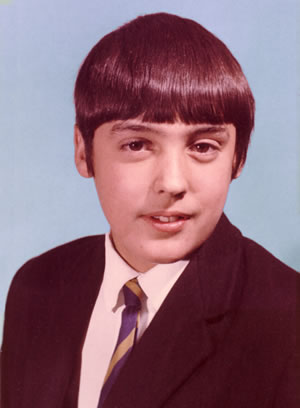
Kevin Gallagher (1968-73)

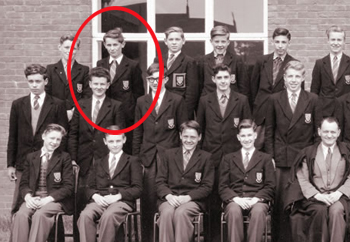
MeThis is the only picture that has survived from my time at Burton Grammar School. I really hate it but, since I have featured a great number of faces of pupils who probably think the same way about theirs, I suppose it is only fair that I should include it.

I joined the school in 1968 and from fairly early on, it was made fairly clear that if I didn’t achieve “Maths, English and three other ‘O’ Levels”, I was doomed to failure. That, therefore, is exactly what I achieved having opted for science subjects.

I was due to stay on to do Maths and Physics ‘A’ Levels but, due to family circumstances, I instead needed to leave and find employment.

Some of the schoolmasters here enjoyed a glorious career that long preceded my knowing them; in meeting some of them as an adult, it is clear that there was sometimes an underlying irony that went straight over the head of a young boy at school; many of them have passed on and we should “never talk ill of the dead”. Be those things as they may, as with the rest of this website, I want to provide an accurate a record as I can of my time there so I speak as I find… or should I say “found”, many decades ago.
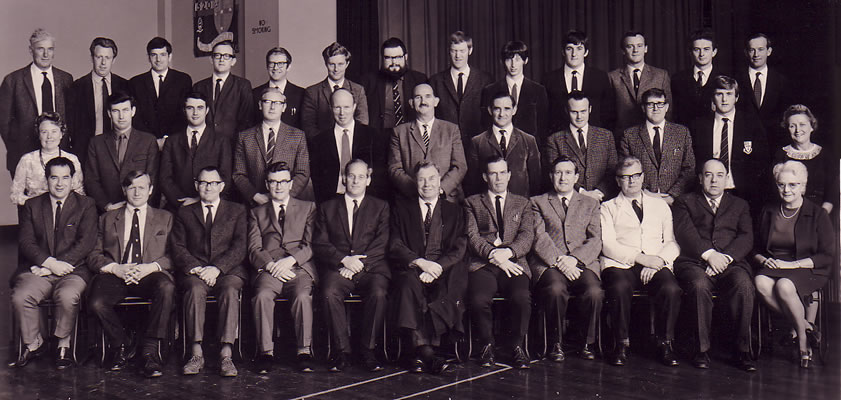
Back Row:

John Andrew (Tinman) – [Metalwork]
‘Tinman’ always seemed to have a certain anger about him. He had deep red veins in his cheeks and when he was having one of his occasional rants, they seemed to glow.

At some point or other, I think most of the class had ducked their head as he bellowed his favourite scorn “Gallagher – you blessed simpleton!!”.

Colin Bagshaw (Bogwash) – [Physics]
Colin was a generally calm and effective teacher. He was my Physics teacher for the whole of my time there and it was always my favourite subject on the timetable. This made the ‘O’ Level a complete breeze with never any doubt that I would pass it without much effort. I am not sure how much of this was down to Mr Bagshaw and how much of it was down to the fact that Physics is just (or was to me anyway), so inherently interesting. Certainly, a school full of teachers like him would make for a very easy passage.

I can remember one slightly amusing anecdote which is nothing to do with school – I used to deliver his daily newspaper to his semi-detached house in Dovedale Close and he was the one person on my round who made me walk back to the pavement and round rather than cut across his lawn.

John Long – [Latin]
I had no contact with Mr Long, nor Latin come to that; he was simply a familiar face.

David Wyatt – [Spanish]
I had to think hard if I actually did Spanish at school, certainly, I can’t count to ten in Spanish which suggests that the brief period for which I took the subject was not particularly arduous.

David was equally wishy-washy leaving a just as scant lasting impression.

John Sneyd – [Physics]
I had nothing to do with John Sneyd, neither for that matter did the rest of the staff seem to. He always seemed a bit of an outsider somehow.

Alan Brewerton (Doc) – [Chemistry]
Doc Brewerton took us for a very brief period, I am not sure if it was even a whole year. He was young and his nickname implied that he was particularly clever though I seem to remember his lessons being pretty dull and humourless.

Robin Langton (Bumble) – [English/Literature]
Bumble didn’t take me for a single lesson. I think his main subject was English Literature which was an ‘options’ subject which I didn’t take. He always seemed very jovial and pretty harmless.

Graham North – [History]
I had absolutely no contact with Graham North and needed help to fill his name in here.

John Armstrong (Louis) – [Maths]
I think Louis was a nice enough chap but completely ‘wet behind the ears’. I am pretty sure it was his first teaching post but generally, he could keep little order and was irresistible to wind up which was an unfortunate combination.

His favourite punishment was rather than dish out 200 lines of 10 words, to award 10 lines of 200 words. The idea only amused him, as a consequence, no one bothered to do them anyway.

He once told us to watch ‘Star Trek’ for homework and to make a note of any occasions where Mr Spock used logic. Unfortunately, my Dad didn’t believe me and wouldn’t let me watch it.

Alan Cure – [Geography]
I had no contact with Alan Cure but he seemed to enjoy very good popularity with those that did.

John French (Frenchy) – [PE]
Frenchy always seemed a bit fearsome with a mean one-eyed scowl which I am sure he must have practiced in the mirror. He only ever took us for games or PE and he certainly made me try for brief periods when I felt that his eyes were upon me.

Chris Aylott – [Maths]
I had absolutely no contact with Mr Aylott. Again, I had to have his name filled in here and, when it was confirmed, I had no recollection of it whatsoever.

Michael Green (Ma) – [English/Economics]
Ma took us as a stand in for occasional lessons. In this role, he was a kind of caretaker teacher and used to give us fairly menial things to do, usually read, to get through the lesson without the need to develop any kind of rapport.

Middle Row:

Barningham – [Office]
Just a vaguely familiar face in the office I’m afraid.

M02 & M03
I swear to this day, these two men are complete imposters who snook into the photo because they happened to be in the school, probably for interviews. I don’t have the foggiest idea who they are.

Chris Shepard (Shep) – [English]
Chris Shepard was a pretty good English teacher and in general, I used to enjoy his lessons. It all seemed to turn a bit sour when noises were first heard about the abolition of Grammar schools when it became obvious that he had very ‘left wing’ sentiments not shared by almost the remainder of the staff.

Peter Dawe (Jackdaw) – [Music]
I always thought that Jackdaw’s name was ‘Jack’ so it was a slight shock when it was corrected to Peter; although thinking about it now, with a name like Dawe, who would ever call their son Jack?!

As a music teacher, he was a complete and utter failure. His lessons were totally meaningless and no-one in his classes gained the slightest musical knowledge. He seemed to spend some time with the very small number of pupils that could actually play an instrument already. Aside from that, the only useful aspect of Music lessons was the chance to catch up with a few lines of the ‘I must not run in the corridor’ type.

Harry Smith (Brab) – [Maths]
I didn’t have Brab for a single lesson. I was slightly disappointed by this in some ways because there was the general air that he was an amazingly good teacher and that students of his were automatically assured of high grade results. He was always a very central character with numerous legendary attributes – such as the ability to draw an almost perfect circle with one quick twirl of the elbow.

Harry seemed to enjoy almost unanimous respect from the lowest pupil to the Headmaster.

G. Davis (Taffy) – [Woodwork/Eng.Drawing]
To say that Taffy was quiet was something of an understatement. He would demonstrate how to make a very neat rectangle hole with gentle taps of a mallet on a chisel and then quietly disappear into the woodwork (excuse the pun), leaving us all to hack a piece of wood to death in the vain attempt of imitating him.

Alan White (Chalky) – [English]
I didn’t have Chalky but he did strike me that his lessons might be fun and animated.

Brian Luckett (Chinner) – [Chemistry]
Brian seemed pretty unique in that he seemed to remember exactly what it was like to be a pupil and almost seemed like he would still like to be one. This had the unfortunate effect that he could generally anticipate most chemical pranks.

Robert James (Jessie) – [French/Latin]
I didn’t have any contact with Mr James but again, he seemed generally popular with everyone who did.

Coates – [Office Secretary]
Just another vaguely familiar face in the office I’m afraid.

Front Row:

Walter Chadbourne (Walt) – [Physics]
I didn’t have any contact with Walt. He only seemed to take lower streams and was probably better known to me as the Scout Leader, not that I was a member. He had a reputation for administering whacks with a gym shoe that I never saw first hand. I was actually very surprised to now learn that he had a longer service with the school than I thought. He always seemed like the Scout Master cajoled into taking a few lessons somehow.

Victor Roebuck (Vic) – [PE/English]
Vic had quite a pleasant manner about him. Firm, but you always knew that he was never really as harsh as he was making himself seem. I think he genuinely enjoyed engaging in sports with boys. I never particularly got on with him because running about on a muddy rugby pitch or, even worse, trudging around sodden farmland was never more than an unfortunately necessary evil to me.

It was actually quite a shock during this project to discover that Vic was such a first class athlete in his day, very narrowly missing out on the Olympic running team.

Ellick Ward (Ernie) – [French]
I didn’t have any teaching exposure to Ernie. I had brief experience of him when I joined the lunchtime ‘Radio Club’ so that I could join others in making a device that could be engineered into a desk to make a faint beeping noise. Four of five of us used to switch them on for a few seconds so that the whole class could delight in watching the masters ears prick up as they wrote on the black-board.

Hugh Wood (Woody) – [French]
Hugh was always friendly and seemed a genuinely nice guy. Unfortunately, his subject was French which no-one ever seemed to have the most remote interest in. Although I never got to take the ‘O’ level, I am actually surprised how much French I almost inexplicably seem to know as an adult which suggests that he was a very effective teacher and that I could have been half-proficient had I been able to muster enough interest.

When the class was noisy, he used to stand and take a pin out of his jacket lapel. We had been conditioned to know that in a few seconds, he was going to drop it and that if its faint ping couldn’t be heard as it hit the floor, the whole class would be in detention.

On one occasion, Chris Borrington deliberately coughed at the crucial moment making everyone groan at him after it was announced that we must all return at the end of school.

Geoffrey Henton (Gaff) – [Geography]
Geoff Henton had an inexplicable air about him. He never shouted – only raised his voice; not once did he ever dish out a single punishment to my recollection, and yet, the moment he entered the room or came into view, there was automatically complete silence and order.

He was a good Geography teacher and I would actually have liked to have taken it as an option but, slightly bizarrely, it was not classed as a science subject so was not available with Biology taking its place.

Bill Gillion (Beak) – [Maths] Headmaster
Bill Gillion was simply the Headmaster was never seen outside of school assembly. I did visit his office on two occasions, neither of them pleasant. On the first, he announced at the end of assembly that someone had been talking the whole way through. He pointed at me and asked me to put my hand up. Though strongly suspecting that I was his quarry, I kept my hand down. His response was to get someone in my vicinity to put their hand up; he then gave instruction, “the boy to his left, put his hand up”, “the boy in front of him put his hand up”; after a few steps, it fell to my turn and when I raised my hand, my heart sank as he announced “Yes, YOU”. I was instructed to report to his study after assembly where I was given a stern telling off. The second occasion was following the fencing accident where a small unsupervised group of us were hacking around with swords outside without wearing face-shields and Robert Whetton was badly injured. I had to go and give my account of the happenings. He did seem a kind, upstanding man though and very worthy Headmaster.

Ron Illingworth (Ronnie) – [Geography]
I had no direct dealings with Ron Illingworth which I must admit, I was slightly relieved about. I always had the impression that he would like to swipe me hard across the back of the head for the sheer pleasure of it. I felt well out of his way but don’t know if he was as fearsome as he seemed.

Norman Jones – [Chemistry]
I didn’t have Norman but he always seemed a pleasant sort.

Raymond Crowther (Joey) – [Biology]
I always thought that Joey was Mr Crowther’s proper name so it was very strange to change his name here from Joseph to Raymond. He was a fairly effective teacher though somehow strangely detached from the rest of the staff. He seemed to spend most of his non-teaching time in a small room at the back of the Biology Lab. I didn’t particularly like Biology though; it was really an imposed subject that I had to do in order to continue with Physics which was my favourite subject.

When the class was unruly, Joey used to stand a chunky table leg up on the front bench and announce something like “Signum Bellum Stat”, which he explained to us was Latin for ‘Symbol of war stands’. This was an indication that the next offender would receive a knock on the head with a wooden baton with a severity (lump size) proportional to the degree of misdemeanour.

I once received the worst punishment, referred to a ‘Crunchie’ as explained below.

Percy Barratt (Butch) – [History]
Percy was another of those familiar characters that ambled around but with whom I had no contact.

Elizabeth Radford (Fanny) – [Divinity/French]
At some point, Mrs Radford seems to have switched from ‘Gertie’ to ‘Elizabeth’ but we only ever really referred to her as Fanny which was always a bit confusing.

Divinity lessons were a complete non-event really. I can only remember pupils being instructed to read a passage from the bible with the constant farce that the next pupil instructed to take over took a while to do so because invariably, no-one but the current reader had got the foggiest idea where the passage was up to.

Questions were sometimes asked at the end with everyone smirking at the hapless victim knowing that his made up answer would be no better than any of theirs.

Missing:

The following masters are not featured in the photo but I did have direct experience of them.

Jack Playll (Pleb) – [History]
Pleb’s history lessons were all comprised as follows: we were given a page range to read from a text book “could you please read pages 112 to 119”. The class would then fall into silence as they armed themselves with elastic bands to flick at one another. Occasionally, when someone made a noise after being caught sharply on the cheek, Jack would look up from his book slightly and cough. And so it went on. Twenty minutes or so later, he would ask questions on the passage we were supposed to have read. It was only a mild dread of being asked a question because a response of “I can’t quite recall the answer sir” simply passed the book to the next person with very little repercussion. To assist things, Mr Playll tended to concentrate his answers on the small minority that were likely to be able to supply an answer and largely left everyone else alone.

He was definitely teaching History for an easy option. He used to heavily tip exam questions to ensure that marks could be easily gained, and wasn’t bothered about ‘O’ levels because most would not take History as an option and those that did would effectively be starting again.

Lewis Heath (Chippy) – [Art]
I quite enjoyed art and Lewis Heath was a decent enough sort of guy. Splodging paint onto paper never really felt like a ‘real’ subject though, particularly since there was no Art ‘O’ level or further ‘lessons’ after the third form, so it always felt like a sort of recreation period for the youngest pupils.

James Moore (Jomo) – [Maths]
Jomo was absolutely legendary! His lessons were a complete riot. He had been persuaded back into service having retired as a local Maths teacher at aged 65, simply because there was a great shortage of maths teachers and the timetable could not be fulfilled.

His maths knowledge seemed such that he wouldn’t be able to pas the ‘O’ level himself and his class control was completely non-existent.

I can remember on one occasion, the adjourning door between classrooms opened and Geoff Henton stuck his head in to find several pupils standing on chairs and an unearthly din. On Gaff’s appearance, everyone immediately sat to silent order; he gave Jomo a sharp look before disappearing again and the class continued with HCFs and LCMs (the ONLY lesson Jomo knew confidently) now much more subdued – but only because of the impending threat from the neighbouring classroom.

David Mart – [Maths]
David Mart started whilst I was at the school but had a much more difficult task on his hands that he could have imagined. He had taken over from Jomo Moore who had firstly, firmly established the culture that Maths was a complete free-for-all and secondly, had left the class quite literally one whole year behind in the syllabus.

To this day, my first lesson with Mr Mart provides me with one of my clearest memories of the school as he very successfully asserted himself where Mr Moore had failed. Maths lessons were suddenly very different with a necessarily increased workload to make up for lost time.

Unknowingly, I had a reasonably strong natural ability for maths. The ‘O’ Level most had once dreaded was completely changed around into one that everyone could take with complete confidence. In a completely unprecedented gesture, I can remember the class collecting all of its tuck-shop money and presenting him with a bottle of wine.

I didn’t find out until this project that David was also an ex-pupil of Burton Grammar School and had attended at both Bond Street and Winshill. By all accounts, he was never a very exceptional student but he turned out to be a very exceptional teacher.


SCHOOL RUGBY

Burton Grammar School had a long and proud tradition of Rugby; “hard and fair play on the sports field to instil a character which carries through to the classroom as a complement to academic success”, and all that. Unfortunately, this was always somewhat lost on me and my memories of the Rugby field may not be entirely typical.

A whole year’s worth of pupils did afternoon sports which usually meant just under ninety pupils. This gave rise to three games. The first, made up of the most impressive thirty, was on the top, carefully tended pitch. The second was on the middle pitch, which was still a very impressive playing surface, inferior to the first only in that it was some distance lower down a steep bank. The third was made up of the rest of the stragglers on the bottom pitch which it would be fair to say, was sometimes ‘quite water-logged’. As you may have already guessed, this included me. I can’t now recall who used to referee the games. Vic and Frenchy took two but I can’t for the life of me remember who used to take the third.

Quite often, there were not quite enough players to make up full teams on the third pitch, sometimes; there was an odd number of players meaning that one side had an extra player, although this was usually in the form of Kenny Mycock which gave little or no advantage. I think it was him I remember one day being adorned in ridiculously ill-fitting spare kit supplied to him after he had tried to forge a letter from his parents to excuse him from the games period for an implausible (and most probably mis-spelled) ailment.

The rules of Rugby were, and remain today, a complete mystery to me. The whistle used to blow, seemingly at random and many of us huddled around in confusion trying to establish whether someone had now got to drop kick the ball or whether we had got to endure another scrum. Almost invariably, it seemed to be the latter which meant, as one of the second-row, I was anticipating getting my ears squashed again, but I didn’t know enough about the rules to question the decision. Neither did I ever really fully understanding the scoring but I learned early in my Rugby career that Mr French did not appreciate the question “Sir, who’s winning?”, so I usually waited until the end of the game where I would try to establish the final score. Not once do I ever recall contributing to it.

Despite my general lack of enthusiasm for the game, it did supply me with some treasured memories. I can remember one occasion in particular, when the field was particularly sodden with one corner being so muddy that to venture onto it meant almost for sure, that ones boots would be completely submerged. The ball plopped down in the middle and shortly afterwards, Frenchy was bellowing at the interested group of pupils standing in a circle around the mud wondering how we were to retrieve it. Frenchy made us all lie on the ground to get covered in mud. “There”, he exclaimed with some satisfaction, “now no-one need worry about getting muddy”. This sparks the memory of another incident were a heavily muddied ball escaped the catch of, I think, Duncan Andrew, and instead bounced off his chest leaving a ball shaped imprint on his previously clean shirt which he then pulled outstretched in front of him and studied it with the disdain that someone might apply to bolognaise sauce being slopped down a best shirt. One more mud anecdote before I move on, some fun was had by sharply kicking ones foot forwards to turn the mud clogged around their boot studs into a muddy projectile to splat on someone’s back. On one occasion, I can recall missing my intended target and instead catching Frenchy on the back of the head. He turned to find out who had dared to throw it; I looked as innocent as possible but was betrayed by a number of traitorous team-mates who were all sniggering in my direction. I was in the middle of trying to explain how it had somehow flown from the bottom of my boot as his sharp slap caught me briskly across the back of the head.


GOOD MEMORIES

Sports Day
I have fond memories of Sports Day. Not for the athletics you understand, ‘Skinny’ Goodwin and myself, being careful not to qualify for any events so that we didn’t have to hare around like demented whippets, devised a much more fun activity.

On Sports days, the steep banks that seperated the different levels of playing field came into play providing a large seating area. Armed with bottles filled with water from the Pavilion, we used to quietly position ourselves a few feet behind a target group, release all of the water and quietly walk away to a spot some distance away from which to observe.

As sure as day, a short while later, the group would instantly spring to their feet feeling their inexplicably wet trousers and we would crack up with as quiet laughter as possible so as not to be discovered.

Bleepers
In the electronics club (run I think by Mr Ward), we made a number of simple bleepers that made a faint bleep when two wires were touched together. These were engineered into around half a dozen desks, well distributed around the form room. At random intervals, the class sniggered as the teacher’s ears pricked up, never quite being able to establish where the faint noises playing for a few seconds were coming from.

Chemical Warfare
Skinny Goodwin found an excellent recipe for ‘nitrogen tri-iodide’, which was a highly explosive powder that could be sprinkled everywhere to produce a loud crack when, for example, a ruler was dropped on it.

The entire stock was eventually confiscated and Chinner Luckett and Doc Brewerton took it to a distant border of the playing fields where they very gingerly disposed of it wearing face masks.

Sledging
I have absolutely no idea where they appeared from but one snowy winter, there was a small fleet of corrigated iron sheets fashioned into sledges with a bent up front and enough space for around four passengers. They were used to hurtle down the bank from the Winshill Church graveyard wall down onto the playground.

It would then be dragged back up and passed to the next waiting team and we would take our place at the back of the queue again.

Unintelligible Questions
There was a short fad where pupils would raise their hand and ask some unintelligible question. When they could stall no longer, the gabble was replaced with a question like “Can I fill my pen please Sir”.

Kudos was gained for a) How long the gabble could be. b) How many times it could be repeated before a proper question was asked. c) The level of fear of the involved teacher (very little for Jomo, maximum points for Gaff Henton).

Army Cadets
I joined the Army Cadet Force with one objective in mind – to fire a gun. I was prompted to join after hearing an account from someone in my class that was already a member that they had spent the previous night on the firing range firing real army guns which was enough to persuade me along.

It turned out to be somewhat duller than I hoped and in fact, .303 rifle shooting was something of a rare treat. Far more time was spent on the playground doing ‘drill’ with Captain Playll shouting (to the best of his ability) “Squad, fa-ace left” whereupon, after the stamping of boots, I would usually end up facing David ‘Numb’ Sherratt wondering which of us was wrong (usually him).

I can remember it being demonstrated how to strip an automatic gun (could be a ‘sten gun’ but don’t quote me) and re-assemble it as quickly and efficiently as possible following which, we all took it in turns. I think the record was around twenty minutes if it could be accepted that the sight was facing the wrong way.

Andrew Bodger seemed to take things seriously and genuinely believe that he was the first line of home defense; thankfully, it was never put to the test.

We spent a few days on an army camp once. My main recollection was getting very comfy on a grass bank with my legs either side of a small mount making a comfortable saddle. The type of gun however, had a much greater recoil than anticipated which brought home most forcibly why this was a very bad idea.


BAD MEMORIES

Fencing Accident
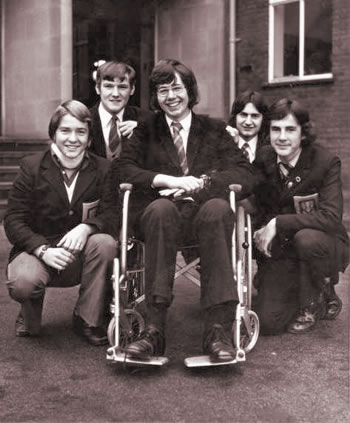
I was a friend of Robert Whetton at Joseph Clark primary school. At the Grammar School, we got split up because he was in the ‘A’ stream, I was in the ‘B’. Though not particularly close friends, I had been to his house in Balmoral Road on numerous occasions. His Mum was always very nice and taught piano. It was there that Robert taught me how to play chess.

On this particular day, Mark Osman was playing in the National Schoolboys Rugby Final at Twickernham. Mr Gillion and Mr Henton, all of the games masters and a number of selected pupils had gone on a coach trip to watch.

It was an ‘easy’ afternoon for those of us that remained and a small group of us, including Robert and myself, went outside as a small unsupervised group having decided to do fencing. Although fencing helmets were provided, we didn’t bother wearing them because you couldn’t see through them very well!

In a very unskilful hack around with Robert, my bowed blade somehow flicked off his and hit him in the face. He dropped to the floor and at first, it didn’t seem serious; everyone expected him to get up and laugh it off. However, he didn’t move and vomit began trickling from his mouth. Myself and Steve Goodwin went to report the incident and an ambulance came and took him away.

It transpired that whilst the foil had only inflicted very minor damage, he had hit his head hard on the floor when he fell which had caused brain damage. As a result of the incident, Robert suffered permanent disability. To this day, it has been one of my greatest regrets and I have thought of him countless times. To some extent, this website is dedicated to him.

First Day
On my very first day at Burton Grammar, I turned up very bewildered by it all, with my school cap. In my allotted main corridor cloakroom area, I was approached by Kelvin Russell who tried to snatch the folded cap out of my pocket. I managed to grab it so we both ended up pulling on it. In the stalemate, I was hoping that he would simply let go; instead, he pushed me in the face which caused me to let go and he disappeared up the corridor laughing, throwing it to someone else rugby style.The cap was never seen again and I got a major roasting for losing a garment we could ill afford when I got home. This has always stuck in my mind; it is amazing how much older second year pupils seemed at the time!

Spoiled Blazer
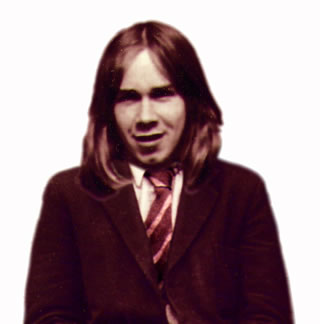
SharpTimes were pretty hard at my house, my Dad being a coal-miner in very troubled times. My clothes seemed to have to last much longer than most people’s and were sometimes shabby. I was fairly proud therefore, to be wearing an overdue new blazer.Going upstairs after assembly, I felt a number of firm strokes down my back. When I turned around, John ‘Scabby’ Sharpe (pictured) gestered that he had done it with his finger. After it was pointed out by others however, I took my blazer off to discover that he had drawn chalk marks as hard as possible all over it.My parents were furious, I got a good beating from my Dad and the marks never did come out fully.

Cross Country
Myself, Jez Stevens (now living in Carlisle) and someone else from Dalebrook Estate whose name escapes me, skipped cross country a few times by lingering to the back and diverting through ‘winshill dales’ where we used to play in the third boy’s house. At the appropriate time, we went back and re-joined the home runners when there was a suitable gap.On one particular occasion (maybe because someone had grassed), Frenchy stood by a stile at Bladon House Farm ticking names off.When we got back, looking as exhausted as possible, it became obvious that we had been rumbled and we were forced to stay behind and run around the whole school perimeter ten times. Worst of all, I missed my evening paper-round and almost got the sack.

Canoeing
One year, I can remember opting for Canoeing as a summer-time Games activity. I had already conjured up the image of gliding around on the river, jabbing my oar in the water on one side or other to force the boat to sharply turn on my command.

It turned out that we had been suckered; we had to report to the Metalwork room where we discovered that the Canoes were in kit form and our first task was to build them. Now when I say “kit form”, I don’t mean two halves that join neatly together and a seat that clips firmly into place – I mean bales of fibre, cans of resin and uncut lengths of wood.. the sort of thing you would complain bitterly to PayPal about if it had turned up off eBay.

For reasons I don’t now understand, the group was a mixture of pupils from my year and pupils from the next year up, including Keith Large, Robert Large and Stephen Johnson. I always thought that each year did games on a different afternoon.

Summer came and went by which time, we hadn’t managed to construct anything that looked remotely sea-worthy, so we never got to actually experience floating on water.


GOOD/BAD NOT SURE MEMORIES

Methane Bubbles
In the chemistry lab., the benches had twin methane taps for use with Bunsen burners. Chinner used to disappear into the small room at the front of the lab for inordinately long periods which we, correctly or otherwise, referred to as ‘fag breaks’. On one such reprieve, someone behind us was going “Aaahh” and an increasing number of pupils were sniggering as they turned around. I joined them when I saw that someone had lit the tap and had an eighteen inch flame roaring towards him as he rubbed his hands, apparently enjoying the warmth. When the distrurbance grew too loud, it was quickly extinguished when Mr Luckett suddenly appeared at the door to investigate. I seem to be far more concerned about the possibility of a flash-back into the supply as it was turned off now that I was then.

This soon progressed to soap bubbles filled with methane to coax into the air and ignite. Eventually, a large methane bubble was quietly manoeuvred to behind someone’s head; one person tapped him on the shoulder as the other lit it to provide the impression that the world had come to a flaming end. Someone tried the same ploy on me but, now alerted to the possibility whenever we were left alone, I turned to spot the bubble which was just as well because Chinner reappeared forcing the perpetrators to burst it – choking me with methane instead. “Get back to your seats”, ordered Mr Luckett. “Gallagher, why have you turned green?” (I made the last question up).

Crunchie
As indicated above, Joey Crowther used to administer punishment in the form of the whack on the head with a special baton, specially chosen I feel for making the loudest possible ringing tone when a cranium was struck.

I think there were five different degrees, ranging from a light tap to a good strike, depending on the seriousness of the offence. The largest was known as a ‘Crunchie’ which I received on one occasion. It was for flicking something slimy (I think a piece of frog) to startle someone as it landed on their exercise book in front of them. My amusement turned to dread when I faced forwards and saw that Joey had been watching the whole proceedings. I was actually surprised how much it actually hurt and felt that it was close to doing some real damage. It certainly brought tears to my eyes.

School trips
Huh?! I have been slightly surprised to read about the exotic trips to Europe and places. I don’t recall any such opportunities (although I would generally have expected to be in the small group that always got left behind to do lessons because my Dad couldn’t/wouldn’t pay the ten bob).

I have a very vague recollection of a trip with the new drama teacher to a theatre that could have been in Leicester, but was equally possibly Nottingham to see some kind of performance. I can’t recall any singing which probably rules out an Opera; I seem to remember not having a bloody clue what was going on, which suggests it may have been a classic Shakespeare play; and I have no recollection of any laughs so it was probably not one of his better works.


CONCLUSION

There are generally strong sentiments that it was a grave government mistake to abolish Grammar Schools, and in some ways, so it was. Comparing my account of the school to much earlier ones however, I get the feeling though, that the ‘rot had already set in’. One of the key indicators of this I feel was the discontinuance of Class 5X.

For a short period in the nineteen-sixties, Burton Grammar School enjoyed one of its finest hours. It was a period of strong Oxford/Cambridge success and an overall academic success that out-performed nearby Repton School – one of the most esteemed Private Schools in the country. Due to enormous pressures, Mr Gillion however, he had to abandon his thoughts of Academic excellence by the top stream of pupils, leaving the lower streams with much less attention. Instead, the reverse was imposed – to bolster a National average deficiency, there was a shift in ethos to making sure that as many pupils as possible received the ideal of five good pass ‘O’ levels. The brighter students could achieve that with much less guidance.

Gone was the overall feeling of great aspiration by those that had it within their grasp; instead, there was the much diminished feeling that everything was geared to trying to ensure that as many as possible got the requisite five ‘O’ levels, ideally including the most esteemed Maths and English, anything above that was a bonus.

True, I got my ‘Maths, English and three others’ which provided me with the minimum requirement for some Higher Education, but I was never one of the pupils that shone – it was they who really suffered.
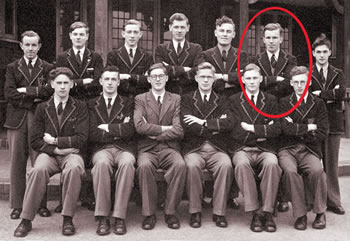
R.A. ‘Raser’ Smith (1941-49): The War Years

SmithThe Headmaster, W.D. Fraser died of a stroke whilst on a walking holiday in Scotland at Michaelmas half-term 1941. He was eventually succeeded by Harold Moodey in 1942.
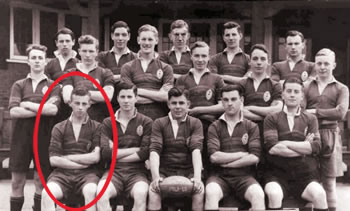
Mr Moodey was an Oxford graduate (Chemistry) as per regulations, and probably secured his appointment by having recently had a book published on Analytical Chemistry. I am afraid I endeared myself to him by finding three errors in it.

In my time Mr Moodey never took a chemistry lesson, even when Nick Nicholson was ill. He concentrated on religious instruction, usually using the period to harangue pupils on their poor performance. One of his early acts was to change the house system from one where boys were allocated by area of the town or to the same house as their fathers had been in, to a random distribution. At a time of severe clothes rationing this made him very popular.

Not mentioned so far are Hilda Press; she was a thug who taught French. I am sure many B form members will remember being whacked on the back of the head by this virago. There was also Norman Cleave who returned after the war (Tank group commander) to resume his post as senior English master but left after a term, to become headmaster of Poole Royal Grammar School. In his absence the English posts had been filled by Jake Hammond and Cyril ‘the weed’ Edlin. Cleave taught the Lower Sixth Science Logic for one term. I believe woodwork was abandoned in 1942 due to lack of materials, After the departure of Davis, the subject was taken over by Jenkins who also taught Latin. This master left in 1942 and Jake Hammond took over Latin.

Chemistry was not taught until one reached form 2, George Cooper took us for our first year, his degree was in Chemistry despite being Senior Maths Master. George always played the piano for assembly and the organ at Speech Day, etc. He was organist at Horninglow Methodist Church. Bill Read, Jake Hammond and Ronny Illingworth favoured the Wyggeston Hotel as their watering hole. Unfortunately Bill, who lived at the top of Foston Avenue, was found asleep in the front garden of a member of 4b halfway home, this took some living down.

Tom Parkin achieved notoriety by standing up in the middle of a church sermon and accusing the vicar of using the pulpit as a coward’s castle. He retired at the end of the war to be succeeded by Shorthose (the Drip-after an end of nose feature), another author. His book, ‘The Properties of Matter’ occupied 75% of the teaching time, but only 10% of the examination questions. He was the only master who came to school in a car, a Ford Popular, and had the distinction of being caught in the car in the middle of a level crossing with the gates closed. Schoolboys have eyes and ears everywhere.

Charlie Brown taught History and some Geography and was press ganged into teaching American history to 2A in 1942. He did this by reading a chapter in the text book during the preceding week then regurgitating it as a lesson. One week Charlie, always rather scatter brained, lost his text book. Charlie also kept bees and several times interrupted assembly with “Excuse me Headmaster, has any boy in the Field Lane area seen my bees?”

‘Old Nick’ Nicholson, an Irish communist, was the senior Chemistry master. He had previously been employed in industry which he left under a bit of a cloud. He was held responsible for a gas explosion in a large calciner which disintegrated. Chemistry lessons lasted two periods, for the first part, a lecture/demonstration, the class sat in a circle in an alphabetical order clockwise with Nick at 12 O’clock and Timber Woodcock at 11.30. Consequently Timber got the pleasure of sniffing any obnoxious gasses produced in the demonstration. There was one fire extinguisher, which after use, remained empty for a term.

In Harold Moodey’s time the procedure was for the extant prefects to send a list of preferred candidates for the next year to him, he then amended it. Up to the end of the 1940s prefects had a fair amount of power, they could set lines, put a persistent offender in detention and administer a smart clip on the ear. Discipline was pretty tight.

The War Years

Turning to the war years I started as one of twenty scholarship pupils in September 1941, eight from Grange Street eight from Horninglow Rd. four from the rest of Burton. The total of new entrants was made up to about forty, from the outside districts and the Prep form. The intake was lager than usual due to families moving out of Derby and Birmingham to the Burton area and commuting to their wartime jobs by bus or train. Their sons passed the entrance exam for paying pupils. We were divided into 1A form master Bill Read and 1B. We were taught identical lessons until the February exams and from the results reallocated to 1A&B. These results virtually governed whether you were in the ‘A’ or ‘B’ stream throughout your school career. This had the knock-on result that many of the brighter boys trapped by the scheme were removed and sent to the technical school in Guild Street. This school had a very good reputation thanks in part to the efforts of Arthur Blake, Burton’s very competent Director of Education.

School hours were 9.00 am till 4.05pm with lunch from 12.20 until 2.00pm. The problem of going home in the dark did not occur as single and double summertime were adopted throughout the war years. However detention was moved to Saturday mornings in the mid winter months. As a general rule school could start at 10.00 if the air raid warning had lasted for more than three hours in the preceding night. This was frequently the case in the winter of 1940 but not subsequently.

After school activities were severely limited in the winter months due to the blackout which despite the adoption of summer time, could be as early as 4.45. It was impossible to blackout the school though I think an attempt was made with A room and the adjoining corridors.

Their was also the deterrent of boys having to cycle home in the blackout and masters having to do fire-watching about once a week. An air raid shelter was constructed in the garden where U & V rooms were later constructed and several more in Peel Croft between the grand stand and Lichfield Street. They were relatively shallow shelters due to the possibility of flooding. I can only recall their use on one genuine occasion and several practises. Ironically the ATC’s uncamoulflaged Bulldog bi-plane was parked about 20 yards from the shelters.

Woodwork classes were abandoned in 1942 and with the advent of hit and run raids it was decided that the Art Room with its glass roof, was unsafe. This meant the loss of two class rooms and to compensate rooms were occupied in Bond St infants school which had been closed in 1939 and the Mission Hall in Bond End. As neither locations had an allocation of fuel, classes were conducted in gloves and overcoats. Infant size desks also caused problems. The Mission Hall was however successfully blacked-out, and was used by the Scouts, the ATC and the Aircraft Spotters Club. The Chess Club also functioned during the war years.

Most boys and masters came to school by cycle in all weathers. If it rained or snowed it was impossible to get on the buses unless you lived within two stops of the terminus. Waterproof capes and leggings were in short supply and required clothing coupons for purchase, so assembly and the first lesson were frequently accompanied by a steamy atmosphere. The school yard was surrounded by cycle racks, mostly undercover. All were numbered and you were allocated a number for the year. Cycles had to be pushed along Bond Street  and mounted in Lichfield Street. Lichfield Street had to be crossed by the pedestrian crossing. Scooting on one pedal across the Ferry Bridge was not permitted and detention was the punishment.

In common with other schools the toilets were outside and froze in winter, smoking in the toilets was a caneable offence. Gas masks had to be carried from lesson to lesson until 1944 when regulations became less stringent. The school bell, traditionally rung by the weeks duty prefect, was not rung between 1940 and 1944.

Sport took its usual pattern during the war except that rowing had been abandoned. Rugby was played in the Autumn term and the first few weeks of the Spring term. House matches were played on Peel Croft as Burton rugby club was not functioning. Inter-school matches on Wednesdays and Saturdays were played at Senior and Junior level, travel usually being by Stevenson’s yellow peril. Cricket was also played at the same levels. Amongst the school opponents were:-Lichfield GS, Coton College,Denstone College,Uttoxeter GS, Burton Tech., Ashby GS, Newport GS, Trent College, King Edwards GS Aston & Five Ways, Radcliffe College, Nottingham High Pavement GS, Nottingham GS, Tamworth GS. Some fixtures were cricket only. Photo’s of the Cricket 1st XI are confusing, in general they were taken of the XI chosen for the Old Boys match which began at 11 am and frequently coincided with A level exams. This explains why a number of stalwarts are missing.

The school had a very strong swimming team and thrashed most opponents, the climax came in 1948 with a match against Motherwell GS which we narrowly lost. The opponents had three team members who subsequently swam in the London Olympic Games.

Cross country was the main athletic event in the second half of the spring term. The senior course started on the Ox Hay, then across the Ferry Bridge, through the back streets of Stapenhill, up to Brizlincote Hall Farm, across to Winshill Clump, down Tower Road and Ashby Road to Elms Road; across Stapenhill Road, through the Riverside Gardens and back to the Ox Hay via the Ferry Bridge. Track athletics were not taken very seriously until the arrival of Norman Jones and Norman Paine after the war.

The easing of blackout restrictions in 1944, lead to the renewal of evening activities. The Scouts held Gang shows in the school hall and the drama group got back into full swing.

The Fauld explosion has already been written about. There has been no mention of the fairground fire in 1943, which conveniently started at about 3.50 pm so had most ot he school as audience.

1945 saw many changes, partly due to the influx of new masters, contacts with the Girl’s High School previously fround upon were increased , initially with the Circle Francais (Wood),drama selection of plays with more female characters and by 1947 joint ballroom dancing classes. The cafe at the Ritz cinema also proved a great Saturday morning attraction.

E J Ward (Ernie as we new him then) partially took over rugby from Jake Hammond though there was a slight problem as Ernie had played the dreaded Rugby League as scrum-half for Bradford Northern. The opposition consequently received an unpleasant surprise. ernie also ran the radio society which operated from the sports pavilion, he had a very early so attracted a lot of contacts on the air waves.

There was also a man called Paine about 6’4″ tall, ex-Nottingham University, who took over part of Ronnie Illigworth’s cricket for a time. He lived up to his name, if you dropped a catch , mis-fielded or bowled a wide you were sent to run round the boundary several times.

Norman Jones boosted the interest in athletics and organised a visit to the 1948 Olympic Games. At that time you accumulated points for your house by acheivng a certain standard.

On Sports Day points were also awarded for the positions in the races and the house with the highest aggregate of the combined set of points won the cup. David (Spike) Finch who was Athletics Captain of Drake house caused some embarassment by turning out his house members to achieve the standards to such an extent that the difference between Drake’s pre Sports Day total and that of the other houses could not be made up by results on the day. Another entertaining incident was when Norman introduced and demonstrated the hammer. He got it wrong somehow and the hammer finished in the circle and Norman on his back outside. He had some diffculty in persuading Ronnie Illingworth that those spectators who applauded the effort should not be put in detention. It was quite noticeable that the attitude to the boys, of most of the post 1945 staff arrivals differed considerably from the pre-war ones.

The diagram of the lay out of the school is correct for the late 1940s except that L room was not divided fom the Art Room and J room was the home of 2a Charlie Brown in charge in the early 40s. Incidentally the photo Pre-World War II b is of the Art room not the Woodwork Room. In the early 40s the other form rooms were 1A in F (Frank Reed),4A in G (R Illingworth), 5A in C (H Pitchford), 2B in L, 3B in M (J Daffern), 4B in D (H Press) 5B in B ( J Hammond) Lower 6th Modern in N 6th Science in O (G Cooper). On completion of S and T rooms 2B went to S and the Lower 6th Science to T.

T room was fitted out with a demonstration bench, gas and water taps and basin, though it waas rarely used for its original intention as a supplementary physics lab.. However the was a perforated ventilation brick in the wall between between T and S and in free periods it was not unknown for a fine spray of water to be directed via a rubber tube and the ventilation brick on to the head of the master teaching in S room. It was surprising how often the roof of S room was examined for leaks.

Another feature of S and T rooms was the coke stove, totally inadequate in winter but stoked enthusiasically by the inmates to such an extent that the chimney often glowed red hot. On one occasion a small oxygen cylinder was left in T room, so it was decided that supplementing the air with oxygen would boosted the efficiency of the stove. The experiment was abandoned when the chimney softened and sank several inches.

Prefects and masters did one week on duty per term, this involved opening the garden gate, patrolling the school yard at breaks, tolling the school bell and reading the lesson (getting told off by H Pitchford if you said Jerusalum instead of —lem). In general prefects were allocated to individual forms for one term at a time and were expected to keep order in the absence of the master. They also did Dinner Duty once every three weeks supervising setting up and removing of tables etc.. Sandwiches were eaten in D room which was also used for pupils excused prayers.

Aubrey C. Baggley (1900-06): School Impressions

When I arrived with my brother, I about eleven and a half and he two years my senior, I felt myself a minnow among big fish. I was quite small for my age. What was still more frightening was seeing boys whizzing through the air holding on to pieces of wood tied on to the ends of ropes, the other ends of which were fastened to a circular metal plate at the top of a large, thick, shortened telegraph pole. I learned afterwards that it was a ‘Giant Stride’, and I enjoyed many a round on it myself in later years.

Assembly for prayers, read I his booming voice by the Rev. T.W. Beckett (headmaster) was followed by the daily hymn, sung to the accompaniment of a wheezy harmonium played by a young master named Cole (assistant to Mr Beckett). After he left, Mr Cyril Hartshorn took over but, as an accomplished musician, that harmonium was a real trial to him. He hated it but, with only 150 or so boys, no-one else could be found to be pressed into service.

Mr Beckett was to me, a very imposing person with very large hands, which were used in such a way as to put the fear of the Lord into us. On one occasion, Jack Rudd, a member of my brother’s form, felt the full weight of it. What Jack said I never knew but, as a result, he received a cuff on each side of his face. For two days, his face was red and swollen. Such things were completely accepted in the school in those days.

Mr Beckett left in 1900 to become Vicar of Anslow. Having been Headmaster since 1884, he had a special farewell at the annual prize-giving in the Town Hall. I was greatly impressed by Mrs Beckett who had looked after the twenty or so boarders. She had been greatly liked. With no public transport, except trains, and almost no motor-cars, boys from a distance had to board. Willie Wain from Bretby often came by pony and stabled it in High Street, near the market place.

In September 1900, Mr R.T. Robinson, from Wyggeston School, Leicester, succeeded Mr Beckett and caused something of a stir when he introduced Saturday morning school from 9:00 – 12:30am in place of Wednesday afternoon from 2:00 – 4:00pm. His reason seemed shameless; we were fresher in the morning and Wednesday afternoon could be used for games. He omitted to mention the extra one and a half hours work. In fact, not many boys played football and cricket in school at this time. The games were run by a Sports Club to which members had to pay a fee of 2/6d (12.5p) per term and supply their own gear, and pay for travelling to such places as Ashby, Lichfield and Atherstone. This was prohibitively expensive for quite a number of boys in those days of large families and low wages. The days of financial backing by the Local Education Authority or the ‘State’ were yet to come. There were also ‘bathing sheds’ by a backwater of the Trent used for swimming. “The Field”, as we called it, lay immediately behind Peel Croft, and the pavilion was a very drab, corrugated iron covered hut, the only window being a large wooden panel on one side, which could be pushed open by an iron rod and fastened by then putting the end in a staple. There was no groundsman. It was a DIY world in those days! We rolled the pitch and marked out the whitewash lines ourselves. For non-school matches, ‘Tommy’ Stevenson, who took Form I for all subjects, and who had been said to play on occasion for Warwickshire, and W.H. Robinson known as ‘Taffy’, and the Headmaster’s bother, and still later, A. Rigby the Physics master, all played in the cricket team. R.T.Robinson himself, by now known as ‘Dicky’ ,turned out at centre half in the football team at least once. J.W. Ramshaw, who joined the school when the Physics Lab. was built, also played football at times. Two record scores of later days in1905 stand out in my mind as I was Captain then. We beat Congregational Church 24 goals to nil; Sam Oulton scoring eighteen.

When I first went to Burton Grammar School, I was put in the fourth form on the strength of my having gained one of the three ‘Feoffees’ Scholarships but, having done no Latin or French ever before, I had to catch up with my classmates. In wat was called ‘Extra Division’, I did intensive Latin Primer and ‘Gepp’ work for about eight lessons a week with ‘Piggy’ Jeffcott, and spent the whole of Monday, Wednesday and Friday afternoons doing French, missing all lessons in Music and Art. By the end of the school year, which ran from January to December in those days, I had advanced far enough to start on Vergil’s Aeneid IX in Latin Div. IIb, and ‘Remi et ses Amis” in French Div. IIa. ‘Cambridge Local Examinations’ were compulsory for fourth forms and above so, at aged twelve, I joined my brother and a lot of other boys in evening preparation from 6:00 – 8:00pm at the school from around mid-October to early December. I remember the gas lit rooms with incandescent mantles (the school had no electricity then). One incentive for these examinations for the more gifted boys and their parents was that, for 1st Class Honours 36/- (36 shillings or £1.80) worth of books of one’s own choice were awarded. 24/- (24 shillings or £1.20) was awarded for 2nd Class and 12/- (12 shillings or £0.60) for 3rd Class. In those days, when all books and stationery had to be paid for by one’s parents, such awards were very welcome. Books belonging to school-leavers were often bought second-hand for new boys. Several of mine belonged to someone called ‘Billy Balfry’ who had himself inherited them from an older brother, hence they all had ‘J.C.K. Balfry’ in them.

Earlier on, I mentioned Jack Rudd’s beating by Mr Beckett. R.T. Robinson gave one beating which I should think stood out for years in the minds of all who heard it. Len Hearn, who later gave money for a prize to the school, and so must have forgiven the indignity, was the victim. Having been previously reprimanded for smoking by ‘Dicky’, he was seen smoking again in High Street. The whole school was assembled and ‘Dicky’ lectured us about the offence. He then ordered Len to go to his study. In a few moments, we heard a “swish”. Being boys, we started to count and we became more and more amazed. It went on until we had counted 21 strokes, but not a single cry. Later, I asked Len why he hadn’t shouted out and he said “If he’d have given me one more, I would have yelled the place down”.

During the Second Boer War (1900 – 02), we began Military Drill after school and Sergeant-Major Maher put us through our paces either in the school playground or on ‘The Field’. We also had targets under the covered shed in the playground for rifle-shooting. We used ordinary rifles with tubes inside them making them suitable for the short 22-yard range. ‘Kitten’ Thompson established himself as our ‘crack-shot’.

In a cricket match in 1902 against the Burton Gentlemen, for whom S.H. Evershed, recently Captain of Derbyshire C.C and his brother, Frank Evershed, a Rugby International, played, my brother managed to score 30. They were so impressed that they awarded him with a bat. From then, they continued to award two bats for the best batting and bowling averages. In 1907, I finally got one for batting and H.A. Jones, who later became Dean of Manchester, got the one for bowling.

In 1905, ‘The Cygnet’ came into being. At a meeting in the Chemistry Lecture Room, H.S. Staley was appointed its first Editor. He left at the end of term to go to Birmingham University and later to Cambridge and I succeeded him as Editor.

When Mr Beckett died in 1907, I together with Arthur Bonfield went to represent the school at his funeral.

We always had prayers again at the end of afternoon school. After the service, the Headmaster read out the names of all boys who were to stay behind for detention for various misdemeanours.

We wore red and blue wide-striped caps, commonly known as ‘bull-scarers’ which cost 2/6d (12.5p) or round black or dark blue ‘polo’ caps with the school badge on the front. No blazers. The school caps annoyed the local ‘Park Street Boys’ and there were frequent battles between them on the way to and from school.

Ted Warren (1936–42): School Memories

WarrenSchool started with assembly in the hall under the eagle eye of Tom Parkin. The Headmaster read a prayer, a hymn was sung, notices read and then quietly and orderly we left for our classrooms. Breaktime we went across Bond Street to the Rawlings sisters (Gertie & Maisie) where if you were lucky, you bought a doughnut or a twist. Back to school until Dinner time from 12:00am to 1:30pm and finally home at 4:00pm
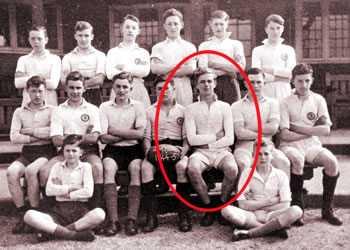
The school had scholarship boys & fee payers. I remember lining up in the hall to pay Mr Marshall of Talbot Stein & Evershed. Fees per term were £5-5-0 if you lived in the Borough, and £7-7-0 if you lived outside. Uniform, which was strictly enforced, was either blue blazer, grey flannels, white or grey shirt with blue & red school tie, and blue cap with a broad red band at the back OR a grey suit. These had to be purchased at either Tarvers or Ellis & Sons.
For sports, in those days masters used to coach boys after school. Frank Read, swimming, Ron Illingworth, cricket & Jake Hammond, rugby. House matches were held on Saturday mornings and you were expected to attend wearing school caps and were punished if you forgot your cap.

Some of the outstanding students were:
P.C.H. Davies who was a fine sportsman, captaining the school at cricket, rugby and athletics. He set many school records, some were still held by him when the school ceased. Norman Dent became an English cross country runner.
Oscar Deville became a C.B.E. before being knighted for his services to industry. He is a very gifted man. John Dent was knighted for services to aviation & travel. On a sad note – N Carfoot, Tom Thorley & Peter Berry all died due to war service.

Some memories of the staff:
The Headmaster, Mr Frazer, died tragically in 1941. Deputy Head and Physics master Tom Parkin was feared in early years but respected in the 5th & 6th forms. ‘Cherry’ Major Orchard was a territorial so went to war in 1938-9, and returned to the school afterwards. Dai Davies – Woodwork and P/T Terrier with South Staffs, was also called up 1938-9, returning after war. Nicholson took us for Chemistry and Dai Hughes for English & Cricket. Frank Read took Maths & coached swimming. During the war he was C.O. 351 Squadron Air Training Corps . Ron Illingworth – Geography & coached cricket and was also an officer in 351 ATC. ‘Chasser’ Brown, History master, formed a League of Nations society which ceased when war broke out.

The famous H.H. Pitchford, who taugh both History and Geography, always carried a small case with him and wore a trilby hat. He ran the school bookshop for years with George Cooper and was eventually to become Headmaster. ‘Scraggy’ Shan taught French and had a viscious right hand. ‘Bunny’ Leighton also taught French and organised the school scouts. ‘Daddy’ Spooner taught Art. Monsieur Vinc was yet another French teacher but he resigned before the war and returned to Belgium where he died fighting for the Belgian Resistance. ‘Reggie’ Neale taught Biology and was a good rugby referee; he left to join the Navy; he did not come back to BGS but became a well known author. N. Crystal, who I can only just remember, came back to Burton after the war but he did not return to BGS being blinded and badly injured by bomb explosion due to his service with a bomb disposal unit. ‘Connie’ Illsley came to replace Neale as Biology teacher and was the first lady on staff. Lastly ‘the boy who never left’ BGS, George Cooper, gained a scholarship to BGS Higher School Certificate and entrance to university. Qualified and returned to teach at BGS for the whole of his long scholastic career; he taught Maths and helped to run the school bookshop.

Don Payne (1942-45): BGS as an Evacuee

PayneHaving been bombed out in London’s East End in 1941, I was evacuated with my brother Dennis and my Mother to Newhall near Burton. We were billeted in a very small cottage in the back gardens of homes in Oversetts Rd. “Grandy Sabin one of the characters of Newhall was the tenant. He lived and slept in one downstairs room whilst we used all the other rooms. There was no bathroom and an outside toilet. The downstairs rooms must have been infested with cockroaches because if we returned home at night and switched the lights on there was a very large gathering of them in the middle of the floor! My primary school was in Newhall. In 1942 I had to take the London County Council entrance examination at the primary school and the paper was sent to the London Education Authority for assessment. Due to administrative delays my results were not processed until October 1942 and I was awarded a special place at Burton Grammar School; my London grammar school would have been Coopers Company Boys School in East London.

I enrolled at Burton Grammar on 23rd October 1942 and was immediately in trouble with French language having missed the first few weeks of lessons. My early impression of Horace Pitchford (History) was of a dapper but fierce master who did not suffer fools gladly! During my first few months at school I managed second place behind Brian Fretwell in the Junior Cross Country race and we were both awarded our Athletic Colours. This helped me integrate into school life very quickly as I was recognised by Masters and senior boys of the school.

I never carried a gas mask although we had them at home. Assembly was in the main hall, in form order and Tom Parkin Senior Master would scowl at any one making too much noise before we were addressed by the “Beak” Mr. Harold Moodey. Tom Parkin, for all his serious exterior, frequently had a half smile on his face as if to say “I know what boys can be like”. Masters and Prefects could give detention for various misdemeanours which required attendance on Saturday morning to complete set work. Morning and afternoon breaks were in the rather small playground. The tuck-shop opposite the main entrance, run by Lily and Gertie provided smashing current buns and they did brisk business. For mid-day meals we sat on benches at long tables in the Hall. Food was still plentiful and I frequently went up for seconds if they were available.

I do not think the school had an air raid shelter as I never visited one during my time. Emeny air raids were at night when they bombed Coventry, Birmingham, and Derby (Rolls Royce) and other industrial cities. You could hear the anti aircraft guns and the steady drone of enemy bombers. Blackout of all lights was enforced with shaded headlights on vehicles and black curtains which had to be drawn when lights were switched on. In the later part of the war we saw plenty of large formations of American bombers and fighters that were carrying out daylight bombing missions over enemy territory.

Discipline at school was strict but fair. All boys had to wear the school hat and tie and touch their hat when acknowledging a member of staff out of school. I never had a school blazer as family finances were tight. The annual Speech Day took place in the Town Hall. I believe all the school attended and the Masters wore their gowns with University colours. Awards were made for various achievements during the academic year and consisted of books with a label inside indicating the proficiency and signed by the Headmaster. During my stay I was taught variously by Connie Illsey, Polly Lownds, Miss Selby, Jake Hammond, Bill Read, Ronnie Illingworth, Joey Daffern, George Cooper, Chazzer Brown, and Horace Pitchford. Although I was not taught by Mr. Moodey I did make his acquaintance when receiving “six of the best” for some demeanour in my first year! Sporting activities consisted of Rugby, Cricket, Athletics and Swimming. There were regular matches against other schools including Trent College, Denstone College, K.E.S. Aston, K.E.S. Birmingham and Repton. These were limited because of transport difficulties. Inter House matches were introduced during the war to stimulate competition and were mainly played on Wednesday afternoons and Saturday mornings.

As a member of the air scouts we had the opportunity to cycle to Fradley airfield which was an Officer Training Unit. They used Wellington Bombers for training which consisted mainly of “circuits and bumps” continuingly landing and taking off for about two hours. If flying was taking place that day you drew a parachute and when the plane was ready you climbed aboard and had a rather bumpy flight for two hours. It was just too bad if you felt sick as you could not get off! There were a number of clubs at the school which met after school hours.

Any boy at the school during 1944 will remember the explosion when the ammunition dump at 21 MU RAF Fauld near Hanbury blew up.4,000 tons of bombs blasted a crater 400ft deep and three quarters of a mile long. One farm with all buildings, wagons, horse, cattle and six people disappeared. It happened on 27th November 1944,was the largest explosion during both World Wars, and killed seventy people, eighteen of which were never found. At the time, just past eleven, Chazzer Brown was taking my class for Geography. There was a muffled rumble and all the lights in the room rattled. Chazzer, quite unruffled just got on with the lesson. Later that week I cycled to the area and many of the local roads had large clods of earth littered about that had been deposited by the blast. The area was cordoned off and even in 2004 sections of land are cordoned off due to unexploded bombs.

John Hicklin: The Fauld Explosion

It was just after 11 o’clock on a foggy Monday morning,the 27th November 1944. As a ten year old boy I sat at my desk in ‘A’ room at the Burton Grammar School. I thought that I was about to faint. Without any noise at all my desk seemed to rise up towards me, or perhaps I was going down towards it. A very strange sensation was soon gone but quickly the whole class realised we had all experienced the same feeling. From the floor upstairs came a noise of the whole class there scrambling under their desks. Around lunchtime the rumours were well established and it was only later that we found out that the ‘Dump’ had gone up.

The ‘Dump’ was an ammunition store underground in some old gypsum mine workings at Fauld about five and a half miles from our school.The blast of some 4000 tons of high explosive bombs detonating together had sent tremours underground for many many miles and what seems to have happened was that the whole school building, floor, desks and all had silently moved as one then settled down again.

On the way home I stopped to take train numbers but there was still a dense fog and we heard the endless sounds of emergency vehicles going to the local hospital that was just down the road from us. I remember the eerieness of everything drove me home.

My mother was away in Derby for her father that day and only learned of the awful event that evening. The following day mother went with the WVS mobile canteen to the site at Fauld and did her stint two days each week until the following March. I remember she had some harrowing tales to tell and I don’t believe I heard the worst. The whole area was a sea of liquid mud which frequently came over the tops of their wellingtons as they moved around the site in threes and fours holding hands as so many small craters were just levelled with the liquid mud.

Sixty-eight people lost their lives in a bang which took out the crater, (which was some 90 feet deep and covering an area of 12 acres) in a second. A whole farm with buildings implements and stock vanished without trace. A thousand acres of topsoil was redistributed, some up to 11 miles away.
The crater is still there near the small village of Hanbury and is now marked on the Ordnance Survey map. A Memorial stone and plaque stand alongside the crater and each Remembrance Sunday the names of those who lost their lives there are read out in church alongside the those that fell during the two world wars.

Stories and facts of this tragedy abound. So horrific was it that tales of ‘When the Dump went up’ will be told for generations to come.

John Goodhead: 1959 RAF Church Fenton Cadet Visit

In the 1950s the RAF seemed to be very exciting. The new RAF fighter planes the Supermarine Swift and the Hawker Hunter broke several world records. The new Gloster Javelin all weather fighter had a delta wing and new Air-to-Air missiles. The iconic V-bombers were entering service. The first V-bomber was the Valiant painted in ‘anti-flash’ white. A year later there were the delta winged Avro Vulcans, then a year after that the last of the V-bomber types, the crescent winged Victors. Even RAF Transport Command had a jet transport squadron by the time I joined the Grammar School.
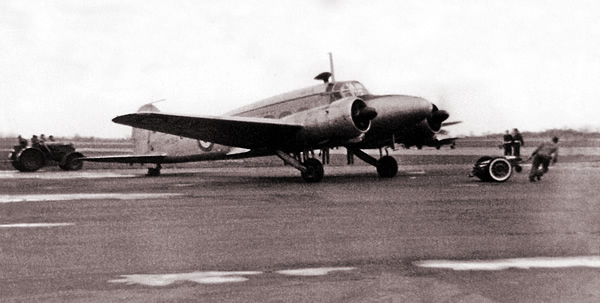
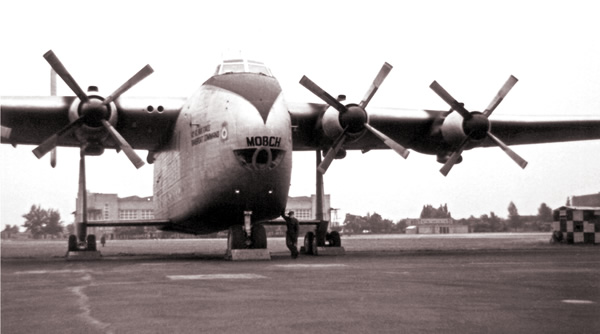
Bomber Command was commissioning a Thor missile squadron and Fighter Command seemed to be swapping fighter planes for Ramjet powered Bloodhound missiles. Then the amazing Lightning interceptor entered service so there was still a chance to be a pilot of the future in the RAF.

With all this in mind a week or two at an RAF camp in the late 1950s and early 60s looked like an exciting prospect for any RAF cadet.

Training Squadrons and Air Experience.
I am sure that most of the RAF personnel do not fly when they are at work, however it was important to get cadets into planes and off the ground. This was called Air Experience. At camps there were two ways to get Air Experience. The first was to be a passenger on a multi engine training flight with free seats in the back. The second was to become a temporary trainee pilot and sit with a pilot instructor, hands-on.


The Avro Anson looked like an old mini airliner. This type had been in service with the RAF since before WW2 and was still the standard twin engine trainer in the 1950s and 60s. They were slow, noisy, often smelling of ‘AvGas’ and exhaust fumes and were nothing like the supersonic RAF of the New Elizabethan Era of the newspaper headlines.

The Avro Anson was the most common provider of our Air Experience probably because there seemed to be one at every camp, more at RAF Shawbury and RAF Swinderby. One time Cadet Under Officer Ian Quayle took over the controls of one and took us all for a spin for an half an hour or so.


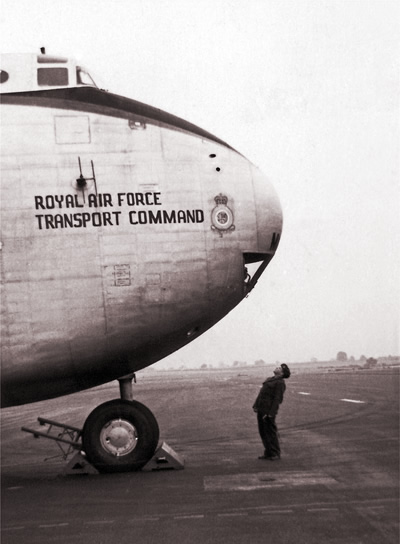
While at camp with Transport Command at RAF Dishforth we had the opportunity to fly in a Blackburn Beverly transport which was quite new, having only been in service since about 1955. At the time of entering service it was the largest aircraft in the RAF, I suppose they were around 3 stories high, they could carry 30 paratroopers in the tail boom and many more in the main cargo hold.

This is why I had my chum in the above shot for scale. There was an opportunity to fly in one of these planes when the crew were training on circuits and bumps. Circuits and bumps involves a plane taking off, flying round and coming in to land, rolling along the runway, powering up and taking off again, then doing it all over again and again. I declined the kind offer. Fortunately there was an option to go on the rifle range.

I had a hands-on opportunity in a De Havilland Chipmunk. This was a tandem seat basic trainer. I remember that it was difficult to walk to and get into the aircraft with my parachute bashing against the back of my legs, below the knee.

I also had a go in a Vampire T11, this fighter trainer had ejector seats. An aircraftwoman fastened me into the parachute which was fastened to the ejector seat. Even my ankles were strapped to the seat to stop my legs from flaying around and getting chopped off in the event of ejecting. Once I was fastened in, the aircraftwoman pulled out the seat’s arming pin and it’s big red disc from the back of the seat (like the pin out of the grenade) then showed it to me and stuck it in a pocket on the side of the seat. Now I knew that the seat was armed and it was safe for the pilot to take off.
Frontline Squadrons.


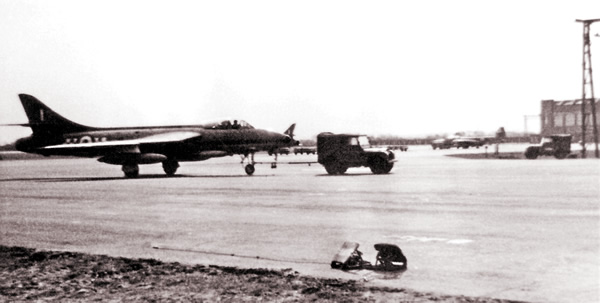
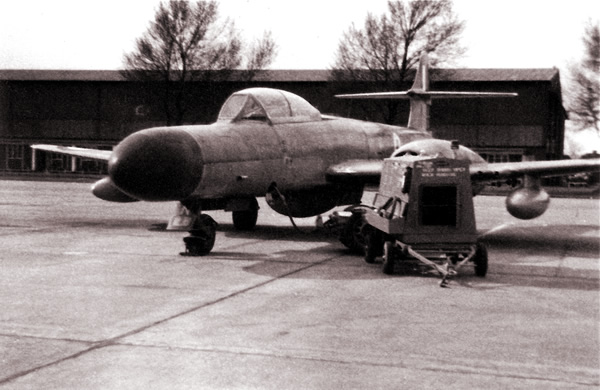
At RAF Church Fenton in 1959 there were two squadrons, one flying Hawker Hunter day fighters and another flying Gloster Meteor NF11 and NF14 night fighters. The Meteors were in the process of being phased out as the new Gloster Javelin night fighters came into service. If we had flown in a Meteor the bail out instructions were as follows; If you should need to leave the aircraft the pilot will let you know. He will tell you that he is releasing the canopy. After he has released the canopy he will tell you to stand. You stand and the airflow will carry you out of the cockpit to safety. So you stand, get hit in the chest by a 500+ mph gale which will thrust you backwards into the tail fin. Some new definition of the term ‘Safety’?

When I discovered the black and white contact prints from which these photographs have been taken I could not believe how very old fashioned the Meteors look. We were not allowed to photograph the Javelin or it’s air to air missiles.

RAF camps and air fields seemed to me to be a bit strange. Vast expanses of flat ground, buildings sparse and most of the time there seemed to be no one around. Great times, did a lot of shooting and learned a lot. However the RAF was a lot sexier in the newspapers.

David Moore (1954-61): First Day at Bond Street

MooreOn the face of it there’s never been anything special about Bond Street. Nothing at all, except, that is, for many of us who used to turn up there from Monday to Friday each week, weighed down with bulging satchels wondering what the day held in store. No, not the fashionable shopping paradise situated in London’s West End. This Bond Street was, and still is, the Burton upon Trent version. Stretching from Lichfield Street to the old Ice Storage building it was a thoroughfare far less grandiose than it’s namesake in the capital. Gaze along it these days from a vantage point on the pavement near Peel Croft and you will notice the open ground on the left which is used as a car park. And, like me, you will probably wonder how a school with it’s sprawling collection of outbuildings could possibly have fitted into such a tiny piece of land. But it did, for this is where Burton Grammar School was situated – from 1877 until the new premises in Winshill were opened in 1957.
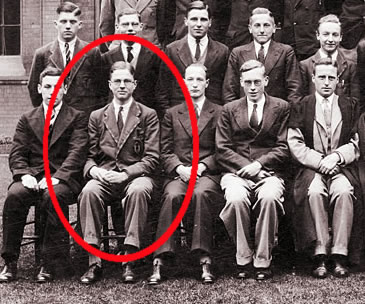
Access to the school was through an entrance about half way along the street. Immediately on the left was a door leading into the main building itself. Then it was along a corridor and past the changing rooms with their distinctive odour. Sharp right and then straight in front, the main hall where assembly was held each morning. At the other end of the hall, a narrow dark corridor leading to the chemistry laboratory and G-Room with it’s rows of desks arranged in tiers. Upstairs, another sprawling maze of corridors and rooms. Then there was the old headmaster’s house which had been converted into classrooms and a library. Situated outside, in what had previously been a garden, were some rather dilapidated prefabricated huts – more classrooms. There was a playground, of course, and in the far corner the bicycle sheds leading to two more places of learning some distance from the main school building itself. And a few hundred yards away, an old chapel. This was to be our form-room three years later. One thing is certain, the whole complex would be condemned as totally unsuitable these days.

Rather like eighty-nine other boys back in early September 1954 I was feeling excited and, I have to admit, rather pleased with myself, as I made my way to Bond Street for the very first time as a Grammar School student, but slightly apprehensive and a touch nervous too. Smart navy blue jacket, red and blue striped tie, grey shirt and grey trousers short ones – but most important of all, that distinctive cap with it’s red flashing across the back, proudly perched on my head. You could always tell where your mum had bought it from, the depth of the red band was slightly different depending on whether it came from Ellis’s or Tarver’s. Things like that seemed very important.

Yes, I remember that first day vividly. Forcing down my eggs and bacon seemed slightly more difficult than usual. An anxious wait for the maroon double-decker bus in Bearwood Hill Road, the journey down from Winshill across the Burton bridge, along High Street past Bass’s offices where the clerks would soon be taking up their positions on their high stools, finally climbing from the bus at the junction with Station Street. From there it was a short walk along the far end of High Street, past Oakden’s shop with that wonderful smell of roasting coffee beans and then sharp right into New Street. Across the old bus park into Lichfield Street before finally ending up at my destination of Bond Street itself.

I think most of us had some idea what to expect when we made our way through the entrance gates and along the short passage into the playground that morning. There had been rumours of some sort of initiation ceremony so it wasn’t totally surprising to find ourselves subjected to what can only be described as a pseudo public school welcome which involved “running the gauntlet” through a group of older boys who gave us a not so gentle clip across the head which didn’t do a lot for the condition of our smart new caps most of which finished up scattered along the ground and trampled on.

Soon it was into assembly in the main hall and a short welcoming address from the headmaster H.H. (Horace) Pitchford before moving off to Z-room, one of the huts behind the bicycle shed. This was to be our form room, a sort of home base, for the next two years. Pupils had already been divided into three classes and for me it was the middle one – B-stream. We knew which of the four houses we would compete for too, Clive, Drake, Nelson or Wellington. I would be wearing the green of Clive, at least that was the colour of the rugby and cross country shirts. Named after Clive of India, at the time it had the reputation of being the weakest of the four in terms of sporting achievements. If only they played soccer instead of rugby I might have been in Wellington instead or so I kidded myself. Apparently Wellington was the strongest but what was the basis for selection, were there mischievous forces at work?

Our form master was Mr Ward who taught French. We called him Ernie, not to his face of course, that was “sir”. Only later did we find out that his real name was Ellick, one that I’d never come across then and haven’t since. We liked him straightaway. Soon we would come to respect him too. One of the first formalities was to have a desk allocated to each of us. Seating was arranged in alphabetical order, that’s why I became friendly with a boy called John Monk. I guess it was just hard luck if you didn’t get on with your alphabetical neighbour; fortunately we seemed to hit it off, partly because we were both keen on football and cricket. Not rugby football but the version played with a proper ball, a round one. Before long we would be under no illusion as to which code was encouraged at this particular school.

Soon it was time for the mid-morning break and a first visit to the tuck shop run by Miss Rawlins and situated on the other side of Bond Street. Decision time, was it to be a jam doughnut or a sticky iced bun? Or maybe both! Ninety minutes later it was lunchtime and, for me, a second bus ride of the day – back home and an interrogation from mum. How did you get on? Have you behaved yourself? What on earth have you done to that cap? I don’t know what happened in the afternoon, I suppose we must have had a lesson or two. But looking back now it was a very special day. I certainly slept soundly that night. As for the joys of freezing cold cross-country runs ending with the acrid fumes from the paintworks the occasional visit to the headmaster’s study, ups and downs on the cricket pitch, detention, school reports and, best of all, that wonderful feeling at the end-of-term assemblies – all of those, and much more, would come later.

John P Bull (1927-34) – Natural History became Biology

Until the late nineteen twenties, it was Natural History taught by the greying and kindly Mr Storer who lived handily in a large house at the Bond Street end of High Street. Appropriate to his subject but not to the man was the nickname ‘Pongo’. Lessons seemed to be in the late afternoon in the draughty classroom/laboratory on the first floor beyond the Masters’ common-room. The wind rattled the dark blinds and, by the blackboard, hung a roll-down picture of the ‘Corvidae’; the group of birds that contains the crows, ravens, rooks, jackdaws, jays, magpies, treepies, choughs and nutcrackers. On this a large rook presided over the lesson as did the portrait of John Jervis, Admiral Lord St. Vincent at the head of the stairs outside. The textbook was an impenetrable work by Stenhouse and, like the Corvidae, it was seldom referred to in the lessons. We were encouraged to report the various wonders we had seen, or imagined we had seen, like white blackbirds and unusual nesting sites – a selection would later be published in ‘The Cygnet’.
Mr Storer had also assembled much of the collection that used to reside in the cabinets leading to the Biology lab at Bond Street.

Then suddenly Mr Storer disappeared, the subject became Biology and the teacher a young Cambridge graduate, R G Neill (pictured), fresh from research work at the Plymouth Marine Biology Station (and, I believe, free also from the ‘benefits’ of teacher training). Soon the Corvidae and the white blackbirds were replaced by the different sources of evidence for Evolution and the latest chemistry of Photosynthesis. The genetics of Drosophila were just being explained in terms of genes and chromosomes. Sturtevant, one of the American researchers came to England on a lecturing visit and somehow we got specimens of the fruit-flies and tried to repeat some of his work, feeding the tiny insects on a banana mixture in jam jars.    
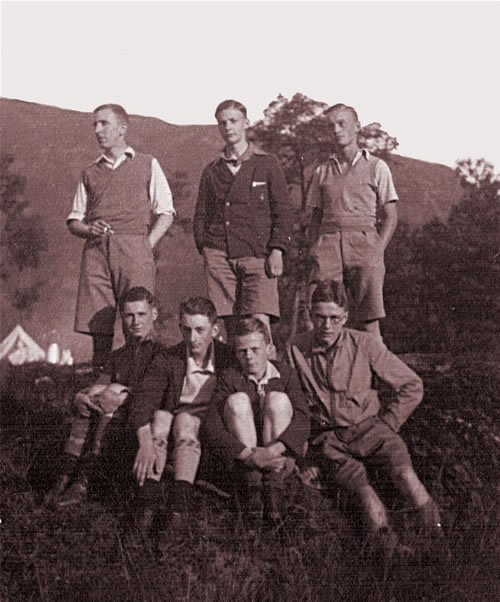
       
Neill (‘Reggie’) had an awkward manner but his penetrating intelligence and devotion to his task made many who might come to scoff remain to learn. His lessons were soon assembled and published in his admirable ‘Aids to Biology’, a miraculous alternative to ‘Stenhouse’. His writing style was precise; he was an admirer of H L Menchen and a favourite quotation was that some claim was ‘neat, plausible and wrong’.
       
The ‘Biology Sixth’ particularly appreciated the clear scientific approach and his enterprising new schemes. There were weekly excursions on bicycles to Hoar Cross to take measured samples of pond life; the counts of animals were correlated with records of pH and temperature. To keep the catch we constructed a series of aquaria with an aeration tower some ten feet high for the water circulation. Another ambitious construction provided the stage which could be erected in the Hall for dramatic performances (I recall that the generous lighting we organised demanded 30 amp wiring). Mr Davies and Mr Neill collaborated in writing and producing the shows.

Some remember that ‘Reggie’ Neal’s desk in the Biology lab stood on a platform. whcih no one was allowed to step on. If they did they were told in no uncertain terms “get off my quarter deck boy.”
       
Mr Neill was also responsible for taking groups of Grammar School pupils on field trips. One such excursion was a summer cycle-camping holiday to the Lake District. This photo shows him standing with C.H. May and Frank Shotton with (left to right) James Woolley, WMN, CM and John P. Bull seated.
 
Another outstanding trip was to the Port Erin Marine Biology station in the Isle of Man. What could be a more enjoyable way to study than to row round a sunny bay and pick up samples of Sea Urchins from the clear pebbly sea floor!

Another of Neill’s literary favourites was ‘The Hunting of the Snark’ and we vied with one another to find appropriate quotations for the various adventures on our journeys – there was never any doubt as to who the ‘Bellman’ was.
       
Reggie Neill left the school during the war years, being replaced as Biology master during his absence by teacher from Newhall called Connie Illsley. Mr Neill returned to the school after the war.

It seemed incongruous that RGN was knowledgeable about spiritualism; we never knew whether his claim to have an aunt who levitated was just a spoof, but he turned such matters to good advantage in his historical novel ‘The Witches of Pendleton’. After marrying late in life, he retired to his beloved Lake District where he continued with success his third career as a novelist.

His first novel under the name of Robert Neill was ‘Mist over Pendle’, published in 1951. The success of this led to other novels, including ‘Moon over Scorpio’. By the time of his last book, ‘The Devil’s Door’, being published in 1979, he had sixteen books published.
       
Robert Neill made good contribution to the life of Burton Grammar School and to the achievements of many of its pupils. Several, such as Dr J.P. Bull C.B.E, C.H. ‘Bert’ May, whose prize giving book can be found elsewhere on the website, and Archie Grain who tragically did not survive the War; also John Woolley, Research Chemist with ICI and expert on photography and caves. His brother Jim and Noel Perks who both became teachers and Frank Shotton an Agricultural Scientist all feel endebted to Mr Neill for his influence and teaching.