Menu Close

Staff Biographies

Biographies (click name to view):

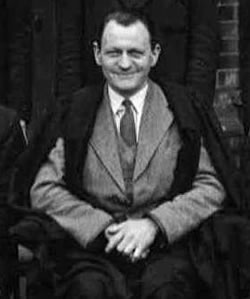
Arthur Cecil Brown

Burton Grammar School Master (Geography / History 1920-1960)

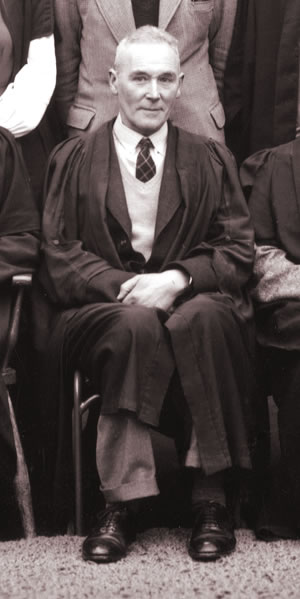
BrownCecil was born in Oxford, son of a watchmaker. He went to school in Oxford, and later worked in the library of St Edmunds College. Both he and his father were keen fishermen and cyclists. He cycled all over Oxfordshire and the Thames valley in the days of bumpy roads and mostly horse-drawn traffic.

In the war of 1914-8 he enlisted in the Queens Own Oxfordshire Hussars (aka queer objects on horses) and served in France and Belgium. The days of cavalry charges were over but horses were essential for moving armaments and supplies to the front and bringing back casualties in the atrocious conditions.

After four years of service in the war, in 1920, he took a post-war emergency degree at St. Catherine’s College, Oxford, which served students ordinarily resident in the town; he went on to train to be a teacher.

He took a post as history teacher at the BGS. He met and married Elsie Allen, daughter of the Borough Treasurer, Sidney Allen who had seven daughters at the High School and three sons at the Grammar.

Cecil was known to boys as Chas or Chazza. He stayed in the same job until 1960, along with Frank (Bill) Read, Jake Hammond, Nicholson, Dai Davies, Ron Illingworth – the long stayers. He taught mainly History and Geography up to School Cert – later GCE O-level, but on occasions he also taught English, French or RI.

Probably because of his ordinary degree, he rarely taught the A-stream and never the 6th form. He struggled to get the Bs and Cs to understand the world and get through their School Cert or O-levels. He was probably more interested in the kids and current affairs than in his subjects, though he saw these as essential background knowledge for understanding government and world affairs.

He was able to add colour to 20th century history by having lived through it. He would have remembered the death of Queen Victoria, if not her jubilee. He experienced the horror of WW1 as a private. He remembered the public mood and the newspaper reports during the general strike, the depression and the rise of fascism.

Because of his experiences in WW1 he was strongly in favour of the League of Nations and later the United Nations and he supported the Labour party. He was in trouble in the 30s when he clashed with Burton politicians and the local Tories tried to get him sacked for allegedly getting schoolboys to disrupt their public meetings. Fortunately they were wrong and they failed.

Tennis was his life-long sporting activity but he was an all-rounder, being a keen angler, a tireless walker, a cyclist and a camper. He was also a stout advocate of the League of Nations, the United Nations, UNESCO — and privately, a beekeeper, a gardener and a motorist. His motoring career began when he bought a second-hand car, and a colleague gave him an hour’s lesson on how to drive it; the next day, he drove it from Burton to Oxford, with the whole family on board!

At school he looked after the library and ran the International Relations Society, encouraging pupils to interest themselves in politics and world affairs. He was very suspicious of closed minds, received opinions and humbug and liked everyone to think things through properly. He was unimpressed by religious truth. Look at all these religions and sects claiming to have exclusive truth: they can’t all be right, but they could all be wrong.

In WW2 he was in the Home Guard and ARP and dug for victory with the rest. He kept chickens, ducks and rabbits and for several years kept bees. He was a keen angler and cunning tennis player.

In 1948 his pituitary gland stopped working and his joints started to grow. It was a worrying time but new drugs were found to bring the disease back under control. He was left with exceptionally large hands, which are remembered by some old boys who might have had their ears boxed.

He enjoyed his work, particularly helping his pupils develop from timid boys to almost respectable adults, and he continued working for two years beyond the retirement age. Retirement was devoted mostly to gardening, fishing and keeping up with friends and relations.

The Library was his hobby in school, for he was Librarian from 1926 to 1959. If Mr. Brown was wanted, the most likely place to find him was browsing in the library.

After retiring, Mr. Brown was still very much an active retired member of Staff and enjoyed to visit the School on numerous occasions to see how it was doing without him.

Cecil had three children: Bernard went on from BGS to Christ’s Hospital School. He won a scholarship to Balliol College Oxford but his studies were interrupted by war service in the far east. He was a career Civil Servant, sometime Chief Statistician at the Treasury. Audrey was Head Girl at the High School. She took a degree in French and taught French in various schools, including BGS for a short while. Graham went from BGS to Denstone College, thence to Jesus College, Cambridge to read Maths. He worked in computer software development and research and contributed to international standards in database and communications.

Brian Luckett

Burton Grammar School Master (Chemistry 1963 – 1975)

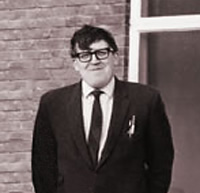
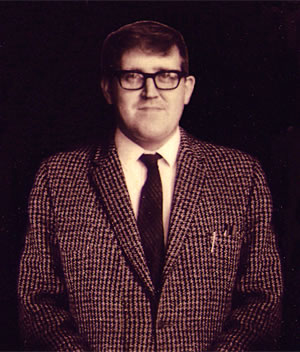
luckettBrian Luckett was born in 1940 in London, and evacuated first to Newquay, Cornwall and then in 1944 to the very contrasting Colne in North East Lancashire.  He was to remain in Lancashire and, during his teenage years, lived close to Pendle Hill where he attended Colne Grammar School. He was a very keen Burnley supporter at this time, always watching them play on a Saturday afternoon, often having played rugby in the morning at school. To this day, despite no longer being able to name any of the players, he finds himself habitually checking on Burnley’s results.

Brian had a very influential chemistry teacher, who made chemistry very interesting and exciting and he opted to take it at ‘A’ Level with a view to reading it at University. It was working in the textile mills of Colne during his school holidays that made him want to specifically read Textile Chemistry . In the noisy environment of clattering looms, spinning and carding machines, he became a very good lip reader which, he claims, helped him on numerous occasions in the classroom!

luckettBrian obtained a BSc (Tech) degree in Textile Chemistry at the University of Manchester Institute of Science and Technology. At this time, the textile industry was going through a crisis and he decided to do a one year Postgraduate Certificate in Education at St. Luke’s College, Exeter. He had little chance of making the college rugby team though with the likes of Don Rutherford and Mike Davis (both future England captains) securing places. It was a much higher standard than the rugby he had enjoyed at school and university. His main teaching practice was at the Technical High School in Torquay.

Mr Luckett had anticipated working in the south west but was attracted by a post at the Burton Grammar School in 1963 to replace the departing Dennis Grimsley which he applied for and was successfully appointed.

The Head of Chemistry was Norman Jones. Also teaching chemistry at the time was Gareth Woods with whom Brian found himself sharing a flat in Blackpool Street. Before long however, Mr Woods was to accept the post of Head of Chemistry at Soham Grammar School in Cambridgeshire meaning that Brian was promoted to second chemistry master and Mr C. Heighington was appointed third.

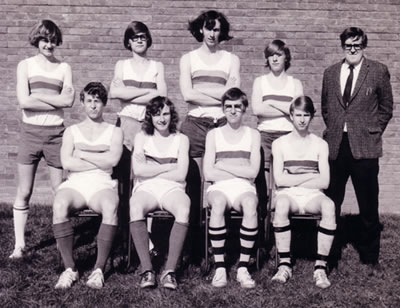
X-CountryShortly after starting, he was persuaded by Headmaster, Bill Gillion, to take charge of Cross Country. It was a burden he was never really happy with although he can recall many fond times with the likes of Peter Rose, Robert Barningham and David Van Der Merwe in the first eight. In particular, he remembers “a small spindly lad called Chadfield” being a superb terrier who joined the Royal Navy and was found to have TB. He could well have competed at international level had he been treated earlier.

He never actually ran round any of the courses, instead, he used to drive to the back of Newton Solney to shout support at the poor unfortunates (eminently more sensible). He even sympathised with those that took short cuts as he had done the same at his school, once falling in the canal. Brian was also happy to occasionally drive some of the chess team to away matches at other schools such as Bemrose, Derby School and Repton.

Brian recalls almost being expelled whilst in the 6th form for nearly setting fire to the school chemistry Lab!  Having read that if you wrapped some sodium peroxide in wet newspaper it would ignite, he and a friend tried it but with little effect. The teacher, Mr ‘Aldophous’ Smith, shortly came into the laboratory and they threw the paper under a desk close to a radiator. Part way through the lesson, flames suddenly appeared as the correct moisture content was achieved.

With this in mind, he smiles at some of the ‘unofficial chemical experiments’ by pupils at the Grammar School during his time: The banned carbylamine reaction, on putting the constituent reactants down various sinks around the lab, when they all met up in the main drain, the really awful smell was generated in the lower corridor; the manufacture of highly explosive nitrogen tri-iodide powder to be distributed around the school. The staff had to pretend to be cross but couldn’t help but smile.

Brian reflects on what current day health and safety inspectors would make of boys sitting on their stools on top of the benches to watch the practical demonstrations without a safety screen. At the same time, he feels that the complete sanitisation greatly diluted the excitement of the subject that had encouraged previous scholars to take up careers within the chemical industry.

In 1966, Brian married Shirley, the Secretary of the Girls High School, at All Saints Church. Michael Thompson a pupil at the Grammar School played the organ at their wedding. The thought of this leads him to again reflect on many aspects of his time at Burton Grammar School which would seem incredible in the light of today’s educational system but which may well have defined the ethos of the school at that time: How well he, and other members of staff, got on with the boys and their families; how most teachers lived fairly close to the school without any thoughts of being in any way harassed by any of the pupils. He is sure that the chance meeting of boys and parents out of school was very healthy for the discipline and behaviour of school life. To this day, some forty years later, the Luckett’s are still occasionally visited by pupils or their parents, such as Peter Rose’s mother. 

Like a number of schoolmasters, Brian also references the Burton Rugby Club as a bonding influence. Staff and pupils were given time off on numerous occasions to, for example, go and watch Burton play an Oxford University XV at Peel Croft, often featuring ex-pupils. It was also host to the Old Boys matches which kept the school’s rugby tradition alive.

On a couple of occasions, Mr Luckett tried to leave Burton Grammar School for higher posts in other schools but Bill Gillion, countered with the offer of a rise in the grading of his current post. He was never quite sure whether this was because of how highly the young staff were valued or whether the headmaster preferred the ‘devils he knew’.

In the early seventies he started the Wildlife Club on the request of pupils Beard and Eaton and, together with Colin Bagshaw, took boys on bird-watching trips to the Norfolk Broads, Slimbridge and other reserves – another “wouldn’t happen today”! ‘Plant a tree in 73’ was one of the catch phrases that helped the small group plant hundreds of trees at the RSPB bird reserve at Coombes Valley in North Staffordshire. To this day, he vows to one day go back to see how they have grown.

He left the school at the end of the final year of Burton Grammar School in 1975 after an offer by Jack Adams, who was a good friend of Norman Jones and the husband of Peggy Adams, head of Physics at the Girls High School, to be Head of Chemistry at Shelton Senior High School in Derby which he accepted. He had been offered the same post two years earlier but had been persuaded to stay.

recentBrian was to remain there for fourteen years, before transferring to Wilmorton Tertiary College in 1989. He finally retired from teaching in 1995, but  carried on marking ‘A’ Level Chemistry papers for  the Cambridge Board for a further six years.

He looks back at his twelve years at Burton Grammar School as being the happiest of his thirty-two years in teaching and has never regretted taking up the post. The Lucketts and Bagshaws remain good friends together with the once assistant secretary of Burton Grammar School who was largely responsible for his meeting his wife.
 
Brian enjoys an active retirement being very keen on reading naval fact and fiction, pottering on his allotment and snoozing in his shed, family history, toy and model making and, at the time of writing, is President of the Ashby Rotary Club.

Dennis Grimsley

Dennis Grimsley belongs to one of the small number of staff whose association with Burton Grammar School started as a pupil before later returning to the teaching staff.

Dennis was a pupil from 1942 to 1950. He enjoyed good success, being a prefect in 1948/9 before going on to become Head Boy.

Aside from school colours for Rugby, Cricket and Cross Country, Dennis played for Derbyshire Schools Under 19’s Rugby XV in 1948/49 and was team captain 1949/50. He was also winner of the S.J.Ife Memorial cup in 1950 for ‘Best all round sportsman’. In the same year, he also became Captain of Drake Champion in a year when Drake were crowned House Champions.

Dennis gained a place at Nottingham University. He gained a 2nd Class Honours Degree in Chemistry in 1953 and a Certificate in Education 1954 when he was also appointed Chairman of the Education Department.

Soon after qualifying, Dennis served his National Service Commission from 1954 to 56 with the Royal Air Force. He married in 1956, just prior to demobilisation.

His first teaching post was back at his own Burton Grammar School in 1956 as assistant chemistry master to Norman Jones. He was appointed President of the Old Boy’s Association for 1960/61.

In 1961, Dennis left Burton Grammar School to take up the post of Head of Chemistry at Brunts Grammar School, Mansfield, where he remained until 1970. Following this, he took the post of Deputy Headmaster at Biddulph Grammar School and was ‘Acting Headmaster’ during 1974 until, as part of a reorganisation, he was appointed Headmaster of Blythe Bridge High School. He remained here until 1988.

He was President of Biddulph Rotary Club 1978 – 79 and was appointed a magistrate in 1981 which he served until 2002.

GrimsleyAt various times, Dennis has been ‘Chairman of Probation Liaison Committee’; was ‘Chairman of Youth Panel of Leek’, then Staffordshire Moorlands and North Staffordshire. When this joined with Stoke-on-Trent, he became ‘Vice-Chairman of combined new North Staffordshire Youth Panel’.

GrimsleyDennis was appointed a ‘General Commissioner of Income Tax’ in 1993 and became ‘Chairman of the Leek Tax Commissioners’ in 2003, a post he held until his retirement in 2007.

…. to be continued …

Raymond Crowther

Burton Grammar School Master (Biology 1948-1973)

Raymond Crowther was educated at Heath Grammar School in Halifax. He qualified from here for a degree at University College, Durham but, during his time there, war broke out which meant that he was to join the RAF. During the war, he spent most of the time with the coastal command in Iceland. At the end of the war, he made the decision not to go back and complete his degree but rather, to complete teacher training.

He was appointed as Biology teacher at Burton Grammar School in 1948 and was to go on to complete over 25 years there. He was affectionately known as ‘Joey’, for which reason, I had always assumed that his name was Joseph. It was only in the preparation of this website that I was corrected to the fact that his name was Raymond which just didn’t seem to fit after all those years!

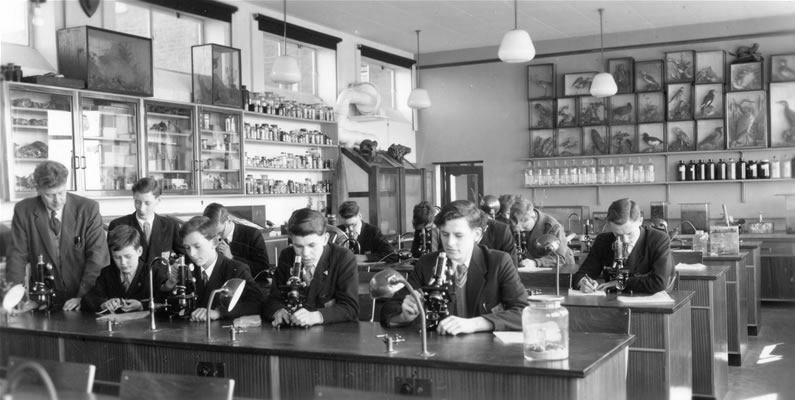
Raymond always had a strong interest in microbiology and in physiology. He had a contact at Birmingham University who supplied a whole range of bacterial cultures which were maintained in the small sanctum off the Biology laboratory at Bond Street. The Grammar School had what would nowadays be considered a quite frightening collection of pathogens. The marine tanks also had an interesting origin. Raymond sourced them from contacts at the Marine Biological Station in Plymouth who supplied carboys of seawater and the specimens of marine life – which were far from easy to keep thriving!

Michael Tanton was one of the first monitors for the Biology lab and remembers the mammoth task of operating the Roneo machine to produce the mountains of typed notes from the stencils he typed out on his portable typewriter. Michael was the first of a number of his students to go to Imperial College, London, to study Zoology, Applied Entomology and Parasitology.

Raymond’s enthusiasm for his subject was considerable. From somewhere he had acquired a dead dog, and decided that the skeleton would be an excellent teaching tool. The problem was, how to get rid of the flesh? The solution was to ‘let nature take its course’ by allowing natural bacteria and flies to do their job! The dog was ensheathed in chicken wire and suspended out of the lab window, more or less above the door into the cloakroom area and opposite the door to the woodwork room.

The next problem, after a week of so, was Mr Redfern the school janitor objecting strongly to maggots falling from above. A school monitor was despatched up a ladder to deposit the dog on the roof, out of site and out of mind. That is, until complaints from the staff room about the smell pervading the upper floor. At that point, discretion played the better part of valour, and the dog was brought down and ‘spirited away’.

After a stint in hospital, he married Mary, one of the nurses he met there and they moved to a house at the bottom of Ashby Road as their home.

He corresponded with many other educational biologists in schools and universities, including London, Oxford, Cambridge and Aberdeen, who held him in high regard. He was also on the national committee for the constant reform of the ‘A’ Level Biology syllabus to reflect the needs of the microbiology industry.

He established the Field Club by popular request and in 1950 took a group to the New Forest, where they camped on the edge of heathland and in sight of the Balmer Lawn Hotel at Brockenhurst. The trip down had been organized ahead in typical Raymond Crowther style, and to students the arrangements just seemed to happen with no regard for the much time and correspondence required by Mr Crowther to ensure that the trip was very successful.

The following year, 1951, the Field Club went to the Lake District and camped for 3 weeks near Watendlath Tarn, again by train and with much man-handling of equipment. In 1952 and 1953 Raymond found a different venue for the Field Club – Flatford Mill Field Centre. Different courses were attended in the two years. The first was on freshwater biology; the following next year was on estuarine biology. They were a valuable learning experience and we were able to make the most of the good weather in both summers. Best of all, they didn’t need to transport all that camping gear of previous years!

Significantly, almost all of the involved groups followed careers in one area or another of biology. Greater detail of these trips may be found in the School Trips section.

At the Winshill School, Mr Crowther always seemed to be a little detached from the rest of the staff, apparently preferring the solitude of the small side-room at the back of the biology laboratory to the staff room. His success as a teacher cannot, however, be denied and many of his pupils went on to start careers with degrees in such fields as microbiology, medicine and dentistry. He also very avidly corresponded with other biology teachers and had some influence on the content of ‘O’ Level biology papers.

He is probably best remembered by many he taught for ‘Percy’, his faithful baton. When the class was being rowdy, he used to stand an old table leg on the front bench, lay ‘Percy’ by its side and utter the Latin phrase “signum bellum sto” (Symbol of war stands) as a warning that the next offender would receive a lump on the cranium with a size proportional to level of misdemeanour; the worst offences being punished by a ‘Crunchie’. This was fairly effective but it is unlikely that the tradition would have survived today!

He was very interested in classical music and a fairly accomplished player on the piano, organ, violin and viola.

Unfortunately his wife Mary suffered from severe arthritis and Raymond relentlessly researched the latest cures and reliefs. In 1973, after a normal day at school, Mr Crowther died very suddenly and without any real prior warning, suffering a heart-attack while helping his wife from the bath. They did not have any children.

Ellick Ward

WardEllick Thomas Ward was born in 1908 at Bingley, Yorkshire, the eldest of seven children and the only one of the siblings to enjoy a university education. He attended Bingley Grammar school, doing particularly well in French, History and Geography, although Physics, especially the construction of wireless sets, had been a main interest for him. In the Upper Sixth he was Senior Prefect and Rugby Captain and was quoted as “one of the most determined Rugby Forwards that the school has had”.

In 1928 Ellick was awarded the Roberts Memorial Leaving Scholarship, tenable at Leeds University. After graduating with a B.A. at Leeds in 1931 he continued studying for a Diploma in Education which he obtained in the following year.

His spoken French was good, and in 1930 he had visited France to work alongside French students in the flooded regions near Montauban.

WardEllick’s first teaching posts were at Bedford and then Doncaster, where he taught French, Geography, Mathematics, English and P.T. Always involved in extra activities, he was assistant scout master of one of the two scout troops at Doncaster, and Group scout master for Doncaster parish church. An unassuming, yet strong character, he is reported to have been much trusted and admired by the boys. At this stage he took the teacher’s certificate of the amateur Swimming Association and the Certificate for instructors in Air Raid Precautions.

During the final years of the war, Ellick was headmaster of the village school at Natland, Westmorland, moving on from there to Burton Grammar School in 1944 to teach French.

At Burton he was able not only to pass on his love of the French language and French literature, but also to continue involvement with the School Scout Troop including taking boys to camp. He was also joint organiser during the war years of Harvest Camps. His swimming qualifications enabled him to give valuable assistance in the swimming instruction – in 1948 fifty boys each year were being taught to swim. His other enthusiasms were also communicated to others – he organised a successful stamp club, and later a radio society – the school had its own radio amateur call-sign. As careers master he took a special interest in building local links to employers in order to help the careers of boys who did not intend to apply for admission to universities.

He was associated from its formation with the local branch of the Alliance francaise, and was concerned with French exchanges. For several years he, Norman Jones and others escorted parties of boys to Belgium where they stayed at the Hotel Venise du Nord in Bruges and enthusiastically explored the area.

WardEllick retired in 1973, glad that he was not involved in the change over to a comprehensive school (even the move from the town centre to Winshill he had scorned as a move to the ‘biscuit factory’).

In retirement he enjoyed extensive travel, especially to Greece and to Egypt, lands which as a boy he had yearned to visit. As a radio amateur he continued to converse with contacts all over the world. A year after the death of his wife, Kitty, he married Peggy Bostock, a former teacher from Byrkley Street School and continued to live life with enthusiasm until his sudden death in 1998. Ellick is survived by his daughter, Christine, a former pupil of Burton Girls’ High School, and by his two grandchildren, Marion and Edmund.

…. to be continued …

Geoffrey Henton

Burton Grammar School Master (Geography 1953-1984, Deputy Headmaster 1968-1984)

HentonGeoffrey was born in Radcliffe-on-Trent, Nottinghamshire in 1928. He was educated at West Bridgford Grammar School from which he gained a place at Hull University College to take a London BA Honors in Geography from 1947 to 1950.

After graduating, Geoff continued at Hull for a further year to complete his teacher training having already decided that he wanted to pursue a profession in teaching. During this period, he met a girl in fencing classes. Daphne, who was also studying at Hull, was from Stapenhill, Burton-on-Trent. In 1951, they were married but almost straight afterwards, Geoff was to start his two years National Service with the RAF where he served in UK and in Berlin.

Henton RAFIn 1953, Geoff and his now wife decided that they would like to move back to the Midlands somewhere near Burton or Nottingham.

In the same year, Mr Pitchford the Headmaster at Burton Grammar School, then at Bond Street, was taken ill and George Cooper, the maths teacher, was to take on the role of acting Headmaster until Mr Pitchford had recovered. This left a temporary vacancy for a maths teacher. Although ideally looking to teach geography, Geoff applied for the post and was successfully appointed. As luck would have it, during this brief period, the geography teacher announced that he wanted to leave the teaching profession and that he would like to leave his post at the end of the term.

HentonHaving been pleased with Geoff’s performance, he was a natural successor so at the start of the following term, Mr Pitchford returned, Mr Cooper resumed to teach maths and Geoff Henton was permanently appointed as geography teacher. All could not have worked out better!

Geoffrey was to hold this post from 1954 to 1968 which covered the period of Bond Street School relocating to the ‘new’ Burton Grammar School in Winshill. During this period, he was also very active outside of school hours and happy to assist with rugby and cricket where he was involved with the school teams and acted as referee and umpire. Eventually, he was on the selection board for Staffordshire and Midlands rugby.

HentonIn 1968, George Cooper retired as Deputy Headmaster. At this time, Geoffrey was still second geography teacher under Ron Illingworth as Head of Geography. Harry Smith had not too long earlier returned to the Grammar School to take over the maths department. Although thought of as being the most likely candidate, Harry had made it plain that he had no interest in such a position wanting instead, to concentrate on mathematics and the open scholarships which were his passion. Speculation was that Mr Hugh Wood, Head of the languages department, would be likely to succeed above other heads of department. Nonetheless, Geoffrey decided to formally apply and was interviewed.

Geoff clearly made a very strong impression. He was young, very committed and had an excellent reputation for maintaining discipline whilst achieving high results and emerged the victor. A few expressed surprise at his appointment but no-one could deny that he very quickly established himself as a very able and successful ‘second in command’. He also continued to teach geography.

During this period, his son David became Burton Grammar School Head Boy. Each year, there was a football match between the prefects and staff. For the only time in the game’s history, two opposing teams were captained by father and son.

HentonIn 1973, William Gillion was to retire as Headmaster in the middle of the year due to external pressures and Geoffrey was appointed acting Headmaster for the remainder of the year until Brian Harris was instated, having been moved from Horninglow Secondary Modern School to oversee the ‘smooth’ transition from Grammar School to Comprehensive. At this point, Geoff reverted to Deputy Headmaster for what was probably going to be the most disruptive period in the school’s history. Geoffrey earned much respect in this period for his strong focus on making sure that the now mixed school students got the best possible education out of the situation as it now was without getting drawn into the politics of either side.

HentonHe continued as an effective Deputy Head and geography teacher until he was forced to take early retirement in 1984 due to poor health.

Post-retirement, Geoff engaged himself in a lot of charity fund-raising activities, most particularly for Oxfam for whom he became Chairman of support and fund-raising. This continued while he was wheelchair bound until 1988, when he became paraplegic.

He finally passed away in 1989 and was survived by his wife Daphne, two daughters Val and Tricia, and son David.

Val B.A, M.A (Applied Linguistics) became Head of General Education Programmes for Higher Colleges in the United Arab Emirates. Tricia B.A. (Music), worked with the London Symphony Orchestra before moving to Australia and joining the Australian Chamber Orchestra as Operations Manger.

David achieved B.Sc Hons. first class (Civil Engineering) at Imperial College, London and spent twelve years working in Kenya before much travelling and finally setting in New Zealand where he started an International Communications Training Company.

Sadly, Geoffrey only knew two of his seven grandchildren.

George Cooper

In 1915, while the First World War was raging, George Herbert Cooper joined Burton Grammar School as one of a small number of Scholarship boys who had performed sufficiently well in an application test to avoid having to pay the then relatively hefty fees.

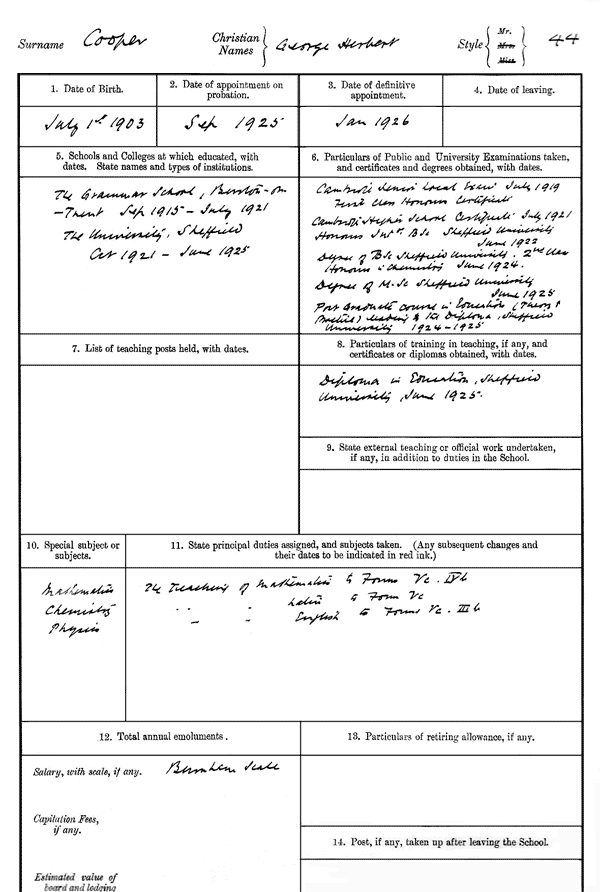
He performed very well at the school and was known for being methodically hard working which awarded him excellent examination results. After completing his Higher School Certificates in the sixth form, he left in 1921 for a place at Sheffield University to read Chemistry. In 1924, he gained a B.Sc and went on to take an M.Sc and Diploma in Education, again, both at Sheffield University.

George was extremely pleased at being able to secure a teaching post back at Burton Grammar School. He was appointed by the headmaster of the time, R.T.Robinson, who was very familiar with him having been the headmaster there for the whole of his time there as a pupil. I think even Mr Cooper would have been amazed to know at the time that he would go on to spend the next 42 years at the school in a career that would span no less than seven different headmasters. After a short probationary period from September 1925, he was formally appointed in January 1926. Despite his main speciality being Chemistry, staff requirements required him to initially teach a combination of Mathematics, Latin and English. As the teaching staff grew, his sole teaching subject became Maths.

George was interested in Drama whilst a pupil and, after the founding of the Burton Grammar School Dramatics Society in 1920, he appeared as one of the cast of its very first production, ‘Jedbury Junior’, where he played ‘Whimper’, manservant to the Jedburys. On his return as a master, he keenly became involved again and became assistant director to Mr E.C. Nicholson, and later took over the business management of the society as well as taking on a number of roles in its productions over the years.

Mr Cooper became known as ‘Black Hawk’ because of his stooped demeanour and rather jerky walk, usually in his robes, that characterized him. In the transition from the Bond Street to Winshill schools, for some reason, he instead became known as ‘Judder’.

In 1950, George became ‘Second Master’ to Horace Pitchford, qualifying by virtue of intimate and long experience of the running of the School. He was hold this position until his retirement some 18 years later whereupon, Geoffrey Henton took over and the post was changed to ‘Deputy Headmaster’.

Although still a member of staff, George was appointed President of the Old Boys’ Association for 1952/3.

When Bill Gillion, a Cambridge Graduate of Mathematics and strong advocate of academic excellence, joined the school as Headmaster, he had plans of improving academic success of the most talented students and, in particular, to prepare them for scholarships for Oxford, Cambridge and other Universities of Excellence. It was his opinion that the Mathematics Department at the school, headed by a methodical but not particularly dynamic or progressive thinking George Cooper, did not offer sufficient provision so he took the tough decision in 1958 to re-appoint Harry ‘Brab’ Smith to take over. George was to retain a position as a Maths teacher to the lower forms but also retained the position of ‘Second Master’.

Outside of the school, George was very involved with the Methodist Church where, among other things, he was organist. He was also an enthusiastic member of the Burton Historical and Archaeological Society.

George H. Cooper lived for Burton Grammar School. He was rather unobtrusive meaning that much of his effect on the School went largely unnoticed. He worked quietly away without getting or seeking much acknowledgement. After his eventual retirement in 1968, he maintained his association with the School through his continued membership of the Old Boys’ Association.

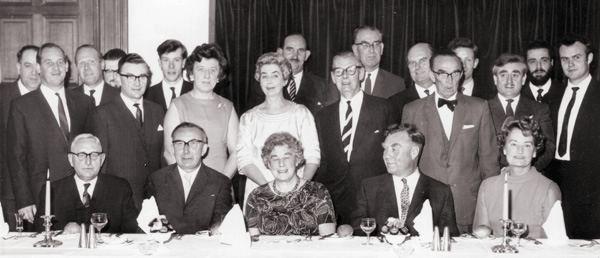
Retirement Dinner, Newton Park Hotel 1969


Standing: Percy Barratt, Geoff Henton, Jack Playll, Robin Langton, Hugh Wood, Richard Inwood, Mrs. Adams, Mrs. Read, Harry Smith, Frank Read, Jack Adams, K.T. Harris, David Davies, David Shrubbs, Norman Roe, John Redmond, Alan White
Seated: Horace Pitchford, George Cooper, Mrs. Cooper, Bill Gillion, Frances Gillion

Entry in Staff Book

Harry Smith

Burton Grammar School Master (Mathematics 1949-1953, 1958-1979)
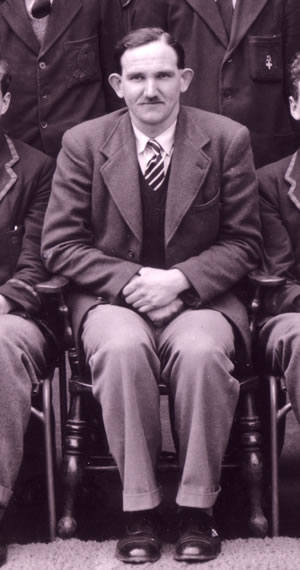
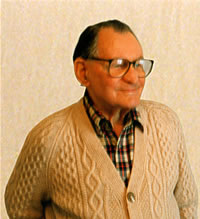
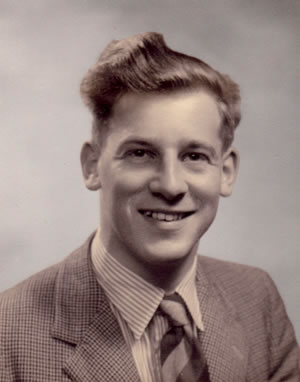
smith1.jpgHarry Smith, affectionately known as ‘Brab’, was born in 1923 in Taunton, Somerset. His Grandfather was the pioneering founder of the Ramblers Autobus company which was to establish routes throughout the West Country. Harry’s father eventually took over the running of the company and they had sufficient means to send Harry to the well esteemed Taunton Public School. To this day, Harry can clearly remember the maths teacher, Mr John Evans, who was to have the strong influence on his life that Harry was himself going to eventually have on so many others.

At the outset of the war, all of the company’s buses were ‘requisitioned’ for the war effort. In 1940, Harry had been due to commence at Bristol University but instead, found himself as a private soldier in the Gloucestershire regiment.

Harry still managed to complete some higher Maths education but in 1941 was transferred to the Royal Artillery and, with the 21st Anti-Tank Regiment, saw some very active service in North Africa and later in Italy. On one occasion, he was subject to such heavy bombardment that he suffered from shell-shock and was found with blood running from his ears. He was to lose most of the hearing on his left side which most Grammar School pupils would have been aware of but without due thought.
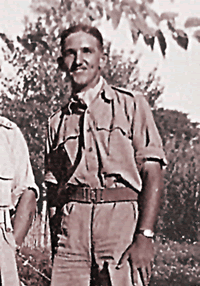
smith armyTowards the end of the war in 1945, Harry was made an Educational Officer and sent to Perugia College in Italy to re-educate troop in preparation for their return to normal life. By sheer co-incidence, he found himself teaching alongside his old Chemistry master from Taunton Public School.

By now a Captain, he was later sent to Austria where he was involved with the re-alignment of National borders. Addressing locals in Austria, Harry asked for someone to translate. An attractive girl, Helen, was to reluctantly volunteer if he spoke slowly. Not long afterwards, she became his wife!

At the end of the war, Harry was deemed DOV (Deferred as Operationally Vital) and was prevented from returning home, missed his London University place. Taking a teaching certificate in the interim, he was somehow able to later catch up and complete the three year degree in two years.

Hearing about a post at Burton Grammar School from his lecturer in 1949, Harry applied and was appointed by the then headmaster at Bond Street Grammar School, Mr Moodey. His remit was not only to teach his main forte of mathematics, but to also teach Physics and Chemistry. Soon after starting, Harry also found himself in charge of School Rugby. This was in parallel to Norman Jones being in charge of Athletics. Victor Roebuck was soon to join the school as Head of Physical Education but, although also a keen rugby player, his weekend interests were with Burton Rugby club. He was also a Captain with the school’s Army Cadet Corps. along with Major D. Davies. 
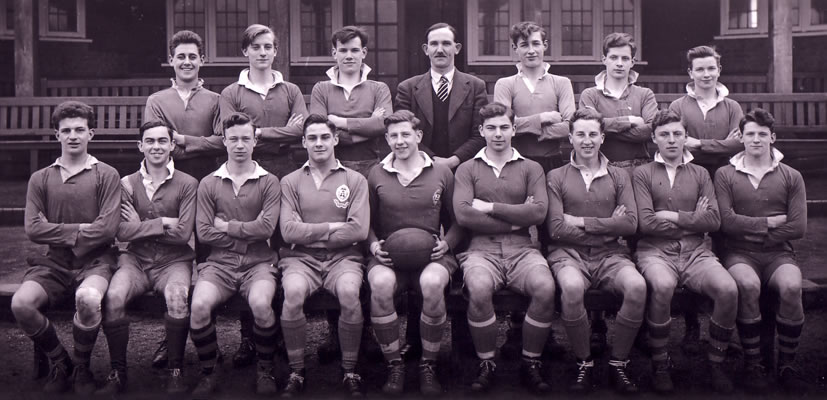
RugbyHarry put a great deal of time and effort into this and spent his Saturday mornings on the school rugby field. He was slightly perturbed to discover that Norman Jones received an additional allowance for his running of the Athletics whereas he received nothing. He took up the issue with the Headmaster, Mr Herbert (Horace) Pitchford, who had been appointed to replace Mr Moodey after is tragic recent death. Harry was declined which led to a feeling of resentment for which the school would pay dearly.

In 1953, disgruntled, Harry applied for a vacancy at Derby Technical College in the Department of Mathematics where he was enthusiastically appointed. Harry enjoyed his time there because, being a college of further education, there was a link to local industry which led him to involvement with ‘real world’ mathematical applications with companies such as Midland Rail and Rolls Royce, both based in Derby. He was to stay there for six years during which time, Bond Street School was closed to be replaced by the ‘new’ school in Winshill.
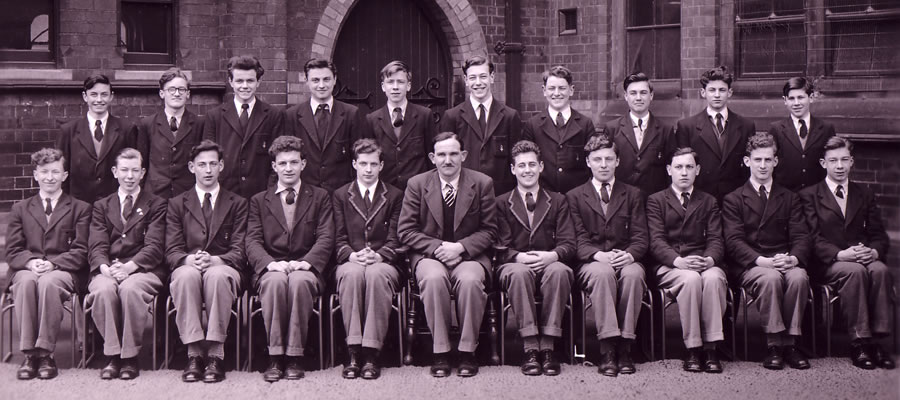
FormShortly after the Winshill school was opened, William Gillion was appointed as Headmaster. Mr Gillion, himself a Cambridge Graduate of Mathematics, was a strong advocate of academic excellence and felt that the Mathematics Department at the school, then headed by George Cooper, did not offer provision for the most talented students. He was aware of Harry Smith and had received numerous accounts that he should never have been allowed to leave. So, in 1958, he wrote to Harry asking if we would consider taking over as Head of Mathematics and to run the Open Scholarships, which went beyond ‘A’ Level to prepare the most gifted students for places at Oxford, Cambridge and other Universities of Excellence.

The latter proved sufficient enticement to attract Harry back so he took up the post; George Cooper was to retain a position as a Maths teacher as well as Deputy Headmaster.

Harry also worked for the Welsh Joint Education Committee for 40 years from 1957 during which time, he composed a new ‘Ordinary Alternative’ maths paper every year which was somewhere between ‘O’ level and ‘A’ level. This entailed several trips a year to Cardiff. He was thought of with some affection and on the occasion of him arriving there after 40 years service, they had prepared a special ‘maths’ cake with forty candles on.
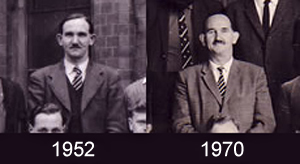
smithsIn 1960, Harry helped Bill Gillion to inaugurated a new form 5X to allow the most gifted pupils of form 3A to jump a year so that they would be able to study for Oxbridge entrance exams in their Upper Sixth without having to spend an addition year there. This proved to be tremendously successful and in their out-take year, the class achieved a record number of Oxbridge places, including Scholarships and Exhibitions, actually out-performing Repton Public School!

Sadly there was strong pressure, both internal and external, to look after the lesser able pupils rather than the brightest so the exercise was never repeated. Harry and other of the school’s most senior teachers saw this as the “start of the rot”.

With a degree of frustration, Harry continued at the Grammar School for a further eighteen years. During this time, he moved house from Scalpcliff Road to Repton and, co-incidentally bought the house from Mr Leech, headmaster of Dovecliff Grammar School and a good friend of William Gillion.

Very tragically, in 1971, his wife Helen, who taught German at the the Technical College and Girl’s High School, was killed in a car accident. He was to mourn for over seven years, unfairly blaming himself, before eventually meeting Diane Bates, an English teacher at the Girl’s High School in 1978 and she became his second wife.
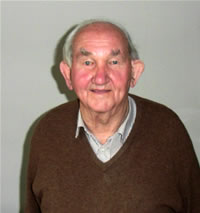
smith_now.jpgHarry’s time at the Grammar School also included the period where it was to be abolished in favour of becoming Abbot Beyne comprehensive school which led to much greater frustration. Harry himself sees this as “one of the greatest howlers the government has ever made”. His pleas for early retirement were declined so he was to continue at Abbot Beyne for a further three years by which time, he felt that we couldn’t have stood it for a moment longer.

Harry’s son, Michael, was also educated at Burton Grammar School until 1969 went to Leeds University and is a very accomplished linguist.

Herbert Pitchford

Pitchford Herbert Harrington Pitchford, better known to all as ‘Horace’, was educated at Adams Grammar School in Newport, Shropshire. From here, he was successful in gaining a place at Saint Catherine’s College, Cambridge where he read Geography and History. During his time there, he also gained his college colours for football and represented the college for athletics.

On completion and deciding to pursue a teaching career, in 1922, he became master at Thetford Grammar School in Norfolk. He remained there for four years before being successfully appointed as Senior History and Geography Master at Burton Grammar in 1926.

PitchfordAt this time, the school was lacking in facilities and equipment, even by the standards of the day, but Mr Pitchford was to soon make his presence felt not only in the classroom but also on the playing fields and in the choir. He gained a strong reputation for being able to communicate the knowledge of his subjects to his pupils, many of whom enjoyed good results.

He was responsible for building up an extensive reference library for the sixth form which enjoyed an increased success and many of them went on to achieve high academic and political success. He also instilled an interest in local history in his pupils and took it upon himself to arrange a number of visits to sites of historic interest which was fairly innovative at the time.

PitchfordFor some years, he was Secretary of the Burton and South Derbyshire Historical Society where again, he had a very positive influence and persuaded a number of significant speakers to provide lectures. Herbert also served a term as President of the Burton-upon-Trent Natural History and Archaeological Society where he again used his abilities to arrange a number of excursions for members.
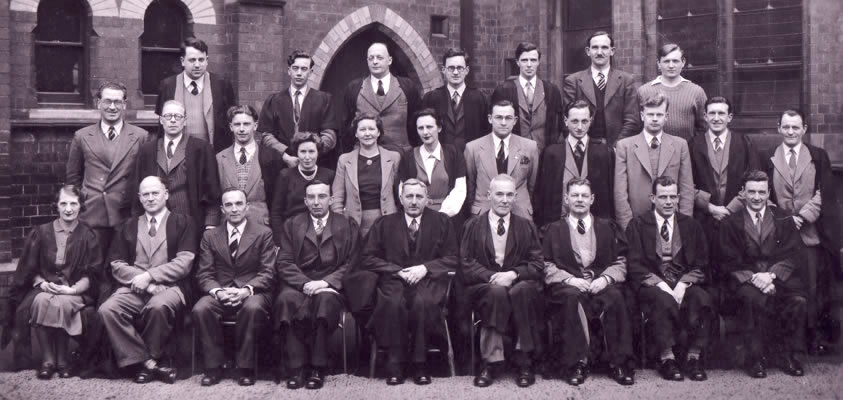
During World War II, he became Secretary of the Committee of No. 351 Squadron of the Air Training Corps.

PitchfordOn the retirement of Mr T.W.Parkin in 1946, Horace took over as Senior Master and in 1950, having now spent twenty-four very productive years the school, he was appointed to replace Harold Moodey as Headmaster after his very tragic suicide.
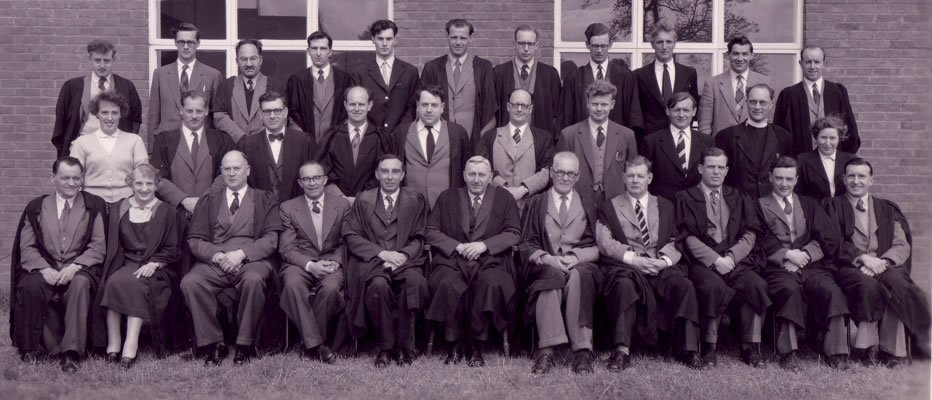
This represented a marked career change for Mr Pitchford as his responsibilities now became largely administrative rather than teaching. In 1952, plans for the new Grammar School in Winshill were finally accepted and a large proportion of his time was taken up with the preparatory work for the new school. Horace was still Headmaster when the time came to transfer from Bond Street to Winshill which he saw as a great opportunity for the academic and sporting expansion of the school.

PitchfordHorace Pitchford finally retired in 1958 after thirty-two years at the school but this was not to be end of his association with it. Post-retirement, he became a co-opted member of the Burton Education Committee where he did everything possible to further the interest of the school, as well as education in the town in general. He was also a staunch of the Old Boy’s Society and in 1959, he became President following which, he was voted a permanent member of its committee.

Outside of the school, Horace was an ardent churchman and was influential in the activities of Burton Parish Church. Extremely conscientious and hard-working in his many capacities, there can be no doubt that he is one of the school’s most important characters.