
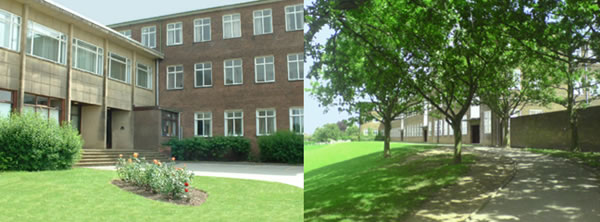
Bond Street school had become hopelessly inadequate after its 80 years of usage. It was in fact, already experiencing difficulties before the outbreak of the first world war.
In 1918, 1931 and 1938, plans for a new school had looked close to coming to fruition but had eventually fallen through. A new school might have succeeded earlier had it not been for the outbreak of the second world war shortly afterwards.
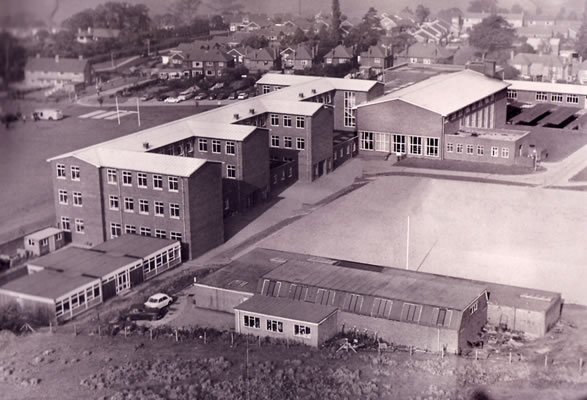
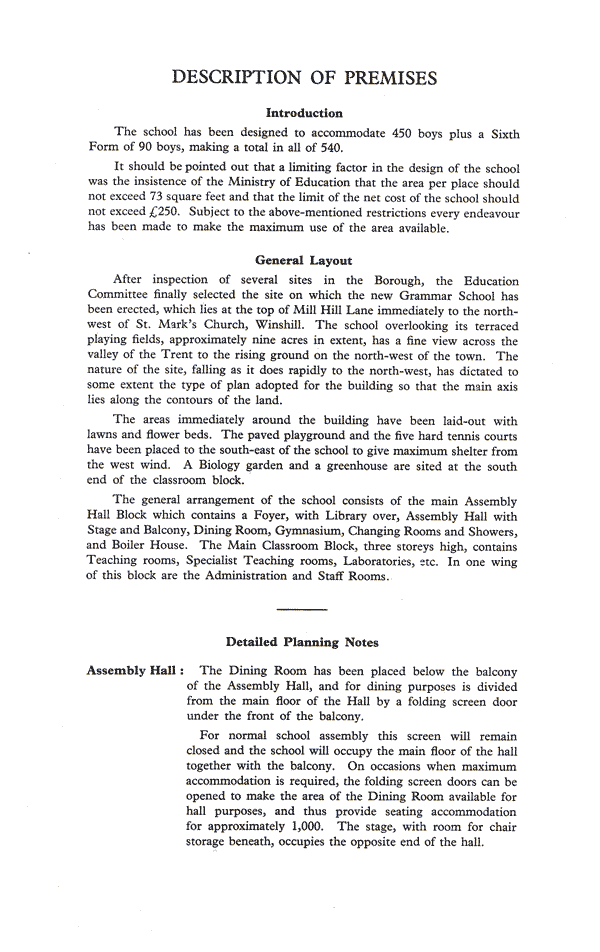
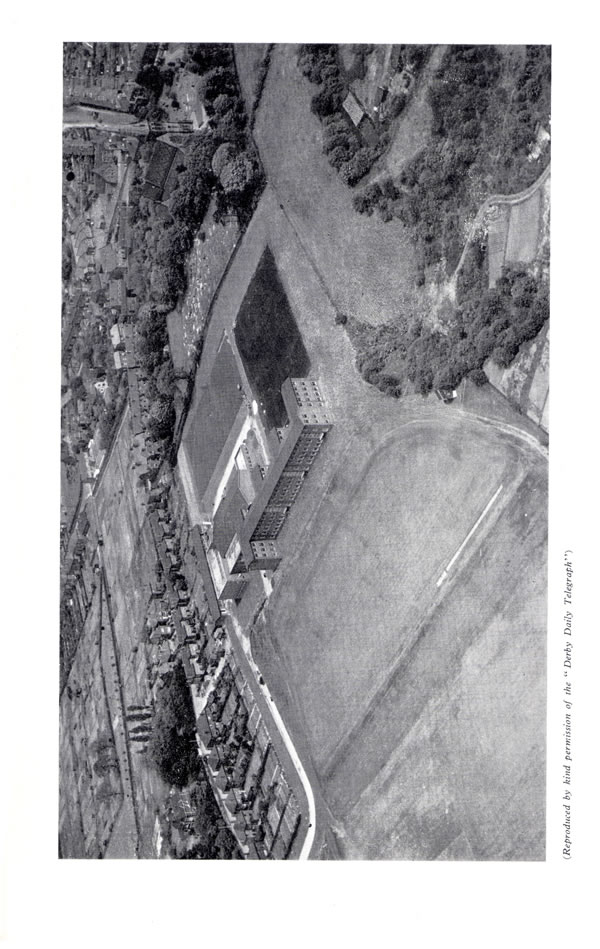
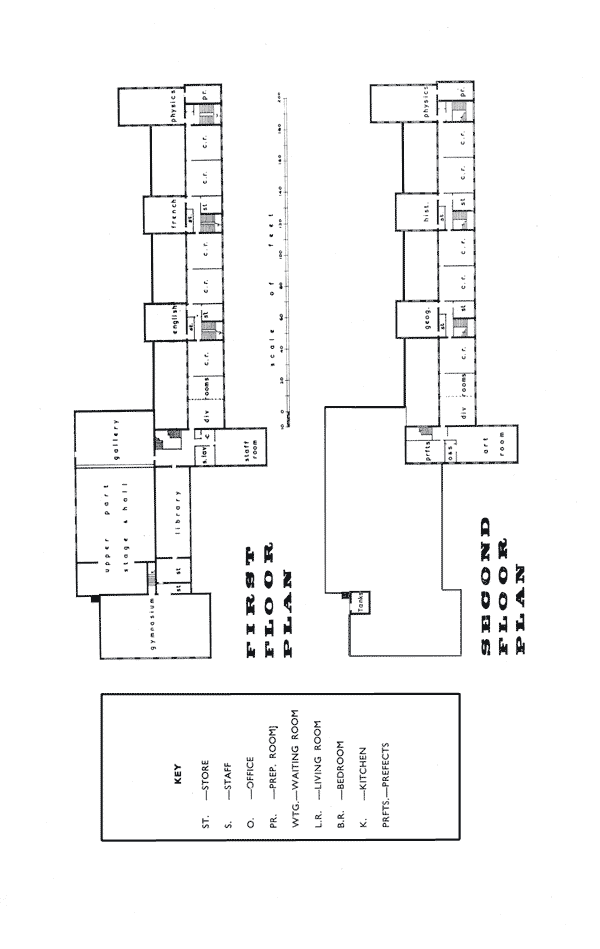
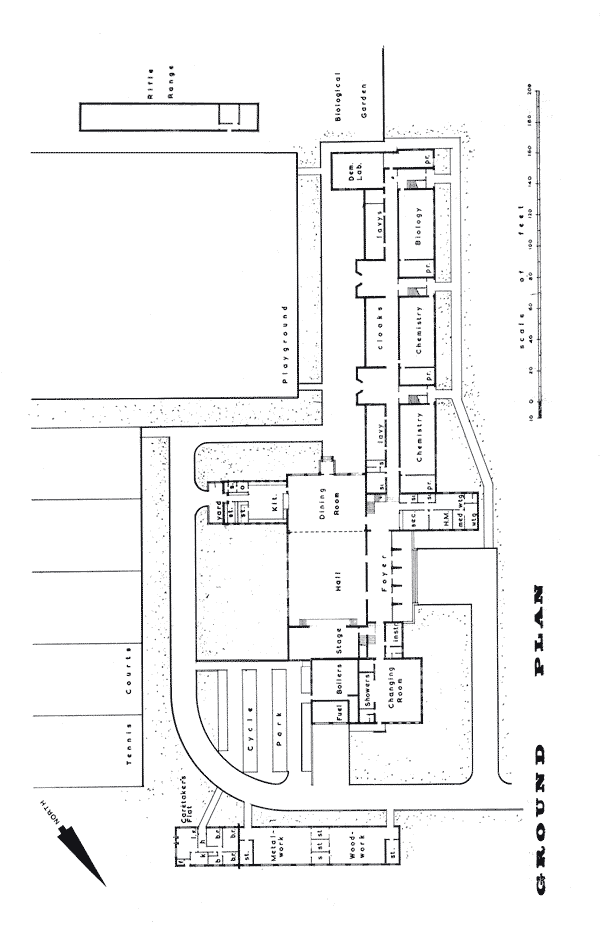
Finally, in 1952, plans for a new school were accepted. A deal was worked out to exchange the land currently belonging to the school for a new four acre site in Winshill. Final plans were completed on time for March 31st 1953. By 1955, building was very well on the way and it was expected that occupancy of the new school would begin after the school holidays in September, 1956. The school buildings would belong to the Governors, chaired by Mrs Evershed; all equipment would belong to the Town.
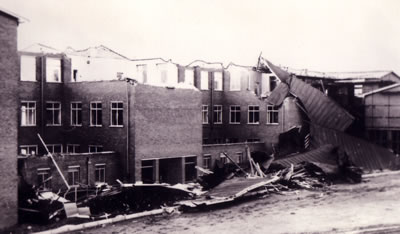 On February 29th 1956 however, disaster struck. The exposed site on the top of a hill had not been glazed, particularly the large staircases, and a freak storm with almost hurricane strength winds tore the entire roof off the school and destroyed supporting walls and sections of the building. This proved to be disastrous and was to put back the opening of the school for a full twelve months.
The final cost of the building, not including any furniture or equipment, was a little over budget at £192,744 4s. 4d. It was opened in 1957 by Lord Evershed.
Aside from the main school, a new ATC headquarters complete with rifle range was built, assisted by a grant from the War Department, remembering that this was not that long after the war, together with a scout hut. In 1962, a Sports Pavilion was added together with a playing field extension and running track in substitution for the old pavilion and playing field in Lichfield Street close to the old school.
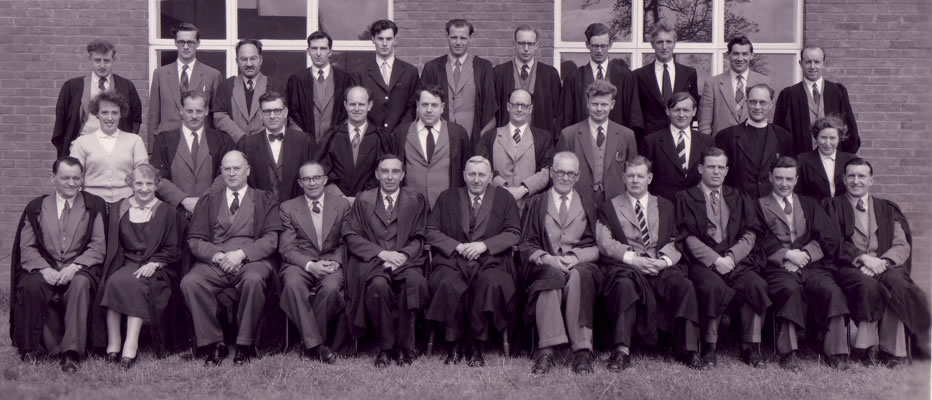
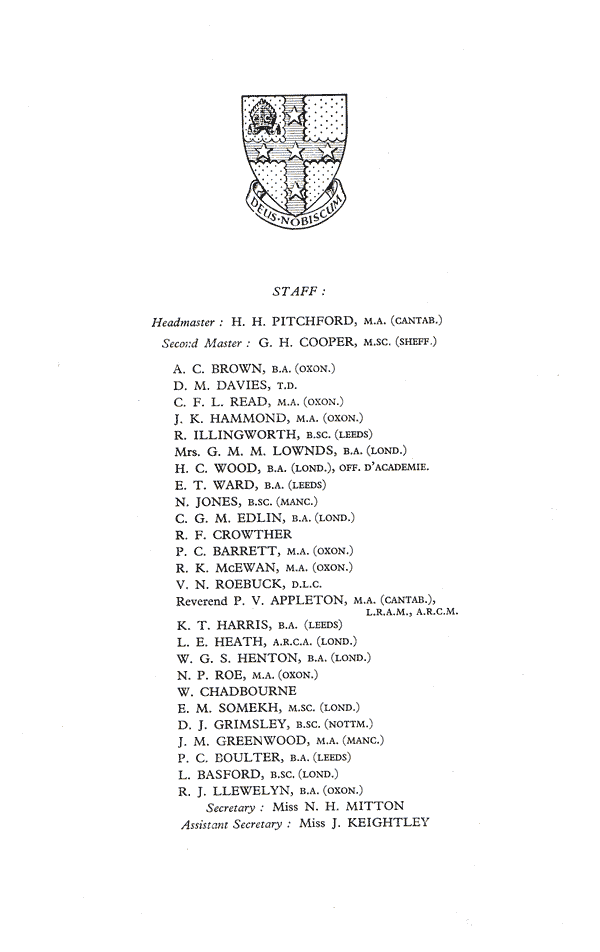
The school was designed to accommodate 540 pupils. It was allocated a staff of 28 including a Headmaster and Deputy. The Headmaster at the time of opening was Herbert Pitchford, better known as Horace, who had been headmaster at Bond Street Grammar School since 1950 but was soon to retire to be replaced by William Gillion. The majority of the staff also transferred from Bond Street; it was slightly extended in the first year.
By 1966, despite the new, large Dovecliff Grammar School now also serving Burton, the school was struggling for space with now over 600 pupils. In 1967, a new three classroom block was built which included a Technical Drawing room, a Mathematics room and an expensively equipped Language Laboratory overseen by Hugh Wood.
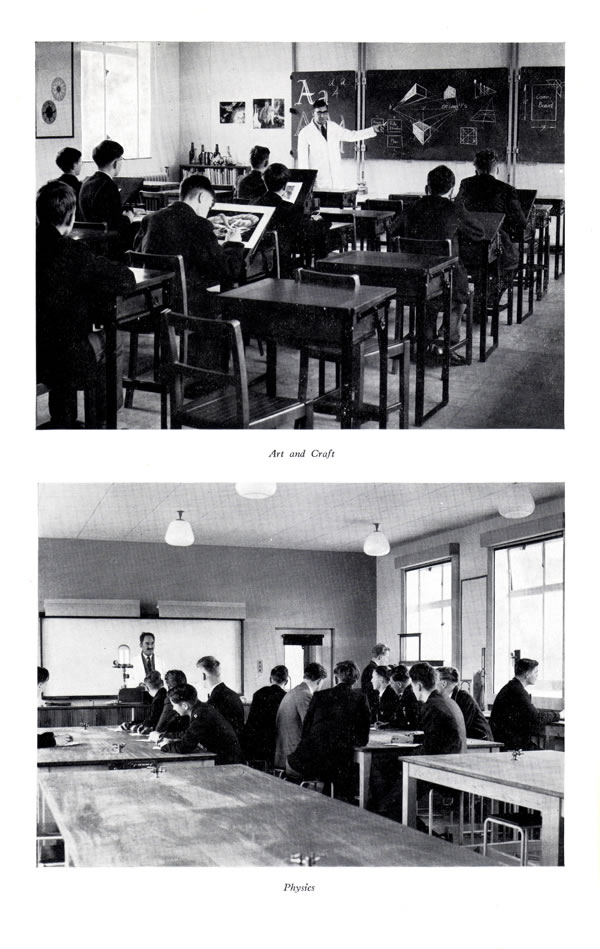
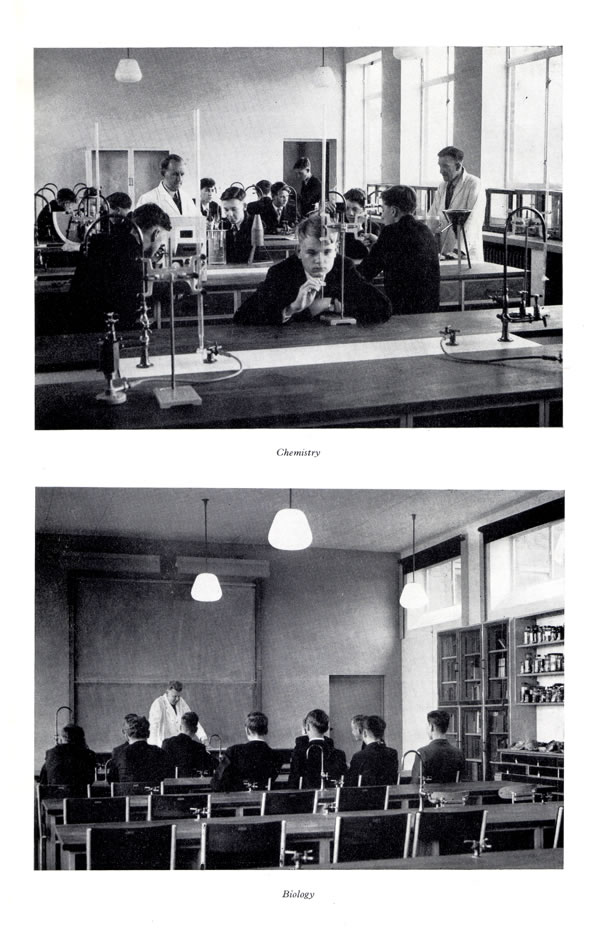
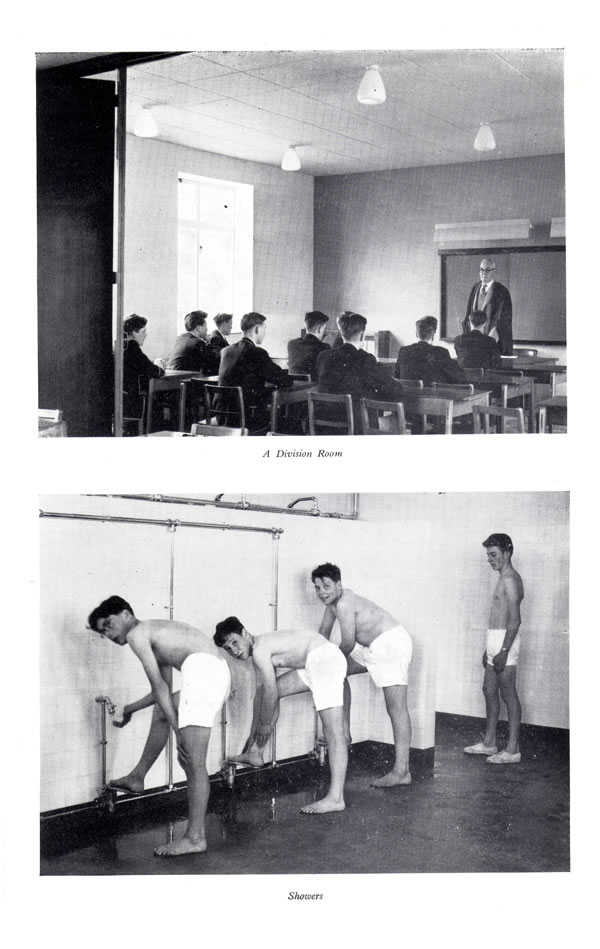
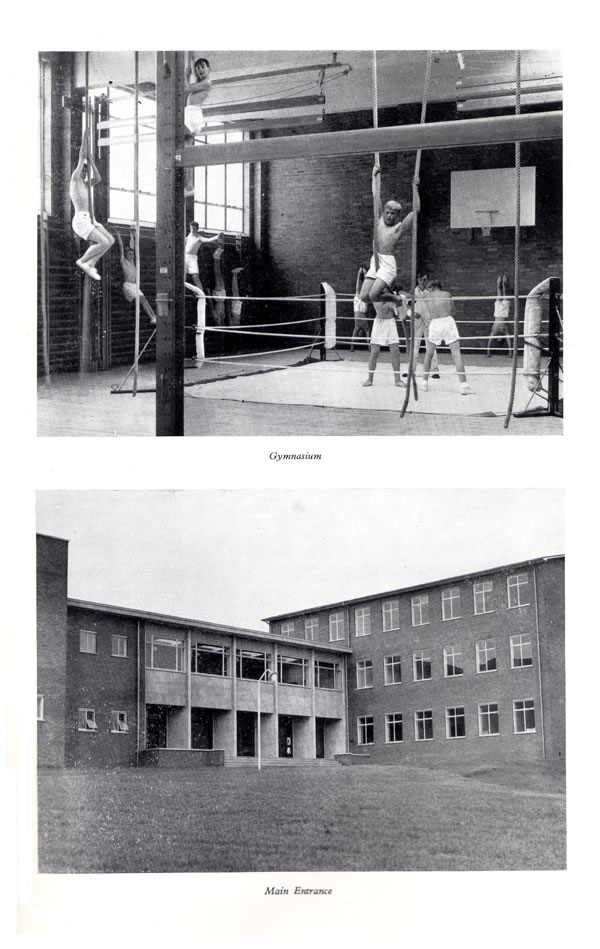
These pictures are taken in the first year of the ‘new’ Burton Grammar School in Winshill.
Art Room – with ‘Chippy’ Heath trying to look busy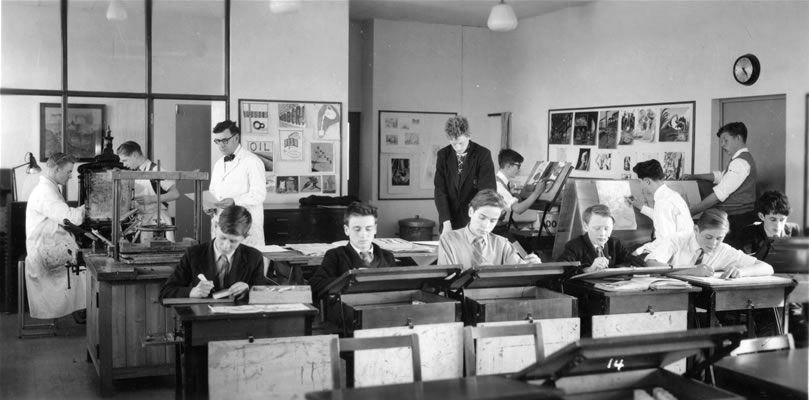
Woodwork Workshop – with ‘Taffy’ Davies managing to keep out of frame 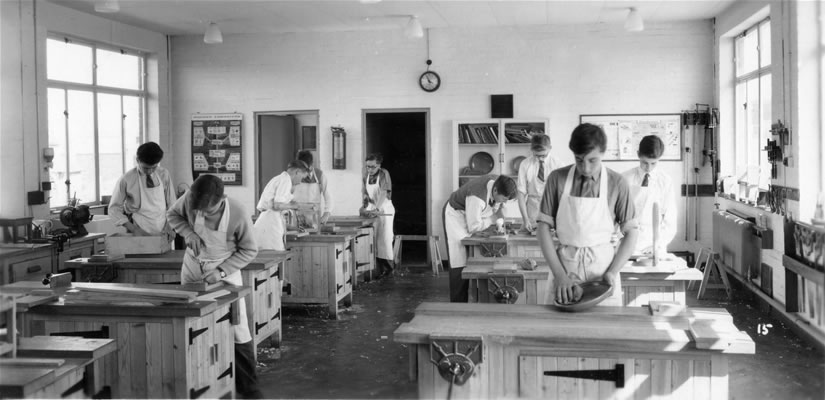
Senior Physics Lab – with Ezra Somekh, sadly just before my time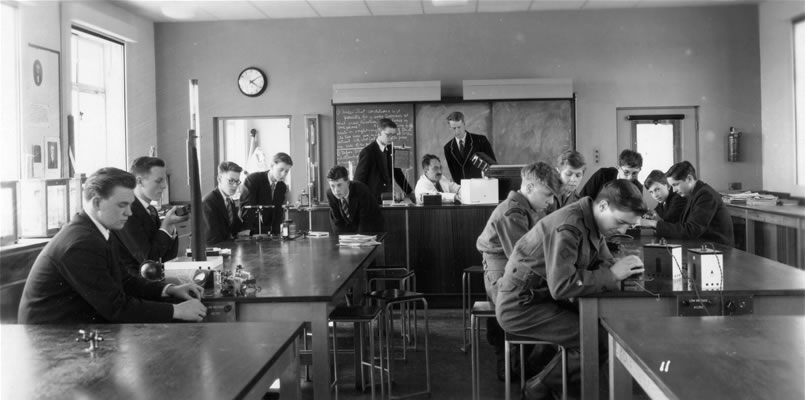
Metalwork Workshop – under ‘Tinman’ Andrew watchful eye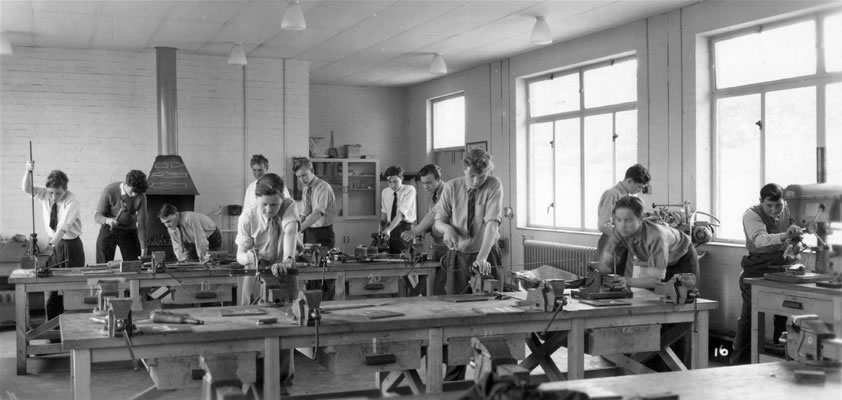
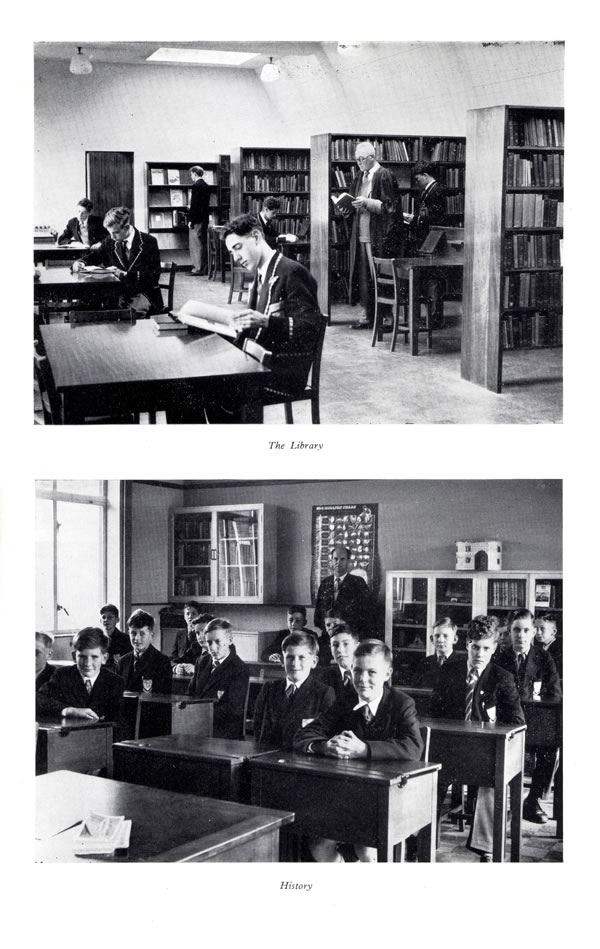
Library – not posed… honestly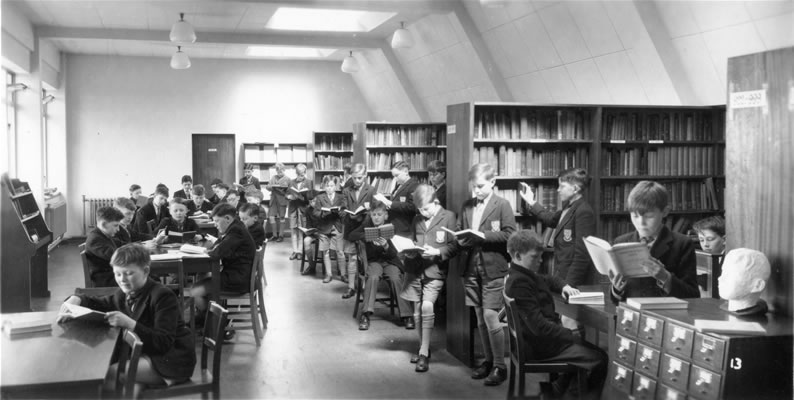
Dining Hall – with everyone hoping that the photographer will fall off his chair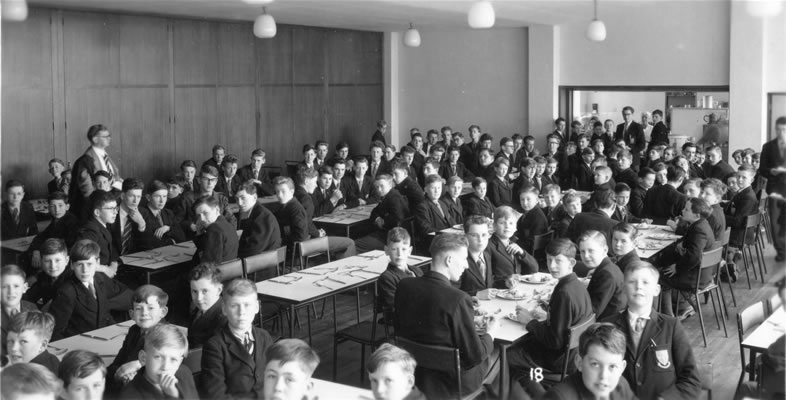
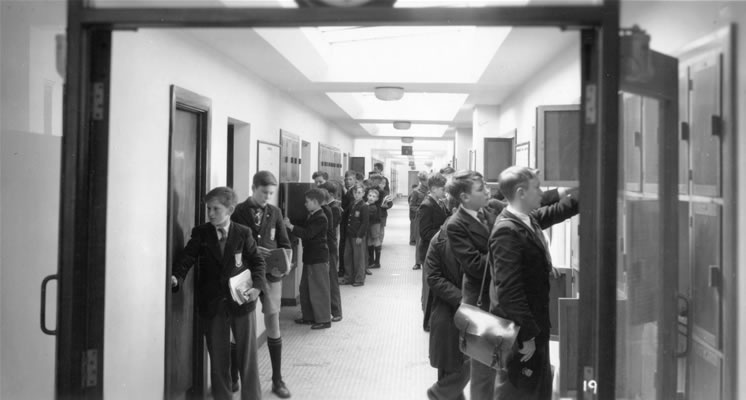
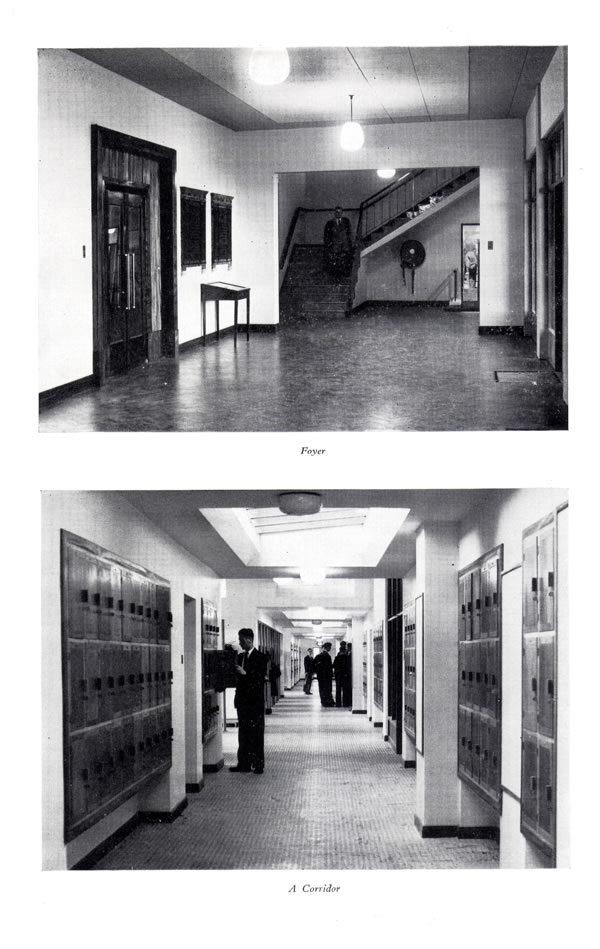
Main Corridor – Sorry Lad, the tuckshop’s not open yet
Chemistry Lab – with Norman Jones trying to disguise himself as a student to Dennis Grimsley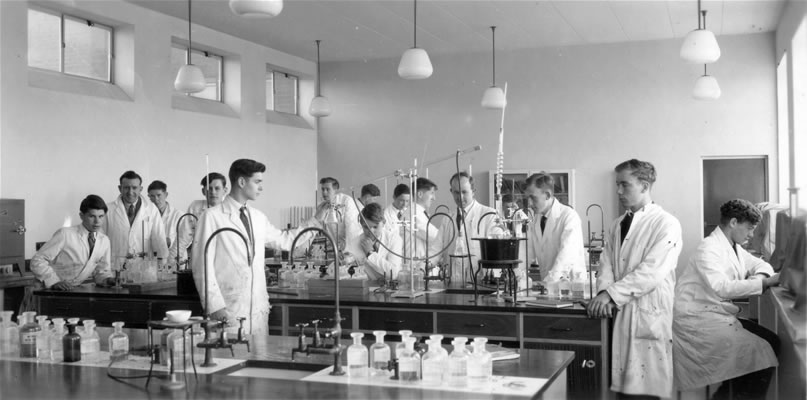
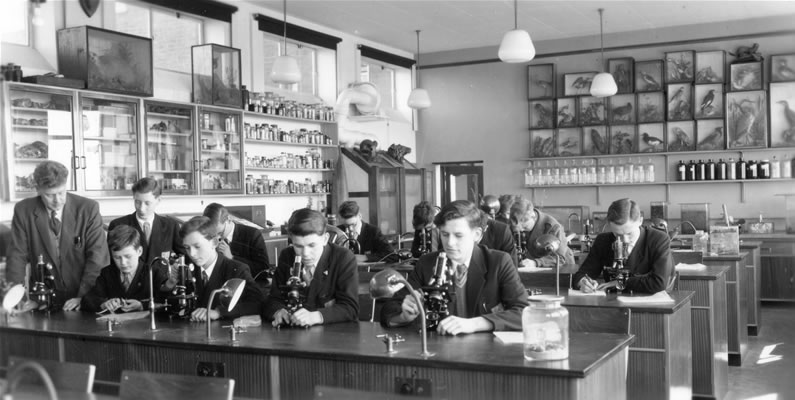
Biology Lab – with ‘Joey’ Crowther on the prowl
Gym – with Vic Roebuck slighty over-posing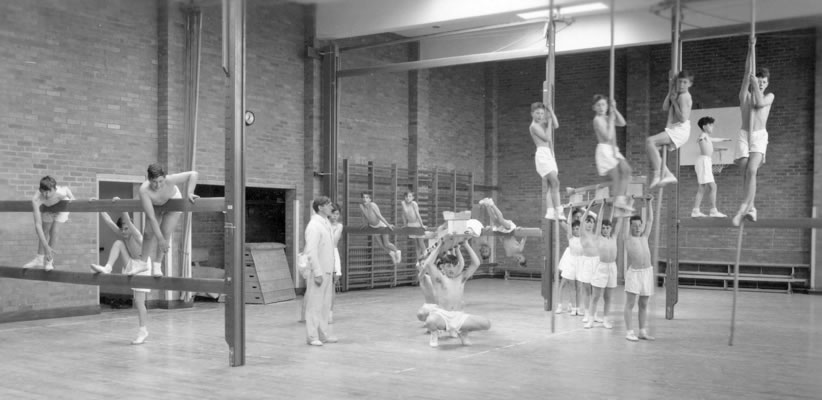
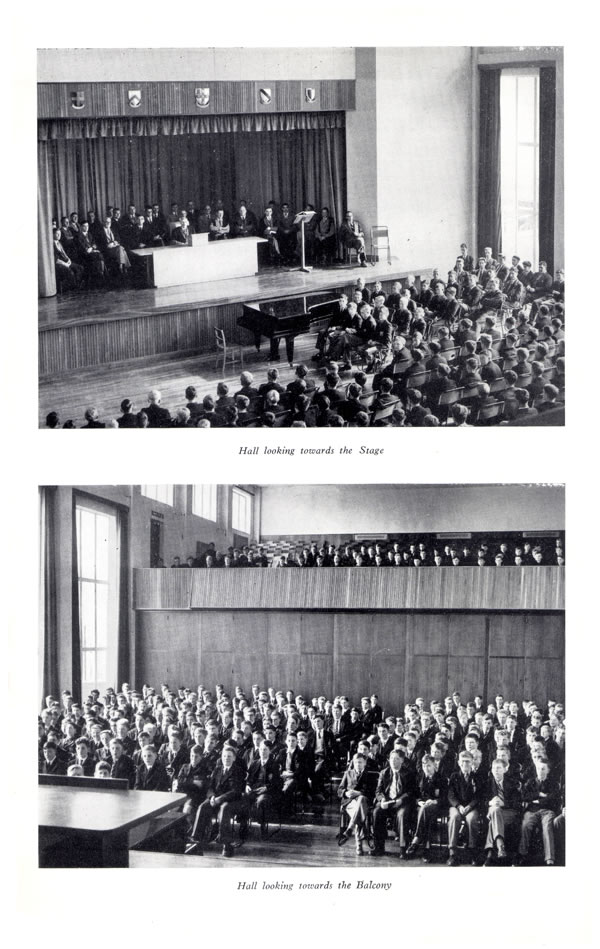
Stage and Hall – with its always amusing ‘No Smoking’ signs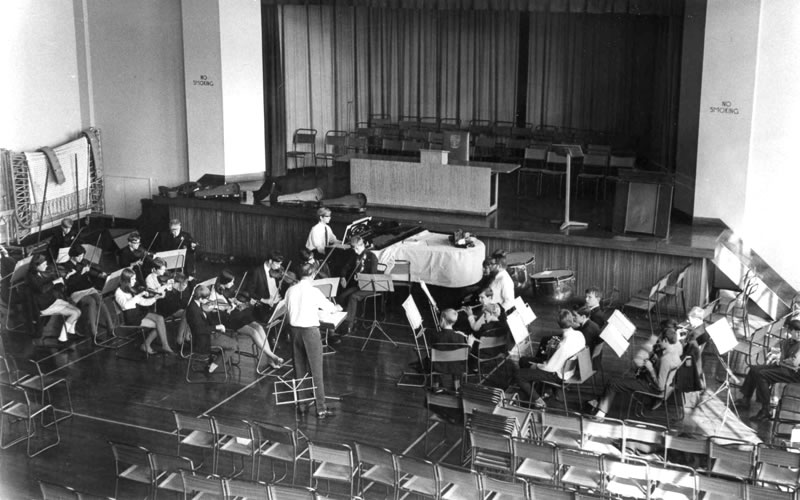
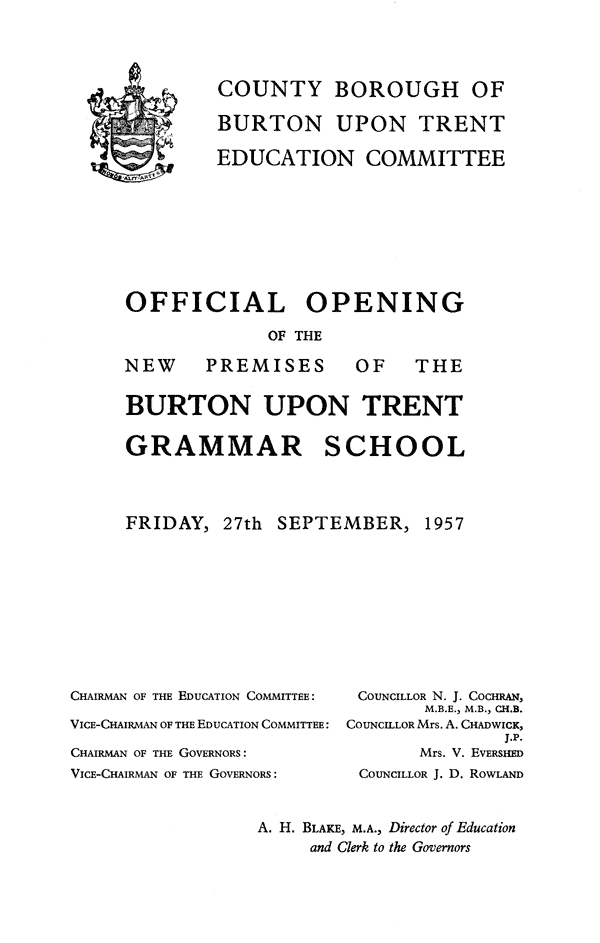
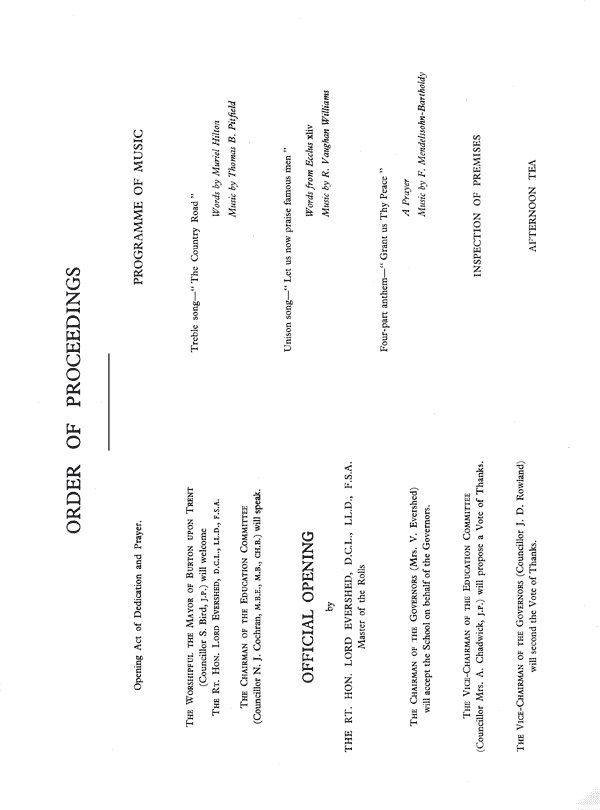
The new premises were opened officially on the afternoon of Friday, 27th September, 1957 by the Honourable Lord Sydney Herbert Evershed, D.C.L., L.L.D., F.S.A., Master of the Rolls.
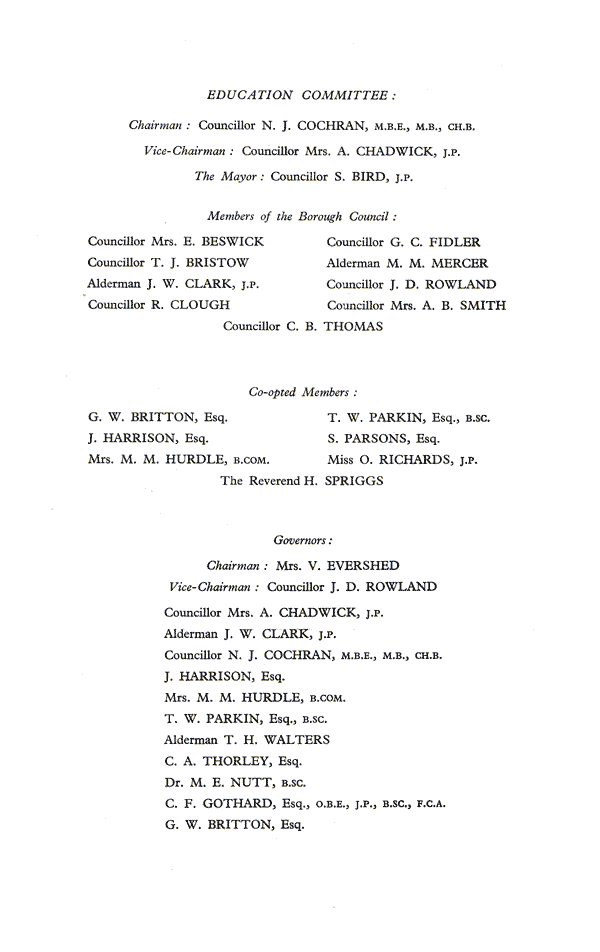
In addition to the Headmaster and Staff, those present included members of the Education Committee, with their Chairman, Councillor Dr N.J. Cochran MBE and their Vice-Chairman, Councillor Mrs Ada Chadwick (after who the new Secondary Modern school would later be named). Also present were the Mayor, Councillor S. Bird; the Governors of the School with their Chairman, Mrs S.H. Evershed; the Architect, W. Porter Mitchell, Esq.; the Deputy Town Clerk, A.G. Williams Esq.; three of Her Majesty’s Inspectors; Arthur Blake, Director of Education and Clerk to the Governors; the President of the Old Boys Association, W.R. Souster, and other Old Boys of the School. Also present was former Headmaster S.E. Wilson who had travelled especially from the Isle of Man.
After the Reverend Harold Sprigge had performed the opening act of dedication and prayer, the Mayor, in welcoming Lord Evershed, spoke of the long and close association Lord Evershed’s family had had with the school. Councillor Dr Cochran spoke of the necessity of educating the boys sensibilities and training them to understand their fellow men, as well as how to understand and control the physical world. He also spoke of the history and significance of the Grammar School. His speech was recorded as follows:
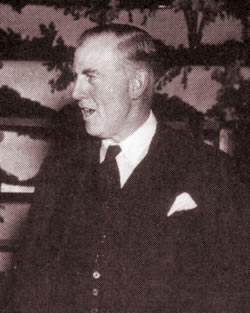 Lord Evershed ( pictured ) began by saying how proud, delighted and touched he was by the honour of being invited to perform the opening ceremony. It seemed only a short time since the highest of honours had been conferred on him when he had been received as Freeman of the County Borough of Burton, and he was encouraged to think, then as on the former occasion, that the name of Evershed was not without honour in Burton.
The connection between the school and the family of Evershed was amusingly illustrated by the speaker when he referred to a Cricket Match played in 1874 between the Grammar School and Allsopp’s, in which the Grammar School was beaten by an innings, scoring just 62 of which 31 were extras; a player called Evershed contributed nothing in his innings!
He was indebted to Mr Blake for an account of the negotiations and meetings which had begun in 1919, and had at last been fulfilled on this day. “The winds of heaven had postponed that happy day for one year, but the winds of government policy had deleyed it for twenty times that period”.
Whilst the building was very new and splendid, the School was an old one and there was a real significance for the future in old tradition and what he called standards of value that, over the more than 400 years of the School’s life had created. That, he thought, was something which must inspire the present and the future generations. “As Walter Whitman said, the modern ship of democracy has, in its valuable freight, the past as well as the present”.
It was interesting to observe that though Burton was one of the English towns furthest from the sea, among its old members were two very distinguished sailors, John Jervis, Lord St Vincent, and shortly afterwards, Byard. More lately, there had been distinguished men of science like Professor Hobday.
In John Jervis’s day, this school was in truth, a Grammar School where you learned only Latin and Greek. Now, he regretted to say, there was a tendency to regard Latin and Greek, or the humanities, as being opposed in some sense to the entirely scientific education. In truth, they were not opposed but complementary, and he claimed not to be alone in this repudiation of the tendency he had mentioned. No one would have more readilit denied the alleged antipathy than, say, Aristotle or Leonardo da Vinci. One mark of the educated man was that he was willing to be led away by shibboleths and slogans, but insisted on pursuing the truth. Only by that means could men achieve a balanced judgment.
We are in an age in which terrible things seem to hang over us. A Chinese philosopher, he believed, had accused Western Civilisation of being composed only of statistics, mathematics, diesel engines and high explosives. Since that was said, the changes had been first that high explosives had achieved an altogether more terrifying force, and the same is presumably now as true of Eastern Civilisation as of the Western, and the ordinary man finds himself faced with these terrifying prospects and must at all times regard himself as powerless to prevent some hideous calamity which would destroy us all. And yet it was a fact that, in a free country, the ordinary man had to assume the responsibility by exercising his rights as a citizen and of deciding what we do. (Editor: I’m half glad I wasn’t there now; I think I would have left scared to death).
And so, it was the hope of humanity that by good education, you would get men wishing for the truth and able to exercise a balanced judgement. Truth sometimes was not easy to find. When Milton said that the truth was never put to the worst in free and open encounter, I think he would have had no difficulty in assuming general agreement. And Goldsmith said that ten millions of circles can never make a square; just as the united voices of millions could not lend the slightest foundation to falsehood, but, with the modern devices of radio, some malicious untruth ight be, as they say, plugged day after day. Were we sure that the united voice of the myriads did not sometimes lend more than a particle of truth to that which was false? (Editor: By now, I would definitely have been losing the will to live).
This occasion was one of great importance, and he felt that he might say, on behalf of them all, a warm word of appreciation to the Headmaster and Staff of the School and to express grateful appreciation of the noble profession they had chosen to follow. No one could accuse the academic profession of thirsting after riches; they had to possess two very difficult qualities – patience and, that noblest quality of all, integrity of scholarship.
It is not merely by their teaching but by their example that we are led. A wise man had said “You cannot wear a sword beneath a scholar’s gown”. What the teachers, the professors and men and women who teach in schools did was by their example to show that they are, at any rate, being undeterred by the World’s disparagements and certainly uncorrupted by the prizes, remained for us ardent and serene in a faith by which alone we held mankind could live.
To conclude (Editor: Hoorah!), perhaps he might say something to those boys at the school who were present and to suggest to them that during the last year or two they spent at the school, they might have the last opportunity of living life as the best human life might be lived. When they left school, they would inevitably find that their actions would be influenced by the hard facts of life, by finding and keeping a job and earning a living. While they were at the school, they were untroubled by such considerations and lived as members of a community in the truest sense. They had the chance of doing what was best for a human-being – giving all that they could to the community and at the same time, they had laid before them all the knowledge and wisdom and all the beauty that the past generations of mankind had acquired.
The Mayor had been complimentary enough to refer to him as one of the present generation. In sad truth, he was actually one of the generation whose race would soon be run, but those boys who were present bore on their shoulders the future of humanity. It would be a heavy responsibility. So, therefore, he urged them to take the great opportunities the new school offered. Shakespeare had said (Editor: groan) that “He who made us with such large discourse, looking before and after, gave us not that capacity and God-like reason to rust in us unused”.
It was his great pleasure and privilege to declare the new school OPEN.
Accepting the school on behalf of the Governors, the Chairman, Mrs S.H. Evershed, especially congratulated the Architect, Mr Porter Mitchell, and other associates on the fine new premises and expressed gratitude of the Governors to the Headmaster for the way he had maintained the high standards of the Grammar School in difficult circumstances in the old buildings.
There is no denying what the Evershed family had managed to achieve but it definitely seems as though Lord Evershed might have been better advised leaving speeches to his wife. His wife however, very shortly afterwards, resigned as Chairman of the Governors, to be succeeded by Councillor J.D. Rowland.
The visitors were then shown around the school with refreshments partaken in the Dining Hall and some of the classrooms.
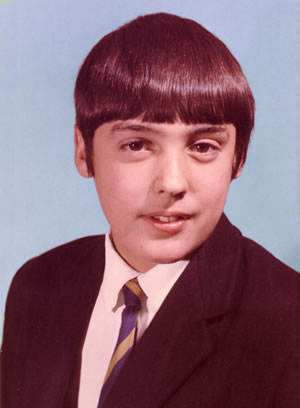 This is the only picture that has survived from my time at Burton Grammar School. I really hate it but, since I have featured a great number of faces of pupils who probably think the same way about theirs, I suppose it is only fair that I should include it.
I joined the school in 1968 and from fairly early on, it was made fairly clear that if I didn’t achieve “Maths, English and three other ‘O’ Levels”, I was doomed to failure. That, therefore, is exactly what I achieved having opted for science subjects.
I was due to stay on to do Maths and Physics ‘A’ Levels but, due to family circumstances, I instead needed to leave and find employment.
Some of the schoolmasters here enjoyed a glorious career that long preceded my knowing them; in meeting some of them as an adult, it is clear that there was sometimes an underlying irony that went straight over the head of a young boy at school; many of them have passed on and we should “never talk ill of the dead”. Be those things as they may, as with the rest of this website, I want to provide an accurate a record as I can of my time there so I speak as I find… or should I say “found”, many decades ago.
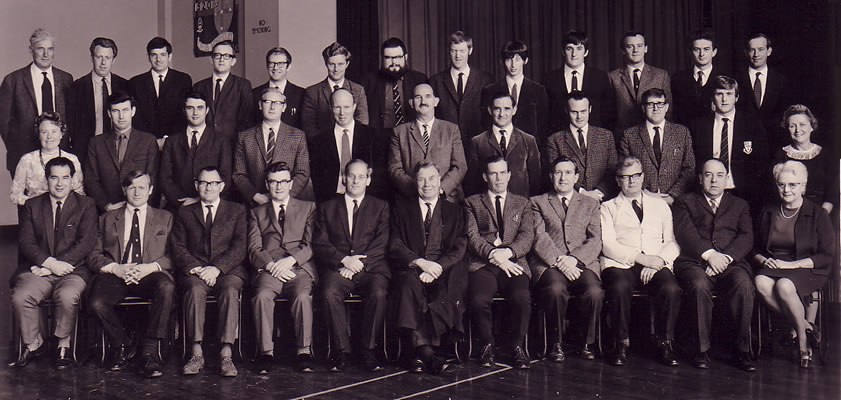
John Andrew (Tinman) – [Metalwork]
‘Tinman’ always seemed to have a certain anger about him. He had deep red veins in his cheeks and when he was having one of his occasional rants, they seemed to glow.
At some point or other, I think most of the class had ducked their head as he bellowed his favourite scorn “Gallagher – you blessed simpleton!!”.
Colin Bagshaw (Bogwash) – [Physics]
Colin was a generally calm and effective teacher. He was my Physics teacher for the whole of my time there and it was always my favourite subject on the timetable. This made the ‘O’ Level a complete breeze with never any doubt that I would pass it without much effort. I am not sure how much of this was down to Mr Bagshaw and how much of it was down to the fact that Physics is just (or was to me anyway), so inherently interesting. Certainly, a school full of teachers like him would make for a very easy passage.
I can remember one slightly amusing anecdote which is nothing to do with school – I used to deliver his daily newspaper to his semi-detached house in Dovedale Close and he was the one person on my round who made me walk back to the pavement and round rather than cut across his lawn.
John Long – [Latin]
I had no contact with Mr Long, nor Latin come to that; he was simply a familiar face.
David Wyatt – [Spanish]
I had to think hard if I actually did Spanish at school, certainly, I can’t count to ten in Spanish which suggests that the brief period for which I took the subject was not particularly arduous.
David was equally wishy-washy leaving a just as scant lasting impression.
John Sneyd – [Physics]
I had nothing to do with John Sneyd, neither for that matter did the rest of the staff seem to. He always seemed a bit of an outsider somehow.
Alan Brewerton (Doc) – [Chemistry]
Doc Brewerton took us for a very brief period, I am not sure if it was even a whole year. He was young and his nickname implied that he was particularly clever though I seem to remember his lessons being pretty dull and humourless.
Robin Langton (Bumble) – [English/Literature]
Bumble didn’t take me for a single lesson. I think his main subject was English Literature which was an ‘options’ subject which I didn’t take. He always seemed very jovial and pretty harmless.
Graham North – [History]
I had absolutely no contact with Graham North and needed help to fill his name in here.
John Armstrong (Louis) – [Maths]
I think Louis was a nice enough chap but completely ‘wet behind the ears’. I am pretty sure it was his first teaching post but generally, he could keep little order and was irresistible to wind up which was an unfortunate combination.
His favourite punishment was rather than dish out 200 lines of 10 words, to award 10 lines of 200 words. The idea only amused him, as a consequence, no one bothered to do them anyway.
He once told us to watch ‘Star Trek’ for homework and to make a note of any occasions where Mr Spock used logic. Unfortunately, my Dad didn’t believe me and wouldn’t let me watch it.
Alan Cure – [Geography]
I had no contact with Alan Cure but he seemed to enjoy very good popularity with those that did.
John French (Frenchy) – [PE]
Frenchy always seemed a bit fearsome with a mean one-eyed scowl which I am sure he must have practiced in the mirror. He only ever took us for games or PE and he certainly made me try for brief periods when I felt that his eyes were upon me.
Chris Aylott – [Maths]
I had absolutely no contact with Mr Aylott. Again, I had to have his name filled in here and, when it was confirmed, I had no recollection of it whatsoever.
Michael Green (Ma) – [English/Economics]
Ma took us as a stand in for occasional lessons. In this role, he was a kind of caretaker teacher and used to give us fairly menial things to do, usually read, to get through the lesson without the need to develop any kind of rapport.
Barningham – [Office]
Just a vaguely familiar face in the office I’m afraid.
M02 & M03
I swear to this day, these two men are complete imposters who snook into the photo because they happened to be in the school, probably for interviews. I don’t have the foggiest idea who they are.
Chris Shepard (Shep) – [English]
Chris Shepard was a pretty good English teacher and in general, I used to enjoy his lessons. It all seemed to turn a bit sour when noises were first heard about the abolition of Grammar schools when it became obvious that he had very ‘left wing’ sentiments not shared by almost the remainder of the staff.
Peter Dawe (Jackdaw) – [Music]
I always thought that Jackdaw’s name was ‘Jack’ so it was a slight shock when it was corrected to Peter; although thinking about it now, with a name like Dawe, who would ever call their son Jack?!
As a music teacher, he was a complete and utter failure. His lessons were totally meaningless and no-one in his classes gained the slightest musical knowledge. He seemed to spend some time with the very small number of pupils that could actually play an instrument already. Aside from that, the only useful aspect of Music lessons was the chance to catch up with a few lines of the ‘I must not run in the corridor’ type.
Harry Smith (Brab) – [Maths]
I didn’t have Brab for a single lesson. I was slightly disappointed by this in some ways because there was the general air that he was an amazingly good teacher and that students of his were automatically assured of high grade results. He was always a very central character with numerous legendary attributes – such as the ability to draw an almost perfect circle with one quick twirl of the elbow.
Harry seemed to enjoy almost unanimous respect from the lowest pupil to the Headmaster.
G. Davis (Taffy) – [Woodwork/Eng.Drawing]
To say that Taffy was quiet was something of an understatement. He would demonstrate how to make a very neat rectangle hole with gentle taps of a mallet on a chisel and then quietly disappear into the woodwork (excuse the pun), leaving us all to hack a piece of wood to death in the vain attempt of imitating him.
Alan White (Chalky) – [English]
I didn’t have Chalky but he did strike me that his lessons might be fun and animated.
Brian Luckett (Chinner) – [Chemistry]
Brian seemed pretty unique in that he seemed to remember exactly what it was like to be a pupil and almost seemed like he would still like to be one. This had the unfortunate effect that he could generally anticipate most chemical pranks.
Robert James (Jessie) – [French/Latin]
I didn’t have any contact with Mr James but again, he seemed generally popular with everyone who did.
Coates – [Office Secretary]
Just another vaguely familiar face in the office I’m afraid.
Walter Chadbourne (Walt) – [Physics]
I didn’t have any contact with Walt. He only seemed to take lower streams and was probably better known to me as the Scout Leader, not that I was a member. He had a reputation for administering whacks with a gym shoe that I never saw first hand. I was actually very surprised to now learn that he had a longer service with the school than I thought. He always seemed like the Scout Master cajoled into taking a few lessons somehow.
Victor Roebuck (Vic) – [PE/English]
Vic had quite a pleasant manner about him. Firm, but you always knew that he was never really as harsh as he was making himself seem. I think he genuinely enjoyed engaging in sports with boys. I never particularly got on with him because running about on a muddy rugby pitch or, even worse, trudging around sodden farmland was never more than an unfortunately necessary evil to me.
It was actually quite a shock during this project to discover that Vic was such a first class athlete in his day, very narrowly missing out on the Olympic running team.
Ellick Ward (Ernie) – [French]
I didn’t have any teaching exposure to Ernie. I had brief experience of him when I joined the lunchtime ‘Radio Club’ so that I could join others in making a device that could be engineered into a desk to make a faint beeping noise. Four of five of us used to switch them on for a few seconds so that the whole class could delight in watching the masters ears prick up as they wrote on the black-board.
Hugh Wood (Woody) – [French]
Hugh was always friendly and seemed a genuinely nice guy. Unfortunately, his subject was French which no-one ever seemed to have the most remote interest in. Although I never got to take the ‘O’ level, I am actually surprised how much French I almost inexplicably seem to know as an adult which suggests that he was a very effective teacher and that I could have been half-proficient had I been able to muster enough interest.
When the class was noisy, he used to stand and take a pin out of his jacket lapel. We had been conditioned to know that in a few seconds, he was going to drop it and that if its faint ping couldn’t be heard as it hit the floor, the whole class would be in detention.
On one occasion, Chris Borrington deliberately coughed at the crucial moment making everyone groan at him after it was announced that we must all return at the end of school.
Geoffrey Henton (Gaff) – [Geography]
Geoff Henton had an inexplicable air about him. He never shouted – only raised his voice; not once did he ever dish out a single punishment to my recollection, and yet, the moment he entered the room or came into view, there was automatically complete silence and order.
He was a good Geography teacher and I would actually have liked to have taken it as an option but, slightly bizarrely, it was not classed as a science subject so was not available with Biology taking its place.
Bill Gillion (Beak) – [Maths] Headmaster
Bill Gillion was simply the Headmaster was never seen outside of school assembly. I did visit his office on two occasions, neither of them pleasant. On the first, he announced at the end of assembly that someone had been talking the whole way through. He pointed at me and asked me to put my hand up. Though strongly suspecting that I was his quarry, I kept my hand down. His response was to get someone in my vicinity to put their hand up; he then gave instruction, “the boy to his left, put his hand up”, “the boy in front of him put his hand up”; after a few steps, it fell to my turn and when I raised my hand, my heart sank as he announced “Yes, YOU”. I was instructed to report to his study after assembly where I was given a stern telling off. The second occasion was following the fencing accident where a small unsupervised group of us were hacking around with swords outside without wearing face-shields and Robert Whetton was badly injured. I had to go and give my account of the happenings. He did seem a kind, upstanding man though and very worthy Headmaster.
Ron Illingworth (Ronnie) – [Geography]
I had no direct dealings with Ron Illingworth which I must admit, I was slightly relieved about. I always had the impression that he would like to swipe me hard across the back of the head for the sheer pleasure of it. I felt well out of his way but don’t know if he was as fearsome as he seemed.
Norman Jones – [Chemistry]
I didn’t have Norman but he always seemed a pleasant sort.
Raymond Crowther (Joey) – [Biology]
I always thought that Joey was Mr Crowther’s proper name so it was very strange to change his name here from Joseph to Raymond. He was a fairly effective teacher though somehow strangely detached from the rest of the staff. He seemed to spend most of his non-teaching time in a small room at the back of the Biology Lab. I didn’t particularly like Biology though; it was really an imposed subject that I had to do in order to continue with Physics which was my favourite subject.
When the class was unruly, Joey used to stand a chunky table leg up on the front bench and announce something like “Signum Bellum Stat”, which he explained to us was Latin for ‘Symbol of war stands’. This was an indication that the next offender would receive a knock on the head with a wooden baton with a severity (lump size) proportional to the degree of misdemeanour.
I once received the worst punishment, referred to a ‘Crunchie’ as explained below.
Percy Barratt (Butch) – [History]
Percy was another of those familiar characters that ambled around but with whom I had no contact.
Elizabeth Radford (Fanny) – [Divinity/French]
At some point, Mrs Radford seems to have switched from ‘Gertie’ to ‘Elizabeth’ but we only ever really referred to her as Fanny which was always a bit confusing.
Divinity lessons were a complete non-event really. I can only remember pupils being instructed to read a passage from the bible with the constant farce that the next pupil instructed to take over took a while to do so because invariably, no-one but the current reader had got the foggiest idea where the passage was up to.
Questions were sometimes asked at the end with everyone smirking at the hapless victim knowing that his made up answer would be no better than any of theirs.
The following masters are not featured in the photo but I did have direct experience of them.
Jack Playll (Pleb) – [History]
Pleb’s history lessons were all comprised as follows: we were given a page range to read from a text book “could you please read pages 112 to 119”. The class would then fall into silence as they armed themselves with elastic bands to flick at one another. Occasionally, when someone made a noise after being caught sharply on the cheek, Jack would look up from his book slightly and cough. And so it went on. Twenty minutes or so later, he would ask questions on the passage we were supposed to have read. It was only a mild dread of being asked a question because a response of “I can’t quite recall the answer sir” simply passed the book to the next person with very little repercussion. To assist things, Mr Playll tended to concentrate his answers on the small minority that were likely to be able to supply an answer and largely left everyone else alone.
He was definitely teaching History for an easy option. He used to heavily tip exam questions to ensure that marks could be easily gained, and wasn’t bothered about ‘O’ levels because most would not take History as an option and those that did would effectively be starting again.
Lewis Heath (Chippy) – [Art]
I quite enjoyed art and Lewis Heath was a decent enough sort of guy. Splodging paint onto paper never really felt like a ‘real’ subject though, particularly since there was no Art ‘O’ level or further ‘lessons’ after the third form, so it always felt like a sort of recreation period for the youngest pupils.
James Moore (Jomo) – [Maths]
Jomo was absolutely legendary! His lessons were a complete riot. He had been persuaded back into service having retired as a local Maths teacher at aged 65, simply because there was a great shortage of maths teachers and the timetable could not be fulfilled.
His maths knowledge seemed such that he wouldn’t be able to pas the ‘O’ level himself and his class control was completely non-existent.
I can remember on one occasion, the adjourning door between classrooms opened and Geoff Henton stuck his head in to find several pupils standing on chairs and an unearthly din. On Gaff’s appearance, everyone immediately sat to silent order; he gave Jomo a sharp look before disappearing again and the class continued with HCFs and LCMs (the ONLY lesson Jomo knew confidently) now much more subdued – but only because of the impending threat from the neighbouring classroom.
David Mart – [Maths]
David Mart started whilst I was at the school but had a much more difficult task on his hands that he could have imagined. He had taken over from Jomo Moore who had firstly, firmly established the culture that Maths was a complete free-for-all and secondly, had left the class quite literally one whole year behind in the syllabus.
To this day, my first lesson with Mr Mart provides me with one of my clearest memories of the school as he very successfully asserted himself where Mr Moore had failed. Maths lessons were suddenly very different with a necessarily increased workload to make up for lost time.
Unknowingly, I had a reasonably strong natural ability for maths. The ‘O’ Level most had once dreaded was completely changed around into one that everyone could take with complete confidence. In a completely unprecedented gesture, I can remember the class collecting all of its tuck-shop money and presenting him with a bottle of wine.
I didn’t find out until this project that David was also an ex-pupil of Burton Grammar School and had attended at both Bond Street and Winshill. By all accounts, he was never a very exceptional student but he turned out to be a very exceptional teacher.
Burton Grammar School had a long and proud tradition of Rugby; “hard and fair play on the sports field to instil a character which carries through to the classroom as a complement to academic success”, and all that. Unfortunately, this was always somewhat lost on me and my memories of the Rugby field may not be entirely typical.
A whole year’s worth of pupils did afternoon sports which usually meant just under ninety pupils. This gave rise to three games. The first, made up of the most impressive thirty, was on the top, carefully tended pitch. The second was on the middle pitch, which was still a very impressive playing surface, inferior to the first only in that it was some distance lower down a steep bank. The third was made up of the rest of the stragglers on the bottom pitch which it would be fair to say, was sometimes ‘quite water-logged’. As you may have already guessed, this included me. I can’t now recall who used to referee the games. Vic and Frenchy took two but I can’t for the life of me remember who used to take the third.
Quite often, there were not quite enough players to make up full teams on the third pitch, sometimes; there was an odd number of players meaning that one side had an extra player, although this was usually in the form of Kenny Mycock which gave little or no advantage. I think it was him I remember one day being adorned in ridiculously ill-fitting spare kit supplied to him after he had tried to forge a letter from his parents to excuse him from the games period for an implausible (and most probably mis-spelled) ailment.
The rules of Rugby were, and remain today, a complete mystery to me. The whistle used to blow, seemingly at random and many of us huddled around in confusion trying to establish whether someone had now got to drop kick the ball or whether we had got to endure another scrum. Almost invariably, it seemed to be the latter which meant, as one of the second-row, I was anticipating getting my ears squashed again, but I didn’t know enough about the rules to question the decision. Neither did I ever really fully understanding the scoring but I learned early in my Rugby career that Mr French did not appreciate the question “Sir, who’s winning?”, so I usually waited until the end of the game where I would try to establish the final score. Not once do I ever recall contributing to it.
Despite my general lack of enthusiasm for the game, it did supply me with some treasured memories. I can remember one occasion in particular, when the field was particularly sodden with one corner being so muddy that to venture onto it meant almost for sure, that ones boots would be completely submerged. The ball plopped down in the middle and shortly afterwards, Frenchy was bellowing at the interested group of pupils standing in a circle around the mud wondering how we were to retrieve it. Frenchy made us all lie on the ground to get covered in mud. “There”, he exclaimed with some satisfaction, “now no-one need worry about getting muddy”. This sparks the memory of another incident were a heavily muddied ball escaped the catch of, I think, Duncan Andrew, and instead bounced off his chest leaving a ball shaped imprint on his previously clean shirt which he then pulled outstretched in front of him and studied it with the disdain that someone might apply to bolognaise sauce being slopped down a best shirt. One more mud anecdote before I move on, some fun was had by sharply kicking ones foot forwards to turn the mud clogged around their boot studs into a muddy projectile to splat on someone’s back. On one occasion, I can recall missing my intended target and instead catching Frenchy on the back of the head. He turned to find out who had dared to throw it; I looked as innocent as possible but was betrayed by a number of traitorous team-mates who were all sniggering in my direction. I was in the middle of trying to explain how it had somehow flown from the bottom of my boot as his sharp slap caught me briskly across the back of the head.
Sports Day
I have fond memories of Sports Day. Not for the athletics you understand, ‘Skinny’ Goodwin and myself, being careful not to qualify for any events so that we didn’t have to hare around like demented whippets, devised a much more fun activity.
On Sports days, the steep banks that seperated the different levels of playing field came into play providing a large seating area. Armed with bottles filled with water from the Pavilion, we used to quietly position ourselves a few feet behind a target group, release all of the water and quietly walk away to a spot some distance away from which to observe.
As sure as day, a short while later, the group would instantly spring to their feet feeling their inexplicably wet trousers and we would crack up with as quiet laughter as possible so as not to be discovered.
Bleepers
In the electronics club (run I think by Mr Ward), we made a number of simple bleepers that made a faint bleep when two wires were touched together. These were engineered into around half a dozen desks, well distributed around the form room. At random intervals, the class sniggered as the teacher’s ears pricked up, never quite being able to establish where the faint noises playing for a few seconds were coming from.
Chemical Warfare
Skinny Goodwin found an excellent recipe for ‘nitrogen tri-iodide’, which was a highly explosive powder that could be sprinkled everywhere to produce a loud crack when, for example, a ruler was dropped on it.
The entire stock was eventually confiscated and Chinner Luckett and Doc Brewerton took it to a distant border of the playing fields where they very gingerly disposed of it wearing face masks.
Sledging
I have absolutely no idea where they appeared from but one snowy winter, there was a small fleet of corrigated iron sheets fashioned into sledges with a bent up front and enough space for around four passengers. They were used to hurtle down the bank from the Winshill Church graveyard wall down onto the playground.
It would then be dragged back up and passed to the next waiting team and we would take our place at the back of the queue again.
Unintelligible Questions
There was a short fad where pupils would raise their hand and ask some unintelligible question. When they could stall no longer, the gabble was replaced with a question like “Can I fill my pen please Sir”.
Kudos was gained for a) How long the gabble could be. b) How many times it could be repeated before a proper question was asked. c) The level of fear of the involved teacher (very little for Jomo, maximum points for Gaff Henton).
Army Cadets
I joined the Army Cadet Force with one objective in mind – to fire a gun. I was prompted to join after hearing an account from someone in my class that was already a member that they had spent the previous night on the firing range firing real army guns which was enough to persuade me along.
It turned out to be somewhat duller than I hoped and in fact, .303 rifle shooting was something of a rare treat. Far more time was spent on the playground doing ‘drill’ with Captain Playll shouting (to the best of his ability) “Squad, fa-ace left” whereupon, after the stamping of boots, I would usually end up facing David ‘Numb’ Sherratt wondering which of us was wrong (usually him).
I can remember it being demonstrated how to strip an automatic gun (could be a ‘sten gun’ but don’t quote me) and re-assemble it as quickly and efficiently as possible following which, we all took it in turns. I think the record was around twenty minutes if it could be accepted that the sight was facing the wrong way.
Andrew Bodger seemed to take things seriously and genuinely believe that he was the first line of home defense; thankfully, it was never put to the test.
We spent a few days on an army camp once. My main recollection was getting very comfy on a grass bank with my legs either side of a small mount making a comfortable saddle. The type of gun however, had a much greater recoil than anticipated which brought home most forcibly why this was a very bad idea.
BAD MEMORIES
Fencing Accident
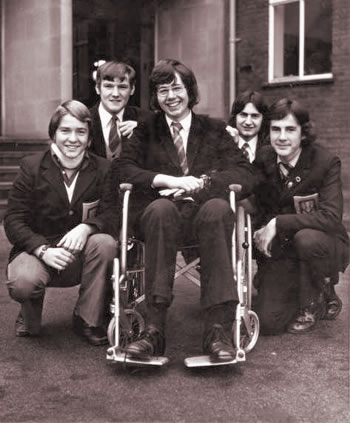 I was a friend of Robert Whetton at Joseph Clark primary school. At the Grammar School, we got split up because he was in the ‘A’ stream, I was in the ‘B’. Though not particularly close friends, I had been to his house in Balmoral Road on numerous occasions. His Mum was always very nice and taught piano. It was there that Robert taught me how to play chess.
On this particular day, Mark Osman was playing in the National Schoolboys Rugby Final at Twickernham. Mr Gillion and Mr Henton, all of the games masters and a number of selected pupils had gone on a coach trip to watch.
It was an ‘easy’ afternoon for those of us that remained and a small group of us, including Robert and myself, went outside as a small unsupervised group having decided to do fencing. Although fencing helmets were provided, we didn’t bother wearing them because you couldn’t see through them very well!
In a very unskilful hack around with Robert, my bowed blade somehow flicked off his and hit him in the face. He dropped to the floor and at first, it didn’t seem serious; everyone expected him to get up and laugh it off. However, he didn’t move and vomit began trickling from his mouth. Myself and Steve Goodwin went to report the incident and an ambulance came and took him away.
It transpired that whilst the foil had only inflicted very minor damage, he had hit his head hard on the floor when he fell which had caused brain damage. As a result of the incident, Robert suffered permanent disability. To this day, it has been one of my greatest regrets and I have thought of him countless times. To some extent, this website is dedicated to him.
First Day
On my very first day at Burton Grammar, I turned up very bewildered by it all, with my school cap. In my allotted main corridor cloakroom area, I was approached by Kelvin Russell who tried to snatch the folded cap out of my pocket. I managed to grab it so we both ended up pulling on it. In the stalemate, I was hoping that he would simply let go; instead, he pushed me in the face which caused me to let go and he disappeared up the corridor laughing, throwing it to someone else rugby style.The cap was never seen again and I got a major roasting for losing a garment we could ill afford when I got home. This has always stuck in my mind; it is amazing how much older second year pupils seemed at the time!
Spoiled Blazer
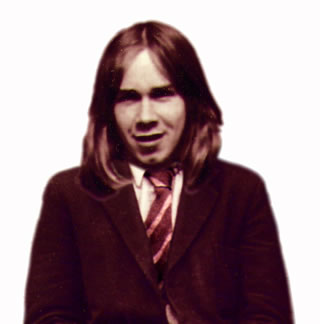 Times were pretty hard at my house, my Dad being a coal-miner in very troubled times. My clothes seemed to have to last much longer than most people’s and were sometimes shabby. I was fairly proud therefore, to be wearing an overdue new blazer.Going upstairs after assembly, I felt a number of firm strokes down my back. When I turned around, John ‘Scabby’ Sharpe (pictured) gestered that he had done it with his finger. After it was pointed out by others however, I took my blazer off to discover that he had drawn chalk marks as hard as possible all over it.My parents were furious, I got a good beating from my Dad and the marks never did come out fully.
Cross Country
Myself, Jez Stevens (now living in Carlisle) and someone else from Dalebrook Estate whose name escapes me, skipped cross country a few times by lingering to the back and diverting through ‘winshill dales’ where we used to play in the third boy’s house. At the appropriate time, we went back and re-joined the home runners when there was a suitable gap.On one particular occasion (maybe because someone had grassed), Frenchy stood by a stile at Bladon House Farm ticking names off.When we got back, looking as exhausted as possible, it became obvious that we had been rumbled and we were forced to stay behind and run around the whole school perimeter ten times. Worst of all, I missed my evening paper-round and almost got the sack.
Canoeing
One year, I can remember opting for Canoeing as a summer-time Games activity. I had already conjured up the image of gliding around on the river, jabbing my oar in the water on one side or other to force the boat to sharply turn on my command.
It turned out that we had been suckered; we had to report to the Metalwork room where we discovered that the Canoes were in kit form and our first task was to build them. Now when I say “kit form”, I don’t mean two halves that join neatly together and a seat that clips firmly into place – I mean bales of fibre, cans of resin and uncut lengths of wood.. the sort of thing you would complain bitterly to PayPal about if it had turned up off eBay.
For reasons I don’t now understand, the group was a mixture of pupils from my year and pupils from the next year up, including Keith Large, Robert Large and Stephen Johnson. I always thought that each year did games on a different afternoon.
Summer came and went by which time, we hadn’t managed to construct anything that looked remotely sea-worthy, so we never got to actually experience floating on water.
GOOD/BAD NOT SURE MEMORIES
Methane Bubbles
In the chemistry lab., the benches had twin methane taps for use with Bunsen burners. Chinner used to disappear into the small room at the front of the lab for inordinately long periods which we, correctly or otherwise, referred to as ‘fag breaks’. On one such reprieve, someone behind us was going “Aaahh” and an increasing number of pupils were sniggering as they turned around. I joined them when I saw that someone had lit the tap and had an eighteen inch flame roaring towards him as he rubbed his hands, apparently enjoying the warmth. When the distrurbance grew too loud, it was quickly extinguished when Mr Luckett suddenly appeared at the door to investigate. I seem to be far more concerned about the possibility of a flash-back into the supply as it was turned off now that I was then.
This soon progressed to soap bubbles filled with methane to coax into the air and ignite. Eventually, a large methane bubble was quietly manoeuvred to behind someone’s head; one person tapped him on the shoulder as the other lit it to provide the impression that the world had come to a flaming end. Someone tried the same ploy on me but, now alerted to the possibility whenever we were left alone, I turned to spot the bubble which was just as well because Chinner reappeared forcing the perpetrators to burst it – choking me with methane instead. “Get back to your seats”, ordered Mr Luckett. “Gallagher, why have you turned green?” (I made the last question up).
Crunchie
As indicated above, Joey Crowther used to administer punishment in the form of the whack on the head with a special baton, specially chosen I feel for making the loudest possible ringing tone when a cranium was struck.
I think there were five different degrees, ranging from a light tap to a good strike, depending on the seriousness of the offence. The largest was known as a ‘Crunchie’ which I received on one occasion. It was for flicking something slimy (I think a piece of frog) to startle someone as it landed on their exercise book in front of them. My amusement turned to dread when I faced forwards and saw that Joey had been watching the whole proceedings. I was actually surprised how much it actually hurt and felt that it was close to doing some real damage. It certainly brought tears to my eyes.
School trips
Huh?! I have been slightly surprised to read about the exotic trips to Europe and places. I don’t recall any such opportunities (although I would generally have expected to be in the small group that always got left behind to do lessons because my Dad couldn’t/wouldn’t pay the ten bob).
I have a very vague recollection of a trip with the new drama teacher to a theatre that could have been in Leicester, but was equally possibly Nottingham to see some kind of performance. I can’t recall any singing which probably rules out an Opera; I seem to remember not having a bloody clue what was going on, which suggests it may have been a classic Shakespeare play; and I have no recollection of any laughs so it was probably not one of his better works.
CONCLUSION
There are generally strong sentiments that it was a grave government mistake to abolish Grammar Schools, and in some ways, so it was. Comparing my account of the school to much earlier ones however, I get the feeling though, that the ‘rot had already set in’. One of the key indicators of this I feel was the discontinuance of Class 5X.
For a short period in the nineteen-sixties, Burton Grammar School enjoyed one of its finest hours. It was a period of strong Oxford/Cambridge success and an overall academic success that out-performed nearby Repton School – one of the most esteemed Private Schools in the country. Due to enormous pressures, Mr Gillion however, he had to abandon his thoughts of Academic excellence by the top stream of pupils, leaving the lower streams with much less attention. Instead, the reverse was imposed – to bolster a National average deficiency, there was a shift in ethos to making sure that as many pupils as possible received the ideal of five good pass ‘O’ levels. The brighter students could achieve that with much less guidance.
Gone was the overall feeling of great aspiration by those that had it within their grasp; instead, there was the much diminished feeling that everything was geared to trying to ensure that as many as possible got the requisite five ‘O’ levels, ideally including the most esteemed Maths and English, anything above that was a bonus.
True, I got my ‘Maths, English and three others’ which provided me with the minimum requirement for some Higher Education, but I was never one of the pupils that shone – it was they who really suffered.
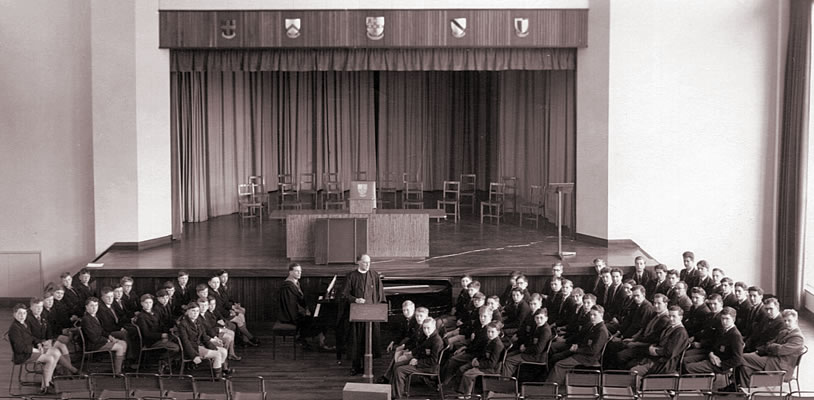
Most conspicuous in this 1958 photo are, Ron Illingworth on the piano and Reverend Paul Appleton as choirmaster.
Right Row (from front): Raymond ‘Joey’ Crowther, Lewis ‘Chippy’ Heath, Peter Evanson, R1-4 , David Berker, Peter Jennings, Rodney Hardwick, Alan Whittaker
Second Right: Noble, Colin Mason, R2-3, ‘Taff’ Davies, Bob Knight, Brian Bradbury, Bert Copestake
Third Right: Hugh Wood, P. Boulder, R. Llewellyn, Anthony Hughes, Maurice Kersey, Alan Cloves, R3-7
Fourth Right: R4-1, R4-2, ‘Polly’ Lownds, R4-4, R4-5, R4-6
(The scratch, painstakingly removed as part of the restore, was re-introduced after I realised that it was a cable to the large on-stage speaker!).
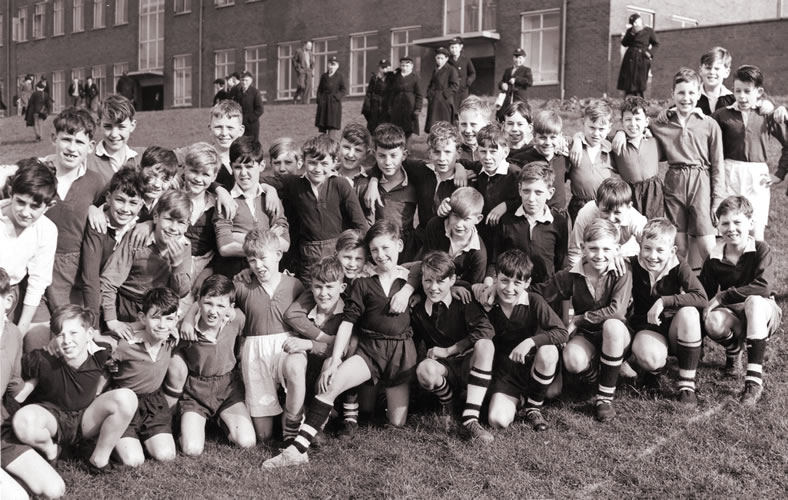
A couple of supplied photos taken in 1959 are too good to leave out because they capture the mood so well.
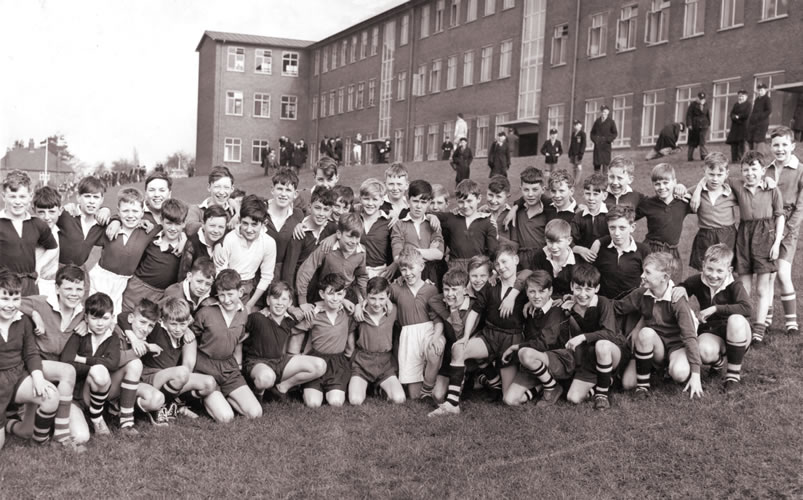
There are probably a few too many to name but they show the first-formers kitted up ready for ‘games’. The fact that the photo is black and white hides the assortment of Blue (Drake), Green (Clive), Maroon (Wellington) and Black (Nelson) shirts and socks.
Stumbling across an old Grammar School Timetable brought back many memories. This was the timetable for Form 1B in 1960.
The day was split into seven 45 minute periods; some were double periods. There was a break between periods II and III and lunch-break followed period IV
|
I |
II |
III |
IV |
V |
VI |
VII |
|
|
Monday |
English |
French |
Maths |
Geography |
History |
French |
Physics |
|
Eng Room |
Fr Room |
7 |
Geog Room |
Dem |
11 |
Jnr. Physics Lab |
|
|
Tuesday |
Metal or Wood |
Music |
French |
PE |
English |
French |
|
|
Met/Wood Rooms |
Dem |
Dem |
Gym |
12 |
12 |
||
|
Wednesday |
Maths |
English |
Maths |
Swimming |
Geography |
Physics |
|
|
Dem |
Dem |
7 |
Baths |
6 |
Snr. Physics Lab |
||
|
Thursday |
History |
Maths |
Art |
English |
Religion |
||
|
9 |
9 |
Art Room |
12 |
Art Room |
|||
|
Friday |
Geography |
Maths |
Music |
French |
History |
Games |
|
|
6 |
10 |
Hall |
Dem |
Hist. Room |
|||
|
Locker 136 |
Form Master: Mr. L.E.Heath |
Form Room: Art Room |
|||||
The whole class stayed together for the same timetable. Only later, after ‘Science’ or ‘Modern’ options were taken, did the form split to do different subjects.
The timetable shows Physics but no Chemistry. In the 1950s and early 1960s, there were several experiments on what science subjects should be taken in the first year. In this particular year, science subjects were rotated each term so that the A, B and C streams swapped Physics, Chemistry and Biology.
By 1963, things had been fixed so that first-formers did Chemistry and Physics but no Biology until later.
I can remember some speculative discussion on the first day about what ‘Physics’ actually was! In the days of Bond Street, it was encompassed by ‘General Science’ which only later split into more focused subjects.
This first form school report for 1969 gives some idea of the curriculum.

Subjects taken can be seen to include:
- English
- History
- Geography
- French
- Mathematics
- Chemistry
- Physics
- Art
- Metalwork
- Physical Education
The class was split so that half did Metalwork, the other half did Woodwork. After the first half of the year, the groups swapped over. Latin was only taken by the ‘A’ Stream.
Note that the pocket calculator had not yet made its debut and log tables were still very much in evidence so subjects such as the modern ICT (Information and Computer Technology) were still pure Science Fiction!