Menu Close

Bond Street Opening (1877)

School

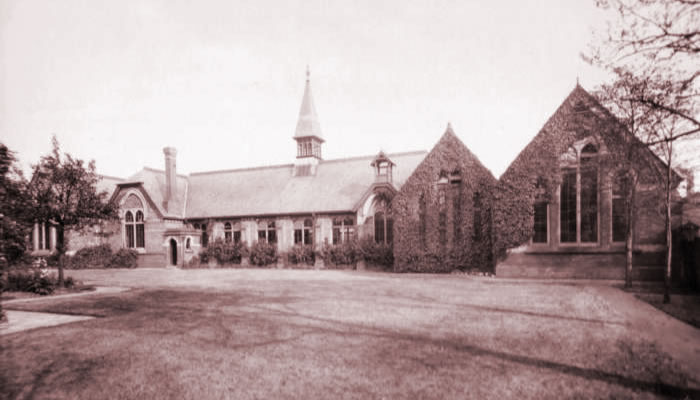
Many years later than originally expected, in 1877, Burton Grammar School was at last transferred to the newly erected Bond Street School.

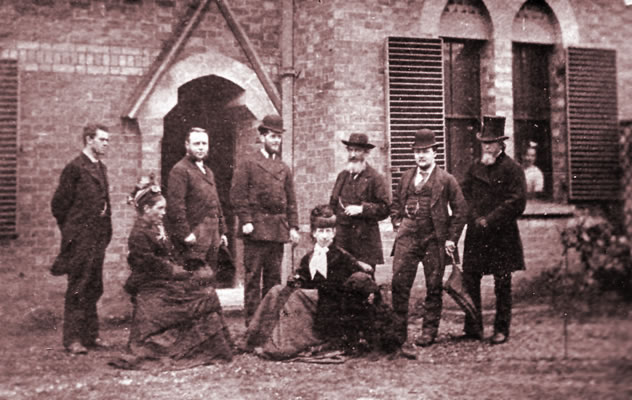
Staff
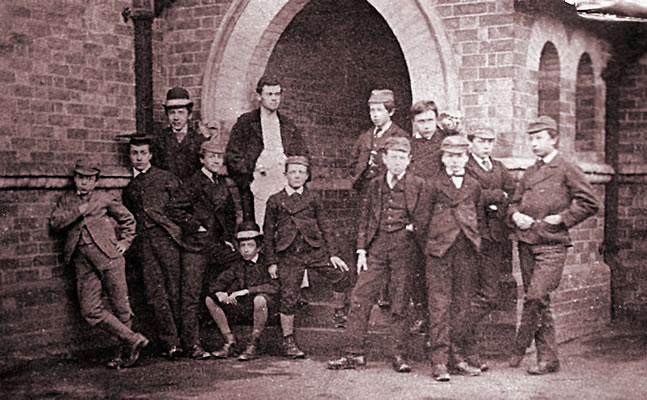
The above picture was taken just prior to the opening of the new school and shows the school staff and their wives.

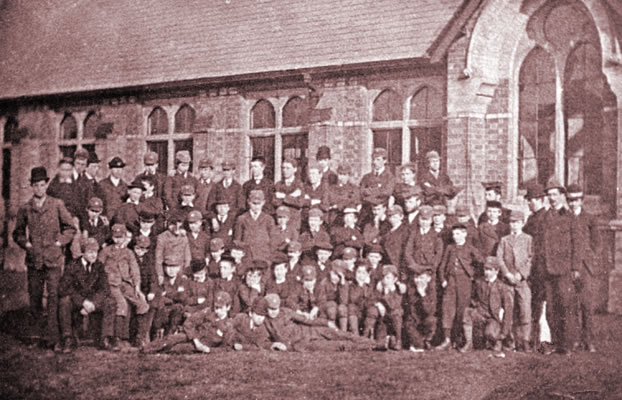
Group

Fortunately for us, Mr Tripp had the foresight to have the above picture taken which shows the entire school, pupils and staff, at the time of transfer. This included the grand total of sixty-seven, all boy, pupils.

The majority of students at this time still had to pay a £8 per annum fee. Scholarships were available from the Local Education Authority to boys who had passed a satisfactory examination, although only four such scholarships were available each year.

Subjects on opening included: Mathematics, Geography (political and physical), English (grammar, composition and literature), History (ancient and modern), Natural Science, Latin, Economics, Art and Drawing, Vocal Music and one foreign, European language.

1880 – Bond Street

My apologies for the poor quality of the photos but they have been restored as far as possible without destroying any of the original character or information; they are after all, well over 120 years old and just too good not to feature!

By 1880, the school was now established with just over seventy pupils. The number of pupils was to remain very low but received a boost a few years later, in 1884, with the amalgamation of Allsop’s School – but still well short of the over 500 boys by the time the school moved to much needed larger premises. Accommodating such a number would have been inconceivable at the time.

The Headmaster in 1880 was still Charles Undershell Tripp who had seen the school move from Friars Walk to the new premises. Second master was T.W. Beckett. Other masters were Dr. A.B. Plant (music master), J.F. Halker, J.O. Webb and Mssr. H.L. Guilmant (French).

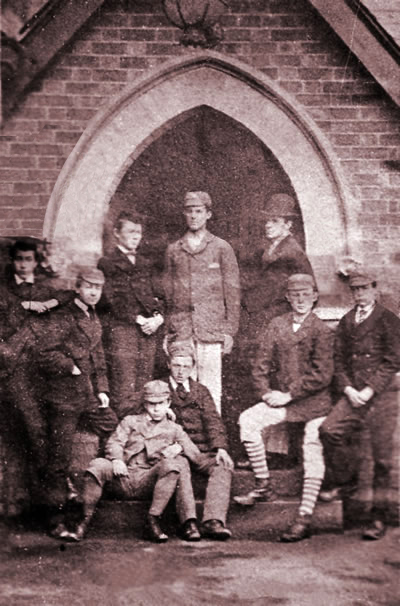
It can be seen that there is no formal uniform yet. Boys had to wear trousers and jacket to an approximate style and colour and some form of cap for juniors which bore a school badge, designed by Mr Tripp; this appears to be relaxed to other types of hat for seniors.

School Regulations – 1930/40s

The School Regulations for the late 1930s and early 1940s provide a good feel for the school in those times.

The standard fee which applied to almost all pupils was Five Guineas (£5.25) per term – not including text books on top of which had to be paid 9d (3.75p) for the Cygnet magazine subscription and 1 Shilling (5p) for the Hospital – a not insignificant fee at the time!

rules

rules

rules

rules

rules

Just to put all of this in context – at the time:

angliaAn average three bedroom semi-detached house would be around £550
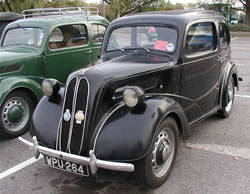
A new Ford Anglia de Luxe family car would set you back £140 and to keep it going, petrol was 1 shilling and sixpence a gallon (1.65p per litre).

Boy’s Flannel suit 25/-, shirt 7/6, jumper 7/6, shoes 16/- (total £2.80).

Mars bar from the tuck shop 6d (2.5p)

Bond Street 1900 Textbooks

The following text books were in use in 1900. Tantilizingly, some of these books are still obtainable from book collector websites.

Maths
A Treatise on Arithmetic – James Hamblin Smith
Exercises in Algebra – James Hamblin Smith (Later re-published by Hall and Knight).
Euclid – Isaac Todhunter (Euclid was still fashionable to be eventually replaced by general geometry).
Elementary Trigonometry – Hall and Knight
Differential and Integral Calculus –  J. Edwards

Science
The Elements of Statics and Dynamics I & II (Mechanics) – S.L. Loney
Heat for Advanced Students – Edwin Edser
Modern Chemistry (!) – Henry Roscoe

Other
French – Chardenal for Grammar and Sentences. Set books for Cambridge Local.
Latin – Kennedy’s Latin Primer, Caesar to Division III. Gepp’s Latin Prose. Vergil, Ovid and Cicero for Divisions I and II.
English – West’s Grammar. Verity’s Texts for Shakespeare.
History – Ransome.
Geography – Longman’s series for political and physical geography.

Bond Street School

In 1877, some sixteen years after it was first proposed, Bond Street School, together with the Headmasters house which had caused some controversy, was finally opened and the school was relocated from its now uncomfortably overcrowded premises in Friar’s Walk.

A new chapter in the school’s history had begun.

Select page to view:

1931 Nelson House

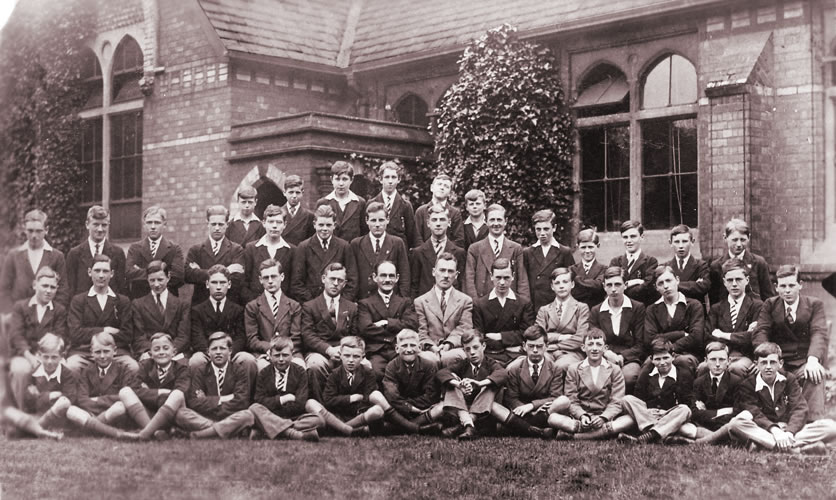
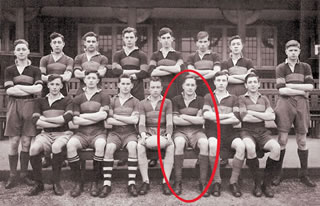
This excellent find shows the complete Nelson house for 1931. The Headmaster during this period was S.E. Wilson. Masters featured include E.C. Nicholson (House Master?) and A.C. Brown and the only pupil identified is Charles May who can be seen 5th from right on the centre row.

It is tantilizing to know that photos of the other three houses were taken and it is my hope that they can all be rescued before it is too late.

1951 – School Report

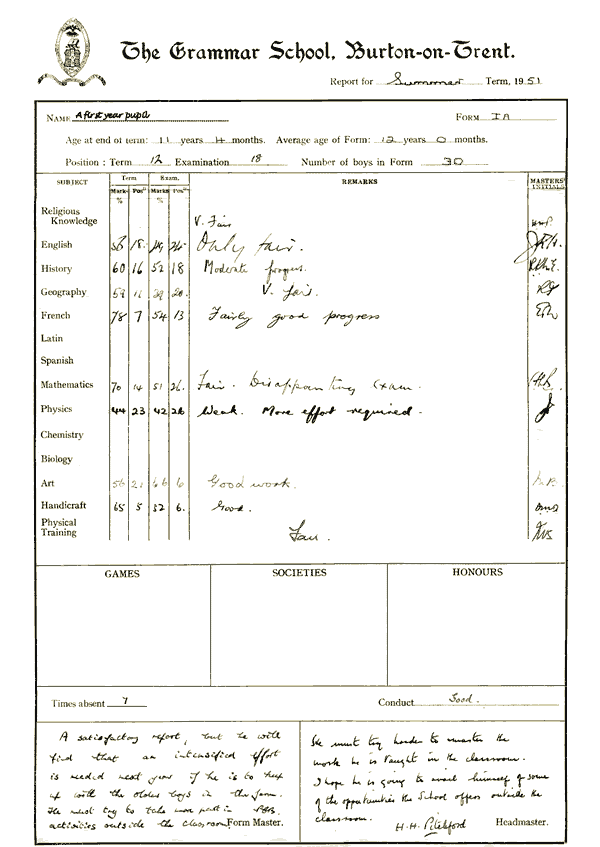
This first form school report for 1951 gives some idea of the curriculum.

Form Teacher: A satisfactory report but he will find that an intensified effort is needed next year if he is to keep up with the older boys in the form. He must try to take more part in activities outside the classroom. (Percy Barratt).

Headmaster: He must try harder to master the work he is taught in the classroom. I hope he is going to avail himself of some of the opportunities the school offers outside the classroom.
H.H. Pitchford (Headmaster).

Subjects taken can be seen to include:

  • Religious Knowledge
  • English
  • History
  • Geography
  • French
  • Mathematics
  • Physics
  • Art
  • Handicraft
  • Physical Training

With Latin, Spanish, Chemistry, Biology to come later.

John Clubb: How the War affected the school

ClubbI was evacuated from my home in Manchester in August 1939 to live with my maternal Grandfather, R.W. Clubb who was a long-retired Head Cooper at Bass’s Brewery. When my sister Helen and I came to live with him at 6 Brizlingcote Lane we were 10 and 11 respectively and he was about 87, a widower with living-in housekeeper.

As I had not been at Burton Grammar School before the War, I am not able to make any comparisons. However, I assume the average age of the schoolmasters went up pretty quickly after 3rd September 1939.

My first impression as a new boy was the strong smell of carbolic mixed with the fainter smell of vomit which pervaded my classroom which was close to the place where the daily milk deliveries were left and to the lavatories nearby. An early Form Master was “Chas” Brown who also taught History. A gentle man who, though not fierce, kept our attention and respect. I used to go to school by bike or bus though we had to travel to the few away sports fixtures by train. Most distant venues were KES Aston, Cotton College who, with Denstone Grammar School normally beat us in my time. We used to beat Lichfield, but we were only just beginning to become useful at cricket and rugby at the end of my time at BGS. We always had an excellent Swimming team in those days.

I suppose one thing the War did for the school was to promote the introduction of Sea Scouts and Air Training Corps. The latter did a great deal for me in that it prepared me for what eventually became my main career in the Royal Air Force which lasted until I was 47 years old. Bill Read (Maths and Swimming) was the leading light in the ATC and he had support from Ron Illingworth (Geography and Cricket) and Jake Hammond (French and Rugby). We did Drill, Navigation, Shooting and latterly went on camps at RAF stations (Halton was one I think). We also were given the opportunity to fly as passengers in powered aircraft (my first was a De Havilland Rapide twin engined biplane flying from RAF Hednesford I think) and we did a bit of gliding from Burnaston airfield.

Before the ATC I had been a member of the Scout Troop run by ‘Tweak’ Hearne (Maths and English) – so nicknamed because of his evil habit of grabbing a finger and thumbfull of short hair at the back of the neck of miscreants in his classes. Most painful, but very effective in those days when schoolchildren did not, could not, fight back. The days when parents sided with schoolmasters and, as often as not, added their own punishment if their children were unwise enough to complain of the punishment already meted out in school. As a scoutmaster ‘Tweak’ was excellent and ensured that his charges had plenty of opportunity for rough, well controlled horseplay mixed with reasonable discipline. The senior scouts were given opportunities to control and lead the juniors.

We went on scout camps and school camps which were open to all. Vague memories of both types of camp were that there was plenty of excitement and frequent dramas, but always good fun. The school camps I attended were a farming camp to West Hanney in Oxfordshire (we got there on bikes) and a forestry camp near Lake Bala, North Wales. At the latter I managed to slice a large piece out of my knee with a billhook and, after a few days in bed in a tent, the wound began to smell so that all concerned thought hospital might be a good thing. I finished up in Wrexham Hospital amongst injured troops and, thanks to the newly discovered penicillin, didn’t lose my leg. Incidentally I was there when ‘VJ Day’ (end of the war with Japan) was declared. Despite the forecasts of the Wrexham doctors that I would never play again, I was back playing rugby before the end of the year. Mrs Hearne was also with us on camp and I used to wonder how on earth she could have enjoyed herself with such a rabble as us.

Back to the War. I saw 3 Junkers 86s fly over one day and one night 3 bombs were dropped in Burton but, apart from seeing the searchlights, hearing the anti-aircraft guns and the throbbing engines of the German raiders on many nights as they flew over to bomb various towns and cities in the Midlands, we saw no action – though you may be interested to know that my Mother (who was an Old Girl of Burton High School and died last November in her 107 th year) experienced a Zeppelin raid on Burton in World War I.

We did see the glow of Coventry burning one night. Boys used to bring in to School pieces of shrapnel from the anti-aircraft shells – I never heard of anyone on the ground being hit. Also, on one occasion during a French lesson (I can’t remember the name of the lady teacher) we were almost blown out of our seats when the bomb dump near Hanley blew up – not, apparently, the result of enemy action. This was later claimed to be the largest conventional explosion of the War. Strangely, we didn’t hear a bang although the noise of the explosion was heard in Manchester, 60 plus miles away. But -as they say- the earth really did move. Our French teacher thought it was an earthquake.

There were fairly frequent air raid alerts when we were supposed to dash into the air raid shelters, but I don’t recall doing much of that after the first false alarm the day war was declared, possibly because most of the sirens were at night. All the School windows had sticky tape across them to prevent injury from glass blown in by explosions. We all had gas masks too, but we didn’t carry them with us at all times as we were supposed to. We quickly became complacent as the War progressed. I’m sure I must have eaten lunch at School, as there wasn’t enough time to get home, but they must have been not too bad, since I can’t remember anything about them – not even where we ate.

I met Thomas Griffiths at a rugby match in Cambridge last week; he was about 2 classes above me at Burton Grammar School and he told me that the 6th Formers were on a Fire Watch roster and took it in turns to sleep on the school premises and patrol from time to time looking for any signs of incendiary bombs (I don’t think they ever found any). He also said that one of the bombs fell in Abbey Street, near to Bond Street and that the bomb blew a bird cage, complete with budgie, through the wall of one of the houses hit. The bird survived unharmed – despite the absence of counselling in those days! My sister tells me that William Joyce (Lord Haw Haw – a British traitor who used to broadcast nightly from Germany) said that Burton had been completely destroyed by the bombing and that beer was running down the streets!

Nothing to do with the War, but a very clear memory was when Mr Frazer, the Headmaster, died suddenly and unexpectedly of a heart attack in around 1940. He was replaced by Mr Harold Moodey who died in even worse circumstances, but after I had left School, in about 1949 I should think. Mr Moodey used to take our class in Religious Instruction when I was in 5 th Form (1946) and was a wonderful gentle man who took a great interest in my progress (or lack of it) in the last 2 years of my school time and in the start of my career in the Royal Air Force. We exchanged letters for a few months after I had left school and was in Southern Rhodesia (Zimbabwe) with the Royal Air Force and it was a great shock when he killed his wife and children and then committed suicide. Never was I more certain that the verdict it suicide whilst the balance of the mind was disturbed was correct in his case. Without doubt he killed his family to protect them from the consequences of his suicide and his state of mind must have been unimaginable – he was such a God-fearing man.

From 1945 onwards there was a sense of change as those who had been in the Armed Forces began to return. I noticed it mainly in the cricket when the newcomers seemed to have decided to take over the annual Masters versus the School match. We, who were loyal to our hero Ron Illingworth and, to a lesser extent, Jake Hammond and Bill Read, felt they were being pushed into the background – particularly as Ron, who usually opened the innings and scored a century, was put in to bat at number 7. I was quite pleased that we beat them comfortably and that Ron top scored for the Masters.

H.J. Wain (1907-11): Memories of the School

In September 1907 I entered Burton Grammar School as a new boy, and even in those days there was talk of a new school, to be erected finally in 1957. As a small boy fresh from a tiny village school the buildings at Bond Street  seemed palatine, although the manual room downstairs, and the Art room, biology room and staff room upstairs were not added till after my departure in 1911.

My previous education had taken place in one large room, in which different classes, for children of various ages were held. So I found it easy to get lost in the multiplicity of rooms at the Grammar School. The first day I was there I strayed into the wrong classroom and it was sometime before my unwanted presence was discovered. And if the grandeur of the buildings oppressed me, I was awed by the appearance of the masters in their gowns and mortar boards.

Few Scholarships
In those days the number of minor scholarships granted by the Education Authorities was extremely small. I believe that only four per annum were granted by the Education Committee at Burton, tenable at the Grammar School. I know for certain that only two scholarships tenable at the Grammar school were granted by the Derbyshire Education Committee. I remember this very well indeed, for I was placed 3rd out of 527 candidates from various schools in the county and the other entrant from Bretby School obtained seventh place. But a Swadlincote boy obtained a higher place, and the Bretby boy was not granted a scholarship. As he had done so well, however, Derbyshire Education Committee, after some pressure, granted him a scholarship tenable at a school in Derby, to which he had to travel each day from Bretby.

Scholarship Boys
At the Grammar School there was a distinction between “scholarship boys” and those whose parents paid for their education. As a rule  the former came from poorer homes and were not so well-dressed, but the masters made no discrimination, and the majority of fee-paying boys were tolerant, though there were a few little snobs. Probably the latter were envious for usually the scholarship boys displayed a brighter intellect, though not all of them made the grade. On the first day of each term, an official from Talbot & Co. – a partner in the firm being Clerk to the Goveners – attended the school with a Gladstone  bag in which to put the money, and a book of receipts. Each fee-paying boy stepped forward in turn, and handed over £3  6s.  8d., in cash, for there were no Treasury notes in those days.

No School Meals
There were no facilities for a hot meal at mid-day. Those boys who lived a long way from school brought their mid-day meal with them, and ate it in the school yard if the weather was fine, or in the Assembly Hall when it rained. There was no school tuck shop, but buns, lemonade and sweets could be obtained at a shop, which consisted of the front room of a cottage, opposite the school, in Bond Street. At a later date a new shop was built a little further down the street. But pennies were scarce in those days, and few of us were regular patrons.

There were a few “boarders” at the school, i.e. pupils who stayed at the Headmaster’s house throughout the term, and were looked after by the Headmaster’s Aunt. Two masters – the Rev. J. Mills and A. Rigby – who lived some distance away usually had their midday meal with the boarders.

Sporting Activities
Attendance at cricket or football was voluntary, and boys who like myself lived at some distance from the school, were not expected to attend, but any keen boy soon found his place.  Wednesday and Saturday afternoons were devoted to sport, attendance at school on Saturday mornings being compulsory. There was a miniature rifle range in a shed in the playground where on certain evenings, after school hours, it was possible to obtain practice in shooting under the supervision of a master. Similarly there were facilities for swimming in the River Trent near the Stapenhill end of the Ferry Bridge. One evening a week after school hours there was half an hour’s physical training with dumbbells under the supervision of Sergeant Micky Maher. During the dinner hour, rough and tumble games of football were played in the school playground.

No Uniform Dress
There was no attempt at uniformity in dress. The only distinguishing mark of a Burton Grammar School boy was his cap, which was marked with alternate bands of red and blue, each band one inch in width. These caps were conspicuous at a distance, and any boy infringing a rule was careful to take off his cap before doing so! There were no school badges, and no prefects’ insignia, for the good reason that there were no prefects! The school was not divided into houses, and there was no school magazine since the ‘Cygnet’ had temporarily stopped, although a boarder named Drewry and myself tried to start one a new one, by carefully writing out the ‘copy’ and using a gelatine bed. I believe it ran for about half-a-dozen issues!

‘Dickie’ Robinson – Headmaster
In 1907 there were 134 boys at the school, and the staff consisted of the Headmaster and eight assistant masters, Even in those days space was limited, and not infrequently two, and sometimes three masters would teach at the same time in the Assembly Hall, which could be divided into three “rooms” merely by pulling curtains across.

The Headmaster, Mr. R. T. Robinson, M.A., B.Sc., was affectionately known as ‘Dickie’. He had a fierce bristling moustache of the type favoured in after years by R.A.F. officers. But his fierce expression was belied by a twinkle in his eye, and my four years at school laid the foundation of a lasting friendship which lasted until his death. He was just and impartial, and had the knack of imparting mathematical knowledge which stirred the dullest intellect. On occasion he did not hesitate to inflict corporal punishment. Such an incident being a rare occurrence had the greater effect upon the school.

‘Piggy’ Jeffcott – Second Master
The senior assistant master was W.T. Jeffcott, B. A.,  known to generations of boys as ‘Piggy’. Stout of body, ponderous in movement, and sporting a ragged yellow moustache, his brain was keen and alert, and it was a very smart boy indeed who contrived to bluff him. His particular subject was Latin, and with experience gained over many years he had reduced teaching to an art. He seemed to know instinctively what questions would appear on an examination paper, and any boy who was prepared to work benefited greatly, but a shirker felt the lash of his sarcasm.

Rev. ‘Nitty’ Mills
Another interesting character was the Rev. James Mills, who was irreverently nicknamed “Nitty”. His lean, stooping figure was garbed in clerical black or dark grey, and he had a neat grey beard. His watchful eyes immediately detected any slackness in class, and his favourite punishment was an entry in the “black book”. Three entries in this book caused the culprit to forfeit a half-holiday, and subsequent entries led to an interview with the Headmaster. Of all the masters, Nitty was the most frequent user of the book, and if it was not in its usual place in the drawer of the desk in the Assembly Hall, any master needing it would send a boy to see if Mr. Mills was using it!

‘Strongy’ Storer
 Probably the most popular master was ‘Strongy’ John Storer. Small and slight in build, with a ragged
moustache, Strongy had a pair of twinkling grey eyes which missed little that went on. His subjects were chemistry with the higher forms (IV B upwards), and Natural History with the lower forms. The latter subject was his favourite and my regret I had collated Chemistry with him instead of Natural History. But we became great friends, and many specimens from his collection and in the school Biology laboratory were obtained by me. Our friendship continued long after I left school, and we enjoyed many rambles together.

‘Theta’ Rigby
And then there was the lean dark figure of Arthur Rigby, B.Sc., noted for his sarcastic  remarks. His main subject was Physics, and he was nicknamed ‘Theta’ because he frequently used this symbol to denote a rise or fall of temperature during his lessons. Subsequently he became Headmaster of Coalville Grammar School. It was he who gave me my only entry in the Black Book. In practical Physics we worked in pairs, and my partner, a boy called Adams, burned the bottom out of a calorimeter. Theta was very annoyed and gave Adams an entry in the Black Book. Then, turning to me, he said, “I’m going to give you two entries, Wain. Always remember, when you have a fool for a partner, you’ve got to watch him!”

‘Pecky’ Pecquintot
The French master in those days was a Swiss named Pecquinot and nicknamed ‘Pecky’. He possessed prodigious strength, and his favourite trick was to take a batch of impositions, and tear them across repeatedly, displaying a strength of wrist and fingers I have never seen equalled. If he caught a boy not attending to him, he would seize the culprit by his ears and lift him out of his seat saying, “Ach, I will pull your cabbage-leaf for you!” Pecky spoke several languages and once confessed that Welch was the hardest to learn.

Two other masters were the Headmaster’s brother ‘Taffy’, and ‘Paddy’ Wood.

‘Tommy’ Stevenson
‘Tommy’ Stevenson was concerned with the lower forms and I never had a lesson under him. His burly form and twinkly eyes concealed a hidden sense of humour. He was a bachelor, living in lodgings and on one occasion when he was ill, two of his colleagues went to see him. “Front room upstairs”, said his landlord after they had introduced themselves. Pushing open the door, the visitors saw a mound of bed-clothes on top of which lay a wreath. “Good Lord!”, said one of them, “she might have said that he has passed away”. Then a voice boomed out from the bed, “Pleased to see you fellows”. “What is the meaning of this?”, they queried. “Oh, I felt a bit low so I sent for a wreath and lay there admiring it. I feel much better now”. And he duly recovered.

John F. Rose
On one occasion, John Rose who lived in Stapenhill came over the Ferry Bridge on his way back from school lunch. A sudden rainstorm caught him unprepared and he was wet through when he arrived back at the school. As he entered the Assembly Hall, he was spotted by the Headmaster. “Ah Rose”, he said, “you look wet, come along with me”. He took him across to the headmaster’s house and rigged him out with a spare suit of plus fours. John was a fairly big man but with the kneebands of the plus fours fastened around his ankles, he presented a startling appearance which fascinated the school for the rest of the afternoon. He was very glad to change back into his own clothes at the end of the day which had been dried for him.