Menu Close

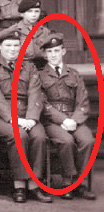
John Goodhead: 1959 RAF Church Fenton Cadet Visit

In the 1950s the RAF seemed to be very exciting. The new RAF fighter planes the Supermarine Swift and the Hawker Hunter broke several world records. The new Gloster Javelin all weather fighter had a delta wing and new Air-to-Air missiles. The iconic V-bombers were entering service. The first V-bomber was the Valiant painted in ‘anti-flash’ white. A year later there were the delta winged Avro Vulcans, then a year after that the last of the V-bomber types, the crescent winged Victors. Even RAF Transport Command had a jet transport squadron by the time I joined the Grammar School.
Bomber Command was commissioning a Thor missile squadron and Fighter Command seemed to be swapping fighter planes for Ramjet powered Bloodhound missiles. Then the amazing Lightning interceptor entered service so there was still a chance to be a pilot of the future in the RAF.

With all this in mind a week or two at an RAF camp in the late 1950s and early 60s looked like an exciting prospect for any RAF cadet.

Training Squadrons and Air Experience.
I am sure that most of the RAF personnel do not fly when they are at work, however it was important to get cadets into planes and off the ground. This was called Air Experience. At camps there were two ways to get Air Experience. The first was to be a passenger on a multi engine training flight with free seats in the back. The second was to become a temporary trainee pilot and sit with a pilot instructor, hands-on.


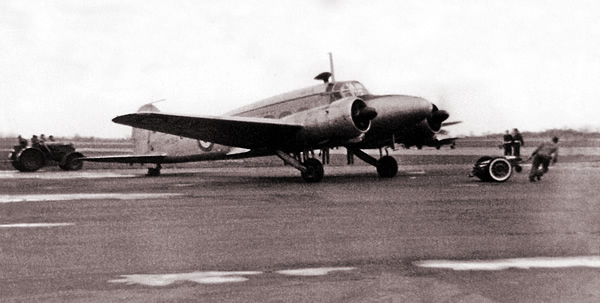
The Avro Anson looked like an old mini airliner. This type had been in service with the RAF since before WW2 and was still the standard twin engine trainer in the 1950s and 60s. They were slow, noisy, often smelling of ‘AvGas’ and exhaust fumes and were nothing like the supersonic RAF of the New Elizabethan Era of the newspaper headlines.

The Avro Anson was the most common provider of our Air Experience probably because there seemed to be one at every camp, more at RAF Shawbury and RAF Swinderby. One time Cadet Under Officer Ian Quayle took over the controls of one and took us all for a spin for an half an hour or so.


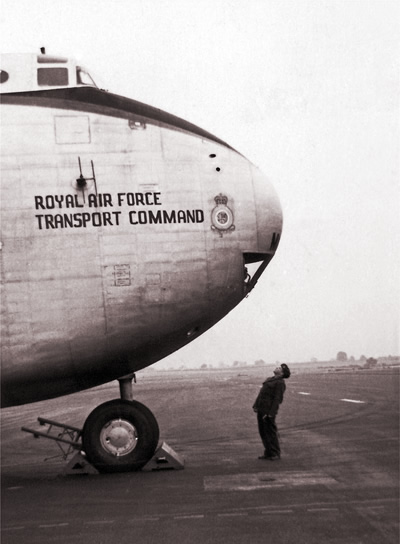
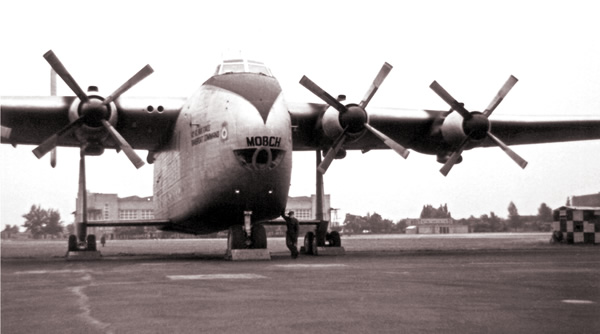
While at camp with Transport Command at RAF Dishforth we had the opportunity to fly in a Blackburn Beverly transport which was quite new, having only been in service since about 1955. At the time of entering service it was the largest aircraft in the RAF, I suppose they were around 3 stories high, they could carry 30 paratroopers in the tail boom and many more in the main cargo hold.

This is why I had my chum in the above shot for scale. There was an opportunity to fly in one of these planes when the crew were training on circuits and bumps. Circuits and bumps involves a plane taking off, flying round and coming in to land, rolling along the runway, powering up and taking off again, then doing it all over again and again. I declined the kind offer. Fortunately there was an option to go on the rifle range.

I had a hands-on opportunity in a De Havilland Chipmunk. This was a tandem seat basic trainer. I remember that it was difficult to walk to and get into the aircraft with my parachute bashing against the back of my legs, below the knee.

I also had a go in a Vampire T11, this fighter trainer had ejector seats. An aircraftwoman fastened me into the parachute which was fastened to the ejector seat. Even my ankles were strapped to the seat to stop my legs from flaying around and getting chopped off in the event of ejecting. Once I was fastened in, the aircraftwoman pulled out the seat’s arming pin and it’s big red disc from the back of the seat (like the pin out of the grenade) then showed it to me and stuck it in a pocket on the side of the seat. Now I knew that the seat was armed and it was safe for the pilot to take off.
Frontline Squadrons.


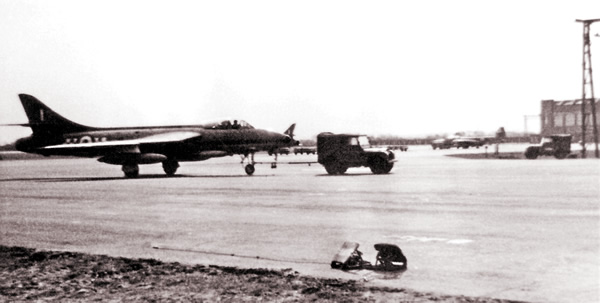
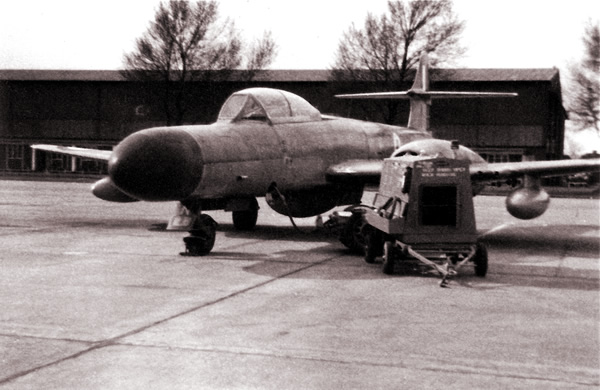
At RAF Church Fenton in 1959 there were two squadrons, one flying Hawker Hunter day fighters and another flying Gloster Meteor NF11 and NF14 night fighters. The Meteors were in the process of being phased out as the new Gloster Javelin night fighters came into service. If we had flown in a Meteor the bail out instructions were as follows; If you should need to leave the aircraft the pilot will let you know. He will tell you that he is releasing the canopy. After he has released the canopy he will tell you to stand. You stand and the airflow will carry you out of the cockpit to safety. So you stand, get hit in the chest by a 500+ mph gale which will thrust you backwards into the tail fin. Some new definition of the term ‘Safety’?

When I discovered the black and white contact prints from which these photographs have been taken I could not believe how very old fashioned the Meteors look. We were not allowed to photograph the Javelin or it’s air to air missiles.

RAF camps and air fields seemed to me to be a bit strange. Vast expanses of flat ground, buildings sparse and most of the time there seemed to be no one around. Great times, did a lot of shooting and learned a lot. However the RAF was a lot sexier in the newspapers.

Special Features

Occasionally, and I suppose inevitably, there is a ‘Story to Tell’ about Burton Grammar School; sometimes positive, sometimes negative. I have decided to feature these in a seperate section.

Select item to view:

Harold Moodey

One of the most tragic events in Burton Grammar School’s history was the case of Mr Harold Moodey, headmaster from 1941-1950.

Harold Moodey was educated at Chatham House Public school where, aside from being an outstanding scholar, he was senior prefect, captain of cricket and captain of football.

He gained an Open Scholarship to Oxford and took first class honours degrees in Natural Science and Chemistry. He entered Jesus College, Oxford and was there were war broke out. He then ‘enjoyed’ distinguished service in the Royal Air Force. Back in Jesus College after the war, he gained college colours for football and rowing and became president of a number of societies including Oxford Colleges Scientific Club.

As a post-graduate, he wrote a number of papers and textbooks and had a distinguished teaching career as second master of Chemistry at the esteemed Liverpool Collegiate School and Head of All Sciences at Hampton-on-Thames Grammar School.

… and so it goes on. Colleagues had nothing but good to say about him before he suffered some kind of mental illness and some unsuccessful procedure that had a very negative effect on his mental well-being. He went off sick just before Christmas, 1949, and was reported to be seriously ill.

One morning in May, 1950, to the shock of the school, he went to Burton Railway Station and committed suicide by jumping in front of a moving train. When the police visited his Stapenhill home, they discovered the true extent of the tragedy. His wife and teenage son and daughter were all found dead as the result of head injuries.

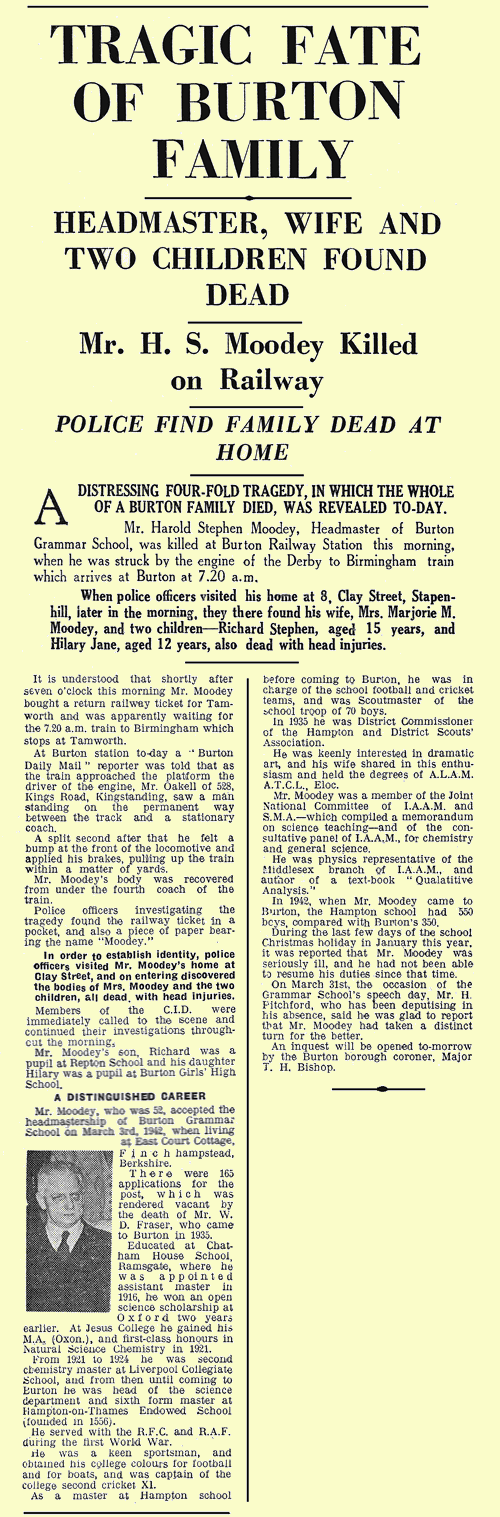
The newspaper reported:

TRAGIC FATE OF BURTON FAMILY

HEADMASTER, WIFE AND TWO CHILDREN FOUND DEAD

Mr. H. S. Moodey Killed on Railway

POLICE FIND FAMILY DEAD AT HOME

A DISTRESSING FOUR-FOLD TRAGEDY, IN WHICH THE WHOLE OF A BURTON FAMILY DIED, WAS REVEALED TO-DAY.
Mr. Harold Stephen Moodey, Headmaster of Burton Grammar School, was killed at Burton Railway Station this morning, when he was struck by the engine of the Derby to Birmingham train which arrives at Burton at 7:20 a.m.

When police officers visited his home at 8, Clay Street, Stapenhill, later in the morning, they there found his wife, Mrs. Marjorie M. Moodey, and two children, Richard Stephen, aged 15 years, and Hilary Jane, aged 12 years, also dead with head injuries.

It is understood that shortly after seven o’clock this morning Mr. Moodey bought a return railway ticket for Tamworth and was apparently waiting for the 7.20 a.m. train to Birmingham which stops at Tamworth.

At Burton station to-day a Burton Daily Mail reporter was told that as the train approached the platform the driver of the engine, Mr. Oakell of 528, Kings Road, longstanding, saw a man. standing on the permanent way between the track and a stationary coach.

A split second after that he felt a bump at the front of the locomotive and applied his brakes, pulling up the train within a matter of yards. Mr. Moodey’s body was recovered from under the fourth coach of the train.

Police officers investigating the tragedy found the railway ticket in a pocket, and also a piece of paper bearing the name “Moodey”. In order to establish identity, police officers visited Mr, Moodey’s home at Clay Street, and on entering discovered the bodies of Mrs. Moodey and the two children, all dead, with head injuries. Members of the C.I.D. were immediately called to the scene and continued their investigations throughout the morning.

Mr. Moodey’s son, Richard was a pupil at Repton School and his daughter Hilary was a pupil at Burton Girls’ High School.

A DISTINGUISHED CAREER
Mr. Moodey, who was 52, accepted the headmastership of Burton Grammar School on March 3rd, 1942, when living at East Court Cottage, Finchhampstead, Berkshire. There were 165 applications for the post, which was rendered vacant by the death of Mr. W. Fraser, who came to Burton in 1935.

Educated at Chatham House School, Ramsgate, where he was appointed assistant master in 1916, he won an open science scholarship at Oxford two years earlier. At Jesus College he gained his M.A, (Oxon.), and first-class honours in Natural Science Chemistry in 1921.

From 1921 to 1924 he was second chemistry master at Liverpool Collegiate School, and from then until coming to Burton he was head of the science department and sixth form master at Hampton-on-Thames Endowed School (founded in 1556).
He served with the R.F.C. and R.A.F. during the first World War.

He was a keen sportsman, and obtained his college colours for football and for rowing, and was captain of the college second cricket XI. As a master at Hampton school before coming to Burton, he was in charge of the school football and cricket teams, and was Scoutmaster of the school troop of 70 boys.

In 1935 he was District Commissioner of the Hampton and District Scouts’ Association.

He was keenly interested in dramatic art, and his wife shared in this enthusiasm and held the degrees of A.L.A.M. A.T.C.L., Eloc. Mr. Moodey was a member of the Joint National Committee of I.A.A.M. and S.M.A. which compiled a memorandum on science teaching and of the conpultative panel of I.A.A.M., for chemistry and general science.
He was physics representative of the Middlesex branch of I.A.A.M., and author of a text-book “Qualatitive Analysis.”
In 1942, when Mr, Moodey came to Burton, the Hampton school had 550 boys, compared with Burton’s 350.

During the last few days of the school Christmas holiday in January this year, it was reported that Mr. Moodey was seriously ill, and he had not been able to resume his duties since that time.

On March 31st, the occasion of the Grammar School’s speech day, Mr. H. Pitchford, who has been deputising in his absence, said he was glad to report that Mr. Moodey had taken a distinct turn for the better.

An inquest will be opened tomorrow by the Burton borough coroner, Major T. H. Bishop.

David Moore (1954-61): First Day at Bond Street

MooreOn the face of it there’s never been anything special about Bond Street. Nothing at all, except, that is, for many of us who used to turn up there from Monday to Friday each week, weighed down with bulging satchels wondering what the day held in store. No, not the fashionable shopping paradise situated in London’s West End. This Bond Street was, and still is, the Burton upon Trent version. Stretching from Lichfield Street to the old Ice Storage building it was a thoroughfare far less grandiose than it’s namesake in the capital. Gaze along it these days from a vantage point on the pavement near Peel Croft and you will notice the open ground on the left which is used as a car park. And, like me, you will probably wonder how a school with it’s sprawling collection of outbuildings could possibly have fitted into such a tiny piece of land. But it did, for this is where Burton Grammar School was situated – from 1877 until the new premises in Winshill were opened in 1957.
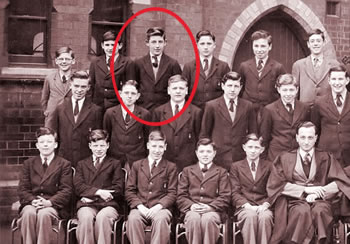
Access to the school was through an entrance about half way along the street. Immediately on the left was a door leading into the main building itself. Then it was along a corridor and past the changing rooms with their distinctive odour. Sharp right and then straight in front, the main hall where assembly was held each morning. At the other end of the hall, a narrow dark corridor leading to the chemistry laboratory and G-Room with it’s rows of desks arranged in tiers. Upstairs, another sprawling maze of corridors and rooms. Then there was the old headmaster’s house which had been converted into classrooms and a library. Situated outside, in what had previously been a garden, were some rather dilapidated prefabricated huts – more classrooms. There was a playground, of course, and in the far corner the bicycle sheds leading to two more places of learning some distance from the main school building itself. And a few hundred yards away, an old chapel. This was to be our form-room three years later. One thing is certain, the whole complex would be condemned as totally unsuitable these days.

Rather like eighty-nine other boys back in early September 1954 I was feeling excited and, I have to admit, rather pleased with myself, as I made my way to Bond Street for the very first time as a Grammar School student, but slightly apprehensive and a touch nervous too. Smart navy blue jacket, red and blue striped tie, grey shirt and grey trousers short ones – but most important of all, that distinctive cap with it’s red flashing across the back, proudly perched on my head. You could always tell where your mum had bought it from, the depth of the red band was slightly different depending on whether it came from Ellis’s or Tarver’s. Things like that seemed very important.

Yes, I remember that first day vividly. Forcing down my eggs and bacon seemed slightly more difficult than usual. An anxious wait for the maroon double-decker bus in Bearwood Hill Road, the journey down from Winshill across the Burton bridge, along High Street past Bass’s offices where the clerks would soon be taking up their positions on their high stools, finally climbing from the bus at the junction with Station Street. From there it was a short walk along the far end of High Street, past Oakden’s shop with that wonderful smell of roasting coffee beans and then sharp right into New Street. Across the old bus park into Lichfield Street before finally ending up at my destination of Bond Street itself.

I think most of us had some idea what to expect when we made our way through the entrance gates and along the short passage into the playground that morning. There had been rumours of some sort of initiation ceremony so it wasn’t totally surprising to find ourselves subjected to what can only be described as a pseudo public school welcome which involved “running the gauntlet” through a group of older boys who gave us a not so gentle clip across the head which didn’t do a lot for the condition of our smart new caps most of which finished up scattered along the ground and trampled on.

Soon it was into assembly in the main hall and a short welcoming address from the headmaster H.H. (Horace) Pitchford before moving off to Z-room, one of the huts behind the bicycle shed. This was to be our form room, a sort of home base, for the next two years. Pupils had already been divided into three classes and for me it was the middle one – B-stream. We knew which of the four houses we would compete for too, Clive, Drake, Nelson or Wellington. I would be wearing the green of Clive, at least that was the colour of the rugby and cross country shirts. Named after Clive of India, at the time it had the reputation of being the weakest of the four in terms of sporting achievements. If only they played soccer instead of rugby I might have been in Wellington instead or so I kidded myself. Apparently Wellington was the strongest but what was the basis for selection, were there mischievous forces at work?

Our form master was Mr Ward who taught French. We called him Ernie, not to his face of course, that was “sir”. Only later did we find out that his real name was Ellick, one that I’d never come across then and haven’t since. We liked him straightaway. Soon we would come to respect him too. One of the first formalities was to have a desk allocated to each of us. Seating was arranged in alphabetical order, that’s why I became friendly with a boy called John Monk. I guess it was just hard luck if you didn’t get on with your alphabetical neighbour; fortunately we seemed to hit it off, partly because we were both keen on football and cricket. Not rugby football but the version played with a proper ball, a round one. Before long we would be under no illusion as to which code was encouraged at this particular school.

Soon it was time for the mid-morning break and a first visit to the tuck shop run by Miss Rawlins and situated on the other side of Bond Street. Decision time, was it to be a jam doughnut or a sticky iced bun? Or maybe both! Ninety minutes later it was lunchtime and, for me, a second bus ride of the day – back home and an interrogation from mum. How did you get on? Have you behaved yourself? What on earth have you done to that cap? I don’t know what happened in the afternoon, I suppose we must have had a lesson or two. But looking back now it was a very special day. I certainly slept soundly that night. As for the joys of freezing cold cross-country runs ending with the acrid fumes from the paintworks the occasional visit to the headmaster’s study, ups and downs on the cricket pitch, detention, school reports and, best of all, that wonderful feeling at the end-of-term assemblies – all of those, and much more, would come later.

John P Bull (1927-34) – Natural History became Biology

Until the late nineteen twenties, it was Natural History taught by the greying and kindly Mr Storer who lived handily in a large house at the Bond Street end of High Street. Appropriate to his subject but not to the man was the nickname ‘Pongo’. Lessons seemed to be in the late afternoon in the draughty classroom/laboratory on the first floor beyond the Masters’ common-room. The wind rattled the dark blinds and, by the blackboard, hung a roll-down picture of the ‘Corvidae’; the group of birds that contains the crows, ravens, rooks, jackdaws, jays, magpies, treepies, choughs and nutcrackers. On this a large rook presided over the lesson as did the portrait of John Jervis, Admiral Lord St. Vincent at the head of the stairs outside. The textbook was an impenetrable work by Stenhouse and, like the Corvidae, it was seldom referred to in the lessons. We were encouraged to report the various wonders we had seen, or imagined we had seen, like white blackbirds and unusual nesting sites – a selection would later be published in ‘The Cygnet’.
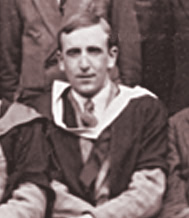
Mr Storer had also assembled much of the collection that used to reside in the cabinets leading to the Biology lab at Bond Street.

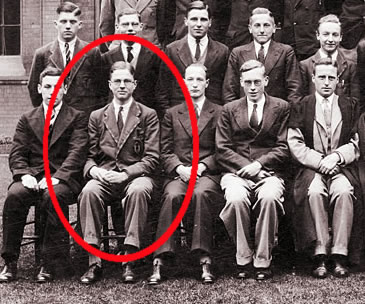
Then suddenly Mr Storer disappeared, the subject became Biology and the teacher a young Cambridge graduate, R G Neill (pictured), fresh from research work at the Plymouth Marine Biology Station (and, I believe, free also from the ‘benefits’ of teacher training). Soon the Corvidae and the white blackbirds were replaced by the different sources of evidence for Evolution and the latest chemistry of Photosynthesis. The genetics of Drosophila were just being explained in terms of genes and chromosomes. Sturtevant, one of the American researchers came to England on a lecturing visit and somehow we got specimens of the fruit-flies and tried to repeat some of his work, feeding the tiny insects on a banana mixture in jam jars.    
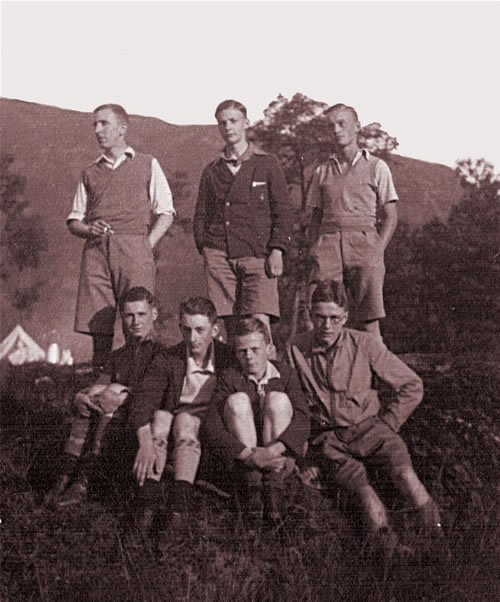
       
Neill (‘Reggie’) had an awkward manner but his penetrating intelligence and devotion to his task made many who might come to scoff remain to learn. His lessons were soon assembled and published in his admirable ‘Aids to Biology’, a miraculous alternative to ‘Stenhouse’. His writing style was precise; he was an admirer of H L Menchen and a favourite quotation was that some claim was ‘neat, plausible and wrong’.
       
The ‘Biology Sixth’ particularly appreciated the clear scientific approach and his enterprising new schemes. There were weekly excursions on bicycles to Hoar Cross to take measured samples of pond life; the counts of animals were correlated with records of pH and temperature. To keep the catch we constructed a series of aquaria with an aeration tower some ten feet high for the water circulation. Another ambitious construction provided the stage which could be erected in the Hall for dramatic performances (I recall that the generous lighting we organised demanded 30 amp wiring). Mr Davies and Mr Neill collaborated in writing and producing the shows.

Some remember that ‘Reggie’ Neal’s desk in the Biology lab stood on a platform. whcih no one was allowed to step on. If they did they were told in no uncertain terms “get off my quarter deck boy.”
       
Mr Neill was also responsible for taking groups of Grammar School pupils on field trips. One such excursion was a summer cycle-camping holiday to the Lake District. This photo shows him standing with C.H. May and Frank Shotton with (left to right) James Woolley, WMN, CM and John P. Bull seated.
 
Another outstanding trip was to the Port Erin Marine Biology station in the Isle of Man. What could be a more enjoyable way to study than to row round a sunny bay and pick up samples of Sea Urchins from the clear pebbly sea floor!

Another of Neill’s literary favourites was ‘The Hunting of the Snark’ and we vied with one another to find appropriate quotations for the various adventures on our journeys – there was never any doubt as to who the ‘Bellman’ was.
       
Reggie Neill left the school during the war years, being replaced as Biology master during his absence by teacher from Newhall called Connie Illsley. Mr Neill returned to the school after the war.

It seemed incongruous that RGN was knowledgeable about spiritualism; we never knew whether his claim to have an aunt who levitated was just a spoof, but he turned such matters to good advantage in his historical novel ‘The Witches of Pendleton’. After marrying late in life, he retired to his beloved Lake District where he continued with success his third career as a novelist.

His first novel under the name of Robert Neill was ‘Mist over Pendle’, published in 1951. The success of this led to other novels, including ‘Moon over Scorpio’. By the time of his last book, ‘The Devil’s Door’, being published in 1979, he had sixteen books published.
       
Robert Neill made good contribution to the life of Burton Grammar School and to the achievements of many of its pupils. Several, such as Dr J.P. Bull C.B.E, C.H. ‘Bert’ May, whose prize giving book can be found elsewhere on the website, and Archie Grain who tragically did not survive the War; also John Woolley, Research Chemist with ICI and expert on photography and caves. His brother Jim and Noel Perks who both became teachers and Frank Shotton an Agricultural Scientist all feel endebted to Mr Neill for his influence and teaching.

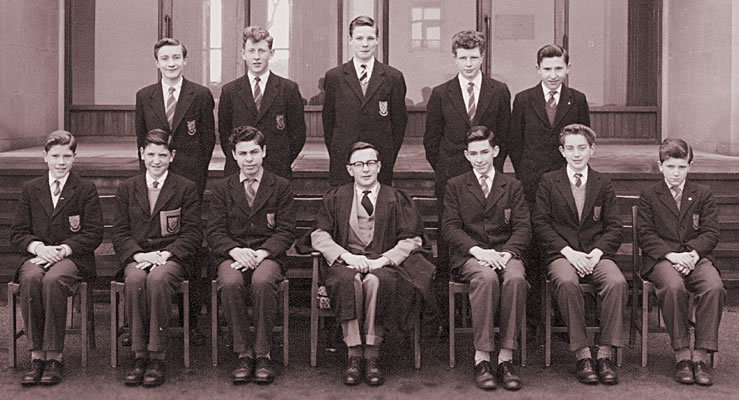
Class 5X

In 1960, Headmaster Bill Gillion, with the co-opted help of Harry Smith, inaugurated a new form 5X. This was a special class was for the most gifted pupils of form 3A. It meant that the small group would study the fifth form syllabus, with the best available tutoring, in their fourth year to gain a year so that they would be able to study Open Scholarship, which went well beyond normal ‘A’ Level, in their year in the Upper Sixth rather than having to spend an addition year there.

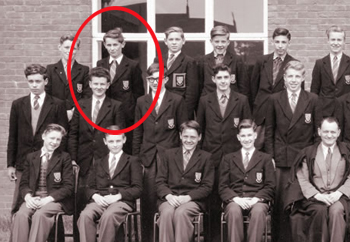
The class was comprised of just twelve boys. Nine of the twelve gained places to Oxford or Cambridge Universities. To put this in context, Repton School achieved eight in the same year!

Sadly there was strong pressure, both internal and external, to look after the lesser able pupils rather than the brightest so the exercise was never repeated. Harry and other of the school’s most senior teachers saw this as the “start of the rot”.

Christopher Tipper is the one pupil missing from the photo. It is thought that he went to Leeds University to he read Mathematics.

Top row from left to right:

Michael Green, studied Metallurgy at Oxford (New College) and now lives in the northern part of England. He visited classmate John Watson some time ago in Copenhagen in connection with some consultative work for IBM. He is still in contact with Roger Heape.

John Watson, studied Chemistry at Oxford (St. Edmund Hall), but converted to the computer industry and moved to Denmark for personal reasons in 1969. He has since worked for IBM for whom he has now worked for close to 40 years and still lives in Copenhagen with his wife Ida.

Roger Heape is considered a very central character. He was a fantastic DJ at John Watson’s 50th birthday in Copenhagen back in 1995 – his guests still talk about it, so many years after! Roger studied Geography at Cambridge (Pembroke College) and has had a lot to do with the Airlines business – BEA in the beginning and British Airways later on in a very top position. Roger has now retired and lives in Winchester together with his wife, Jenny.

Michael Hayton (aka Tudge) went to Cambridge (Churchill College) to study languages and went on to qualify as a Chartered Accountant.

David Allen was the only pupil in the class who did not go on to university.

Bottom Row from left to right:

Richard Inwood became Bishop of Bedford in 2003, however, he started his university career at Oxford (University College) studying Chemistry. (There are lots of web items to be found about Richard and some of them describe his career after Oxford).

Alan Stewart went to Oxford (St. Catherine’s College) and studied Metallurgy on an Exhibition Scholarship. He went on to do a PhD at Oxford before joining the CEGB (Central Electricity Generating Board as it was then).

Chris Howe went to Oxford (St. Edmund Hall) and also studied Metallurgy on an Exhibition Scholarship. He then went into the IT industry where he spent 20 years with ICL before retiring.

Arthur Presswell was the 5x form master and taught History. He did not spend long at the Grammar School and is thought to have come from Southend-on-Sea.

Alan Cooper went to Sheffield University and studied Geology. He also enjoyed an excellent Rugby Union career which included a number of England caps. He went to New Zealand to continue his studies. There, he went to Otago University. Despite not going to Oxbridge, he went on to become a professor (see http://www.otago.ac.nz/geology/afc.htm).

David Gooderick went to Cambridge (Emmanuel College) following which he did a teaching diploma at Oxford (Exter College) and went into teaching.

Chris Jeggo went to Oxford (St. Catherine’s College) on a Full Open Scholarship to study Physics. (articles on the web about him and contributed articles and photos to BGS). Chris moved into defence R&D in 1974 and has remained there ever since, working for a couple of different employers.

Teachers involved with 5x were:

English: Norman ‘Coddy’ Roe
French: Hugh Wood
Latin: Joseph ‘Jake’ Hammond
Spanish: (for the linguists): K.T. ‘Katie’ Harris
Maths: Harry ‘Brab’ Smith
Physics: Ezra Somekh
Chemistry: (for the scientists): Norman Jones
Geography: Ron ‘Ronnie’ Illingworth, and Geoffrey ‘Gaff’ Henton
History: Arthur ‘Elvis’ Presswell who also served as form master.

All pupils in 5x took at least eight ‘O’ levels.

Over 50 years later, a reunion lunch took place in Oxford with nine of the original members in attendance.

Robert James: 1975, Staff eye view

Robert James was a member of staff at the time of transition from Burton Grammar School to Abbot Beyne Comprehensive:

The dreaded ‘C’ word (comprehensive) wasn’t heard a great deal in 1970-71.  Teachers knew that there were plans for re-organisation, but Ted Heath’s victory in the June 1970 general election, contrary to the predictions of every opinion poll, meant that they were unlikely to go ahead.  Burton, it is often forgotten, was then a County Borough, not administratively part of Staffordshire. But local government re-organisation meant that this independence was soon to be lost, and coupled with a change in the political climate locally and nationally, it became clear that comprehensive re-organisation was inevitable.

The Headmaster, Bill Gillion, announced his retirement in 1973, no doubt seeing the writing on the wall, and after a term when Geoff Henton was acting head, Brian Harris took over the reins in January 1974.  He was a man of high principles, as his decision to go into the church five years late clearly showed.  He was approachable whilst at the same time having considerable presence.  It is often forgotten that he had taught at one of the leading grammar schools in the North of England, Stockport G.S., and managed BGS as a grammar school very effectively.

By this time, numbers in the school were falling.  Pupils who had previously come from outlying villages in both Derbyshire and Staffordshire now were directed to their nearest secondary school.  In 1974, the intake was only 2 forms instead of the usual 3.  Another nail was being driven into the coffin.

Before Mr Harris’ arrival, the governors had sought Direct Grant status from the Minister of Education.  There were many Direct Grant Schools in the country, prestigious grammar schools such as Loughborough GS, Nottingham High School, King Henry’s Coventry.  These schools were not funded by the local authority but by a grant from central government, hence the name.  This gave them much more independence than the voluntary controlled schools such as BGS.

The Secretary of State for Education at the time however, refused to re-open the direct grant list. Given that person’s later education policies, this may seem surprising – it was none other than Margaret Thatcher. Fifteen years or so later, her government’s Education Reform Act set up Grant Maintained Schools to free schools, if they so wished, from the dead hand of local authority control.  By that time, the old Direct Grant Schools had been forced by the previous administration to choose either to go totally independent or be subsumed into the local authority system.
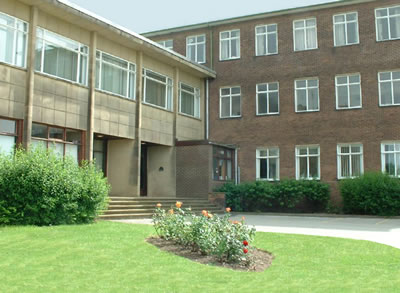
The irony of the setting up of Grant Maintained Schools by the Thatcher government was not lost on those of us still at Abbot Beyne and charged with implementing the 1988 Act.  However, there was considerable opposition and pressure from the local authority and the governors not to seek Grant Maintained Status, and the school’s management got on with the job of implementing the other major initiatives started by the Act – local financial management and the National Curriculum.

It was the elections of 1974 which made re-organisation inevitable.  Few amongst the staff would have argued that the selection process at age 11 was ideal, but there were many who considered that just as flawed was a total, rushed and inadequately funded upheaval of the secondary education of the town based on two split-site schools at the former grammar schools and single site schools at the two remaining secondary moderns.

However, inevitably the plans went ahead and there was to be new school based on the old Girls’ High School, BGS and the Ada Chadwick School.

It was a stressful time for the staff of all three schools.  In the summer of 1975, staff had to apply for the new posts in the new school.  Some kept their status, some were promoted, some moved into new posts and others lost their status, even if salaries were safeguarded.

Everything happened at break-neck speed.  The new school had to be up and running within months.  There was no investment in facilities apart from botched-up conversions of toilets.  One group of parents attempted to halt the re-organisation by seeking an injunction.  It was the middle of August when a judge in chambers ruled that to unpick the re-organisation at that stage would have been more harmful than to let it go ahead.  Until then, we didn’t know for certain what awaited us at the start of the autumn term.
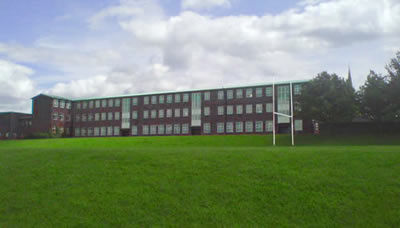
Much bitterness had been generated, with the opinions of many becoming totally polarised.  They were difficult times, and there is little point now in opening old wounds and resurrecting the acrimony of 1975.

Brian Harris, as Head of the new Abbot Beyne School, was inevitably regarded by some of the defenders of the old regime with suspicion, but he showed enormous reserves of resilience as well as sincerity, and did his utmost to bring the staff together and make the new school work.  He did an excellent job in the most trying of conditions, as did the senior staff of all the schools.

Staff opinions at BGS varied.  All were naturally apprehensive.  What many found galling was the fact that some of the more vociferous proponents of the Comprehensive System had left shortly before, leaving the rest of us to pick up the pieces.  Many staff were not opposed to the principle of a comprehensive system, but had well-founded fears about its imposition on three schools without the appropriate investment in new building and resources.  This was, after all, the era in which Denis Healey, as Chancellor of the Exchequer, had to go cap in hand to the International Monetary Fund, such was the state of the nation’s finances.

Split-site schools are difficult to manage.  Travelling between sites leads to stress and fatigue, as well as making timetabling and supervision inordinately difficult.  Gone were the old days when you walked a few yards from the staffroom to your class. Now, for many, it was a dash to the car-park, often carrying a pile of books or resources, and a journey along Bearwood Hill Road to be in time for the next lesson.

The vast majority of staff, especially the younger ones, were pragmatic.  If they wished to teach in a grammar school, then they had to look towards the independent sector.  This was not appealing to many of those who had been educated and had taught in the state system.  Staff had to do their utmost, for the sake of all pupils, to make the slit-site system, imperfect though it was, work.
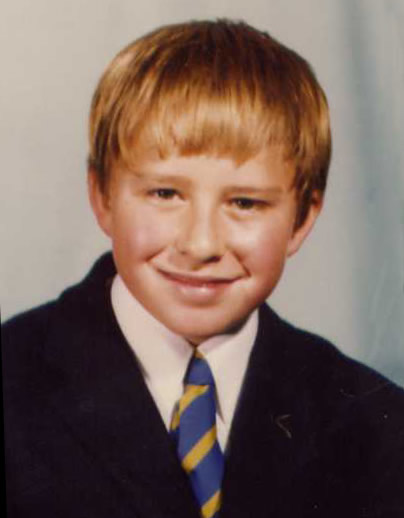
New ways of working had to be adapted whilst at the same time trying to maintain the best features and traditions of the school.  The object was always to provide the best education possible.  Whether this can be judged to be successful or not, it was certainly not for lack of trying by those involved at the time.

Deus Nobiscum

Paul Leedham: 1975, Pupil eye view

Paul Leedham was one of the pupils at the time of transition from Burton Grammar School to Abbot Beyne Comprehensive:

As far as the transition from Grammar to Comprehensive was concerned – the whole subject was full of mixed emotions. Many pupils lived in denial that it would ever happen. The cynics amongst us, always filled with awe at the legacy of Mr Gillion, believed that Bomber Harris was brought in because of his left-wing tendancies!! (it never occurred to us that perhaps, just maybe, Mr Gillion was at retirement age by then!!) Nonetheless, the idea of the school becoming comprehensive was something we could never contemplate, despite the fact that several masters told us “this will happen in Sept ’75” and tried to convince us that converting to a Comprehensive was a much better prospect… as if it were just a game of politics… it became apparent just who the “yes” men were amongst the staff. We were all very proud to ware our Deus Nobiscum badge and accompanying uniform, and what it stood for. Who could possible take the fact that we were Burton Boys Grammar pupils away from us? Well the system couldn’t – the vast majority of us continued to wear our uniform, badge and tie until we left school and moved on, despite being encouraged to hang up our uniform and don the new badge with the motto “Onward Together”.

When the transition arrived in September 1975, the effect ranged from submission to the new regime, to what verged on anarchy. I can clearly remember the first morning, when the doors opened. Where coat hooks had stood at the end of summer term, there now stood horrible, tall metal lockers! Our beautiful wooden lockers, which were built into the walls along the corridors (I’m sure you’ll remember them) were all closed, and were kept that way be means of 4-inch nails through the doors and into the frames. Now we understood why we were asked to empty our lockers at the end of the summer term. Enter the anarchists! A small number of pupils, (suprisingly they were probably the brightest amongst us) borrowed claw hammers and removed as many of the 4-inch nails as possible, and then transferred their belongs back to the wooden lockers. This was followed by a ritual kicking of the new metal lockers, until they were dented and severly damaged. When faced by staff, the anarchists were abusive, disrespectful and downright obnoxious. They’re previous respectful approach to authority was nowhere to be found. Needless to say, the anarchists were dealt with via statutory means at the time, the cane, plus letters to parents. Suprisingly, none were suspended.

Despite the demise of Burton Boys Grammar in name at least, the merger of the three schools caused a number of different emotions. Certain pupils could see the benefits: access to girls from the High School would be much easier, and justified; after all, we were one school now with some mixed classes. However, there was a downside: Ada Chadwick. The girls from there were considered to be “not of suitable standing” to be seen with Grammar School boys, and were avoided at all costs on this basis. The Ada Chadwick boys were another problem all together. They treated us with contempt and regularly called us “Grammar School poofs”, “Nice Boys” or “Snobs”. This led to many bloody scenes, one of which I was involved in; I sustained more damage than any rugby match had inflicted ever on me. Then there was the organised battles on the bank between the rugby field and the ex-Ada Chadwich Building, involving missiles of all shapes and sizes. They were frightening times.

Eventually, I think we came to accept what had happened, but a streak of rebellion always remained. Right to the point where I left the school in 1978, there would be a small contingent that refused to sing the new school song (myself included), and would manage to sing “Deus Nobiscum, God With Us” at the same time as the new song.

At the end of the day, we were all proud to have been pupils at Burton Boys Grammar. Its legacy lives on in all of us. Whenever asked, I’m sure most say “I was at Burton Boys Grammer School” -never- “Abbot Beyne”; I know I do, and always will.

Ian Giles (1949-52): The way it was

GilesLife is punctuated by defining moments, how many defining moments we are allotted in life I have no idea, but do we recognise them when we experience them? Well, looking back on my life I can trace several, but at the time, they came and went without even registering a flicker on the Richter scale of defining moments. Apart from my birth being the first, the next must have been the year 1945, when as a 7 year old, the ending of the second world war was signalled by having a victory party held in the street where I lived, races were held, and during the 60 yard sprint I stumbled at a critical moment, it robbed me of victory my Uncle always told me. I only mention this, because 6 years of grinding war had passed me by almost unnoticed.

It was the following years of the late 1940’s, my education, such as it was, progressed to me winning a scholarship to the Grammar School, which in a way must have been another oblivious defining moment, because apart from my Mother announcing the fact, very little else in the memory department seems to have registered. Yes, there was one thing, to celebrate this result I was rewarded with a brand new gleaming Hercules single speed bicycle, with rod brakes. I well remember preening up and down on my new bike telling anyone who would stand still and listen, that I was going to the Grammar School, what a complete prig I must have been.

Another defining moment was ‘lost’ when; in the September of 1949 I started at Burton on Trent Grammar School. Try as I might, I can honestly say that I cannot recall a single happening of that day, so, it is to elsewhere that I must look for help. First, I would like to take a look at what the social conditions were like at that time, looking back, I was clearly aware that Victorian values were still in evidence, as the foundations of the Victorian era were still very much in place, like all institutions of the time, Burton Grammar School reflected and promoted the ethos and values of the Victorian age, it was a fact, anyone over the age of 50 was born a Victorian.

How hath the mighty fallen, from being a respected member of the hierarchy of Junior School I found myself catapulted into the abyss of the unworthy, mine was to obey, to be seen and not heard, to touch my forelock and passively submit, anyone older than me was god, and if I momentarily overlooked this fact, I was instantly reminded by a swift ‘kep’? around the ear. Beware of those clad in beribboned blazers for they were the High Priests and to be revered accordingly, for they were the police lieutenants of the Masters themselves.

When the grading of newcomers took place, each pupil was allocated to a Form, (class) in other words selected and streamed according to intellectual ability, the elite went into Form 1A, the midstream went into Form 1C and the also-rans went into Form 1B, the logic of A C B alludes me to this day, needless to say I was in 1B. In addition to being selected into a Form, every one was also allocated to a House. The House system comprised of Drake (blue), Nelson (black), Clive (green) and Wellington (maroon) we soon discovered the importance of the house system, which more will be said later. We had barely become accustomed to our new surroundings when 1B had its first incident, we were all waiting in the gym for the PE teacher to arrive and start our first PT lesson. Standing around, curious at the site of strange equipment two or three of the boys started messing about on the ropes, suddenly the cry went up, ‘somebody’s coming,’ by this time one of the climbers was at the top almost touching the ceiling, on hearing the warning from below, he slid down to the bottom like a fireman on a ‘shout’, the state of his hands and legs told their own story, as did the look on his face.

I was struck by the difference of the routine at my new school, laden with books in the ubiquitous satchel (leather bag) I navigated my way around my new surrounds, unlike my previous school, here, different classrooms were used for different subjects. Classrooms were positively Victorian in appearance (probably were) heavily constructed desks made of oak and wrought iron, complete with inkwells. On top of the thick, hinged lid of the desks, was generations of graffiti engraved by former occupants, what stories could they tell? Behind the master’s desk a huge blackboard was affixed to the wall, indispensable, for theses were the days of traditional blackboard teaching, nestling handily nearby, the blackboard rubber, which in experienced hands could be hurled with unerring accuracy at inattentive or fidgeting youth. The be-gowned eagle eyed master, would be perched in his eerie with a clear view of his charge and within handy distance would lurk the whip-like blackboard pointer, which doubled as a rapier when called upon to quell the unruly mob.

All work and no play made Jack a dull boy; cerebral exercise was generously alternated with exercise of the body in the shape of PT in the Gym or games on the playing fields. This is when I came to life, for sport of any kind was the elixer, inter house competition was promoted by the school, thereby inculcating ‘team spirit and what is known nowadays as bonding, victory was desirable but never paramount, modest in victory, magnanimous in defeat, win or lose, it was the taking part that counted. Rugby, cricket and athletics were all played on the schools sports ground, which was located off Branston Road next to the Peel Croft (Burtons RFC playing field) I had completely forgotten (until I recently read on BGS website) that we were also bussed to Shobnall fields for games afternoon. To be caught playing soccer with an oval ball was a cardinal sin and the assembled culprits would be bawled out. (Brab Smith?) Actually, many of the better Rugby players were in fact very good footballers, Gary Jordan (Burton Albion)- Dennis King (Gresley Rovers) – Keith Miller (Albion). I’m sure readers can name more. Obviously, Cross Country was different, an excellent account of the courses and wheezes are documented elsewhere on the website, my abiding recollection was, when on the return home, on the straight passing the Victolac (?) paint factory, the place was turned into a world war I battle scene, as skinny, singlet clad bodies, collapsed, clutching their throats and coughing blood, having inhaled the vitriolic fumes wafting across the fence. What price health and safety at work?

I became acquainted with discipline during my time there, both as a recipient and as an observer, I lived the other side of the river and travelled to school on my now, not quite so shiny Hercules, I had to use the Ferry Bridge and of course had to dismount and walk across the bridge, the penalty for being found guilty of riding was a Fixed £2.00 fine (not an inconsiderable amount) Well, you guessed it, one day I was caught riding by a member of the ‘allo, allo’ allo, who, decided to give me a good ‘wigging’ on the spot, just as this was taking place a Master from the school came walking by pushing his cycle, he strode over to join us, enquired my name and then carried on his way. He duly reported me to the Headmaster who, in due course, kindly invited me over to his study. He proceeded to read me the riot act about bringing the school into disrepute, after which, he picked up a whiplash cane and instructed me to ‘bend over’. In this undignified position he fine-tuned my posture for maximum effect, just like a golfer addressing his next shot, he calmly took aim and proceeded to thrash my backside. This is procedure is euphemistically called ‘six of the best’ or more commonly the ‘Whack.’ There was no emotion from either side, just “Now get back to your lesson” from the Headmaster. There is a sequel to this story, for not long afterwards, the Master who shopped me to the headmaster, was himself caught riding his bike and was fined £2.00.

On another occasion I witnessed a further example of how errant pupils were dealt with. A class was taking place and the master called for ‘quiet’ as some pupils (who were standing behind his desk) were talking. The master was examining a boy’s work and the talking continued. With no more ado, the master casually turned round and grabbed the nearest offending boy, got hold of his ear and proceeded to twist it, at the same time forcing the boy’s head slowly down on to his (Masters) desktop, the boy’s features were contorted and twisted as he was forced to look up at the ceiling to ease his pain, I wanted to shout out and stop it, but couldn’t, I did nothing, I just sat there I was impotent; we all were. This type of behaviour was by no means rare; in my time I saw numerous such incidents.

Mentioning the Ferry Bridge reminds me of a strange bird (of the feathered variety) which appeared around 1950, every day, this bird of swan proportions could be seen ‘swanning around’ on the water near to the ice factory end of the bridge, this unusual, nay, rare bird, was identified by one of the gang as a Canada goose. It was (to my mind) a handsome bird, yet solitary and lonely, where it had come from was a mystery, (please don’t say Canada) there were no signs of any of its brethren at all, even today I cannot recall seeing another. This bird must have been an advance goose-scout on reconnaissance for a resettlement programme, because as we all know, this area of the river is to-day, 50 years on, teeming with them, so much so, culling looks a possibility. Another memory of crossing the Ferry Bridge during this period was when the river was in full flood, each year without fail, the whole area was under water, often several feet deep, to be on the bridge surrounded by acres of deep water was thrilling for a boy on his way to school, I well remember on one occasion when the water was so deep you could touch the surface from the bridge itself.

On school days I used to cycle to my Grans for lunch, she lived nearby so it was handy to nip round on my bike. This meant going past the woodworks (Midland Joinery) and across the railway crossing at Bond End. I remember winters mostly, was it my imagination or were winters really so, so, cold? Fog seemed more frequent in those days too, I can recall many a journey on my bike in clinging freezing fog with visibility measured in feet, clad only in a light-weight school ‘mac’, on arrival at my Grans, the ice on the old, huge beer barrel water butt, would be several inches thick. I hated winters, I was always cold, there were no padded, rainproof winter coats with deep lined pockets or fur lined hoods to retreat into, no instant gas fires or central heating, the only concession to warmth was a few spluttering coals in a dusty grate, always provided there was coal to be had of course.

If my Gran’s house was still standing it would now qualify as a museum, in fact the whole street would, as it consisted wholly of terraced houses, built for the workers and was a monument to the Victorian way of life. On my bike, I would approach down the back way to the house, which was a long narrow alleyway with huge brick walls either side, these prison-like walls were at least ten feet high and stretched the whole length of the alley. Over the wall, was the site of the Burton Corporation waste disposal plant, which everyone referred to as the ‘Destructor, on this side, ancient gas lamps stood sentry at regular intervals down to alley’s abrupt end, which came in the form of large padlocked gates. On the right hand side, the walls of the backyards were punctuated with solid doorways set in the wall and as you entered, you brushed past the wall of the outside toilet. On the left, another high brick wall, which divided you from your neighbour. Equally high on the opposite wall was a substantial wooden lean to shed, which was dark and musty inside and contained a heap of dusty coal and old wheelbarrow, which was used for carrying produce from the allotment. Underneath the kitchen window stood the water butt. To complete the picture, under the left wall a token rockery where scraggy ferns struggled for survival. The backyard faced north and was forever in poor light, the only sign of hope being the beleaguered ferns, struggling for life in the permanent gloom.

The kitchen was built as an extension from the main building and protruded into the backyard, as did all the houses in the street for they were clones of each other. Inside the kitchen there was no direct light so it was as gloomy as ever, even on a sunny summers day, all the old technology of the day was present, in the corner there was a brick built copper hearth, this was integral to the kitchen, it was a brick structure for boiling water on wash or bath days, it had a huge vat shape and sat in the brick framework like a cradle, underneath was a fire grate to heat the water. Strategically placed would be odd looking contraptions to help my Gran to do her washing. Things like a large brass plunger on the end of broom handle, I remember such a tool quite well but hadn’t a clue what it was used for or it’s name, even to this day I had no idea, so to the internet I went, (wonderful thing the internet) apparently it was called a posser and was used to agitate the clothes in the water, all by hand of course, a sort of prototype automatic washer, another similar object called a ‘dolly’ was also used, it looked like a three legged milking stool attached to a long handle, the three legs facing downwards, the whole thing would be twisted left and right alternately by hand to agitate the clothes in the water, it must have been exhausting work. A mangle was a most important machine on washday, it was a heavy wrought iron contraption for wringing the clothes dry; the waterlogged washing was placed between the two sponge-like rollers which were located on the top of the frame, the rollers were powered by turning a huge iron wheel fitted with a wooden handle. When all the water had been squeezed out, the washing was then ready to hang up to dry. Where on earth did my Gran dry it? The only place was in a four by two backyard with little sun or wind, if it was raining or the wind was blowing in the wrong direction and blowing soot on to the nice clean washing, then the whole lot would have to be hauled down and hung inside the house from lines suspended from the ceiling. The combination of problems must have seemed endless. Then of course there was the ironing, the iron was, as it’s name implies, a solid moulded chunk of iron with a handle attached, this was placed on the black leaded grate, which was heated by a coal fire, when the iron was sufficiently hot, then it was then ready to do its job.

What did it all add up to? As I check and reread this script, I find it is impossible for me to convey the conditions and ambiance of those times long gone, to those readers of say under 50 years of age, the world as I have tried to describe must be almost impossible to grasp. Everything I was taught and brought up to believe, became part of me, indeed became me. In the course of my lifetime I have seen and continue to see a systematic dismantling and jettisoning of everything that I am and the values I hold. I think the generation to which I belong, must surely qualify for entry into the Guinness Book of Records, for seeing and experiencing the most dramatic changes (of all kinds) in the span of single lifetime. In the summer of 1952 I left BGS, my parents decided to move home and start a new life, taking me with them.