
Back Row: Clive Hardy, Charlie Holden, ‘Freddie’ Yarranton, B04, Brian Luckett
Front Row: Edwards, Peter Ford, Ian Sutherland, Pat Oven, Chadfield

Back Row: Clive Hardy, Charlie Holden, ‘Freddie’ Yarranton, B04, Brian Luckett
Front Row: Edwards, Peter Ford, Ian Sutherland, Pat Oven, Chadfield
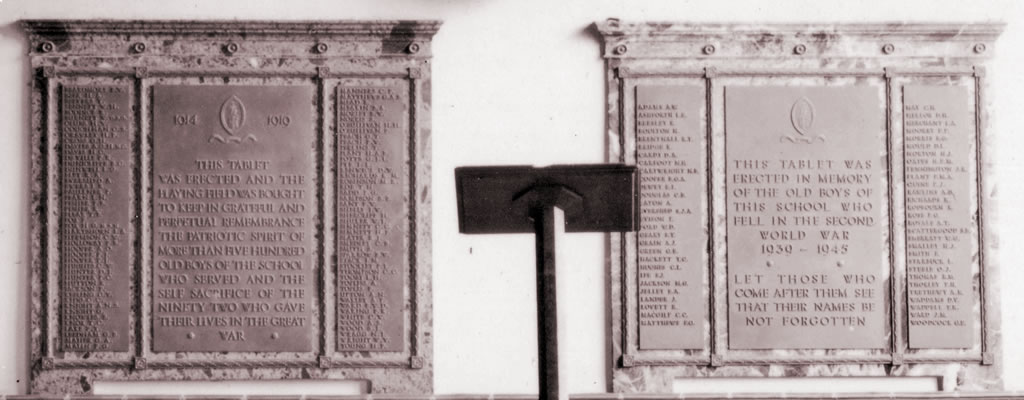
The two Memorial Tablets were situated in the Main Hall at Bond Street School. In the move to the new school in Winshill, they were positioned in the foyer where they remained during the whole time as a Grammar School.

They may still been seen in the current school inside the Main Hall.
WWI Tablet
THIS TABLET WAS ERECTED AND THE PLAYING FIELD WAS BOUGHT TO KEEP IN GRATEFUL AND PERPETUAL REMEMBRANCE THE PATRIOTIC SPIRIT OF MORE THAN FIVE HUNDRED OLD BOYS OF THE SCHOOL WHO SERVED AND THE SELF SACRIFICE OF THE NINETY TWO WHO GAVE THEIR LIVES IN THE GREAT WAR
|
WWI TABLET NAMES |
||
| Beardmore, B. W. | Hughes, C. W. | Robinson, M. R. |
| Beer, H. A. | Hunter, D. J. | Roe, T. H. |
| Beevers, T. | Hunter, P. C. | Sadd, P. G. |
| Bennen, W. H. | Hutton, R. | Sampson, S. E. |
| Boddice, R. | Jackson, F. | Sant, F. W. |
| Burnett, W. (D.S.O.) | Keeling, C. V. | Shelley, J. W. |
| Clubb, H. W. | Kidd, C. C. | Shercliff, H. |
| Couchman, C. S. | Knight, A. N. S. | Shuker, W. J. |
| Crawley, H. F. | Knight, G. | Simnett, C. C. |
| Cross, G. H. | Knowles, E. | Simnett, H. F. |
| Davies, A. G. H. (M.C.) | Knox, T. C. | Slater, R. J. |
| Davis, H. C. | Lake, T. C. | Smedley, C. B. |
| De Ville, P. R. | Leedham, G. E. | Smith, S. |
| Dunnicliffe, E. C. | Maher, G. A. | Sparrow, E. W. |
| Dunwell, L. G. | Malin, F. G. | Stack, J. M. |
| Eley, R. A. | Manners, C. F. | Stockley, P. L. |
| Evershed, A. | Matthew, G. A. | Thompson, C. C. |
| Ewers, L. R. | Mead, E. | Tooby, L. H. |
| Faulkner, P. | Meakin, S. A. | Topliss, A. |
| Fearn, L. N. | Morley, E. W. | Toplis, F. |
| Fisher, F. B. | Norris, S. | Upton, A. N. |
| Fisher, R. | O’Sullivan, H. H. | Wakley, A. P. |
| Flear, T. E. | O’Sullivan, F. | Ward, E. W. D. |
| Fox, F. | Peach, G. T. | Waring, R. R. |
| Fox, H. G. C. (M.S.M.) | Peach P. W. | White, C. W. |
| Hartshorn, L. A. | Perkins, T. | Wood, A. S. |
| Herbison, C. W. | Plant, H. A. B. | Wood, S. J. |
| Holloway, F. B. | Potts, G. T. L. | Wragg, N. J. |
| Hooper, A. O. | Pye, J. L. | Wright, W. V. |
| Hooper, F. J. | Renwick, D. W. | Young, H. F. |
| Hooper, P. J. | Richards, R. M. | |
To see the complete WWI Roll of Honour, Click Here
WWII Tablet
THIS TABLET WAS ERECTED IN MEMORY OF THE OLD BOYS OF THIS SCHOOL WHO FELL IN THE SECOND WORLD WAR 1939 – 1945
+ + +
LET THOSE WHO COME AFTER THEM SEE THAT THEIR NAMES BE NOT FORGOTTEN
|
WWII TABLET NAMES |
||
| Adams A.W. | Hackett T.C. | Quine P.J. |
| Ashford L.E. | Hughes C.L. | Rawlins A.G. |
| Beesley R. | Ife S.J. | Richards R. |
| Boulton H. | Jackson M.G. | Rodbourn K. |
| Brentnall K.T. | Jelley E.A. | Rose P.G. |
| Bridge R. | Lander J. | Royals A.T. |
| Cardy D.A. | Lovett R. | Scattergood S.B. |
| Carfoot N.H. | MacGilp C.C. | Sherratt W.B. |
| Cartwright N.B. | Matthews F.G. | Smalley H.J |
| Cooper B.G.A. | May C.H. | Smith F. |
| Dewey E.I | Mellor D.H. | Starbuck L. |
| Douglas C.B. | Merchant L.A. | Steele O.J. |
| Eaton A. | Moorby F.P. | Thomas R.M. |
| Evershed S.J.A. | Morris E.G. | Thorley T.H. |
| Evison P. | Mould D.L. | Trethewey A.R. |
| Ford W.D. | Norton H.J. | Waddams D.V |
| Geary S.J. | Oates H.F.M. | Waddell T.R |
| Grain A.J. | Pennington J.R. | Ward J.M. |
| Green G.E. | Plant F.M.A. | Woodcock G.E. |
To see more details of the WWII Roll of Honour, Click Here

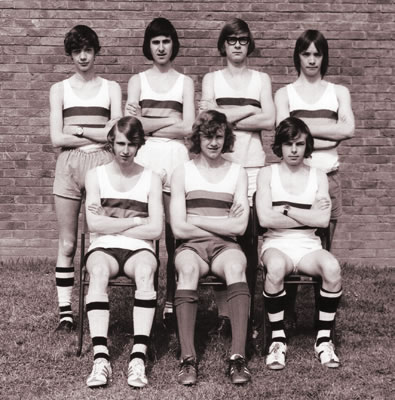
Back Row: B01, Steven Cort, Martin Briscoe, B04, Brian Luckett
Front Row: David Henton, F02, F03, F04
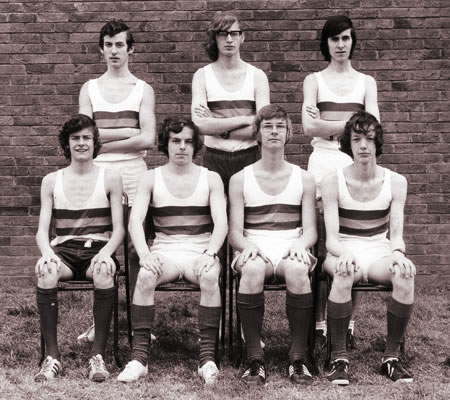
Back Row: Peter Earp, Philip Butcher, Steven Cort, Colin Ball
Front Row: F01, F02, Paul Ballinger
Back Row: David Hartshorn, Simon Larbey, Philip Butcher
Front Row: Mark Turner, Paul Ballinger, Steven Cort, Peter Earp
Stumbling across an old Grammar School Timetable brought back many memories. This was the timetable for Form 1B in 1960.
The day was split into seven 45 minute periods; some were double periods. There was a break between periods II and III and lunch-break followed period IV
|
I |
II |
III |
IV |
V |
VI |
VII |
|
|
Monday |
English |
French |
Maths |
Geography |
History |
French |
Physics |
|
Eng Room |
Fr Room |
7 |
Geog Room |
Dem |
11 |
Jnr. Physics Lab |
|
|
Tuesday |
Metal or Wood |
Music |
French |
PE |
English |
French |
|
|
Met/Wood Rooms |
Dem |
Dem |
Gym |
12 |
12 |
||
|
Wednesday |
Maths |
English |
Maths |
Swimming |
Geography |
Physics |
|
|
Dem |
Dem |
7 |
Baths |
6 |
Snr. Physics Lab |
||
|
Thursday |
History |
Maths |
Art |
English |
Religion |
||
|
9 |
9 |
Art Room |
12 |
Art Room |
|||
|
Friday |
Geography |
Maths |
Music |
French |
History |
Games |
|
|
6 |
10 |
Hall |
Dem |
Hist. Room |
|||
|
Locker 136 |
Form Master: Mr. L.E.Heath |
Form Room: Art Room |
|||||
The whole class stayed together for the same timetable. Only later, after ‘Science’ or ‘Modern’ options were taken, did the form split to do different subjects.
The timetable shows Physics but no Chemistry. In the 1950s and early 1960s, there were several experiments on what science subjects should be taken in the first year. In this particular year, science subjects were rotated each term so that the A, B and C streams swapped Physics, Chemistry and Biology.
By 1963, things had been fixed so that first-formers did Chemistry and Physics but no Biology until later.
I can remember some speculative discussion on the first day about what ‘Physics’ actually was! In the days of Bond Street, it was encompassed by ‘General Science’ which only later split into more focused subjects.
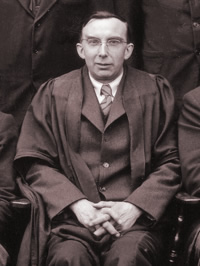 In 1915, while the First World War was raging, George Herbert Cooper joined Burton Grammar School as one of a small number of Scholarship boys who had performed sufficiently well in an application test to avoid having to pay the then relatively hefty fees.
He performed very well at the school and was known for being methodically hard working which awarded him excellent examination results. After completing his Higher School Certificates in the sixth form, he left in 1921 for a place at Sheffield University to read Chemistry. In 1924, he gained a B.Sc and went on to take an M.Sc and Diploma in Education, again, both at Sheffield University.
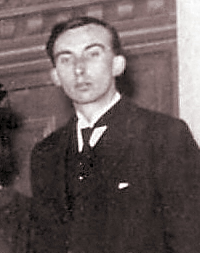 George was extremely pleased at being able to secure a teaching post back at Burton Grammar School. He was appointed by the headmaster of the time, R.T.Robinson, who was very familiar with him having been the headmaster there for the whole of his time there as a pupil. I think even Mr Cooper would have been amazed to know at the time that he would go on to spend the next 42 years at the school in a career that would span no less than seven different headmasters. After a short probationary period from September 1925, he was formally appointed in January 1926. Despite his main speciality being Chemistry, staff requirements required him to initially teach a combination of Mathematics, Latin and English. As the teaching staff grew, his sole teaching subject became Maths.
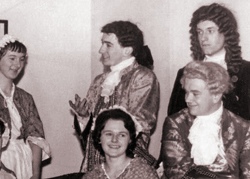 George was interested in Drama whilst a pupil and, after the founding of the Burton Grammar School Dramatics Society in 1920, he appeared as one of the cast of its very first production, ‘Jedbury Junior’, where he played ‘Whimper’, manservant to the Jedburys. On his return as a master, he keenly became involved again and became assistant director to Mr E.C. Nicholson, and later took over the business management of the society as well as taking on a number of roles in its productions over the years.
Mr Cooper became known as ‘Black Hawk’ because of his stooped demeanour and rather jerky walk, usually in his robes, that characterized him. In the transition from the Bond Street to Winshill schools, for some reason, he instead became known as ‘Judder’.
In 1950, George became ‘Second Master’ to Horace Pitchford, qualifying by virtue of intimate and long experience of the running of the School. He was hold this position until his retirement some 18 years later whereupon, Geoffrey Henton took over and the post was changed to ‘Deputy Headmaster’.
Although still a member of staff, George was appointed President of the Old Boys’ Association for 1952/3.
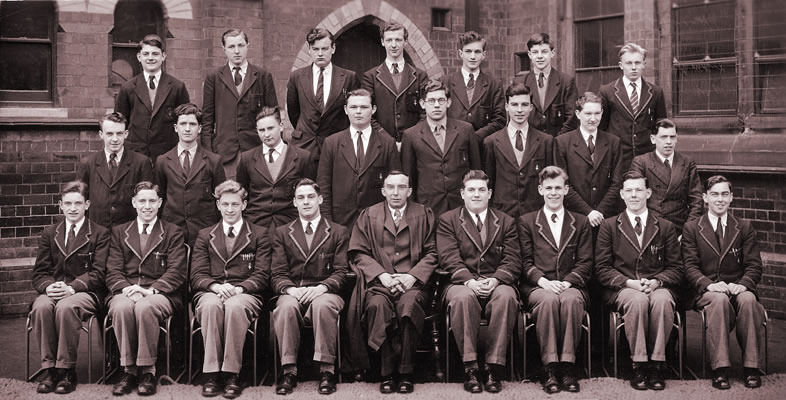 When Bill Gillion, a Cambridge Graduate of Mathematics and strong advocate of academic excellence, joined the school as Headmaster, he had plans of improving academic success of the most talented students and, in particular, to prepare them for scholarships for Oxford, Cambridge and other Universities of Excellence. It was his opinion that the Mathematics Department at the school, headed by a methodical but not particularly dynamic or progressive thinking George Cooper, did not offer sufficient provision so he took the tough decision in 1958 to re-appoint Harry ‘Brab’ Smith to take over. George was to retain a position as a Maths teacher to the lower forms but also retained the position of ‘Second Master’.
Outside of the school, George was very involved with the Methodist Church where, among other things, he was organist. He was also an enthusiastic member of the Burton Historical and Archaeological Society.
George H. Cooper lived for Burton Grammar School. He was rather unobtrusive meaning that much of his effect on the School went largely unnoticed. He worked quietly away without getting or seeking much acknowledgement. After his eventual retirement in 1968, he maintained his association with the School through his continued membership of the Old Boys’ Association.
Retirement Dinner, Newton Park Hotel 1969
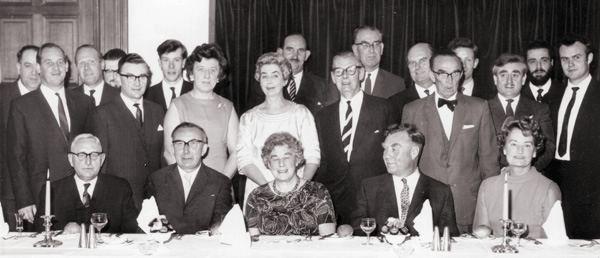
Standing: Percy Barratt, Geoff Henton, Jack Playll, Robin Langton, Hugh Wood, Richard Inwood, Mrs. Adams, Mrs. Read, Harry Smith, Frank Read, Jack Adams, K.T. Harris, David Davies, David Shrubbs, Norman Roe, John Redmond, Alan White
Seated: Horace Pitchford, George Cooper, Mrs. Cooper, Bill Gillion, Frances Gillion
Entry in Staff Book
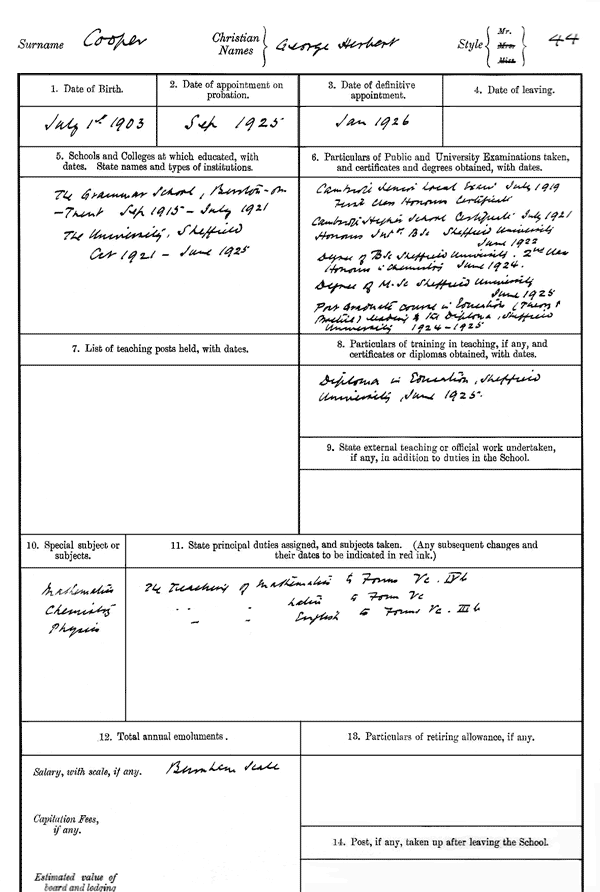
Burton Grammar School Master (Mathematics 1949-1953, 1958-1979)
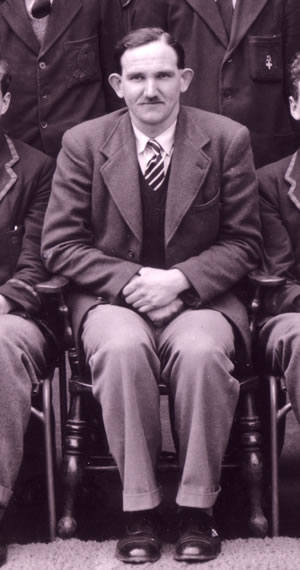 Harry Smith, affectionately known as ‘Brab’, was born in 1923 in Taunton, Somerset. His Grandfather was the pioneering founder of the Ramblers Autobus company which was to establish routes throughout the West Country. Harry’s father eventually took over the running of the company and they had sufficient means to send Harry to the well esteemed Taunton Public School. To this day, Harry can clearly remember the maths teacher, Mr John Evans, who was to have the strong influence on his life that Harry was himself going to eventually have on so many others.
At the outset of the war, all of the company’s buses were ‘requisitioned’ for the war effort. In 1940, Harry had been due to commence at Bristol University but instead, found himself as a private soldier in the Gloucestershire regiment.
Harry still managed to complete some higher Maths education but in 1941 was transferred to the Royal Artillery and, with the 21st Anti-Tank Regiment, saw some very active service in North Africa and later in Italy. On one occasion, he was subject to such heavy bombardment that he suffered from shell-shock and was found with blood running from his ears. He was to lose most of the hearing on his left side which most Grammar School pupils would have been aware of but without due thought.
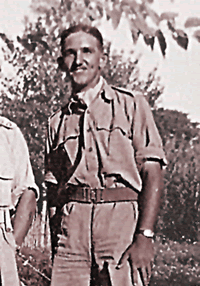 Towards the end of the war in 1945, Harry was made an Educational Officer and sent to Perugia College in Italy to re-educate troop in preparation for their return to normal life. By sheer co-incidence, he found himself teaching alongside his old Chemistry master from Taunton Public School.
By now a Captain, he was later sent to Austria where he was involved with the re-alignment of National borders. Addressing locals in Austria, Harry asked for someone to translate. An attractive girl, Helen, was to reluctantly volunteer if he spoke slowly. Not long afterwards, she became his wife!
At the end of the war, Harry was deemed DOV (Deferred as Operationally Vital) and was prevented from returning home, missed his London University place. Taking a teaching certificate in the interim, he was somehow able to later catch up and complete the three year degree in two years.
Hearing about a post at Burton Grammar School from his lecturer in 1949, Harry applied and was appointed by the then headmaster at Bond Street Grammar School, Mr Moodey. His remit was not only to teach his main forte of mathematics, but to also teach Physics and Chemistry. Soon after starting, Harry also found himself in charge of School Rugby. This was in parallel to Norman Jones being in charge of Athletics. Victor Roebuck was soon to join the school as Head of Physical Education but, although also a keen rugby player, his weekend interests were with Burton Rugby club. He was also a Captain with the school’s Army Cadet Corps. along with Major D. Davies.
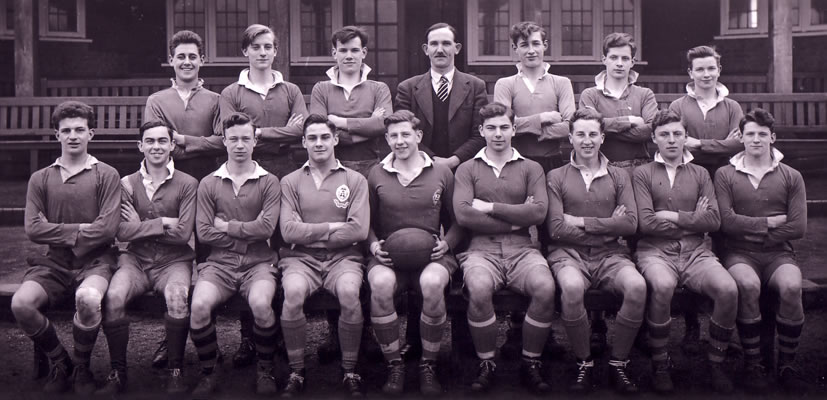 Harry put a great deal of time and effort into this and spent his Saturday mornings on the school rugby field. He was slightly perturbed to discover that Norman Jones received an additional allowance for his running of the Athletics whereas he received nothing. He took up the issue with the Headmaster, Mr Herbert (Horace) Pitchford, who had been appointed to replace Mr Moodey after is tragic recent death. Harry was declined which led to a feeling of resentment for which the school would pay dearly.
In 1953, disgruntled, Harry applied for a vacancy at Derby Technical College in the Department of Mathematics where he was enthusiastically appointed. Harry enjoyed his time there because, being a college of further education, there was a link to local industry which led him to involvement with ‘real world’ mathematical applications with companies such as Midland Rail and Rolls Royce, both based in Derby. He was to stay there for six years during which time, Bond Street School was closed to be replaced by the ‘new’ school in Winshill.
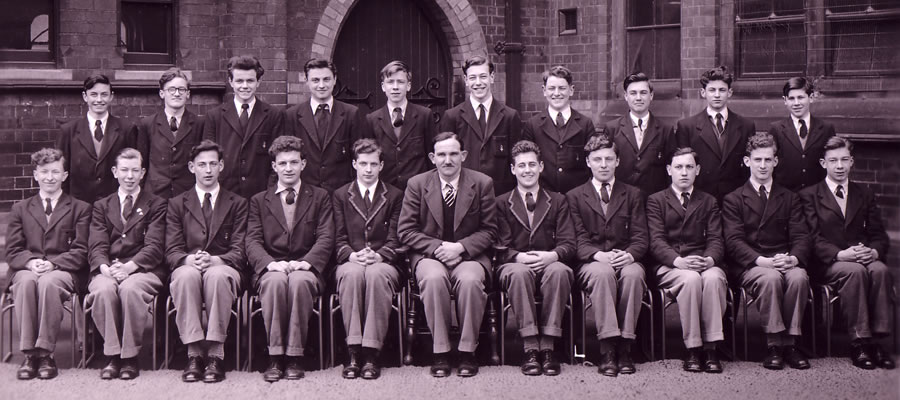 Shortly after the Winshill school was opened, William Gillion was appointed as Headmaster. Mr Gillion, himself a Cambridge Graduate of Mathematics, was a strong advocate of academic excellence and felt that the Mathematics Department at the school, then headed by George Cooper, did not offer provision for the most talented students. He was aware of Harry Smith and had received numerous accounts that he should never have been allowed to leave. So, in 1958, he wrote to Harry asking if we would consider taking over as Head of Mathematics and to run the Open Scholarships, which went beyond ‘A’ Level to prepare the most gifted students for places at Oxford, Cambridge and other Universities of Excellence.
The latter proved sufficient enticement to attract Harry back so he took up the post; George Cooper was to retain a position as a Maths teacher as well as Deputy Headmaster.
Harry also worked for the Welsh Joint Education Committee for 40 years from 1957 during which time, he composed a new ‘Ordinary Alternative’ maths paper every year which was somewhere between ‘O’ level and ‘A’ level. This entailed several trips a year to Cardiff. He was thought of with some affection and on the occasion of him arriving there after 40 years service, they had prepared a special ‘maths’ cake with forty candles on.
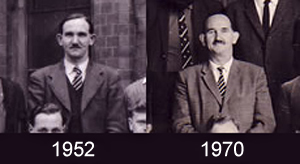 In 1960, Harry helped Bill Gillion to inaugurated a new form 5X to allow the most gifted pupils of form 3A to jump a year so that they would be able to study for Oxbridge entrance exams in their Upper Sixth without having to spend an addition year there. This proved to be tremendously successful and in their out-take year, the class achieved a record number of Oxbridge places, including Scholarships and Exhibitions, actually out-performing Repton Public School!
Sadly there was strong pressure, both internal and external, to look after the lesser able pupils rather than the brightest so the exercise was never repeated. Harry and other of the school’s most senior teachers saw this as the “start of the rot”.
With a degree of frustration, Harry continued at the Grammar School for a further eighteen years. During this time, he moved house from Scalpcliff Road to Repton and, co-incidentally bought the house from Mr Leech, headmaster of Dovecliff Grammar School and a good friend of William Gillion.
Very tragically, in 1971, his wife Helen, who taught German at the the Technical College and Girl’s High School, was killed in a car accident. He was to mourn for over seven years, unfairly blaming himself, before eventually meeting Diane Bates, an English teacher at the Girl’s High School in 1978 and she became his second wife.
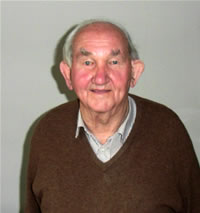 Harry’s time at the Grammar School also included the period where it was to be abolished in favour of becoming Abbot Beyne comprehensive school which led to much greater frustration. Harry himself sees this as “one of the greatest howlers the government has ever made”. His pleas for early retirement were declined so he was to continue at Abbot Beyne for a further three years by which time, he felt that we couldn’t have stood it for a moment longer.
Harry’s son, Michael, was also educated at Burton Grammar School until 1969 went to Leeds University and is a very accomplished linguist.
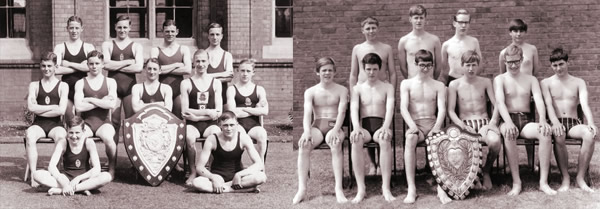
Swimming was always a feature of the Burton Grammar School. In the very early days, the school used to have wooden huts next to the river Trent. They were situated on the Hay to the rear of where the Meadowside Leisure Centre is now situated and swimming classes were actually taken in the river. Use of the these continue for a while after the new, yellow-brick, indoor Swimming Baths on the Ox Hay, adjacent to the Trent Bridge, donated to the town by Richard and Robert Ratcliff in 1875.
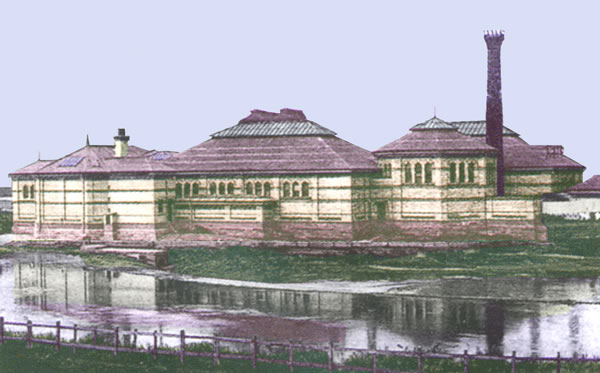
The ‘new’ swimming baths (colour impression by me) were eventually used. Pupils had to walk to and fro from Bond Street. In Winshill Days, a double-decker bus used to take pupils down and they had to make their own way back to school up Bearwood Hill. Only the most affluent pupils paid the 3d to catch the bus although it was common practice for a while for groups of pupils to jump onto the open rear platform, clinging onto the pole, and jumping off as the top of the hill approached and before the bus could pick up any speed – until it announced it assembly that this practice should cease following complaint from the bus company.
The baths survived until the end of the Grammar School’s time and were eventually demolished in 1980 to be replaced by the nearby Meadowside Leisure Centre.
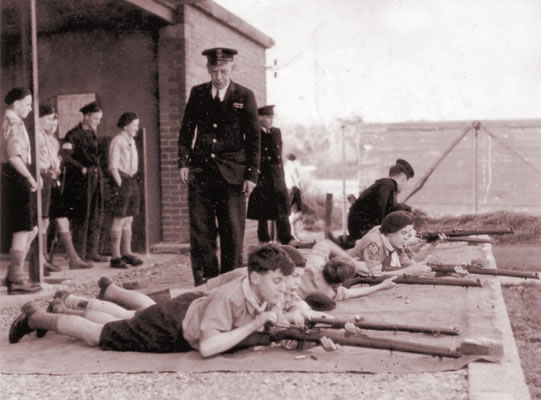 The Cadet Company was first recognised by the Staffordshire territorial army in December 1917, and continued doing drills and exercises until 1931 when the ministry of war discontinued it, ostensibly to replace it with a new organisation. This, however, did not materialise until 1942, when the ATC finally came into existence made up of sixty-nine boys who were a mixture of past and present members of the school.
In the following year, 1943, a Flight of the 351 Squadron was formed. Frank Read was CO of the 351 Squadron ATC which met in a building near to the Ferry Bridge off Bond Street throughout the war. He was assisted by Ron Illingworth.
This was to go on to gain more proficiency badges than any other squadron in the Midlands region with over two hundred in all.
The picture shows BGS Cadets engaged in rifle shooting at Lee-on-Solent camp in 1944. Jim Mayger is lying second from left, while Harry Rothera is standing at the far left.
Both shared their Headquarters down by the end of the Ferry Bridge but in 1944, the school pupil population had reached 381 and out of necessity, the HQ became used for other school activities. First year pupils used it for morning assembly, some used it for PE. Les Simpson, himself a cadet, also recalls music lessons being held there with Dickie Starling.
 Ex-Grammar school pupil, D.A. Richards was awarded the DFC (Distinguished Flying Cross) in 1945. K. Rodbourne and C.B. Douglas later added to this role of honour. In 1946, the headmaster of the school at the time, Harold Moodey, recorded in his Speech Day Report “the heights reached by the 351 Squadron during the war deserve permanent commendation in the school annals“.
In 1949, a unit of the Combined Cadet Force was formed. Under the competent command of Major D. Davies assisted by Captain Harry Smith, two masters who were both to have long association with the school right through until the Winshill days, the fifty original ATC cadets was swelled to over one hundred cadets by 1953. When Peter Boulter joined the staff as an English teacher in the 1950s, he served as a Pilot Officer in the CCF.
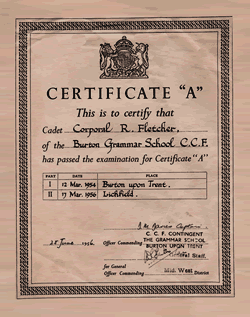
Some may remember the Basic exam followed by the Army Proficiency Certificate which in turn led to Certificate ‘A’ Parts I and II. Successful completion allowed a badge to be worn on the sleeve with pride and many Certificates, such as Bob Fletcher’s shown here, survive to this day. This certificate was presumed to indicate that the cadet was ready for a ‘call to arms’ should World War III ever start, and assuming the Enfield .303 was still in use. In fact, Certificate A’s were important to the cadet force because financial support came from the War Department and the size of each school’s budget was calculated by the percentage of cadets who passed Certificate A, Parts I and II.
In the early 1950s, David Hopkinson was an NCO in the Army section and remembers stripping, cleaning and reassembling rifles and Bren guns in H.Q. and learning some of the theory that was involved in being a cadet. The playground in the school was used for drill and there was a rifle range behind, at the side of the bike sheds. A small hole appeared one day in the wall of one of the two classrooms down the passage from the bike sheds and, though it was ‘hushed up’ at the time, it was later revealed to have been caused by a stray bullet!
The below photo taken in 1952 shows only arond a quarter of the cadet membership of the time. There was still seperate Army and smaller Air Force sections. Only two Air Cadets can be seen here, with a different uniform and, conspicuous by his absence, is Bill Read who was their CO.
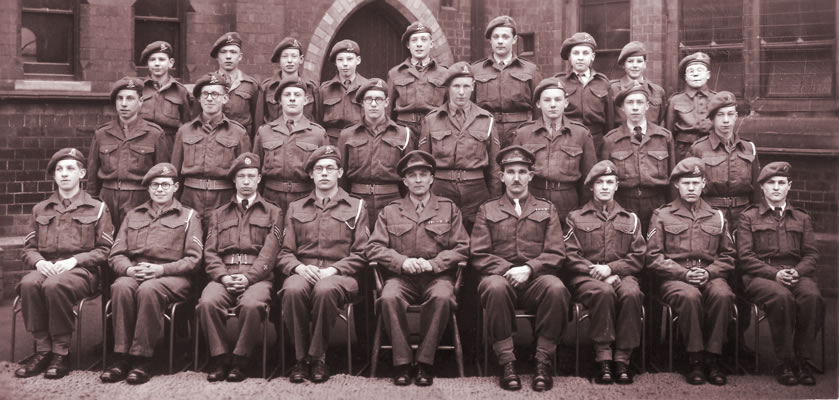 Partial group photo (from around 100 members) 1952
Back Row: Ward, Owen, Allis, Brian Hall, Alan Marshall, Langstone, Askey, Tony Butlin, Booth
Middle Row: Norman Lord, Bill Vernon, Newton, Geoffrey Salt, David Kirk, David Harper, M07, Mick Jordan
Front Row: Shorthose, Cooper, Williams, Sinclair, Major ‘Taffy’ Davies, Captain ‘Brab’ Smith, *Ted Ufton, Bailey, Shaw
* Ted Ufton, who went on to be a Lieutenant in the Royal Marines, was tragically killed in action during the Suez Crisis in 1956. Ufton had been an outstanding and very popular member of the school.
He was buried with full honours at Clayhall Royal Naval Cemetery. The headmaster, Mr. Pitchford, and Major Davies represented Burton Grammar School at his funeral and a plaque to his memory was erected in the school foyer.
His grave remains visited, the below photo taken in 2010 by his classmate Tony Prevett.

In 1957, the now CCF (Combined Cadet Force), having received a substancial sum under the direction of Colonel Scaife of the Staffordshire Territorials, acquired a new purpose built premises within the new Winshill Grammar School grounds which now included a Rifle Range.
Moving into the new premises was postponed for a while, together with the transfer of the school from Bond Street to Winshill after the roof blew off before the school was completed. The new CCF quarters were officially opened in 1958.
At this time, Harry ‘Brab’ Smith was no longer at the school (although he was soon to return at the request of the new Headmaster, Bill Gillion), and Major Davies became seriously ill and was no longer able to continue. This left Flight-Lieutenant Frank Read and a few NCOs to continue on their own. Added to this, with WWII ending some 13 years ago, the force did not really have the same relevance. By 1963, the ranks of the CCF fell below the minimum number required by the War Office and was closed.
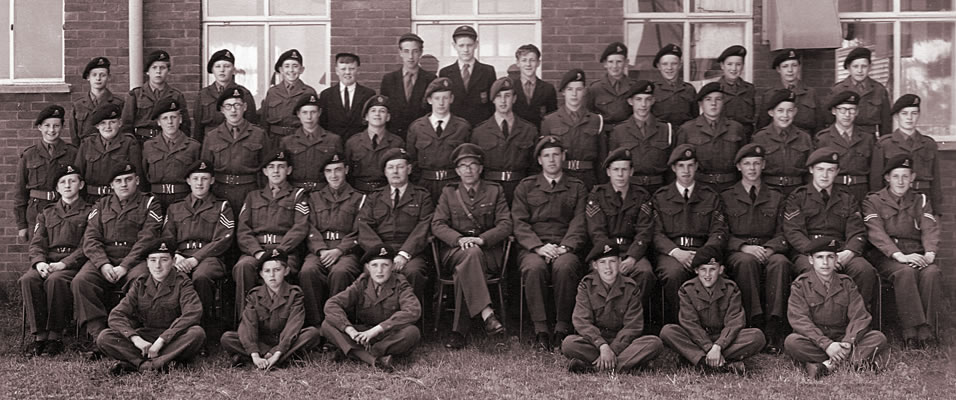 Group photo 1958
Back Row: John Gosling, D. Ball, John Slack, K. Redfern, Watson, Keith Humphries, Mellor, Dunn, T. Hill, T. Jones, Geoff Booth, T. Elks, John Cork
Middle Row: Quayle, D. Pritchard, D. Fletcher, R. Bucknall, Clowns, M. Tracey, M07, J. Birch, J. Buxton, Wadsworth, Rod Alexander, Graham Arnold, C. Freebury, S. Lawrie
Front Row: Smith, R. Hancey, A. Cloves, Yates, R. Fletcher, Flight-Lieutenant Frank Read, Major D.M. Davies, P. Boulter, Yarranton, M. Campbell, P. Rutland, Gilchrist, D. Shrubbs
Front: Woosnam-Savage, David Horsley, John Price, F04, E. Gillespie, A.D. Hughes
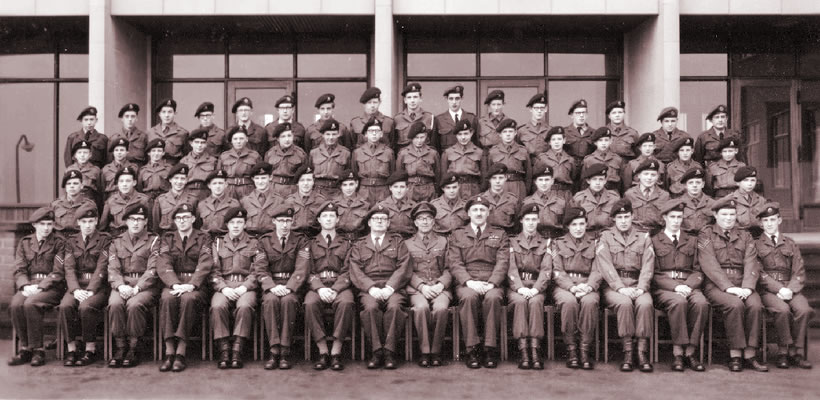 Group photo 1961
Back Row: B01, B02, Rod Moore, Griffin, B05, Terry Butler, B07, B08, Tim Hill, B10, Griffiths, B12, B13, B14, B15, B16
Third Row: T01, T02, T03, T04, T05, T06, T07, T08, T09, T10, T11, T12, T13, T14, T15, T16
Second Row: S01, S02, S03, David Liggins, Jim Roberts, S06, S07, S08, S09, S10, S11, S12, S13, S14, S15
Front Row: F01, F02, Bob Bucknall, F04, Howard Ratcliffe, Charles Freebury, Ian Quayle, Flight-Lieutenant Frank Read, Major D.M. Davies, L.C. Rees (English), F11, John Price, Noel Poxon, F14, Robin Langton, John Goodhead
The following year, in an attempt to keep some pupil activity going, a new detachment of the ACF (Army Cadet Force) was formed and affiliated to the Staffordshire Yeomanry.
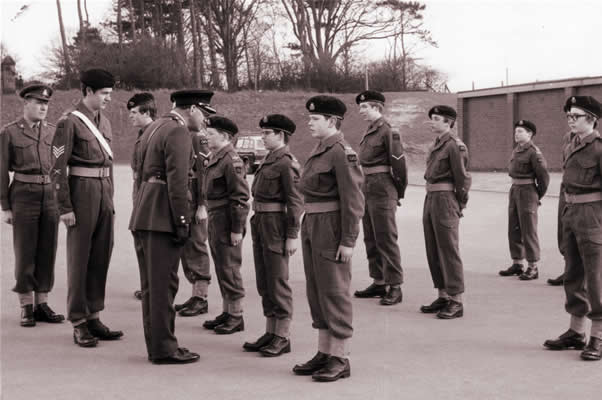
 Captain John (Jack) Playll, seen on the far left in the above photo, was soon to join the school as a History teacher and was persuaded to take over the running of the cadets which he did with some success from 1966 to 1970. Perhaps most notably, in 1967, Seargant F.M. Airey and Corporal John Clark were both awarded Gold in Duke of Edinburgh’s Awards.
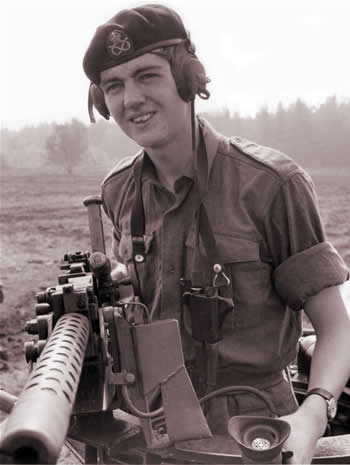
In 1968, Seargant F.M. Airey and Lance-Corprol F.C. Burrows were selected to train with the 16th/5th Queen’s Royal Lancers Regiment stationed in Germany, visiting camps in Hamburg, Celle, Hanover, Belsen and Luneburg. Sgt. F.M. Airey is pictured here in the top of a scout vehicle.
Finally, Sergeant J.E. Simnett received the Charles Black Shooting Trophy on belhalf of Burton Grammar School Troop.
Captain Playll (far left) was followed by a succession of officers, some of whom took the post with some reluctance. Although offering the chance for pupils to engage in such activities as canoeing, camping, rifle shooting, drill, weapon training, and fieldcraft, never really reaching its earlier heights as the relevance of training young men for the eventuality of future combat grew thankfully weaker.