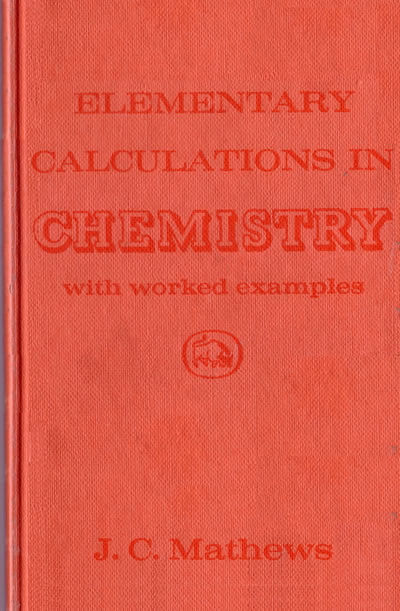
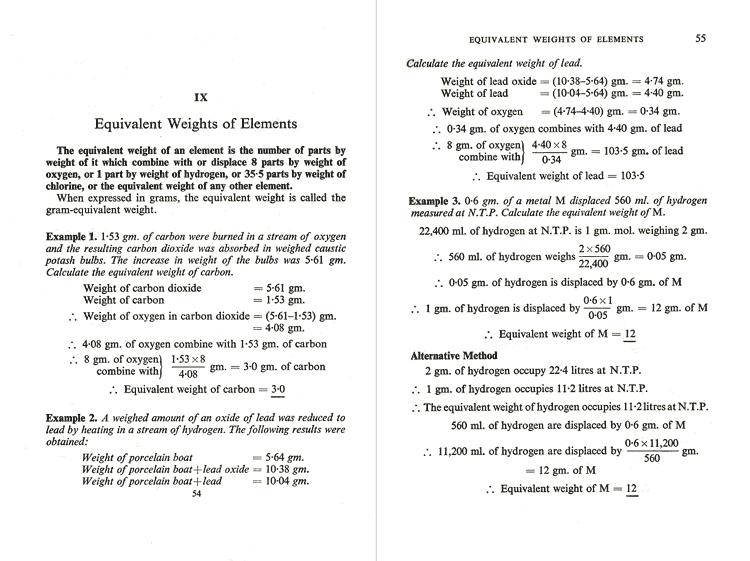
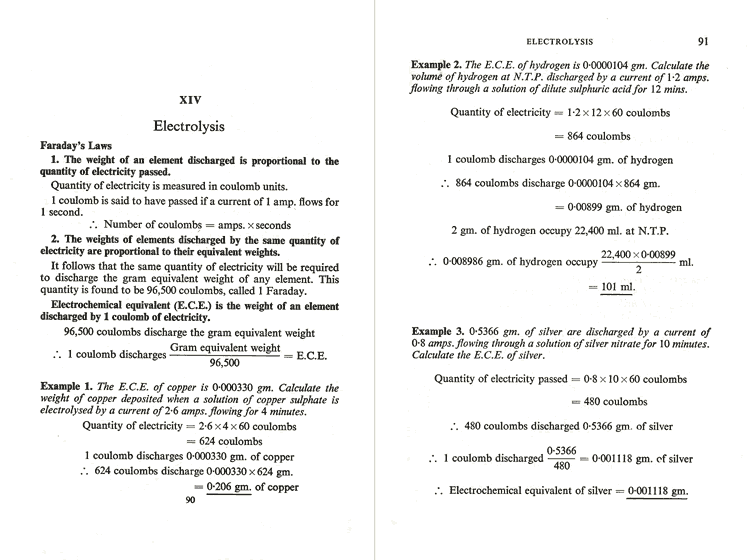
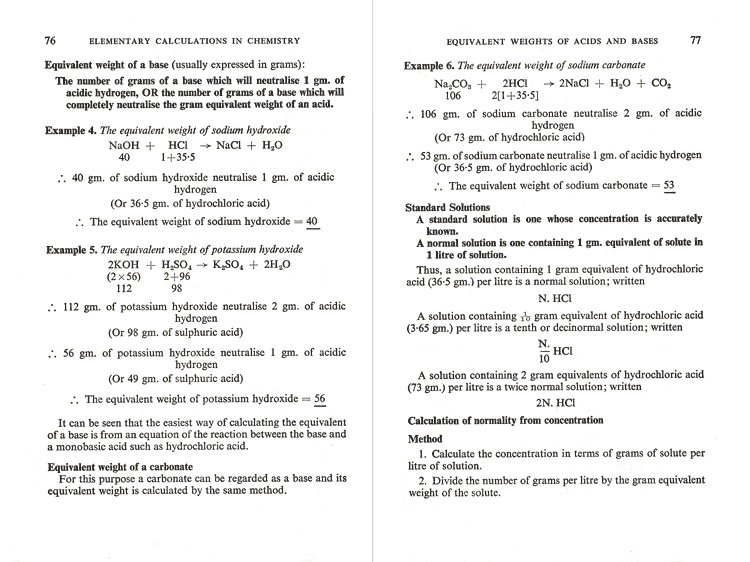
I can certainly remember ‘Elementary Calculations in CHEMISTRY’ by J.C. Mathews and was delighted to get hold of a copy.
Chapters were:
- I – Molecular Weight and Percentage Composition
- II – Formulae from Composition
- III – Reacting weights
- IV – Boyle’s and Charles’ Laws
- V – Gram Molecular Volume
- VI – Reacting Volumes of Gases
- VII – Vapour Density and Molecular Weights
- VIII – Diffusion of Gases
- IX – Equivalent Weights of Elements
- X – Atomic Weights
- XI – The Law of Multiple Proportions
- XII – Equivalent Weights of Acids and Bases
- XIII – Volumetriv Analysis
- XIV – Electrolysis
- XV – Solubility
- XVI – Revision Exercises 1,2,3
Obligingly, this being well before the introduction of the electronic calculator, at the back of the book were Logarithm and Anti-Logarithm tables!
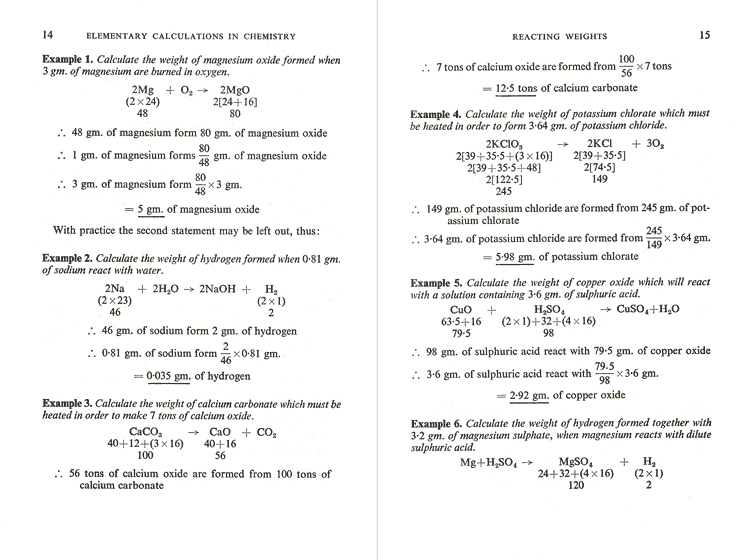
The following page extracts provide a tantilizing glimpse into the past; somehow, they don’t seem to be anything like as fearsome as they seemed at the time…

The original crest dates back to around 1876 and is thought to have been designed by the Headmaster at the time, Mr C.Tripp, in preparation for moving to the new school premises in Bond Street. It is partially derived from the old seal of the Collegiate Church; the shield in the centre is the shield of Burton Abbey. The open book was to depict learning, the bird is generally accepted to be a dove of peace. There was always some controversy over whether the school actually had the rights to use the crest in an official capacity.
On the opening of the new school at Winshill, another new Coat of Arms was introduced. Although not immediately obvious, the scalloped cross and stars are derived from the original shield of Burton Abbey to fit with the newly selected colours. The bishop’s mitre is also influenced by the Abbey and the ‘Deus Nobiscum’ motto is retained.
Sir Clifford Gothard, himself a Burton Grammar School old boy, generously paid the complete cost of having the new Coat of Arms designed and registered with the College of Arms. The Patent of Armorial Bearings was prepared and submitted as follows:
To All and Singular to whom these Presents shall come, the Honourable Sir George Rothe Bellew, Knight Commander of the Royal Victorian Order, Garter Principal King of Arms, Archibald George Blomefield Russell, Esquire, Commander of the Royal Victorian Order, Clarenceux King of Arms, and Sir Gerald Woods Wollaston, Knight Commander of the Most Honourable Order of the Bath, Knight Commander of the Royal Victorian Order, Norroy and Ulster King of Arms, send Greeting! Whereas Violet Evershed, Chairman of the Board of Governors of the Grammar School, Burton-on-Trent, in the County of Stafford, hath represented unto the Most Noble Bernard Marmaduke, Duke of Norfolk, Knight of the Most Noble Order of the Garter, Knight Grand Cross of the Royal Victorian Order, Earl Marshall and Hereditary Marshall of England, and One of Her Majesty’s Most Honourable Privy Council that the said school is of ancient foundation, lands having been endowed for its maintenance by Abbot Beyne in the year 1520. That the said Board of Governors are Governors of a Charity which is regulated by a scheme established by an Order of the Board of Charity Commissioners for England and Wales, dated the Eleventh day of August, 1884, and known and administered under the name of the Burton Endowed Schools. That the Board of Governors of the Grammar School, Burton-on-Trent, is desirous of having Armorial Bearings duly assigned for the said School with lawful authority, and she hath requested the favour of His Grace’s Warrant for Our granting and assigning such Armorial Ensigns as may be proper to be borne and used for the Grammar School, Burton-on-Trent according to the Laws of Arms. And forasmuch as the said Earl Marshall did by Warrant under his hand and seal bearing date the nineteenth day of July last authorise and direct us to grant and assign such Armorial Ensigns accordingly. Know ye therefore that We, the said Garter, Clarenceux, Norroy and Ulster in pursuance of His Grace’s Warrant and by virtue of the Letters Patent of Our several Offices to each of Us respectively granted do by these several Presents grant and assign the Arms following for the Grammar School, Burton-on-Trent, that is to say:— Or on a Cross engrailed Azure five mullets Argent in the first quarter a Mitre of the second as the same are in the margin hereof more depicted to be borne and used for ever hereafter for the Grammar School, Burton-on-Trent, according to the Laws of Arms.
In Witness whereof We the said Garter, Clarenceux and Norroy and Ulster Kings of Arms have to these Presents subscribed Our names and affixed the seals of Our several Offices this Seventh day of October in the Fourth year of the Reign of Our Sovereign Lady Elizabeth the Second by the Grace of God of the United Kingdom of Great Britain and Northern Ireland and of Her other Realms and Territories Queen, Head of the Commonwealth, Defender of the Faith and in the year of Our Lord One thousand nine hundred and fifty-five.
(Signed)
G. R. Bellew, Archibald G. B. Russell, Gerald W. Wollaston,
Garter, Clarenceux, Norroy and Ulster.
The Arms were granted in December 1955 and in that winter edition of the Cygnet magazine, a colour page was included so that each boy should have a copy of the new arms.
On moving to the new school, the following announcement was made by the Headmaster, Herbert Pitchford:
In the course of a long history, the Grammar School in Burton upon Trent has known quite a number of changes and has thus far, survived them all. Under various names and on different sites, the school has worked under several kinds of government, adapting itself to the needs of successive generations and preserving a tradition of learning and service. Now there is to be another change, the removal from Bond Street to Winshill where, in mors spacious accommodation, the tradition may be continued and extended.
At the same time, the school badge is to be altered and the Headmaster wishes the purpose of thr new badge to be understood. It is not just another innovation but rather, an attempt to confirm and establish in a time of transition, a link with the past. For it must be admitted that the school’s right to the present badge has for long been the subject of controversy, as Mr Harold Moodey’s ‘Outline of the History of the School’ published in 1944 makes clear. All we can say from the scanty evidence is that the present badge was designed in the time of Mr C.U. Tripp, who was the Headmaster from 1874 to 1882, and that it was most likely adopted as the official badge in 1876, when the old school in Friars’ Walk was replaced by the (present) building in Bond Street.
When the architect responsible for the design of the buildings in Winshill asked for the emblems of the school which could be displayed as part of the interior decoration, it was felt that the existing badge possessed neither the heraldic accuracy nor the unquestioned authenticity required. The Headmaster therefore, decided that the time was opportune for the school to achieve its own acknowledged coat of arms an asked Mr Lewis Heath, the school’s art master, to design a badge that could be submitted for approval to the College of Arms.
Mr Heath produced a new badge which retains the basic features of the old one, the seal taken from the seal of the Collegiate Church of 1541 and probably itself derived from the Arms of the Abbey. It also emphasizes, by the inclusion of the mitre, the school’s foundation by Abbot Beyne who endowed lands for its maintenance in 1520. Thus, the new design reaches back beyond the present one and preserves the connection of the school with the Abbey of Burton. It is, moreover, heraldically correct and is a very beautiful badge.
The Governors of the School and the Committee of the Old Boys Association having agreed to the idea and to the design, the next step was to submit Mr Heath’s design to the College of Arms for approval. At the suggestion on the Clarenceux King of Arms, the mitre was included in the first quarter so as not to conflict with the existing rights. A petition was then made to the Earl Marshal for a Patent of Armorial Bearings. This involved considerable expense which was met by the generous offer of Mr C.F. Gothard, B.Sc., F.C.A., Old Boy and Governor, who paid for the whole cost of the registration and of the painting of the Coat of Arms. Thus, the Burton Grammar School now possesses its own official Coat of Arms.
Practical Physics has a double significance with Burton Grammar School. Firstly because it was used by those who took ‘A’ Level Practical Physics in the Sixth Form during the 1960s, and secondly, because the author was Ezra Somekh who taught Physics at the school from 1956 to 1967.
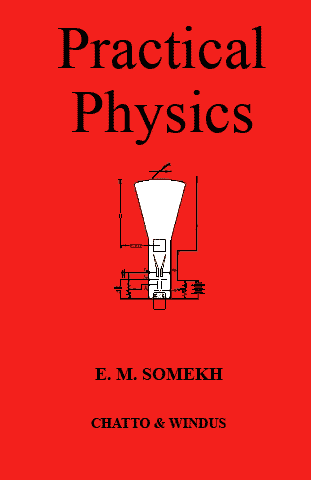
The book contained a number of novel experiments that Ezra himself had designed and it became a widely used text book. Mr Somekh, partly due to the success of the book, eventually, became a chief A-Level examiner.
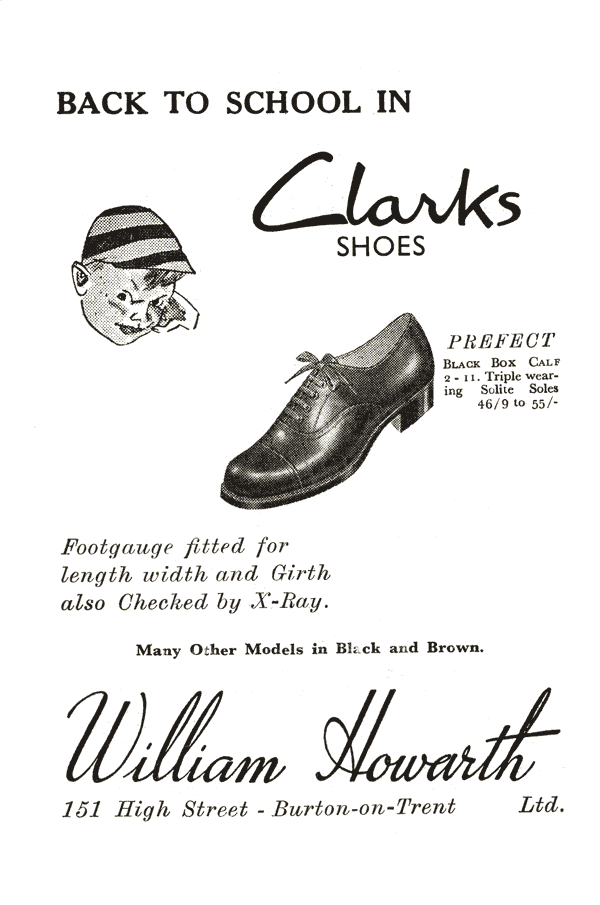
In 1954, William Howarth’s in High Street was often the first port of call for new school shoes; and I must admit, I can see why – at 49/9d (£2.49), for a pair of X-Ray checked stout brogues, I could even be tempted myself.
Even by the Eighteen-fifties, Grammar School education was very ‘classic’ with such subjects as Latin, Greek and Hebrew. The curriculum had simply not moved with the developments of the times. Many of the leading Industrialists and Employers in Burton such as Henry Allsopp and Abraham Bass, who would ultimately make generous contribution to the relocation of the school, expressed some concern that leaving scholars did not have the required skills.
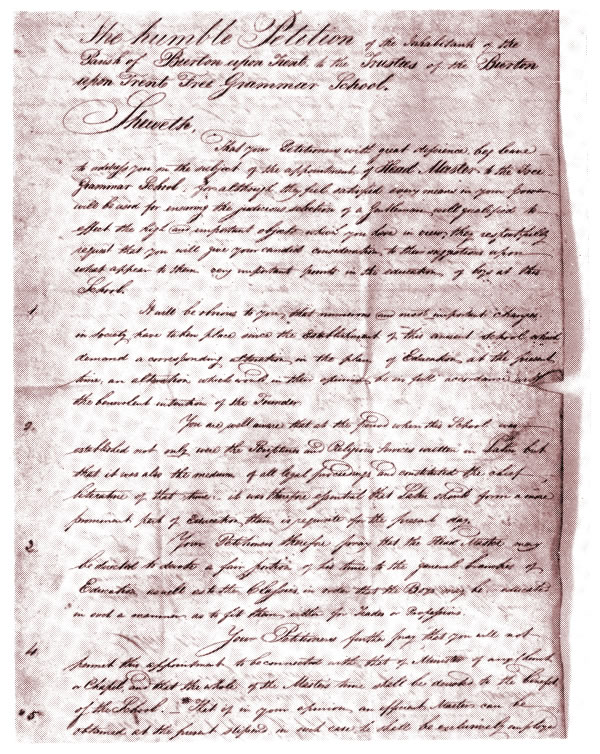
In 1855, a new Headmaster was to be appointed and a partition was raised (Humble Petition) to be presented to the Trustees of the school.
The Headmaster ultimately appointed in 1855 was Rev. Henry Day where he remained for eighteen years until he retired in 1873, four years before the school moved to Bond Street.
Clearly, there are no copies of the petition but below is an image of the original hand-written one.
The full text of the petition was as follows:
The Humble Petition of the inhabitants of the parish of Burton upon Trent to the Trustees of the Burton upon Trent Free Grammar School
Sheweth
That your petitioners with great deference beg leave to address you on the subject of the appointment of Headmaster to the Free Grammar School; for although they feel satisfied every means within your power will be used to ensure the judicious selection of a gentleman well qualified to effect the high and important objects which you have in view; they respectfully request that you will give your candid considerations to their suggestions upon what appear to them to be important points on the education of boys at this school.
1) It will be obvious to you that the numerous and important changes in society have taken place since the establishment of this ancient school, which demand a corresponding alteration in the plan of education at the present time; an alternation which would in their opinion be in full accordance with the benevolent intention of the founder.
2) You are well aware that at the period when this school was established, not only were the scriptures and religious services written in Latin, but that it was also the medium of all legal proceedings and constituted the chief literature of the time: it was therefore essential that Latin should form a more prominent part of education than is requisite for the present day.
3) Your petitioners therefore, pray that the Headmaster may be directed to devote a fair proportion of his time to the general branches of education, as well as to the classics, in order that the boys may be educated in such manner as to fit them for trades and professions.
4) Your petitioners further pray that you will not permit this appointment to be connected with that of Minster of any Church or Chapel, and that the whole Master’s time shall be devoted to the benefits of the school.
5) Your petitioners beg that if, in your opinion, an efficient Master can be obtained at the present stipend, in such case, he shall be exclusively employed in the instruction of free scholars. But on the contrary, if you shall think it necessary to allow the Master to take pupils, that you will limit the number and adopt such means as are best calculated to prevent any preference being given to such private pupils as may operate to the detriment of the free scholars, and consequently to nullify the intentions of the founder.
Your petitioners therefore pray you to listen to their suggestions and that as far as in your opinion they are practicable, you will carry them into effect.
This Ellis & Son advert appeared in numerous school Cygnet magazines as suppliers for the Burton Grammar School uniform as well as sports wear which included, in my case anyway, a white sports shirt together with one in the nominated house colour (Wellington – Maroon, Drake – Blue, Clive – Green, Nelson – Black).
The advert is restored but not in any way improved, remaining as true to the original advert as possible. It appeared in the Cygnet for many years but reduced in quality slightly each year before it was finally revised.

The advert reminds of the grandier of a Burton building which is now very much taken for granted. Ellis & Son Menswear enjoyed some prominence in Burton for over 100 years. It is slightly amusing that in 1954, four digits was though more than adequate to accommodate any likely future demand for telephone numbers.

It is nice that the building survives to this day and is still one of the Town’s most elegant buildings. It is a shame that the equally impressive buildings across the road had to give way to what is now the entrance to the modern day shopping precinct.
These two pictures show the shop in the heyday years of both the Bond Street and Winshill Grammar Schools when the summer months would have done very brisk business kitting out pupils for the start of a new year.
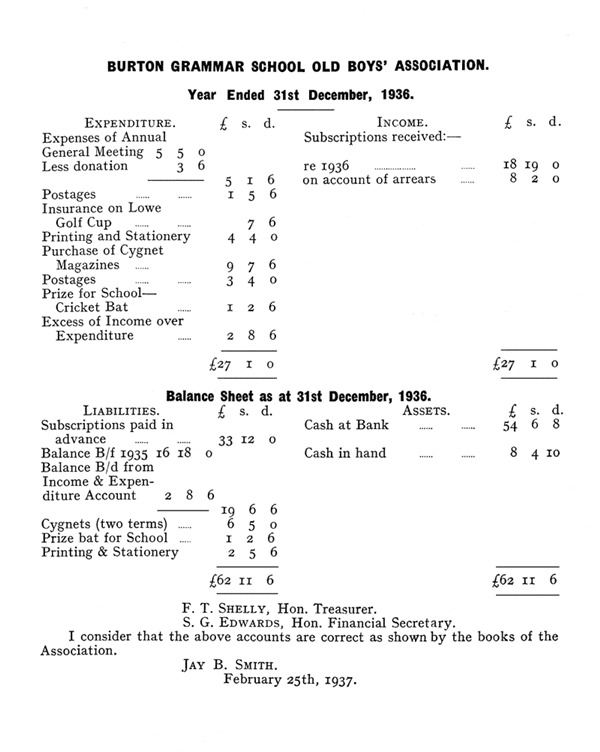
The balance sheet for 1936 is a wonderful find.
I am not sure who made the generous donation of Three Shillings and Sixpence (17.5p) but I don’t doubt that it was warmly received!
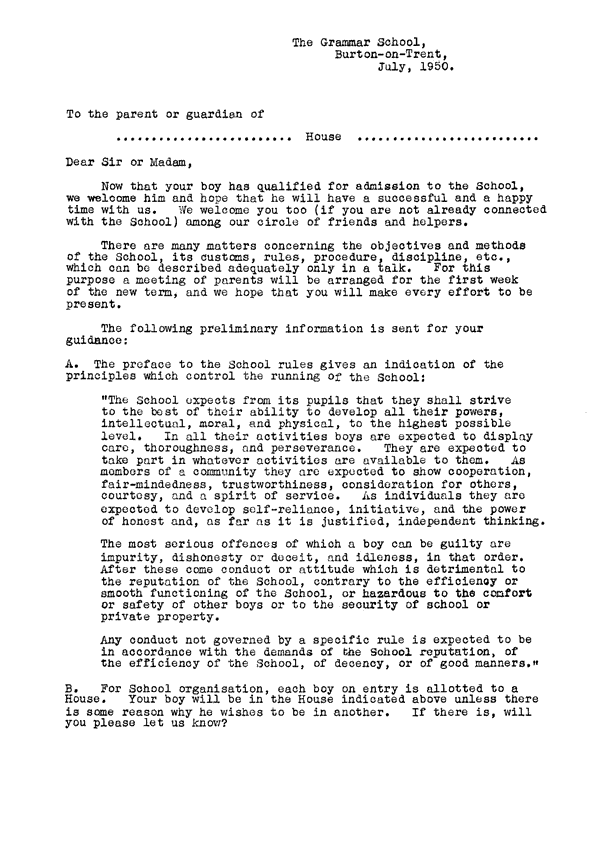
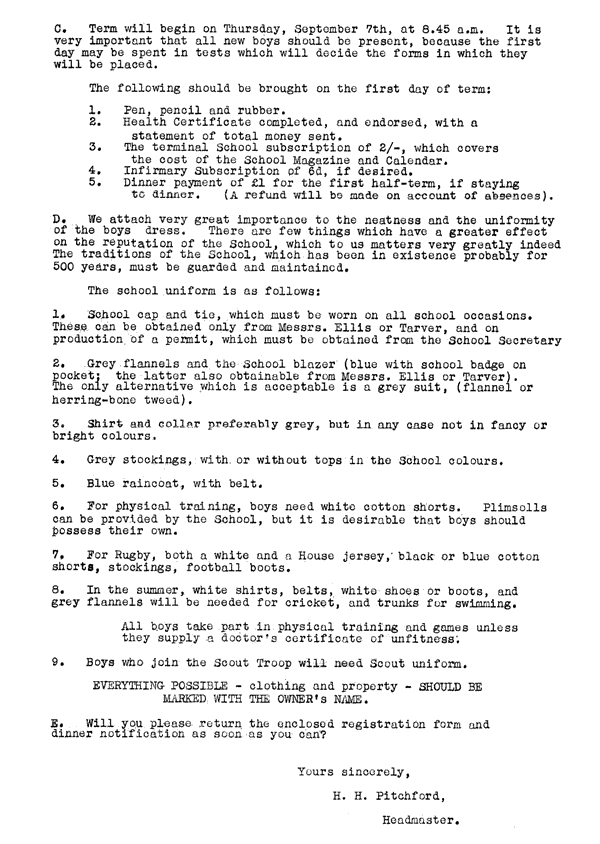
The following form was sent to the parents of all pupils that had passed for the Grammar School.
It makes for interesting reading now and looks very primitive having been produced on a typewriter well before word-processors were available.