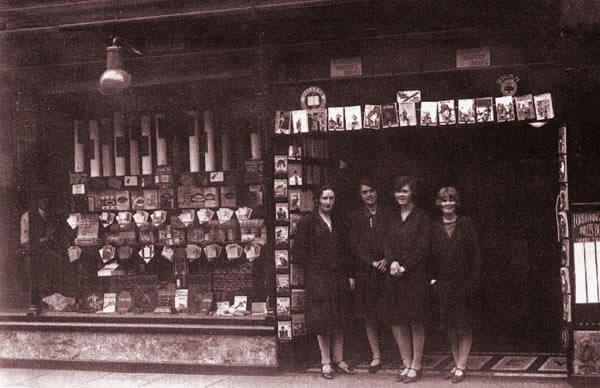
Burton Grammar School Master (Geography / History 1920-1960)
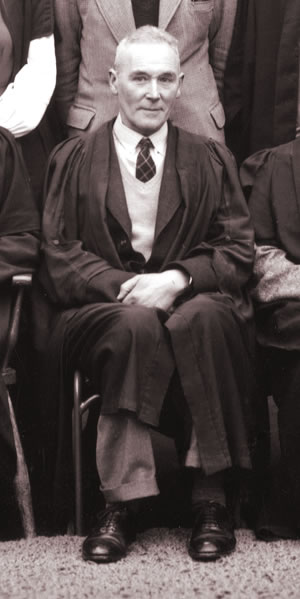 Cecil was born in Oxford, son of a watchmaker. He went to school in Oxford, and later worked in the library of St Edmunds College. Both he and his father were keen fishermen and cyclists. He cycled all over Oxfordshire and the Thames valley in the days of bumpy roads and mostly horse-drawn traffic.
In the war of 1914-8 he enlisted in the Queens Own Oxfordshire Hussars (aka queer objects on horses) and served in France and Belgium. The days of cavalry charges were over but horses were essential for moving armaments and supplies to the front and bringing back casualties in the atrocious conditions.
After four years of service in the war, in 1920, he took a post-war emergency degree at St. Catherine’s College, Oxford, which served students ordinarily resident in the town; he went on to train to be a teacher.
He took a post as history teacher at the BGS. He met and married Elsie Allen, daughter of the Borough Treasurer, Sidney Allen who had seven daughters at the High School and three sons at the Grammar.
Cecil was known to boys as Chas or Chazza. He stayed in the same job until 1960, along with Frank (Bill) Read, Jake Hammond, Nicholson, Dai Davies, Ron Illingworth – the long stayers. He taught mainly History and Geography up to School Cert – later GCE O-level, but on occasions he also taught English, French or RI.
Probably because of his ordinary degree, he rarely taught the A-stream and never the 6th form. He struggled to get the Bs and Cs to understand the world and get through their School Cert or O-levels. He was probably more interested in the kids and current affairs than in his subjects, though he saw these as essential background knowledge for understanding government and world affairs.
He was able to add colour to 20th century history by having lived through it. He would have remembered the death of Queen Victoria, if not her jubilee. He experienced the horror of WW1 as a private. He remembered the public mood and the newspaper reports during the general strike, the depression and the rise of fascism.
Because of his experiences in WW1 he was strongly in favour of the League of Nations and later the United Nations and he supported the Labour party. He was in trouble in the 30s when he clashed with Burton politicians and the local Tories tried to get him sacked for allegedly getting schoolboys to disrupt their public meetings. Fortunately they were wrong and they failed.
Tennis was his life-long sporting activity but he was an all-rounder, being a keen angler, a tireless walker, a cyclist and a camper. He was also a stout advocate of the League of Nations, the United Nations, UNESCO — and privately, a beekeeper, a gardener and a motorist. His motoring career began when he bought a second-hand car, and a colleague gave him an hour’s lesson on how to drive it; the next day, he drove it from Burton to Oxford, with the whole family on board!
At school he looked after the library and ran the International Relations Society, encouraging pupils to interest themselves in politics and world affairs. He was very suspicious of closed minds, received opinions and humbug and liked everyone to think things through properly. He was unimpressed by religious truth. Look at all these religions and sects claiming to have exclusive truth: they can’t all be right, but they could all be wrong.
In WW2 he was in the Home Guard and ARP and dug for victory with the rest. He kept chickens, ducks and rabbits and for several years kept bees. He was a keen angler and cunning tennis player.
In 1948 his pituitary gland stopped working and his joints started to grow. It was a worrying time but new drugs were found to bring the disease back under control. He was left with exceptionally large hands, which are remembered by some old boys who might have had their ears boxed.
He enjoyed his work, particularly helping his pupils develop from timid boys to almost respectable adults, and he continued working for two years beyond the retirement age. Retirement was devoted mostly to gardening, fishing and keeping up with friends and relations.
The Library was his hobby in school, for he was Librarian from 1926 to 1959. If Mr. Brown was wanted, the most likely place to find him was browsing in the library.
After retiring, Mr. Brown was still very much an active retired member of Staff and enjoyed to visit the School on numerous occasions to see how it was doing without him.
Cecil had three children: Bernard went on from BGS to Christ’s Hospital School. He won a scholarship to Balliol College Oxford but his studies were interrupted by war service in the far east. He was a career Civil Servant, sometime Chief Statistician at the Treasury. Audrey was Head Girl at the High School. She took a degree in French and taught French in various schools, including BGS for a short while. Graham went from BGS to Denstone College, thence to Jesus College, Cambridge to read Maths. He worked in computer software development and research and contributed to international standards in database and communications.