Menu Close

1951 – School Report

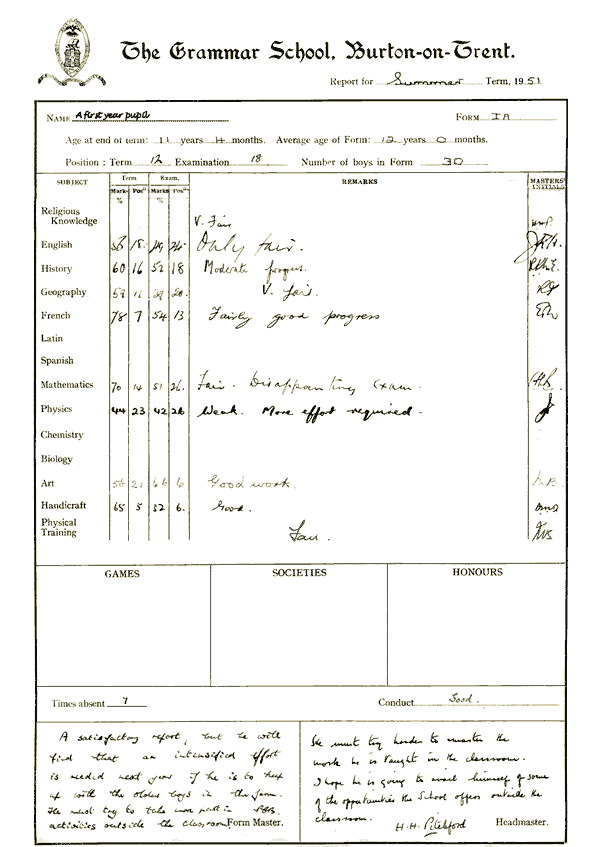
This first form school report for 1951 gives some idea of the curriculum.

Form Teacher: A satisfactory report but he will find that an intensified effort is needed next year if he is to keep up with the older boys in the form. He must try to take more part in activities outside the classroom. (Percy Barratt).

Headmaster: He must try harder to master the work he is taught in the classroom. I hope he is going to avail himself of some of the opportunities the school offers outside the classroom.
H.H. Pitchford (Headmaster).

Subjects taken can be seen to include:

  • Religious Knowledge
  • English
  • History
  • Geography
  • French
  • Mathematics
  • Physics
  • Art
  • Handicraft
  • Physical Training

With Latin, Spanish, Chemistry, Biology to come later.

John Clubb: How the War affected the school

ClubbI was evacuated from my home in Manchester in August 1939 to live with my maternal Grandfather, R.W. Clubb who was a long-retired Head Cooper at Bass’s Brewery. When my sister Helen and I came to live with him at 6 Brizlingcote Lane we were 10 and 11 respectively and he was about 87, a widower with living-in housekeeper.

As I had not been at Burton Grammar School before the War, I am not able to make any comparisons. However, I assume the average age of the schoolmasters went up pretty quickly after 3rd September 1939.

My first impression as a new boy was the strong smell of carbolic mixed with the fainter smell of vomit which pervaded my classroom which was close to the place where the daily milk deliveries were left and to the lavatories nearby. An early Form Master was “Chas” Brown who also taught History. A gentle man who, though not fierce, kept our attention and respect. I used to go to school by bike or bus though we had to travel to the few away sports fixtures by train. Most distant venues were KES Aston, Cotton College who, with Denstone Grammar School normally beat us in my time. We used to beat Lichfield, but we were only just beginning to become useful at cricket and rugby at the end of my time at BGS. We always had an excellent Swimming team in those days.

I suppose one thing the War did for the school was to promote the introduction of Sea Scouts and Air Training Corps. The latter did a great deal for me in that it prepared me for what eventually became my main career in the Royal Air Force which lasted until I was 47 years old. Bill Read (Maths and Swimming) was the leading light in the ATC and he had support from Ron Illingworth (Geography and Cricket) and Jake Hammond (French and Rugby). We did Drill, Navigation, Shooting and latterly went on camps at RAF stations (Halton was one I think). We also were given the opportunity to fly as passengers in powered aircraft (my first was a De Havilland Rapide twin engined biplane flying from RAF Hednesford I think) and we did a bit of gliding from Burnaston airfield.

Before the ATC I had been a member of the Scout Troop run by ‘Tweak’ Hearne (Maths and English) – so nicknamed because of his evil habit of grabbing a finger and thumbfull of short hair at the back of the neck of miscreants in his classes. Most painful, but very effective in those days when schoolchildren did not, could not, fight back. The days when parents sided with schoolmasters and, as often as not, added their own punishment if their children were unwise enough to complain of the punishment already meted out in school. As a scoutmaster ‘Tweak’ was excellent and ensured that his charges had plenty of opportunity for rough, well controlled horseplay mixed with reasonable discipline. The senior scouts were given opportunities to control and lead the juniors.

We went on scout camps and school camps which were open to all. Vague memories of both types of camp were that there was plenty of excitement and frequent dramas, but always good fun. The school camps I attended were a farming camp to West Hanney in Oxfordshire (we got there on bikes) and a forestry camp near Lake Bala, North Wales. At the latter I managed to slice a large piece out of my knee with a billhook and, after a few days in bed in a tent, the wound began to smell so that all concerned thought hospital might be a good thing. I finished up in Wrexham Hospital amongst injured troops and, thanks to the newly discovered penicillin, didn’t lose my leg. Incidentally I was there when ‘VJ Day’ (end of the war with Japan) was declared. Despite the forecasts of the Wrexham doctors that I would never play again, I was back playing rugby before the end of the year. Mrs Hearne was also with us on camp and I used to wonder how on earth she could have enjoyed herself with such a rabble as us.

Back to the War. I saw 3 Junkers 86s fly over one day and one night 3 bombs were dropped in Burton but, apart from seeing the searchlights, hearing the anti-aircraft guns and the throbbing engines of the German raiders on many nights as they flew over to bomb various towns and cities in the Midlands, we saw no action – though you may be interested to know that my Mother (who was an Old Girl of Burton High School and died last November in her 107 th year) experienced a Zeppelin raid on Burton in World War I.

We did see the glow of Coventry burning one night. Boys used to bring in to School pieces of shrapnel from the anti-aircraft shells – I never heard of anyone on the ground being hit. Also, on one occasion during a French lesson (I can’t remember the name of the lady teacher) we were almost blown out of our seats when the bomb dump near Hanley blew up – not, apparently, the result of enemy action. This was later claimed to be the largest conventional explosion of the War. Strangely, we didn’t hear a bang although the noise of the explosion was heard in Manchester, 60 plus miles away. But -as they say- the earth really did move. Our French teacher thought it was an earthquake.

There were fairly frequent air raid alerts when we were supposed to dash into the air raid shelters, but I don’t recall doing much of that after the first false alarm the day war was declared, possibly because most of the sirens were at night. All the School windows had sticky tape across them to prevent injury from glass blown in by explosions. We all had gas masks too, but we didn’t carry them with us at all times as we were supposed to. We quickly became complacent as the War progressed. I’m sure I must have eaten lunch at School, as there wasn’t enough time to get home, but they must have been not too bad, since I can’t remember anything about them – not even where we ate.

I met Thomas Griffiths at a rugby match in Cambridge last week; he was about 2 classes above me at Burton Grammar School and he told me that the 6th Formers were on a Fire Watch roster and took it in turns to sleep on the school premises and patrol from time to time looking for any signs of incendiary bombs (I don’t think they ever found any). He also said that one of the bombs fell in Abbey Street, near to Bond Street and that the bomb blew a bird cage, complete with budgie, through the wall of one of the houses hit. The bird survived unharmed – despite the absence of counselling in those days! My sister tells me that William Joyce (Lord Haw Haw – a British traitor who used to broadcast nightly from Germany) said that Burton had been completely destroyed by the bombing and that beer was running down the streets!

Nothing to do with the War, but a very clear memory was when Mr Frazer, the Headmaster, died suddenly and unexpectedly of a heart attack in around 1940. He was replaced by Mr Harold Moodey who died in even worse circumstances, but after I had left School, in about 1949 I should think. Mr Moodey used to take our class in Religious Instruction when I was in 5 th Form (1946) and was a wonderful gentle man who took a great interest in my progress (or lack of it) in the last 2 years of my school time and in the start of my career in the Royal Air Force. We exchanged letters for a few months after I had left school and was in Southern Rhodesia (Zimbabwe) with the Royal Air Force and it was a great shock when he killed his wife and children and then committed suicide. Never was I more certain that the verdict it suicide whilst the balance of the mind was disturbed was correct in his case. Without doubt he killed his family to protect them from the consequences of his suicide and his state of mind must have been unimaginable – he was such a God-fearing man.

From 1945 onwards there was a sense of change as those who had been in the Armed Forces began to return. I noticed it mainly in the cricket when the newcomers seemed to have decided to take over the annual Masters versus the School match. We, who were loyal to our hero Ron Illingworth and, to a lesser extent, Jake Hammond and Bill Read, felt they were being pushed into the background – particularly as Ron, who usually opened the innings and scored a century, was put in to bat at number 7. I was quite pleased that we beat them comfortably and that Ron top scored for the Masters.

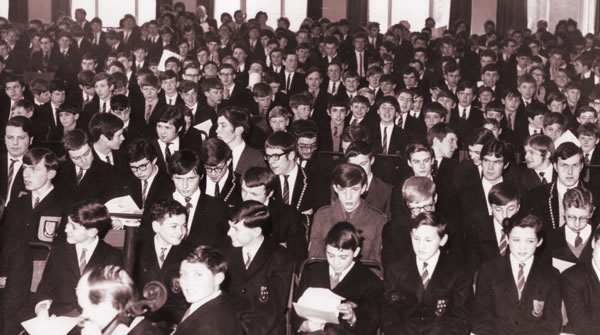
1947 – (Bond Street) Full School Photo

By 1947, the pupil population had reached 450 and Harold Moodey was Headmaster. It was the year that saw the discontinuation of the ‘Preparatory Forms’ which caused some disquiet by some at the time.

Whole School
Click here to view large image

Conditions at the school were by now very congested forcing some huts to be introduced as overflow classrooms. Much talk was in the air about a new much needed school but it would prove to be over ten years before that came to fruition by which time, with over five hundred boys in the school, it really was creaking at the seams.

John C. K. Balfry, C.Eng., F.I.Mech.E. (1892-1896)

I used the Ferry Bridge daily to and from School. The Rev. T.W. Beckett and Mr. Jeffcott, the Second Master, had each a few boarders. The former lived in the School House, the latter in Branston Road.

Mr  W.T. Jeffcott, B.A. (London), was second master. He taught French and also Greek to boys who intended to take Holy Orders. His classroom was “D” and his desk on the right-hand side of the doorway. Woe betide any boy who had the temerity to cross his platform in order to make a quicker exit. Beckoning the boy with a finger he would say: “You know what the Old Book says, don’t you? — Put off thy shoes . . . you know the rest. Well remember that platform is for me to use, and me alone. Understand?” — Yes, Sir.

Mr. James Mills’s classroom was “A”, where he drove into hard skulls the elements of Mathematics with dramatic energy. When sitting at his desk, he was apt to scratch — hence his nickname “Nitty”. A story is told of his absentmindedness. He went to London to sit for an examination and on arrival he simply could not remember the name of the hotel where he was to stay. It is said that he was apprehended by the police for wandering about and so spent the night in a Police Station. He often walked along curbstones of footpaths, and collided with lamp-posts which knocked off his felt hat. This very lovable man took Holy Orders in later life. The writer can speak from experience of the soundness of his teaching of Maths.

W.A. Balfry (1897-1901)

When I entered the School in 1897, entry to the school premises was through a side entrance in Bond Street, into the school playground, in the centre of which stood the “giant stride” which was in constant and regular use by the pupils. Cricket, and Association Football were played on a field in the Branston Road, behind the present Rugby football ground, Peel Croft, which was formerly the home ground of Burton United Association Football Club.

There were also bathing sheds in a side stream of the River Trent, access to which was obtained from the Ferry Bridge.

The Headmaster, who had his desk in the main hall, did not encourage games or sports, but brought the school to a high degree of efficiency in academic successes. Among the pupils who attained an exceptionally high degree of success in the Cambridge Senior Local Examinations were the brothers F. and A. Slator, and Frame, (whose Christian name escapes me at the moment) who obtained honours in no less than eight subjects, and all of whom had their achievements recorded on the Honours Board at the end of the Main Hall.

The school day in my time commenced and ended with prayers. Before the hymns and prayers at the close of school, each of the form-masters handed to the Headmaster a list of the boys who were re¬quired to stay after normal school hours, as punishment for bad work in homework or in class — usually the result of carelessness or idleness. I am afraid my name used to appear very frequently on these lists, and I recollect that on two occasions I was escorted to the Head¬master’s private study where I was obliged to submit to corporal punishment for my sins! The only person allowed to administer this was the Headmaster, and the instrument of torture was a substantial cane of about an inch diameter. Four strokes of this across the palm of each hand, and four across the back of the thighs well laid on by a sturdy Head were not quickly forgotten.

The Annual Prize-giving was held at the Town Hall, and was presided over by Lord Burton, who was, I suppose, Head of the School Governors and who treated the boys to a sumptuous feast which was highly appreciated. The prizes were always books, those for success in the Cambridge Local Examinations being chosen by the winner, whilst those that were awarded for success in school examinations were handsome dark green leather bound volumes, with the School coat-of-arms embossed in gilt on the front cover.

There was no school uniform except for the school cap, which was a pork-pie, or pill-box shape, with a postage stamp badge showing the school crest sewn on the side, and worn on the back of the head.

Although classes had considerably more than the thirty boys which today is considered to be the maximum number a form-master can control, discipline was always well-maintained, and there were never any instances of unruly behaviour.

Masters and their nicknames as I recall (c. 1895-1900) were:

Headmaster: Rev. T.W. Beckett – ‘Spongy’

Assistant Masters:
W.T. Jeffcott – ‘Piggy’
H.T. Walker – ‘H.T.’
W.H. Walker – ‘Blue Blood’
J.W. Mackie – ‘Black Devil’
J. Mills – ‘Nitty’
Stevenson – ‘Tommy’
Stevens – ‘Bullseyes’

C.E. Eley (1925-1932)

For me and my generation life was split by the 1939-45 war, and since then I have found it quite difficult to remember my schooldays in much detail.

When I was about 14 years old, I remember sitting in the old History room (tiered) doing an examination. Mr. Pitchford was invigilating. Another lower form was doing a Scripture exam. At the same time (my examination was probably History or Geography), and the two forms were mixed, to make cribbing impossible. Since I finished my paper in good time I sat doing nothing, and as I could see the paper of the boy in front of me quite clearly, being able to look down on it, and since he was not in my form, I was able to read it without any qualms of conscience. I was, however, astounded to read the following, which has stuck in my mind ever since, because it was so outrageous: “Moses was a good girl; she was a disciple of Jesus”. I will not name the boy although I remember it clearly.

I remember with nostalgia the old Tuck Shop in Bond Street where we could buy warm doughnuts and twists (Chelsea buns) for id. in 1925-27, during mid-morning break. To this day I search for that kind of luscious doughnut, instead of the stale, stodgy kind usually available. This summer I managed to find one, after many years’ search, but it was at Pontevedra, in Northern Spain.

In 1929-30, when I was in Form Va, two others in the form were F. Wheeldon and L. Webb, from Stapenhill and Winshill respectively. They had endless debates on political subjects, Wheeldon being distinctly left-wing, although this was not an expression used then, as far as I am aware. I used to call him a Bolshevik. It was my job to illustrate with cartoons the papers which they used to write and present to each other, for study and further reply. I don’t remember how long this went on, but I was a kind of go-between, very often able to add a twist to the arguments by my graphic illustrations, and usually to the benefit of Webb.

Before S. E. Wilson became Headmaster, sport was more or less for the gladiators only. When I was about ten or eleven, there was little opportunity to play games. A few of us in the 4th form decided to remedy this, so we acquired a football and a set of jerseys, raised a side and arranged a fixture. I believe it was during a holiday: certainly since the School playing field was deserted, we just went to the Rugby pitch and played our match. It must have been on a Saturday afternoon, because Burton were playing a match on Peel Croft, and this meant D. T. Hughes, who used to report the Rugby matches, saw us. Although we were not “molested”, at the time, presumably because he couldn’t leave Peel Croft, I remember the furore over this sacrilege of soccer by Grammar School boys, paricularly on the 92 hallowed rugby pitch. A hue and cry began at school, as soon as this was possible; this led to our owning up and receiving a tremendous lecture from D. T. Hughes. We were made to feel we had committed treason. This is the only soccer match I remember taking place on the school playing fields.

1520-1884 Outline History – Harold Moodey

APPENDICES

THE HOUSE OF PAGET.
Throughout the history of the school, it is perhaps inevitable that contacts with the Lord of the Manor should be continuous.

The first Baron Paget, William (1505-68) was presumably concerned in the pensioning of Richard Harman. His grandson, the fourth Baron, William (d. 1629) was, we have seen, a trustee, and was liable for an annual payment of £2 to the stipend of the schoolmaster. The seventh Baron, Henry (d. 1743) who was Baron Burton and first Earl of Uxbridge, made an annual grant of £5 to the usher; this was continued by his grandson, (d. 1769), who if we may Judge from the lawsuit of 1746-52, was a trustee. There was a then break in the succession. The second Earl of Uxbridge had no Issue, and the title became extinct.

Catherine, however, grand-daughter of William, the fifth Baron, was married to Sir Nicholas Bayley. Her son, Henry Bayley (d. 1812), who assumed the name of Paget, became ninth Baron Paget, and in 1781 became first Earl of Uxbridge of the second creation; he was a trustee in 1795. His son, Henry William, second Earl, had a brilliant military career, and alter the battle of Waterloo in which he lost a leg, was created first Marquis of Anglesey on 4th July, 1815. A Marquis of Anglesey is named as trustee in every list which we have available,beginning with that in White’s 1851 History of Staffordshire, and continuing to the end of our present story. The Marquis was also trustee of Alsop’s school in 1849. Since the 1605 list of trustees were named “with their heirs” It seems probable that the office was held continuously at least until 1802. The survivors named from the 1802 trustees, however, in 1825, did not include his Lordship. There thus appears a possible, but not a certain gap at this stage.

(Although it is outside the confines of the present story, it is worthy of mention that from 1867 or earlier to about 1910, his Lordship presented prizes to the School (In the former year their value WHS reported to the Charity Commissioners as £5); in 1943 the present Marquess renewed the ‘tradition’ by the award of “The most Honourable the Marquess of Anglesey’s Leaving Prize” which he has promised to award annually.)

TRUSTEES.

1540.
Richard Dethick
William Moorcock
Hugh Gilbert
and their heirs

1605.
William Lord Paget
John Bradshaw
William Caldwell
John Hawkes
Jeremiah Horobin
Robert Toone
William Clarke
Henry Clarke
Richard Clarke
Thomas Mutton
William Woodcock and their heirs

1795 app.
Earl of Uxbridge
Isaac Hawkins
John J.Hayne
T.S.Brome
Abraham Hoskins
Henry Evans
John S.Dawson
Charles Leeson
W. Newton

1825.
(survivors from 1802)
Rev. F.H. Carey
Joseph Muckleston J
oseph Pycroft
Abraham Hoskins
Joseph Perks
Thomas Thornewill

1851 (White).
Marquis of Anglesey
Earl of Uxbridge
Rev.C.Kingsley
Rev. H des Voeux
M.T.Bass
E.Thoruewill
Henry Clay
W.Worthington
E.Moseley
W.Wilders

1858.
Marquis of Anglesey
M.T.Bass, M.P.
R.S.Belcher
J.Clay
R.S.Tomlinson
A.Bass
T.Goer
W.Worthinglon
E.Wilder
W.H.Worthington
H.Allsop
T.Salt
H.Thornewill
T.Poyser

1867.
Marquis of Anglesey.
M.T.Rass M.P., Brewer
W.Worthington, Brewer
W.Wilders, gentleman.
H.Allsop, Brewer.
Abram Bass, Solicitor.
R.T.Belcher, Surgeon.
R.S.Tomlinson, Surgeon.
J.S.Clav, Brewer.
W.H.Worthington, Brewer.
T.Goer.Cheese- factor.
T.Poyser.gentleman.
Clerk: W.Small.

1872.
Marquis of Anglesey,
M.T.Bass.M.P., Brewer.
A.Bass.Solicitor.
R.S.Belcher, Surgeon.
J.S.Clay, Brewer.
J.Finlay.
R.S.Tomlinson, Surgeon.
J.R.Warham, Ironfounder.
W.H.Worthington, Brewer.

HEADMASTERS, & Co.
Our information concerning headmasters and ushers is as follows:
1537-1510 and possibly later: RICHARD HACKMAN.
1605: Mn. HAZARD and MB. Shilton.
1656: (Molyneux: the house is occupied rent-free by the master’.
1662: Joseph Shilton, curate, may have been master, before 1745-1757: Rev. H.Jackson, vicar of Stapenhill. (1745: William Shilton was probably usher).
1782: (“B.H.”: the master’s and usher’s salaries were paid)
1795: Rev.John Hepworth.
1795-1808: Rev. Hugh Jonses, senior, curate of Burton and vicar of Stapenhill.
1822-1839: Rev. Hugh Jones.junior, A.B.. curate of Burton;
(Henry Hodson, usher, to 1861.William Shilton master of Alsop’s to 1849).
1839-1858: Rev.J.F.MacMichael
1839-1858: Rev. Valpy (presumably)
1858-1873: Rev. Henry Day.L.L.B. (Mr.H.Heape, second master to 1873)
1874-1882: Charles Undershell Tripp.M.A.Oxon. (Mr.Gardener, then Rev. T.W.Beckett, second master).
1884-1900: Rev. Thomas W.Beckett, M.A.Camh. (Mr. J.E.
Carey, second master).

PAST PUPILS.
From the point at which this record ends, we have a complete record of pupils at the school. Of pupils who were in attendance before 1885. our knowledge is fragmentary. We have named Pointz (1530), Belfield (before 1535), the Shiltons (about 1550), Jervis, Byard, and Hopkins (1745), M.T. Bass (about 1810), and DrcWett (before 1860), W. Clubb (1860): and in section 27 we have given names of boys at school in 1864.

J.E.Auden has recalled the following, who were at school in 1873 and 1874:

J.E.Auden, W.H.Auden, T.J.Allan, Arnold, Archer, Ashby, Baillie, Belcher, H.Beever, Bibby, Barratt, Capron, Cook. T.Callant, two Cottons, Draper, R.Day. Dilke. Feakes, G.E.French, Goodhead, F.,W.M. and another Hopkins, two Hadfields, E. and R. Hunter, Lobb, G. Lowe. S. Lunt. W. Morrall, W. Milne, Martin. J.Potter. Phillips, Rodwell, three Sims, two Smiths, Stynn, Stephenson. F., M., and T.Taylor, Upton, Wallas, C.E.Wright, Williams, S.A.Ward, two Whiteheads (or Whitehursts)

A photograph of the School in the Lent term, 1877. has the following signatures:

W.H.Auden, T.J.Allen, T.F.Auden, J.G.Anderson, A.Atkin, A., C. and J.Atterbury, P.Auty, A.H.Burghope, E.H. and T.A.Beckett, J.H.Birch, F.J.G.Borwell, J.Bullock, F.R.Bell. A.B.Beesby, F.H.Bindley, F.Bosworth, F.W.Bullock. H.J. and W.Clarke. A. and C.W.F.Clubb, J.J.Dickinson. W. and F. Evershed, G.E.French, E.C.Frampton, F.B., J.C.and T.II.Gorton. L. and T.Gibbs, C.H.Graham, E.Guest, F. and W.M, Hopkins, C.T. and S.B.Hallam, H.Higgott. J.W.Jefford. A.E. and F.J. Jackson. T.E.Lowe. P.W.Lunt, A.Litchfield, F.J.Mavgcr. J.Morris, A.J.G. Molvneux. T.Miller, J.E.Xowers, C.E. and F.J. Oldacres, J.Potter. W.J.Pickering, G.E. and J.Robinson, A.T.M.Russell. W.Shaw. J.Scattergood. T.E.Sanders, O.E.Wright. There is a French signature which has become indecipherable

F.R.Bell has sent us a list culled from a note-book of 1875. It contains many or these names, and also: Chancelor, Daniels.

It is one of our ambitious that we shall collect whatever Information about these Old Boys may be still available.

FOUNDATION DAY.
At school on 28th February each year we remember. On the anniversary of the endowment in 1529, all our benefactors. Although much of what follows belongs to a period later than 1884, we think It well at this time to put on record the names ol those from whose generosity the school will always benefit.

1. Of Beyne, Paulett, Finney, Allsop and Astyle, we have spoken in these pages.

2. Public subscriptions in memory of Henry Wardle. M.P. and Governor, in 1892. gave us the Wardle Memorial Prize.

3. In 1922, Old Boys gave to the school the War Memorial Playing Field.

4. In 1933, E.J. Manners. Old Boy and Governor, presented the Pavilion.

5. In 1933, J.H.Birch, Old Boy and later. Governor, instituted, and in 1939 endowed the J.H.Birch English Prizes.

6. 1943, the five brothers Guest, Old Boys, endowed the Guest Memorial History Prize, and Robert Yeomans, Old Boy, endowed the Modern Language Prize bearing his name.

7. In 1943 and 1944, Old Boys subscribed the W.D. Fraser Memorial Fund.

8. In 1945, Mrs. M.Ife endowed the S.J.IFE Memorial Athletics Trophy. (S.J.Ife was lost at sea on Active Service in 1944), and F.Evershed endowed the Frank Evershed Prize.

9. The School also possesses Challenge Trophies, awarded at various times between 1871 and 1945. valued at over £250.

ENVOI.
At some time, as we said in the Introduction, we want to publish this part of the History of the School amplified and possibly amended.

We look forward to incorporating with it the whole of the History of Burton Grammar School in Bond Street. This should be a very different compilation from the present; it can all be based on “living memory” and on properly kept minutes. How successful it will be depends upon the co-operation of those past pupils and others who will send us their recollections. And so every Old Boy and everybody else who in past years bus had connections with the School is invited – rather, urged – to a send his account of the school as he knew it. Many hands make light work: there is no likelihood that too many cooks will spoil the broth. It will be the function of the Editor to see to that.

We also want to compile, as an appendix to the full story, a “Who’s Who” of Distinguished Old Boys. Distinctions have been achieved in a multitude of ways: at the Universities, in the Church, in the professions, in business, in military and in civic affairs. Here also we want help. We want Old Boys to throw away all the restrictions of modesty, and to send us their full biographies, and those of any of their contemporaries. The success of the attempt will depend upon their willingness to do this. Reports of progress when possible will appear in the pages of the School magazine, the “Cygnet.” which is sent regularly to all members of the Old Boys’ Association, the Secretary of which, Mr. J.F.Rose, can be reached either at 62, High Street, Burton-on-Trent, or at the School.

And now we pause. We do not know what the future has in store for the School. A new chapter in Its history is being opened by the operation of the 1944 Education Act. But thepages of that chapter cannot be written or read yet. We must face the future with hope, and with faith.

Floreat Schola Libera Burtoniensis

1957 – Opening Ceremony

The new premises were opened officially on the afternoon of Friday, 27th September, 1957 by the Honourable Lord Sydney Herbert Evershed, D.C.L., L.L.D., F.S.A., Master of the Rolls.

In addition to the Headmaster and Staff, those present included members of the Education Committee, with their Chairman, Councillor Dr N.J. Cochran MBE and their Vice-Chairman, Councillor Mrs Ada Chadwick (after who the new Secondary Modern school would later be named). Also present were the Mayor, Councillor S. Bird; the Governors of the School with their Chairman, Mrs S.H. Evershed; the Architect, W. Porter Mitchell, Esq.; the Deputy Town Clerk, A.G. Williams Esq.; three of Her Majesty’s Inspectors; Arthur Blake, Director of Education and Clerk to the Governors; the President of the Old Boys Association, W.R. Souster, and other Old Boys of the School. Also present was former Headmaster S.E. Wilson who had travelled especially from the Isle of Man.

After the Reverend Harold Sprigge had performed the opening act of dedication and prayer, the Mayor, in welcoming Lord Evershed, spoke of the long and close association Lord Evershed’s family had had with the school. Councillor Dr Cochran spoke of the necessity of educating the boys sensibilities and training them to understand their fellow men, as well as how to understand and control the physical world. He also spoke of the history and significance of the Grammar School. His speech was recorded as follows:

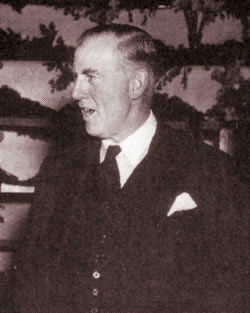
EvershedLord Evershed ( pictured ) began by saying how proud, delighted and touched he was by the honour of being invited to perform the opening ceremony. It seemed only a short time since the highest of honours had been conferred on him when he had been received as Freeman of the County Borough of Burton, and he was encouraged to think, then as on the former occasion, that the name of Evershed was not without honour in Burton.

The connection between the school and the family of Evershed was amusingly illustrated by the speaker when he referred to a Cricket Match played in 1874 between the Grammar School and Allsopp’s, in which the Grammar School was beaten by an innings, scoring just 62 of which 31 were extras; a player called Evershed contributed nothing in his innings!

He was indebted to Mr Blake for an account of the negotiations and meetings which had begun in 1919, and had at last been fulfilled on this day. “The winds of heaven had postponed that happy day for one year, but the winds of government policy had deleyed it for twenty times that period”.

Whilst the building was very new and splendid, the School was an old one and there was a real significance for the future in old tradition and what he called standards of value that, over the more than 400 years of the School’s life had created. That, he thought, was something which must inspire the present and the future generations. “As Walter Whitman said, the modern ship of democracy has, in its valuable freight, the past as well as the present”.

It was interesting to observe that though Burton was one of the English towns furthest from the sea, among its old members were two very distinguished sailors, John Jervis, Lord St Vincent, and shortly afterwards, Byard. More lately, there had been distinguished men of science like Professor Hobday.

In John Jervis’s day, this school was in truth, a Grammar School where you learned only Latin and Greek. Now, he regretted to say, there was a tendency to regard Latin and Greek, or the humanities, as being opposed in some sense to the entirely scientific education. In truth, they were not opposed but complementary, and he claimed not to be alone in this repudiation of the tendency he had mentioned. No one would have more readilit denied the alleged antipathy than, say, Aristotle or Leonardo da Vinci. One mark of the educated man was that he was willing to be led away by shibboleths and slogans, but insisted on pursuing the truth. Only by that means could men achieve a balanced judgment.

We are in an age in which terrible things seem to hang over us. A Chinese philosopher, he believed, had accused Western Civilisation of being composed only of statistics, mathematics, diesel engines and high explosives. Since that was said, the changes had been first that high explosives had achieved an altogether more terrifying force, and the same is presumably now as true of Eastern Civilisation as of the Western, and the ordinary man finds himself faced with these terrifying prospects and must at all times regard himself as powerless to prevent some hideous calamity which would destroy us all. And yet it was a fact that, in a free country, the ordinary man had to assume the responsibility by exercising his rights as a citizen and of deciding what we do. (Editor: I’m half glad I wasn’t there now; I think I would have left scared to death).

And so, it was the hope of humanity that by good education, you would get men wishing for the truth and able to exercise a balanced judgement. Truth sometimes was not easy to find. When Milton said that the truth was never put to the worst in free and open encounter, I think he would have had no difficulty in assuming general agreement. And Goldsmith said that ten millions of circles can never make a square; just as the united voices of millions could not lend the slightest foundation to falsehood, but, with the modern devices of radio, some malicious untruth ight be, as they say, plugged day after day. Were we sure that the united voice of the myriads did not sometimes lend more than a particle of truth to that which was false? (Editor: By now, I would definitely have been losing the will to live).

This occasion was one of great importance, and he felt that he might say, on behalf of them all, a warm word of appreciation to the Headmaster and Staff of the School and to express grateful appreciation of the noble profession they had chosen to follow. No one could accuse the academic profession of thirsting after riches; they had to possess two very difficult qualities – patience and, that noblest quality of all, integrity of scholarship.

It is not merely by their teaching but by their example that we are led. A wise man had said “You cannot wear a sword beneath a scholar’s gown”. What the teachers, the professors and men and women who teach in schools did was by their example to show that they are, at any rate, being undeterred by the World’s disparagements and certainly uncorrupted by the prizes, remained for us ardent and serene in a faith by which alone we held mankind could live.

To conclude (Editor: Hoorah!), perhaps he might say something to those boys at the school who were present and to suggest to them that during the last year or two they spent at the school, they might have the last opportunity of living life as the best human life might be lived. When they left school, they would inevitably find that their actions would be influenced by the hard facts of life, by finding and keeping a job and earning a living. While they were at the school, they were untroubled by such considerations and lived as members of a community in the truest sense. They had the chance of doing what was best for a human-being – giving all that they could to the community and at the same time, they had laid before them all the knowledge and wisdom and all the beauty that the past generations of mankind had acquired.

The Mayor had been complimentary enough to refer to him as one of the present generation. In sad truth, he was actually one of the generation whose race would soon be run, but those boys who were present bore on their shoulders the future of humanity. It would be a heavy responsibility. So, therefore, he urged them to take the great opportunities the new school offered. Shakespeare had said (Editor: groan) that “He who made us with such large discourse, looking before and after, gave us not that capacity and God-like reason to rust in us unused”.

It was his great pleasure and privilege to declare the new school OPEN.

Accepting the school on behalf of the Governors, the Chairman, Mrs S.H. Evershed, especially congratulated the Architect, Mr Porter Mitchell, and other associates on the fine new premises and expressed gratitude of the Governors to the Headmaster for the way he had maintained the high standards of the Grammar School in difficult circumstances in the old buildings.

There is no denying what the Evershed family had managed to achieve but it definitely seems as though Lord Evershed might have been better advised leaving speeches to his wife. His wife however, very shortly afterwards, resigned as Chairman of the Governors, to be succeeded by Councillor J.D. Rowland.

The visitors were then shown around the school with refreshments partaken in the Dining Hall and some of the classrooms.