Menu Close

1934 Nelson House

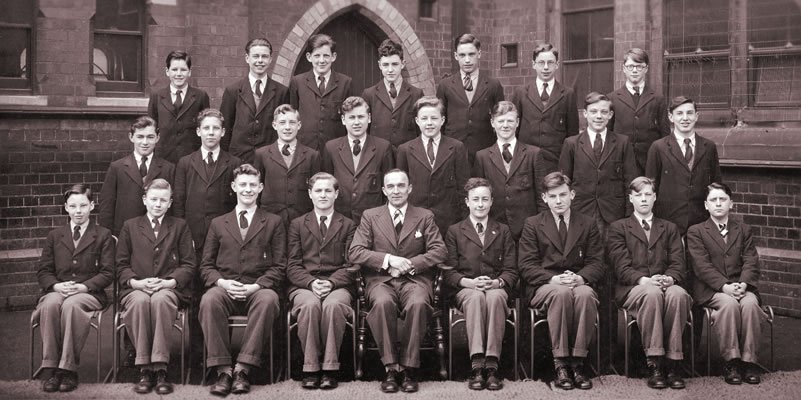
The original of this 1934 Nelson House picture was a fairly poor quality photo so this is about the best possible.

The picture was supplied by the daughter of John P Bull who can be seen fourth from the left on the first row seated on chairs. E.C. Nicholson (Chemistry) still appears as House Master and A.C. ‘Chazzer’ Brown can be seen to his left.

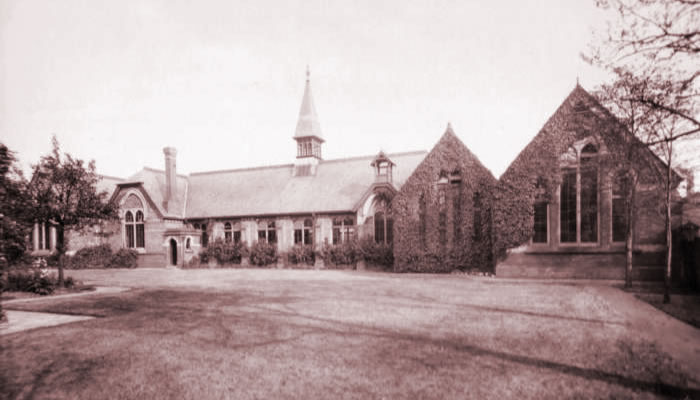
Bond Street School

In 1877, some sixteen years after it was first proposed, Bond Street School, together with the Headmasters house which had caused some controversy, was finally opened and the school was relocated from its now uncomfortably overcrowded premises in Friar’s Walk.

A new chapter in the school’s history had begun.

Select page to view:

Winshill (1964)

By 1964, Burton Grammar School had reached what might be thought of as its heyday.

The new pavillion and extension to the sports fields, including a running track, had recently been put into service. Never before had the school achieved such accademic success. For the first time, over 100 pupils enjoyed ‘O’ level passes, several students were being awarded Open Scholarships at top universities and around 30 students a year were successfully gaining university placements, sometimes out-performing the nearby Repton Public School. The sun was shining!

This was two years before the very first mention of a re-organisation of secondary education. It would have been inconceivable at the time that the Grammar School System, with its centuries of tradition, was soon to be abolished.

On a slightly sad note, the year also saw the death of Miss Mitton who had been the Headmaster’s Secretary for twenty-two years, spanning several Headmasters having been originally appointed by Mr Moodey. She was almost considered ‘part of the furniture’.

Whole School
Click here to view large image

In happy times, another complete school photo was commissioned as a celebration. A mischievous Paul Wheildon at the far right, timed his pose to perfection, escaping the eye of the photographer until after it had been printed.

1948 Intake (Class 4B – 1952)

Back Row: Peter Butlin, Don Elliot, Mick Darby, Stuart Haywood, Gordon Snell, Ian Miller, Alan Worthington
Middle Row: Trevor Botterill, Peter Bennett, Alan Marshall, Brian Giltrap, Barry Walton, Geoff Nicholson, Peter Jackson, Roy Fox
Front Row: Brian Hall, Gerald Huckerby, John Newton, Bernard Shaw, Mr D.M.Davies (Form Master), Colin Bunting, David Harper, George Row, Michael Fraser

Winshill Tour (1958)

These pictures are taken in the first year of the ‘new’ Burton Grammar School in Winshill.

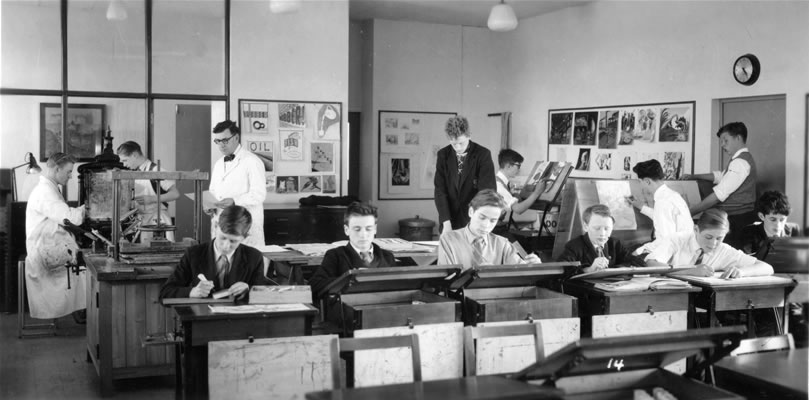
Art Room – with ‘Chippy’ Heath trying to look busy

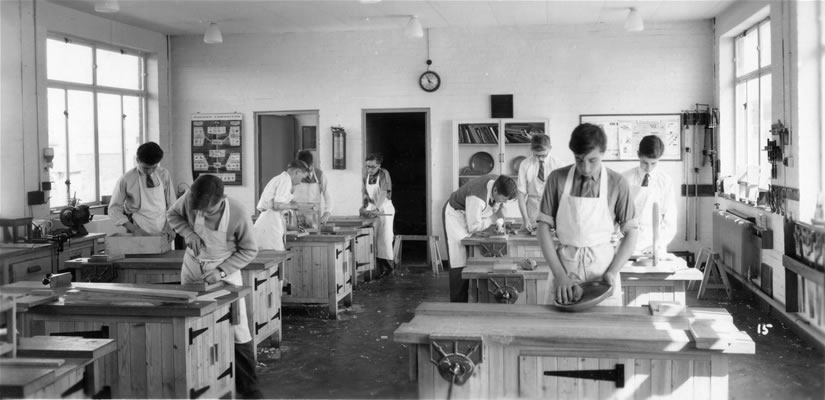
Woodwork Workshop – with ‘Taffy’ Davies managing to keep out of frame

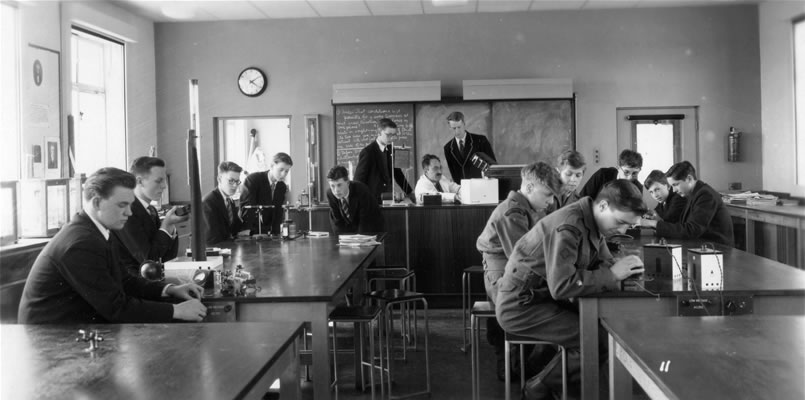
Senior Physics Lab – with Ezra Somekh, sadly just before my time

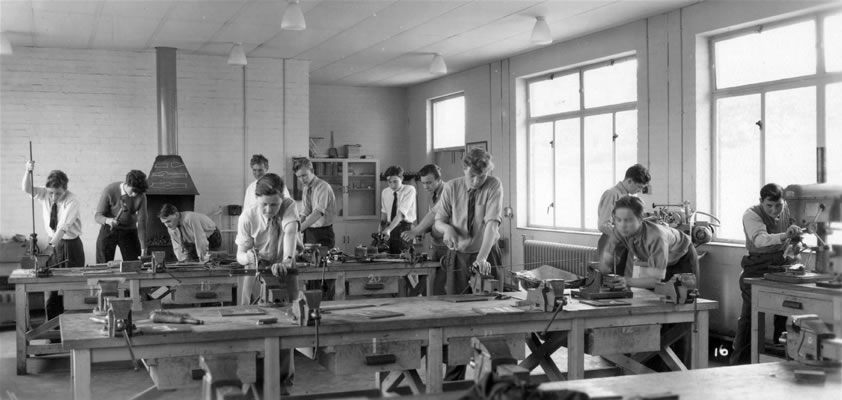
Metalwork Workshop – under ‘Tinman’ Andrew watchful eye

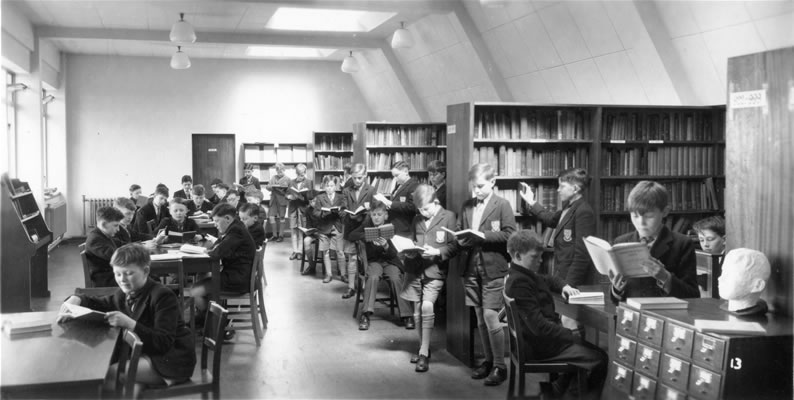
Library – not posed… honestly

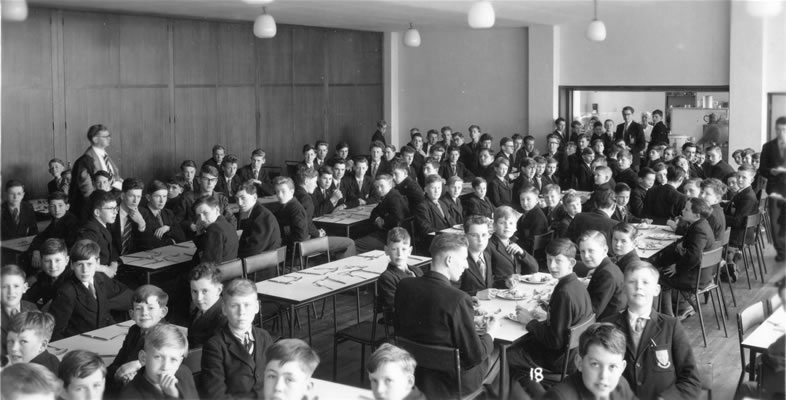
Dining Hall – with everyone hoping that the photographer will fall off his chair

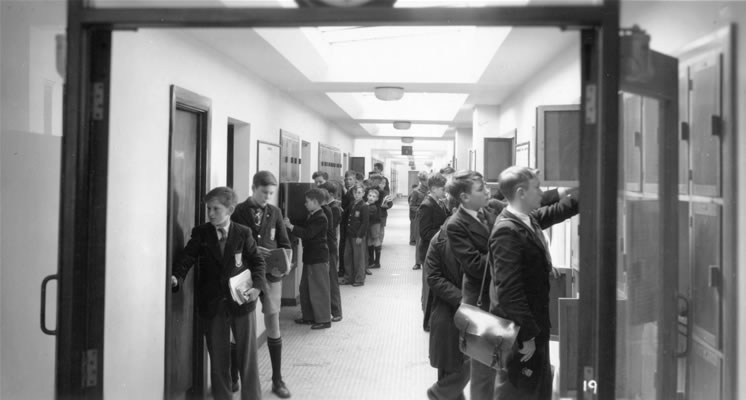
Main Corridor – Sorry Lad, the tuckshop’s not open yet

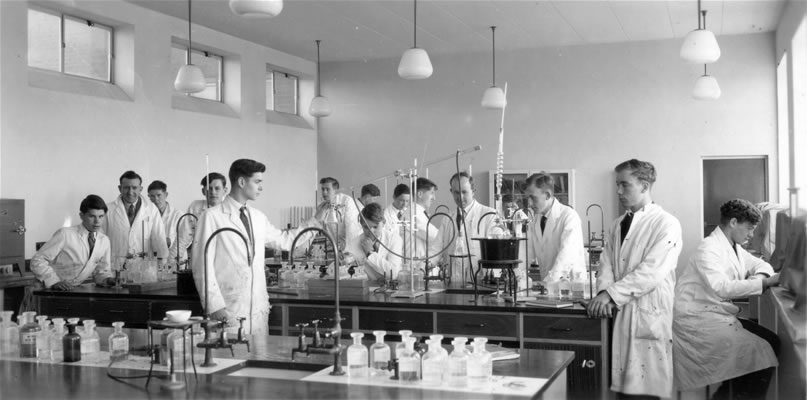
Chemistry Lab – with Norman Jones trying to disguise himself as a student to Dennis Grimsley

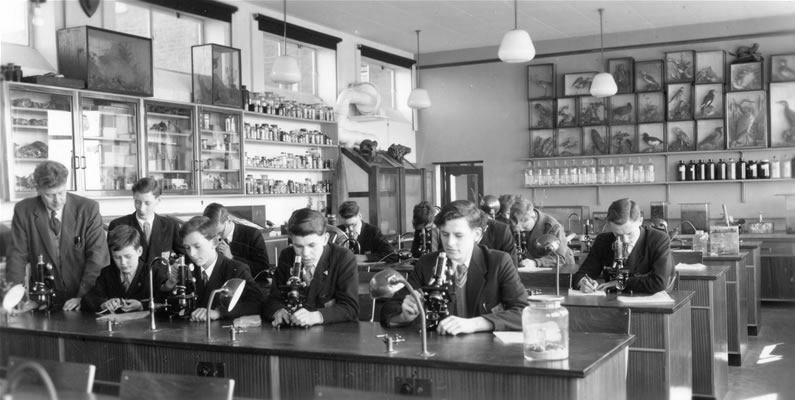
Biology Lab – with ‘Joey’ Crowther on the prowl

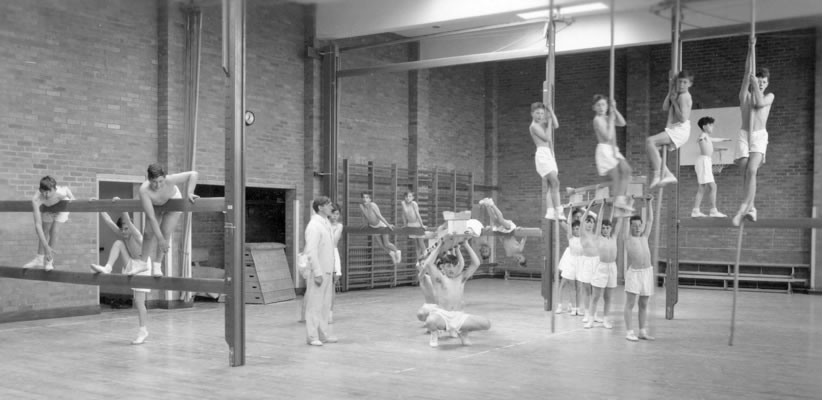
Gym – with Vic Roebuck slighty over-posing

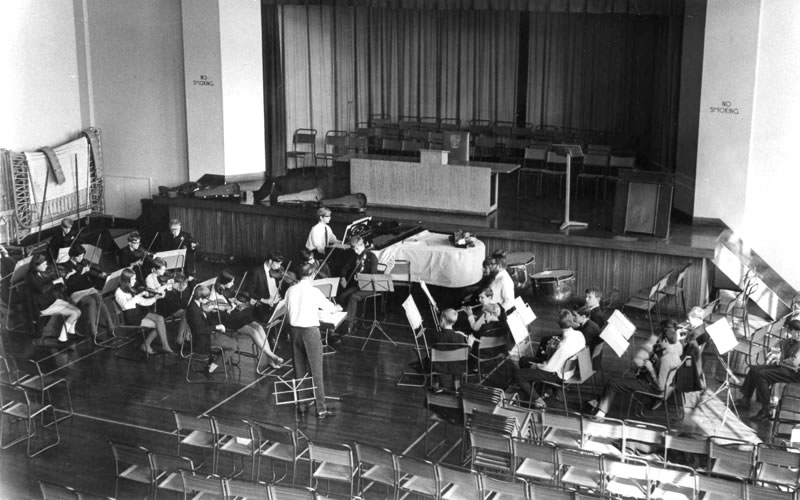
Stage and Hall – with its always amusing ‘No Smoking’ signs


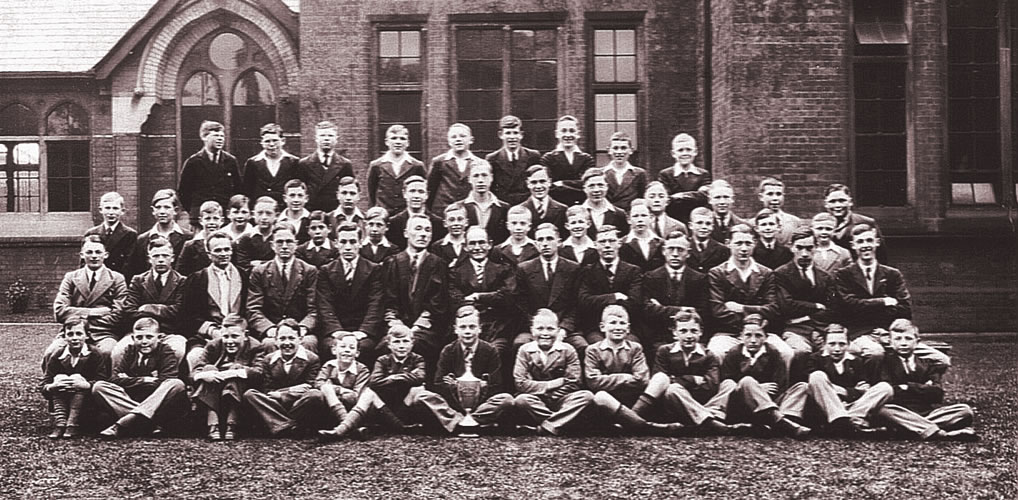
1939 – (Bond Street) Full School Photo

In 1939, just prior to the outbreak of World War II, there were 316 boys in the school.

Whole School
Click here to view large image

It would be fairly natural to assume that the largest man in the centre was the headmaster, but this was in fact, Mr T. Parkin who had recently been acting headmaster for a short period before being replaced by Mr W.D. Fraser, who is next on the right.

A few faces can been seen that would remain on the staff until after the school had moved to Winshill almost twenty years later. Most notably, Herbert ‘Horace’ Pitchford, who would by that time be headmaster, George Cooper, Frank ‘Bill’ Read, Joseph ‘Jake’ Hammond, Ron ‘Ronnie’ Illingworth, Dai ‘Taffy’ Davies and Cecil ‘Chazzer’ Brown.

C.C.F. Royal Centenary Parade, 1960

Remembered by T.H. Quayle L.VISc.

Two cadets, one from each section of the School C.C.F., were invited to attend the Cadet Royal Centenary Parade on the 22nd July, 1960. Corpral Price from the army section, and myself from the R.A.F. section, were the lucky ones.

We arrived, after an uneventful journey, at Woolwich Arsenal. We were immediately taken into a small room and our particulars were taken by several officers. I was handed a piece of paper with the mysterious formula “Con-naught, Room 38” scrawled on it. This, I assumed, was my barrack block and room number. I was right ! I was separated from Cpl. Price, being an R.A.F. cadet, and taken to my room. Whilst I was settling in cadets from all over the country, from the Isle of Wight to Glasgow and from Bristol to London arrived one by one.

At about five o’clock we were told that it was time to go for tea, which was had in a Cookhouse about a quarter of a mile from our barracks. After tea we went to see a film show in the camp cinema.

The next morning we were allowed a lie in, and then, after breakfast, we were inspected by an R.A.F.V.R. officer, who told us that there would be two rehearsals, one in the afternoon and the other after tea.

The afternoon parade rehearsal was quite tiring because of the long waits while the organising officers discussed various points about the parade, and also whilst an officer directed us from a loudspeaker van. An army and a navy officer played the part of the Queen and Prince Philip in the rehearsals ; it was quite touching to see the short navy officer gallantly-helping the tall thin army man from the Land-Rover.

In the evening the barrack was a hive of activity. Never before had so many belts received such generous layers of bianco and boots so much “spit and polish.” Most people were in bed by nine-thirty as everyone knew that we should have to be up early for the great day.

After breakfast, all wearing our “best bib and tucker”, and knowing that we would not return to our barracks again, we packed our luggage and ourselves into our respective coaches and set off for Wellington Barracks. On the way we were put at our ease by the strains of “Housewives’ Choice” coming from the coach radio and also by chewing the barley sugars that we had been given. Arriving at Wellington Barracks we immediately fell in, and after a short pause marched off to Buckingham Palace to the accompaniment of the Band of the Junior Wing H.M. Royal Marines.

We entered the Palace through the back way, the highly-mysterious “Electricians’ Gate.” We had to wait about a quarter of an hour for the Queen to appear with Prince Phillip, and as she did so we were ordered to attention and then saluted. The Queen then inspected us, going round on a Land-Rover. When Her Majesty returned to the dais we were again called to attention while General Sir Oliver Leese presented the C.C.F. Commemoration Book. Three hearty cheers were given and then the banners moved forward to their positions near the Terrace Steps. Then we all took part in a march past the Queen to music appropriate to whichever section was passing the dais. We marched out of the main Palace gates and back to Wellington Barracks, where we had a packed lunch.

After lunch we marched to Westminster Abbey for a service, and then back to the barracks for tea. When tea was over we boarded buses for our respective stations.

At St. Pancras station I rejoined Cpl. Price and we entered our reserved compartment back to Burton. On the way we noticed several people reading newspaper articles of the parade of the “Soldiers who never go to war.”

School Magazine

In the 1880s there was a school magazine called ‘The Lyre’. This was leather-bound and hand-written and illustrated so was not distributed in any number and soon ceased production.

There was another attempt to get a school magazine off the ground was in 1905. At a meeting in the Chemistry Lecture room, H.S. Staley was appointed as its first editor. He left at the end of that year to go to Birmingham Univerisy and later, to Cambridge and was succeeded by Aubrey Baggley. Mr W.T. Jeffcott who taught Latin, French and Shakespeare at the time, contributed an ‘Acrostic’, which were fore-runners of the modern day crossword, but he insisted on it not being published in his name. Despite the initial enthusiasm, it was only short-lived.


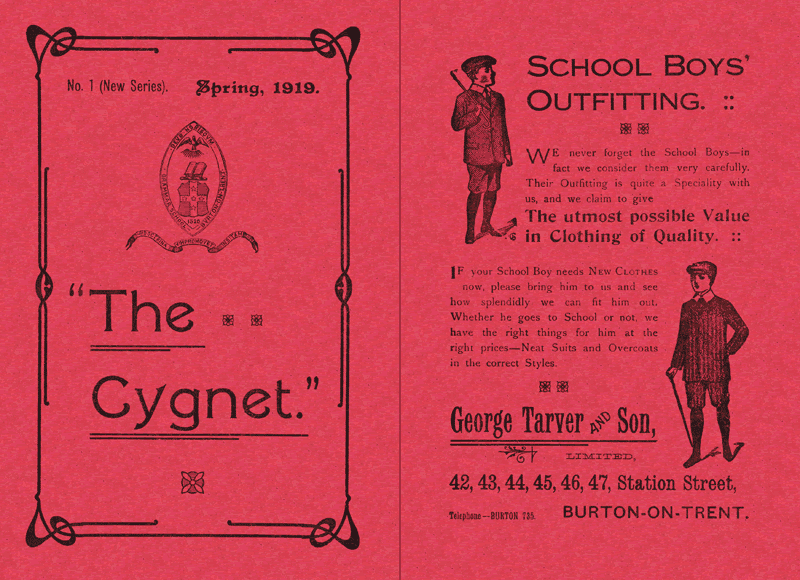
The first Cygnet, Spring Term 1919 – Issue 1

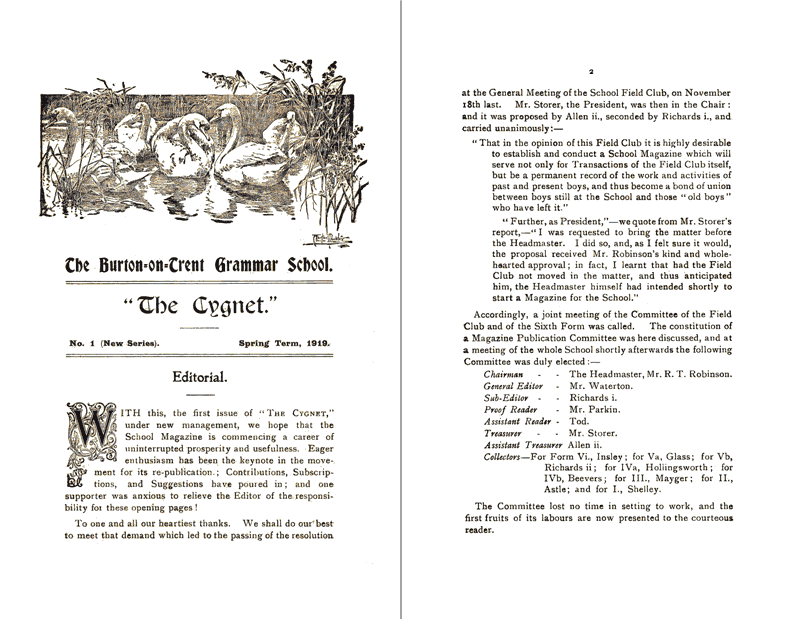
The next attempt was following the end of World War I in 1918. The end of the war prompted form 5B to cobble something together using exercise book covers with loose sheets stuck together and sew in. The first issue was signed by all 22 members of the class. Advertising had been offered at 1d for the first twenty words. Rather ambitiously, it was intended as a weekly journal but this quickly faded away and stopped after just six weeks. The magazine had though, caught the eye of the Headmaster of the time, Mr R.T. Robinson who fully endorsed the idea of a school magazine and decided to add some official weight to it and appointed himself as Chairman. Pupil, Waterton was appointed Editor with Richards as Sub-editor and Mr Parkin as proof-reader. Also appointed were a Treasurer, Assistant Treasurer, Copy collectors (one in each form). The magazine at last had a solid footing and the result was the ‘Cygnet’, Spring Term 1919 – Issue 1.


The first two pages of the first issue

Very soon, it became an integral part of the school and a compulsory subscription required that every member of the school had to pay each term as part of the school regulations.


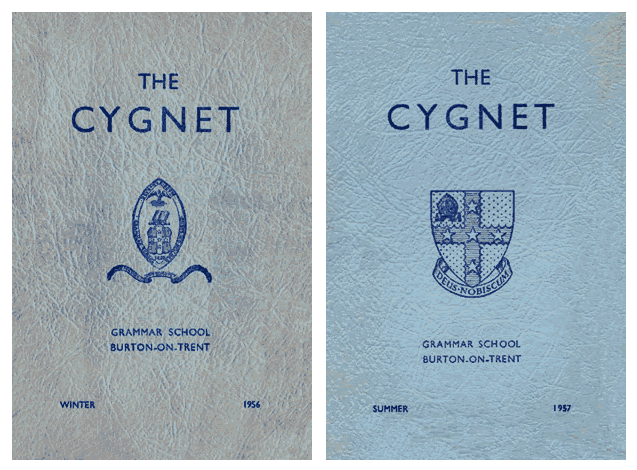
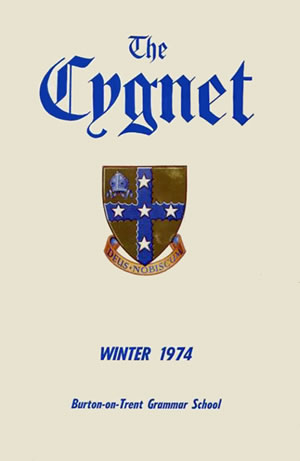
In 1957, the school crest was changed and the cover was given a fresher colour

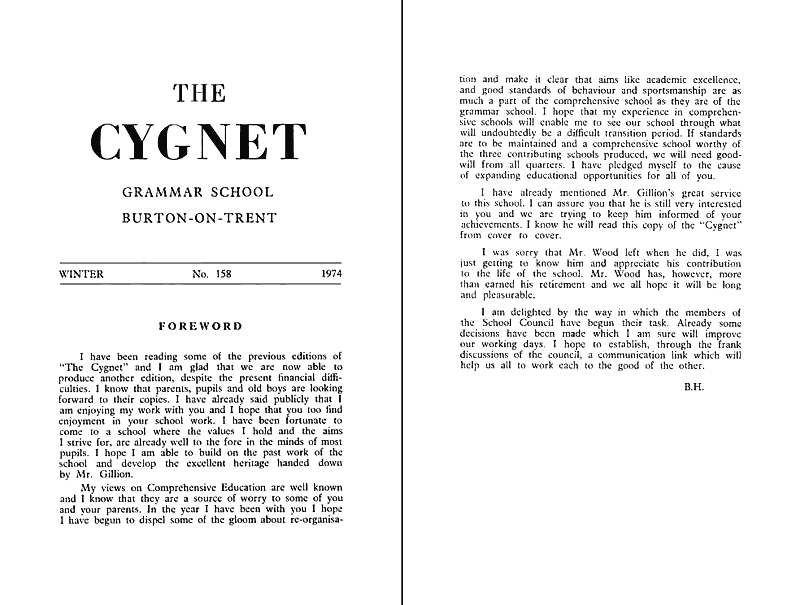
This was to run with Spring, Summer and Winter term issues almost until the very end of the Grammar School with the final issue in Winter 1974.


The final ‘Cygnet’ just before the closure of the Grammar School
(* a PDF copy of this is available on request but too large to feature)


The first two pages of the last issue: Foreword by Brian Harris (Headmaster)

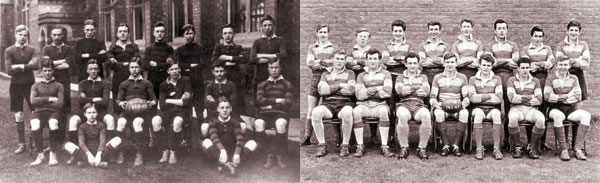
Rugby

Like many Grammar Schools, Burton followed the tradition of playing Rugby rather than football. The only winter alternative was cross-country. Whilst it is nice to now look back at this as a proud tradition of hard but fair play, I can’t remember being particularly enamored with either of these activities!