Menu Close

1855 – Humble Petition

Even by the Eighteen-fifties, Grammar School education was very ‘classic’ with such subjects as Latin, Greek and Hebrew. The curriculum had simply not moved with the developments of the times. Many of the leading Industrialists and Employers in Burton such as Henry Allsopp and Abraham Bass, who would ultimately make generous contribution to the relocation of the school, expressed some concern that leaving scholars did not have the required skills.

In 1855, a new Headmaster was to be appointed and a partition was raised (Humble Petition) to be presented to the Trustees of the school.

The Headmaster ultimately appointed in 1855 was Rev. Henry Day where he remained for eighteen years until he retired in 1873, four years before the school moved to Bond Street.

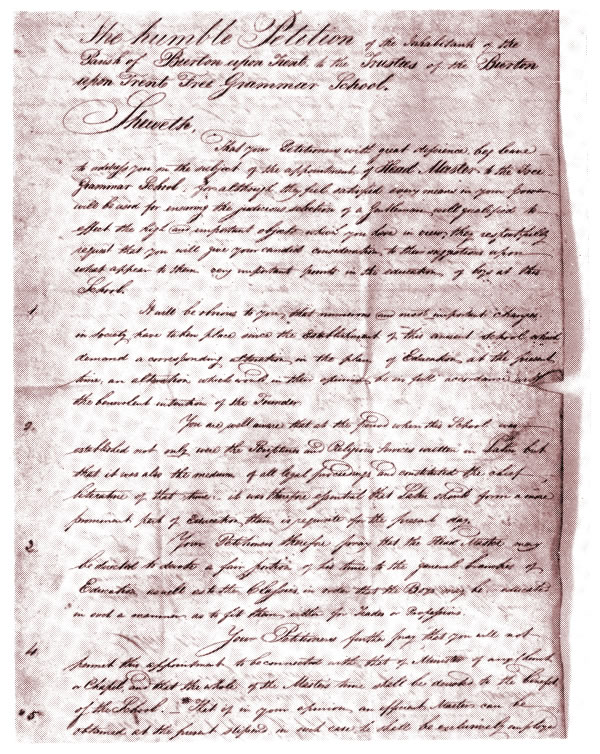
Clearly, there are no copies of the petition but below is an image of the original hand-written one.

The full text of the petition was as follows:

The Humble Petition of the inhabitants of the parish of Burton upon Trent to the Trustees of the Burton upon Trent Free Grammar School

Sheweth

That your petitioners with great deference beg leave to address you on the subject of the appointment of Headmaster to the Free Grammar School; for although they feel satisfied every means within your power will be used to ensure the judicious selection of a gentleman well qualified to effect the high and important objects which you have in view; they respectfully request that you will give your candid considerations to their suggestions upon what appear to them to be important points on the education of boys at this school.

1) It will be obvious to you that the numerous and important changes in society have taken place since the establishment of this ancient school, which demand a corresponding alteration in the plan of education at the present time; an alternation which would in their opinion be in full accordance with the benevolent intention of the founder.

2) You are well aware that at the period when this school was established, not only were the scriptures and religious services written in Latin, but that it was also the medium of all legal proceedings and constituted the chief literature of the time: it was therefore essential that Latin should form a more prominent part of education than is requisite for the present day.

3) Your petitioners therefore, pray that the Headmaster may be directed to devote a fair proportion of his time to the general branches of education, as well as to the classics, in order that the boys may be educated in such manner as to fit them for trades and professions.

4) Your petitioners further pray that you will not permit this appointment to be connected with that of Minster of any Church or Chapel, and that the whole Master’s time shall be devoted to the benefits of the school.

5) Your petitioners beg that if, in your opinion, an efficient Master can be obtained at the present stipend, in such case, he shall be exclusively employed in the instruction of free scholars.  But on the contrary, if you shall think it necessary to allow the Master to take pupils, that you will limit the number and adopt such means as are best calculated to prevent any preference being given to such private pupils as may operate to the detriment of the free scholars, and consequently to nullify the intentions of the founder.

Your petitioners therefore pray you to listen to their suggestions and that as far as in your opinion they are practicable, you will carry them into effect.

1954 Ellis & Son Advert

This Ellis & Son advert appeared in numerous school Cygnet magazines as suppliers for the Burton Grammar School uniform as well as sports wear which included, in my case anyway, a white sports shirt together with one in the nominated house colour (Wellington – Maroon, Drake – Blue, Clive – Green, Nelson – Black).

The advert is restored but not in any way improved, remaining as true to the original advert as possible. It appeared in the Cygnet for many years but reduced in quality slightly each year before it was finally revised.

Ellis

The advert reminds of the grandier of a Burton building which is now very much taken for granted. Ellis & Son Menswear enjoyed some prominence in Burton for over 100 years. It is slightly amusing that in 1954, four digits was though more than adequate to accommodate any likely future demand for telephone numbers.

Ellis

It is nice that the building survives to this day and is still one of the Town’s most elegant buildings. It is a shame that the equally impressive buildings across the road had to give way to what is now the entrance to the modern day shopping precinct.

These two pictures show the shop in the heyday years of both the Bond Street and Winshill Grammar Schools when the summer months would have done very brisk business kitting out pupils for the start of a new year.

Prefects 1936-37


Back Row: K. Neal, W. Cross, E. Sudale, E. Shelton, J. Clarke, A. Stanesby
Front Row: D. Aitken, W. Chesher, P. Davies, C. Stephens (Headboy), S. Felgate, W. Neville

Prefects 1938-39


Back Row: D. Johnston, K. Shooter, J. Halliday, L. Rees, N. Carfoot, P. Thompson, R. Sidwell
Front Row: T. Telford, R. Fletcher, K. Neal (Headboy), W. Cross, G. Woodcock

1884 – Allsopp Amalgamation

Opportunities for education were limited in the eighteenth century. Many children were employed six days a week in such establishments as local cotton mills leaving Sunday the only day on which they could receive basic education as provided by a number of Sunday schools. The Grammar school existing at the time in Friars Walk, taught the ‘classics’ such as Latin, Greek and English. Any other form of schooling was private.

In 1728, Allsopp’s charity school was founded by Richard Allsopp, a Burton mercer, who bequeathed £10 a year for the instruction of 30 poor boys from Burton. Some were also clothed by other charities, such as the Francis Astle foundation, which donated a princely £5 a year for the purpose upon the death of his wife.

Education for girls was generally considered unnecessary. A girl did however, first enter the school in 1785 and a second in 1787. At this time, there were around 23 boys. The number of girls gradually grew. In 1834, the school was moved to New Street.

At a time when the ‘National Society for Promoting Religious Education’ was busy establishing National Schools in England and Wales. It too had recognised the need to provide basic education for the poor with the three R’s (Reading, wRiting and aRithmetic) being taught in conjunction with religious education.

The first National School in Burton was attached to Christ Church in New Street, opened in 1844 providing for 120 boys, 120 girls, and 100 infants. The largest school in the town by far! ( Pictured ). A few years later it was sharing its premises with Allsopp’s Charity School and was extended. (Christ Church received much damage including a cracked spire as a result of the Fauld explosion in 1944 and had to be demolished).

The Education Act of 1870 led to the formation of The School Board in Burton in 1873. As part of a major redevelopment and re-organisation, which included much new building of schools, Burton Grammar School finally made its long overdue move from Friars Walk to a newly built school in Bond Street in 1877. Ironically, Saint Modwen’s church acquired the vacated school for use as a Sunday school teaching the scriptures. Within the next few years, new schools were also built in Victoria Street, Wetmore Road, Grange Street, Uxbridge Street, Wellington Street and Broadway Street.

In this time of much educational change, in 1884, the boys from Allsopp’s Foundation Charity School were amalgamated into the new Bond Street Grammar School, presenting an unprecedented number of non-fee paying boys the opportunity of a Grammar School education.


First Girls school in Burton also formed by the amalgamation of Allsopp’s Charity School

The girls from Allsopp’s Charity School formed Allsopp’s Girls’ School, for girls aged between 7 and 17, in new premises in Waterloo Street. This was effectively, the start of the Girl’s High School with Miss Kate Rutty being appointed as Headmistress.


Girls High School established almost 30 years before WInshill Grammar School for boys

The Girls’ High School was to eventually find an impressive new home in Winshill in 1928, an influencing factor in the selection of site of the Burton Grammar School almost thirty years later. This meant that for an almost 30 year period, Girls in Burton-on-Trent enjoyed much better education facilities than boys.

1873 – The School Board

The Education Act of 1870 made schooling compulsory for all children from the age of five to age thirteen. It was sometimes known as Forster’s Education Act since it was drafted by William Edward Forster, a British industrialist, philanthropist and Liberal Party statesman and MP for Bradford.

The reason for the Act was the recognised need for Britain to remain competitive in the world by being at the forefront of manufacture and improvement and that education was fundamental to this cause.

The country was divided into 2500 school districts, of which Burton Upon Trent County Borough was one. The School Board was elected by ratepayers.

Concerns were raised at the numbers attending private and dame schools, which were often held to be of a poor standard. It was estimated that in 1870, there were about 450 pupils at such schools in Burton, with as many as 165 apparently attending dame schools near Fleet Street, a working-class area, in 1873. The perceived failings of the existing schools, along with a need for around 2,300 more places in the Burton area, led to popular pressure for the formation of a school board under the 1870 Education Act.

Despite the opposition of leading Anglicans, the government ordered the creation of a board for a united school district comprising Burton upon Trent, Branston, Horninglow, Stapenhill, Stretton, and Winshill, and the board was finally established in 1873. This included the formation of the Grammar School Board. The School Board, 1873 allowed the town commissioners, predecessor of the local education authority, control of local education.

The roles of the School Board were:

  • To raise fund by the introduction of education rates collectable from ratepayers
  • To build and run new schools where required to make suitable provison
  • To subsidise church schools where appropriate
  • To provide free education for the poorest children but make their own by-laws to control fees.
  • Where necessary, create by-laws to ensure compulsory education from 5-13
  • To make sure that religious education did not extend beyond simple bible reading

A resolute building program was commenced and Giles and Brookhouse of Derby were appointed ‘Architects to the Board’, and by 1880 there were 15 board schools with a total of 5,084 places.

As part of this program, in 1877, Burton Grammar School would finally made its long overdue move from Friars Walk to a newly built school in Bond Street. Ironically, Saint Modwen’s church acquired the vacated school for use as a Sunday school teaching the scriptures. Within the next few years, new schools were also built in Victoria Street, Wetmore Road, Grange Street, Uxbridge Street, Wellington Street and Broadway Street.

By 1887, when Reginald Churchill of Burton became the board’s architect, there were 9,010 pupils attending the board’s schools. As the numbers attending board schools increased, so attendance at voluntary schools declined, a trend which continued after 1891 when all board schools (except higher-grade schools) were made free under the Elementary Education Act, 1891.

The School Boards were eventually abolished by the Education Act of 1902, which replaced them with Local Education Authorities.

Grand Reunion

In 2007, largely due to the efforts of Keith Large, there was a concerted effort to get together a reunion of the 1967 Burton Grammar School intake.

This enjoyed great success with almost 100 ex-pupils, some travelling considerable distance, enjoying a number of nostalgic events culminating in an evening at The Elms public house, run by ex-pupil of that year, Adrian Leese.

To commemorate the occasion, two special beers were commissioned, ‘Deus Nobiscum’ and ‘Victor Ale’, the latter being named after ex-games master Victor Roebuck who attended as guest of honour.

Following on from this success, Keith has decided to put together an even more ambitious reunion, this time expanding it to ALL ex-pupils, scheduled for February 21st 2009 at Burton Town Hall. It is expected to be the largest ever reunion gathering, with several hundred already pledged to attend, many from overseas.

The project has the full support and co-operation of the ‘official’ Old Boys Association but will have a very different flavour to the OBA annual dinner which, whilst an important date in the calendar for many Old Boys, is a little out-moded for some younger ex-pupils.

In contrast to the official OBA annual dinner, the event will be very informal with a strong emphasis on allowing attendees to circulate, beer in hand, to catch up with old times. If the event proves to be a success, it is hoped that the two can provide some cross-pollination with attendees from both ages supporting both events. It yet remains to be seen how overall Old Boy activity can be administered with the advent of the Internet, for example, giving rise to very different styles of management.

At the end of the day, any activity has the Burton Grammar School at heart and serves to keep the memory of it and its history alive. I think it is fairly safe to predict that the evening will be rounded off with an enthusiastic recital of Deus Nobiscum.

For details of this event, contact Keith Large at Reunion@BurtonGrammar.co.uk or call 07971 972704

Also feel free to register here and use the provided discussion Forum.

1952 – Speech Day

1951 was a fairly key year. It was the final year that the School Certificate and Higher School Certificate were taken before they were respectively replaced by GCE (General Certificate of Education) ‘O’ and ‘A’ Levels; one taken at aged 16, the other at 18. This had been called for since the minimum school leaving age was raised from 14 to 15 in 1947.

The intention was to cater for the increase range of subjects available to pupils and to revise the syllabus of some subjects to make them more relevant. The greater range of subjects was reflected in the results. In 1951, 50 School Certificates and 18 Higher School Certificates were awarded. The following year, after the introduction of GCE, and with only a very slight increase in the pupil population, 75 GCE ‘O’ Levels and 38 GCE ‘A’ Levels were awarded.

This picture was taken at the 1952 Speech Day, the first year after the education reform. Speech Day took place at Burton Town Hall until the school moved to Winshill where the Hall and Balcony made for a much better venue.

Speech Day

Back Row: Mick Harrison, Terry Bentley, Ivan Laud, B04, Mike Freegarde, B06, B07, B08, J. Tovey, Geraint Evans, Ralph Hodson
4th Row: Brian Woollett, Alan Robinson, Paul Williams, 404, Ted Ufton, 406, Ralph White, 408, 409, Ron Keightley, Bob Lester, Bob Garnham
3rd Row: Stuart Watts, 302, ‘Arthur’ Askey, 304, Tony Parker, Maurice Kersey, Godfrey Cooper, Alf Barber, Les Harrison, Pete Gostelow, Michael Lawrence, 312, 313
2nd Row: Ian Robertson, Laurence Ashley, Dickie Ward, Chris Goddard, 05, 06, Geoff Mortimer, Chris Hopkins, Geo. Moore, Iain Cotton, Ray Gilbert, 212
Front Row: F01, F02, Roger Sharp, Peter Smith, Peter Taylor, Joey Bridges, Dave Batty, Cliff Mountney, Roger Potts, John Ash, John Cotton, Peter Graley, Robin Smedley

Headmasters


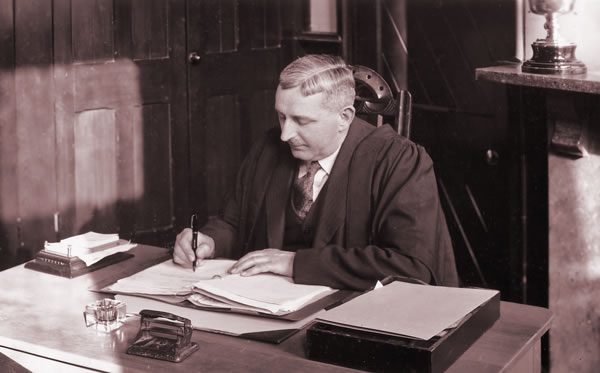
Herbert Pitchford – The last Headmaster at the Bond End School

Reverend Francis Edward Jackson Valpy (1839 – 1843)
Rev. F.E.J. Valpy was the son of Rev. Dr. Richard Valpy who was for many years, the Headmaster at Reading School and one of the founders of the public school system.

On the death of his father, Francis succeeded him. He was by this time himself a Greek scholar of some repute and had published several textbooks on the subject that had been adopted by a number of schools as the ‘standard’ work.

He lacked however, his father’s gift for teaching and organisation and during his time as Reading Headmaster, the number of pupils decreased from over 200 to just 30. He moved to Burton Grammar School to take the vacant headmaster post! This he was able to do largely through his brother-in-law, Rev. Peter French who was successful in his post at Stretton.

Francis Valpy was however, no more successful than he had been at Reading and once again, the school fell into decline with a greatly reduced number of pupils. He only managed to survive for four years by which time, there was considerable pressure for him to be replaced.

The only known account of him reads “He is only remembered for his very tall beaver hat with neither crown nor brim, referred to as ‘the chimney-pot’, and his swallow-tailed coat with shiny buttons which he wore as everyday wear”.

Reverend John Fisher MacMichael (1843 – 1851)
Reverend J.F. MacMichael was a very different character to the Headmaster he replaced. He was educated at Richmond School in Yorkshire following which, he entered Trinity College, Cambridge in 1833. He graduated in 1837 having during his time there, been awarded second prize for English Declamation. From Cambridge, he was Master of University College, London. He was the author of an edition of ‘Xenophon’s Ananasis’ and an edition of the Greek New Testament.

Shortly afterwards, he spent three years at sea, from 1838 to 1841, as a naval instructor.

In 1842, he took the post of Vice-Principal at Hull College. Just one year later in 1843, to accelerate his career, he successfully gained the position of Headmaster at Burton Grammar School to replace the ineffective Rev. F.E.J. Valpy.

He stayed at Burton Grammar School for eight years before leaving in 1851 to become Headmaster of the much larger and more prestigious Grammar School in the cathedral city of Ripon in the Harrogate district of North Yorkshire. He was also appointed curate of Monckton, Ripon. He eventually became Honorary Canon of Ripon Cathedral and died there in 1872. He was buried in the Cathedral’s burial ground.

Reverend Stuart H. Fagan (1851 – 1855)
Reverend S.H. Fagan joined the school at fairly short notice on Rev. J.F. MacMichael’s relatively unexpected departure. Little is actually recorded of Rev. Fagan other than his reign as Headmaster only lasted four years and he was replaced in 1855.

It is known that his son, H.M. Fagan attended Burton Grammar School from around 1868 before going to Worcester College, Oxford, which suggests that after leaving Burton Grammar School, Rev. Fagan remained in Burton concentrating on his work within the church.

Reverend Henry Day (1855 – 1873)
Reverend Henry Day was the son of Rev. Thomas Day of Mendlesham in Suffolk. He was educated at Harrow for whom he played cricket. He won a College Scholarship in 1846 where he gaind a number of prizes for English and Latin. He won the Chancellor’s Medal for poetry in 1848 and a first class Tripos in Civil Law. He later won the English poem prize twice (beating Tennyson himself who only won it once!). He was admitted to the Inner Temple and ordained deacon by the Bishop of Norwich in 1851.

From here, he became curate of Drayton, Berkshire and second master of the associated Abingdon School.

He finally arrived as Headmaster of Burton Grammar School in 1855 and was to remain there until his early retirement in 1873 at the age of 46. He was to remain in Burton for the rest of his life until his death in 1893.

Charles Undershell Tripp (1873 – 1884)
In-progress

Reverend Thomas Wall Beckett (1884 – 1900)
Reverend T.W. Beckett was born at Wellington, Shropshire in 1836.

R.T. Robinson (1900 – 1930)
In-progress

Sydney Ernest Wilson (1930 – 1935)
Sydney E. Wilson was educated at Christ’s School in Sussex where he enjoyed both sporting and academic success gaining, representing the school in both Rugby and Cricket and secured a place at Cambridge to read Matematics; he was also a member of the school orchestra with an interest in music.

His education was interrupted in 1917 to take up service in France during the First World War before returning in 1919 to resume. At Cambridge, he gained a First Class Mathematics Tripos and published a number of maths papers. He also gained a BA degree in 1922 and an MA in 1928.

He became Senior Maths Master at Blundell’s School. This was a prominent public school, sometimes referred to as ‘The Eton of the South-West’ located in Tiverton, Devon.

He was appointed Headmaster of Burton Grammar School in 1930, with the tough job of stepping into the shoes of the very popular and highly effective Mr R.T. Robinson. He remained in the post for five years during which time, the school pupil population exceeded 300 for the first time. He left in 1935 to become the Principal of King William’s College on the Isle of Man. He finally passed away in 1973.

T.W. Parkin (acting) (1935 – 1936)

W.D. Fraser (1936 – 1941)

Harold Stephen Moodey (1941 – 1950)
Harold Moodey was educated at Chatham House Public school where, aside from being an outstanding scholar, he was senior prefect, captain of cricket and captain of football.

He gained an Open Scholarship to Oxford and took first class honours degrees in Natural Science and Chemistry. He entered Jesus College, Oxford and was there were war broke out. He then ‘enjoyed’ distinguished service in the Royal Air Force. Back in Jesus College after the war, he gained college colours for football and rowing and became president of a number of societies including Oxford Colleges Scientific Club.

As a post-graduate, he wrote a number of papers and textbooks and had a distinguished teaching career as second master of Chemistry at the esteemed Liverpool Collegiate School and Head of All Sciences at Hampton-on-Thames Grammar School.

Colleagues had nothing but good to say about him before he suffered some kind of mental illness and some unsuccessful procedure that had a very negative effect on his mental well-being. He went off sick just before Christmas, 1949, and was reported to be seriously ill. One morning in May, 1950, to the shock of the school, he went to Burton Railway Station and committed suicide by jumping in front of a moving train. When the police visited his Stapenhill home, they discovered the true extent of the tragedy. His wife and teenage son and daughter were all found dead as the result of head injuries.

Herbert Harrington Pitchford (1950 – 1958)

William H. Gillion (1958 – 1973)