Menu Close

Old Boys Association

For 100 years there has been an Old Boys’ Association. However, with rapidly diminishing numbers, it eventually became obvious it could not sustain support for an AGM, an Annual Dinner and the cost of distributing a Newsletter.

Select item to view:

In 2019 the OBA membership was consulted about closing the Association and the result overwhelmingly confirmed the Committee’s suggestion to dissolve the Association. This was to be done in 2020 with a final celebration of 500 year history of the school and the 100 year anniversary of the founding of the Association.  Unfortunately, this celebratory AGM and Dinner were postponed due to the Pandemic but the AGM was held as a virtual meeting on Zoom when all Committee members took part. The Association was formally dissolved after the decision was overwhelmingly endorsed by the membership.

LastOBA

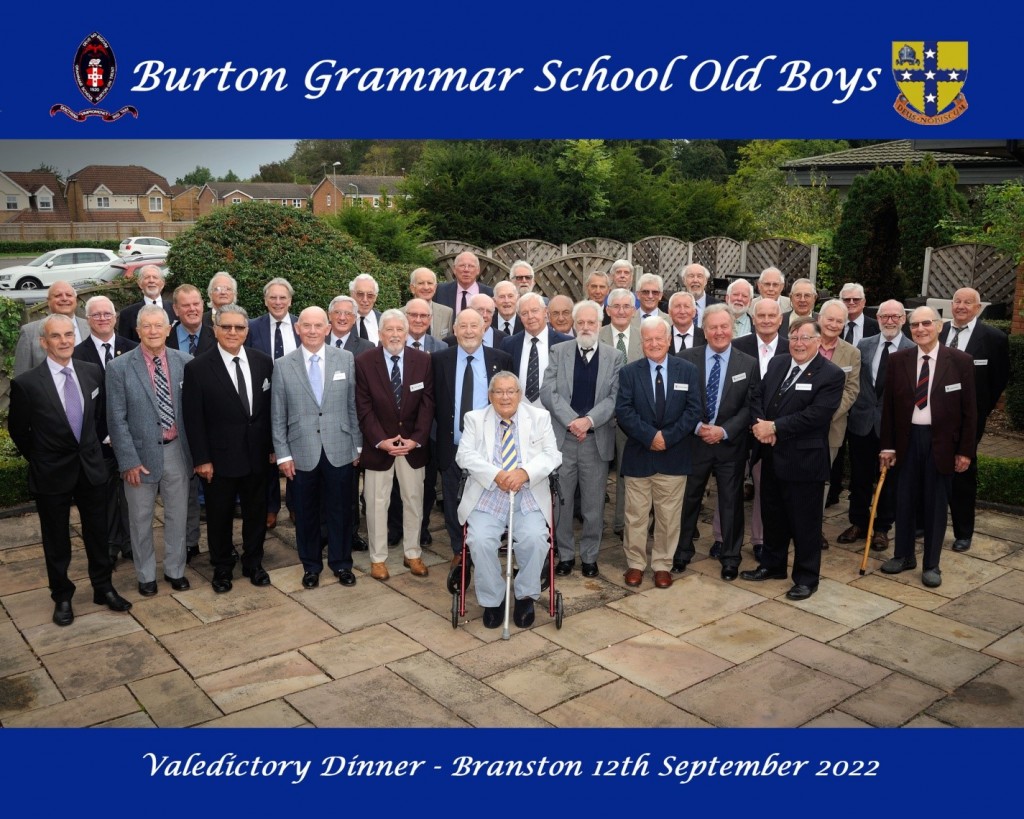
Valedictory Dinner

A final Valedictory Dinner was held at Branston Golf Club on 12th September, 2022. This was thoroughly enjoyed by all 62 attending Old Boys. This included Richard Wain whose father HJ Wain was key in setting up the Association in 1920!

OBAFinal

Continuing to stay in touch
2020 – Until this date, an annual Newsletter had been either emailed or posted to the whole OBA membership. To keep up with modern practice and legislation, it was decided to retain only those alumni who gave their consent to remaining on a database kept by the emeritus Editor, Eric Bodger.

If any Old Boy wishes to receive future newsletters and has not already given his consent to remaining on record, they can contact Eric Bodger at bgs@cicsplex.co.uk to give their approval and they will then go on the database. In doing this, he is being assisted by Graham Marshment. graham@gmarshment.f9.co.uk

Eric and Graham have offered to do this for as long as they are able and for as long as material is submitted to either of them.

In the Beginning

Burton AbbeyBurton Abbey was founded in 1002 by Wulfric Spot, the extremely wealthy Earl of Mercia, and was granted a charter by King Ethelred in 1004. As a Burtonian ‘born and bred’, I was dumbfounded at the sheer scale of Burton Abbey which occupied a 14 acre site. I remain amazed that I could have lived in the Town for 50 years before discovering that such a structure ever existed. What I had always known as the Abbey was in fact, an almost insignificant annex which spent at least some of its time as an infirmary. The picture shows what seems to be the most accurate image of the Abbey in its heyday; it is my own colourization of a 1661 engraving by W. Hollar.

The first mention of a school was not until 1390. The reference to a ‘warden of the boys’ (custos puerorum) in Burton in this year suggests that there may have been an Almonry school within the abbey. Almonry foundations were common around this time in greater Monasteries in the 14th century, with the boys assisting in the celebration of private masses.

The first ‘free’ (as in free of the church as opposed to without fee) Grammar School was founded by Abbot William Beyne in around 1520. The formation of the school however, was likely influenced by the Reformation in an attempt to gain political and financial stability in a time when King Henry VIII was launching campaigns against Monasteries and Abbeys with royal confiscations of the properties of religious houses. By removing the school from the everyday activities and finances of the Abbey and by creating a protectorate of local lay Trustees, the Abbey was to some extent protected. Thus, William Beyne, 32nd Abbot of Burton (1502-1531), provided funds to Sir Richard Sacheverell for land purchases a Orton-on-the-Hill (Leicestershire) and Breaston (Derbyshire), the rent from which would be used to found and maintain a school and master. The school was recorded to have occupied a site on the north-west corner of the churchyard.

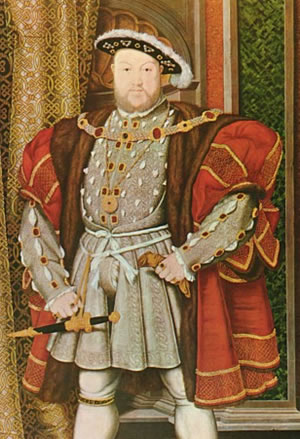
HenryIn 1534, Henry VIII had Parliament authorize Thomas Cromwell to ‘visit’ all monastries, including Burton Abbey, ostensibly to make sure they were instructed by the King instead of the Pope, but making sure to inventory their assets for later seizure. By 1536, Henry was installed as Head of the Church of England and had laws had been enacted to allow the King to seize any church building with an income of less than £200. Many were confiscated. Some were pillaged and destroyed, other smaller ones were turned into graineries, barns and stables. Whilst still under threat, the first recorded mention of a schoolmaster was in 1537 when Abbot William Edys, the 35th and final Abbot of Burton, appointed Richard Harman, a distinguished scholar and dignitary.

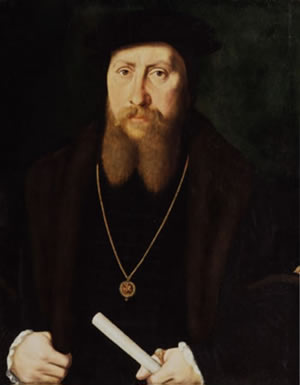
PagetAs the Dissolution continued, many great Abbeys such as Glastonbury, Shaftesbury and Canterbury which had flourished as pilgrimage sites were reduced to ruins. Some were gifted to the Kings most ‘loyal subjects’. On 4th November 1540, Abbot Edys was finally forced to surrender Burton Abbey whereupon it was gifted (together with extensive grants to lands including what is now Cannock Chase) to Sir William Paget – a close adviser to Henry VIII who later became 1st Baron Paget of Beaudesert ( pictured ). This, fortunately, meant that the Abbey was one of the few to survive leaving it one of the largest in the country. A descendent of William Paget became the Marquess of Anglesey in 1815 and still owned most of the land in Burton.

In 1545, explicit funding for a school and schoolmaster was included in the creation of the new Collegiate Church, which succeeded the Abbey following the Dissolution. Richard Harman remained as schoolmaster.

OBA Foundation

Mr. H. J. WAIN: One of the founder members of the Burton Grammar School Old Boys’ Association and its first Honorary Secretary.

Born in 1896, at Bretby. where his family had resided for many generations, he trained a Scholarship, from the Village School, to the Grammar School in 1907, being placed 3rd in a list of over 700 throughout the County.

In 1910 he passed the Junior Cambridge Local, with 1st Class Honours and two distinctions, and the following year he gained 1st Class Honours in the Senior Cambridge Local Examination.

On leaving School he obtained an appointment with Messrs. Worthington & Co., Ltd., but afterwards joined Messrs. Bass, Ratcliff, and Gretton, Ltd.

During the Great War he saw Active Service with the 14th (Sportsman’s Battalion), Argyll and Sutherland Highlanders, serving as a scout and sniper in Fiance, and on returning to Scotland was appointed Signalling Instructor to the Highland Reserve Division, where he founded and edited an Army Magazine.

In 1921-2, he passed the Intermediate and Final Examinations of the London Association of Accountants, and is at present in the Accountants’ Dept. of Messrs. Bass & Co.

Among various other honorary appointments, he was Clerk to the Bretby Parish Council, Hon. Sec. of the Bretby War Memorial Committee, Burton Natural History and Archaeological Society, Royal Society for the Protection of Birds, British Empire Naturalists’ Association, and was also Conservative sub-agent for the Bretby and Newton Solney areas of the Belper Parliamentary Division.

Below is his account of the OBA foundation written for the 1924 Chronicle of Members, some ten years after the organisation was first conceived:

A few years ago, many boys on leaving School expressed a regret that there was no Old Boys’ Club or Association, by which means chums at School might develop life-long friendships, although possibly compelled for various reasons to reside in different parts of the world. For those remaining in Burton, it was also felt that such a Club or Association would not only promote good fellowship among its members, but might possibly develop into a distinct social asset of the town, and afford opportunities of developing individual characteristics, sporting or social or intellectual in a favourable atmosphere.

In July, 1914, C. B. Smedley, F. C. Jefferson and myself consulted the Headmaster and gained his whole-hearted approval to such a scheme, but all our plans were upset by the outbreak of the Great War.

On demobilization, Smedley with characteristic energy, immediately undertook the task single handed, and provisionally arranged an Inaugural Dinner. But the time was hardly opportune – the war had only just ended and people had not yet had time to settle down to their pre-war occupations, indeed many of us had not yet returned to civil life. Sufficient support not being forthcoming, the Dinner was cancelled, and within a few weeks to everyone’s great regret, Smedley suddenly collapsed and died from the effects of his military service.

But matters had now reached such a state that the Headmaster determined the scheme should be carried through, and at his invitation an informal meeting of a few Old Boys was held on November 8th, 1920. A small Sub-Committee with Mr. Frank Evershed as Chairman was formed to draft the necessary rules and a further meeting of Old Boys was held at the School on December 8th, 1920, when a temporary Committee and Officers were appointed. The date for the first General Meeting was fixed for February 19th, 1921, and an afternoon Football Match with a team selected from the Burton Rugby Club was arranged to precede a Dinner in the Town Hall in the evening. All Old Boys whose addresses could be obtained were circularized and copies of the proposed rules were posted to them. Amid scenes of great enthusiasm, the Rules were approved and the Officers and temporary Committee were confirmed in their appointments. It was peculiarly appropriate that the Chief Magistrate of the town at that time should be an Old Boy, and the Association deemed it an honour to elect as its first President, the Mayor of Burton-on-Trent, Councillor A. H. Yeomans, J.P.

From that date, the membership of the Association has steadily increased. From 207 members in 1921 the number has risen to 345 at the present time, and included in these figures are many Old Boys resident in such widely separated parts of the world as British Columbia, Wisconsin, U.S.A., New Zealand, Australia, Malay Straits, Burmah, India, Mesopotamia and South Africa.

Reports and Balance Sheets detailing the various activities and financial position of the Association from the date of its inauguration will be found overleaf, and it is hoped all Old Boys will co-operate in extending the membership, and maintaining the traditions of the old School.

H.J.W

Old Boys Association History

In 1911, Jack Wain left Burton Grammar School in Bond Street and took up employment with Worthington and Company Limited brewing company. Three years later in 1914 he, together with ex-pupils ‘Chips’ Smedley and Freddie Jefferson, went back to see the Headmaster, which was still Mr Robinson, with the idea of forming an Old Boys Association. The ideas were met with some enthusiasm but the outbreak of World War I caused any plans to be postponed.

After the war, Mr Smedley convened a new meeting but many, including Mr Wain, had not yet been demobilised so the response was poor.

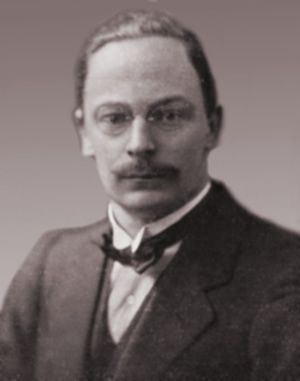
RobertsonAt the end of 1920, Mr R.T. Robinson ( pictured ) was still headmaster and, enthusiastic that an Old Boys Association should be formed, principally to remember the large number of ex-pupils that had fallen in the war, arranged an informal meeting.

In 1921, the Old Boys Association was officially founded. Mr Frank Evershed was elected as its first Chairman, Mr A.H. Yeomans was President and Mr H.J. Wain as Honorary Secretary.

…. to be continued …

In 1957, at the time of opening of the new Winshill school, new ties and blazer badges that featured the school crest and the new coat-of-arms was into the OBA Chain of Office worn by the President. After the opening, an OBA celebration dinner was held at Ashfield House on Ashby Road.

At the 1958 annual reunion, the first guest of honour was introduced in the guise of Mr R.G. Neill who had been on the teaching staff at Bond Street from 1931 to 1946. Mr Gillion had just been instated as Headmaster and was welcomed and a plaque was dedicated to the late Mr R.T. Robinson who had been Headmaster when the association was founded.

…. to be continued …

In 2004, Richard Wain, son of Jack Wain and himself a pupil at Burton Grammar School from 1944 to 1950, was instated as Honorary Secretary.

Frank Toon (1945-51) – Reminisces

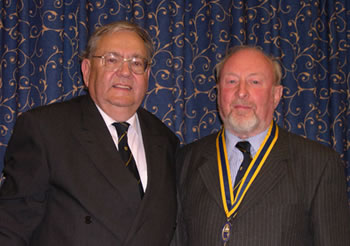
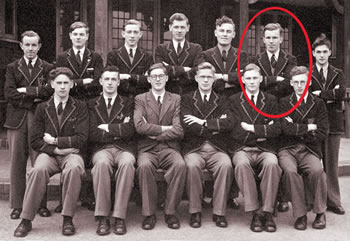
I was at the school from 1945 to 1951 and in many ways the final year was the happiest of the whole time. For various reasons, mainly due to the fact that the minimum age for sitting the new GCE was 16, I repeated a year in the 5th form known as 5CII. It was there I made two very good friends, whom I’m happy to say, I still meet even now, namely Ray Gilbert (shown here with Frank on the right) and Peter Booth, whom we knew at ‘Banty’. It was also a happy year because I was familiar with the syllabus, plus a set of very fine masters, i.e. Ellick Ward for French, ‘Bomber’ Jones for History, Mr Snape, whom we referred to as the Humber Super Snape, ‘Butch’ Barrett for Religion, Norman Jones Chemistry and last, but by no means least, dear Harry Smith for Physics and Maths. Incidentally, Harry taught me for one year at Derby Tec’ for A-level Geometry and I can remember quite well when he put the alternative segment theory on the blackboard. “Come on Toon, you should know this,” was his remark. One never forgot his way of teaching us Fundamental Principles including the method for learning sines, cosines and tangents; i.e. ‘Percy Has Bought His Penny Bun’ for ‘perpendicular, hypotenuse and base’ or when we got on to what he called Ladies’ Maths, i.e. perms and combs. Lastly, when he dictated geometry homework, we would have a rectangle Able, Baker, Charlie, Dog.

Now, to go back to that first year at Bond Street! We were put in desks in alphabetical order, with the result that I sat with Mickey Tew, Pat Thomas and John Toon, the latter being another good friend with whom I still keep in touch. I don’t know whether there are others here tonight who remember Pat Thomas? He went into the RAF and qualified as a pilot. News of him appeared in the Burton Observer from time to time. His death was very tragic, being one of the crew of a BOAC Comet, which was blown up in flight due I believe to a rumour that Archbishop Makarios, the leader of Eoka in Cyprus was on board.

Our form was situated in room S, latterly referred to as “the Shed”, being one of the extra buildings erected in what had been the headmaster’s garden. Heating was by a slow combustion stove with a basic guard around it. What the health and safety establishment would think of it today defies imagination, especially when one recollects that the pupils were expected to keep it stoked up with coke. There was always a bucket of water on top. One wheeze was to ram the poke into the coke just before dinner and on return to pull the poker out with one’s cap and plunge it into the water with the resultant noise and steam. Rumour has it in later years that a well known school rebel, i.e. Derek Kidger when a member of the CCF placed a live round of ammunition on the top of the stove, the bullet consequently going through the ceiling.

A recollection of those early years is that the Grammar School had the use of a classroom in the other Bond Street School for about 2-3 years. This was relinquished and probably as a result a form IVA was put into the ATC HQ around the corner. There was a table tennis table there, which we played continuously, so much so I bought my own bat, which I have recently disposed of. There was also a piano of doubtful tunefulness, which many of us tinkered with, but we had one expert Keith Shaw (Dazzer) whose rendition of 12 Street Rag was memorable. Eventually other classrooms were built, a Physics lab and two other rooms within the grounds plus an aluminium one behind the large bike shed, reached by punching a hole through the shed wall.

A topic no previous president has touched on is the annual Speech Day at the Town Hall. One went straight there in the morning so that the seating could be worked out for the choir and prizewinners, choir rehearsal, other pupils in the auditorium and still leave room for parents and others. If in the auditorium there was an unofficial contest to see how many sweets one could consume during the speeches, which initially I found boring but began to appreciate, as one got older. The choir gave renditions during the course of the afternoon under the baton of dear old ‘Cherry’ Orchard, whose tour de force I always considered to be The Wreck of the Hesperus, but other items still strike a chord when I hear them, such as Linden Lea and the Soldiers Chorus from Faust. Even now I can still see George Cooper resplendent in graduation gown sitting at the town hall organ. There was a legend that during the Head Boy’s speech he would ask the governors for a day’s holiday and it be granted. However, due to more concern government control this could not take place, but most Head Boys considered it worth a try.

Going to school in September 1945, I can count myself privileged to having been taught by the great Tom Parkin. He also taught my father and I can remember father showing me where Tom lived in Stapenhill and going with a party of boys to listen to early radio transmissions. After Tom Parkin came a Mr Kelly, who only taught me for one term followed by Mr Shorthose (‘The Drip’). He was the second master to run a car, a Ford Anglia registration letter KNU (canoe), the first being Taffy Davies’s Morris 10. I’m afraid Mr Shorthose failed to teach me anything, the same going for Mr Nicholson (‘Nick’). But thanks to Norman Jones and Harry Smith I got my O-level in the relevant subjects.

One thing the school were keen on was the showing of films, some in the hall and some in B room where there was a projector shelf and screen. In the room, it would be mainly Mr Ward with Stamp Club films – I saw Desert Victory or short French films including the classic ascent of the Eiffel Tower by mountaineers and a French soundtrack. Films shown in the hall included Henry V, Night Mail and A Young Person’s Guide to the Orchestra, together with Bill Reid’s boxing and swimming films. On two occasions, the whole school went to The Ritz to see Caesar and Cleopatra and Hamlet. I recall a stink bomb being let off during the performance. Do you remember the stage that was erected from time to time for such things as Gang Shows? It was built by the sixth form with components taken from over the main bike shed and a nucleus of 5th formers had to be taken on each time so that the technique could be passed on.

Other memories of Bond Street were the fact that the very fine external double doors were mainly only used for the delivery of school milk. Also, if one was cutting things fine for time to arrive at school in the mornings, you might be lucky and hear the traditional bell rung by the duty prefect which gave one a short period of grace to run to the door in the wall to Bond Street before he had finished ringing and had gone to lock this door. On one side of this door opening was scratched the name ‘Popeye’ and considering it was the nickname of George Cooper no attempt appeared to have been made to remove it. The step to this door was well worn in the middle due to countless shoes.

In addition to the Stamp Club, there were other organisations including Chazzer Brown’s International Relations Society, the IRS. A story goes that a group of lads were in the hall to attend the meeting when Horace Pitchford came across them. “What are you boys doing here?” he asked in his inimitable way. “I-R-S” was the reply, to which he strongly reacted. It was then realised he thought that they said, “Hi-ya Horace!” before stalking away.

I bring my reminisces to a close with just one more memory. This is the annual Hobbies Exhibition, which I entered every year with varying amounts of success. The only school prize I ever won was a Meccano model of a joiner’s workshop complete with working circular saw, planer and drill, all driven by an overhead shaft powered by a clockwork motor. In my final year, I entered a model village I had been working on for many months. The show was delayed that year and I only got a highly commended due to a late entry from someone else. However, in my opinion it was the society event of the year and I continued to attend for years in the 1950s.

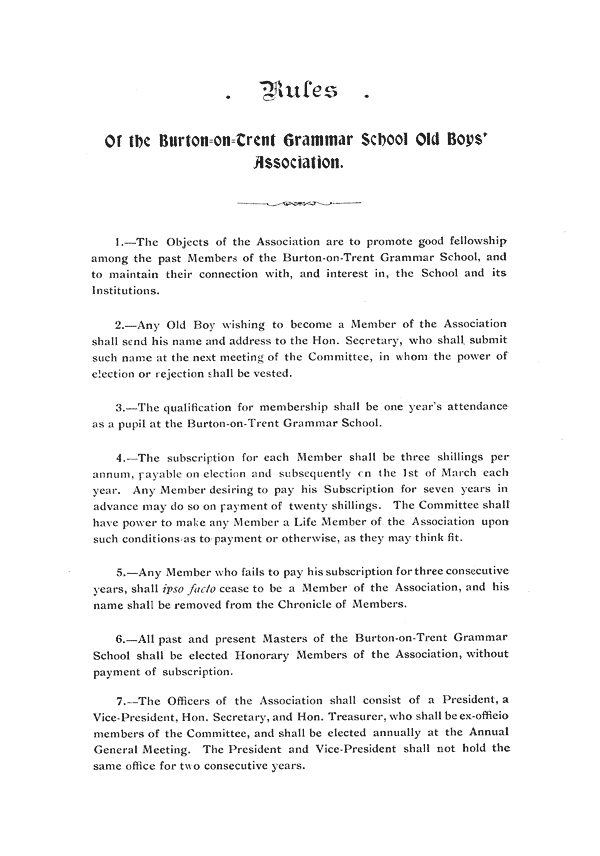
1920s OBA Rules

The OBA rules allowed anyone with one year’s attendance as a pupil to become a member – as long as they were prepared to part with a shilling a year.

RULES

Of the Burton-on-Trent Grammar School Old Boys’ Association.

1. The Objects of the Association are to promote good fellowship among the past Members of the Burton-on-Trent Grammar School, and to maintain their connection with, and interest in, the School and its Institutions.

2. Any Old Boy wishing to become a Member of the Association shall send his name and address to the Hon. Secretary, who shall submit such name at the next meeting of the Committee, in which the power of election or rejection shall be vested.

3. The qualification for membership shall be one year’s attendance as a pupil at the Burton-on-Trent Grammar School.

4. The subscription for each Member shall be three shillings per annum, payable on election and subsequently on the ist of March each year. Any Member desiring to pay his Subscription for seven years in advance may do so on payment of twenty shillings. The Committee shall have power to make any Member a Life Member of the Association upon such conditions as to payment or otherwise as they may think fit.

5. Any Member who fails to pay his subscription for three consecutive years shall ipso facto cease to be a Member of the Association and his name shall be removed from the Chronicle of Members.

6. All past and present Masters of the Burton-on-Trent Grammar School shall be elected Honorary Members of the Association, without payment of subscription.

7. The Officers of the Association shall consist of a President, a Vice-President, Hon. Secretary, and Hon. Treasurer, who shall be ex-officer members of the Committee, and shall be elected annually at the Annual General Meeting. The President and Vice-President shall not hold the same office for two consecutive years.

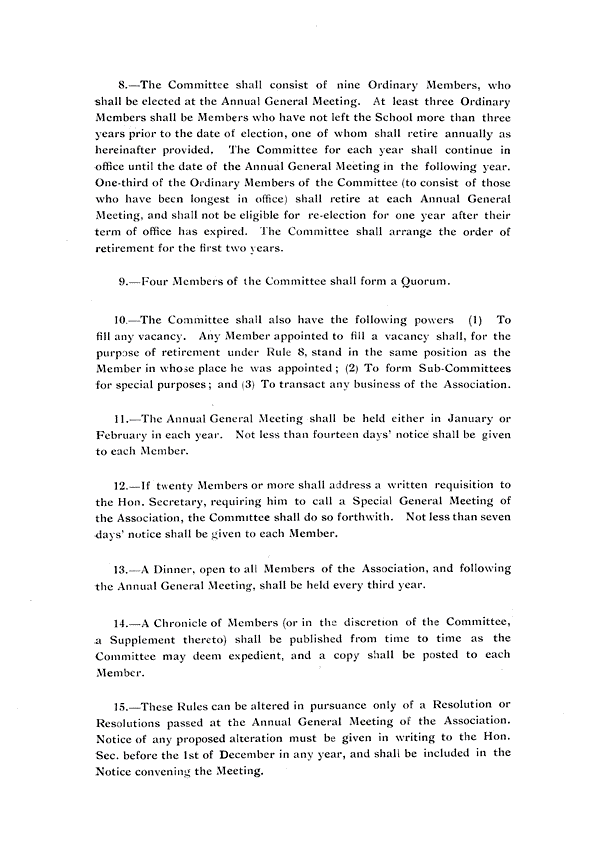
8. The committee shall consist of nine Ordinary Members who shall be elected at the Annual General Meeting. At least three Ordinary Members shall be Members who have not left the School more than three years prior to the date of election, one of whom shall retire annually as hereinafter provided. The Committee for each year shall continue in office until the date of the Annual General Meeting in the following year. One-third of the Ordinary Members of the Committee (to consist of those who have been longest in office) shall retire at each Annual General Meeting, and shall not be eligible for re-election for one year after their term of office has expired. The Committee shall arrange the order of retirement for the first two years.

9. Four Members of the Committee shall form a Quorum.

10.  The Committee shall also have the following powers (1) To fill any vacancy. Any Member appointed to fill a vacancy shall, for the purpose of retirement under Rule 8, stand in the same position as the Member in whose place he was appointed ; (2) To form Sub-Committees for special purposes; and (3) To transact any business of the Association.

11.  The Annual General Meeting shall be held either in January or February in each year. Not less than fourteen days’ notice shall be given to each Member.

12. If twenty Members or more shall address a written requisition to the Hon. Secretary requiring him to call a Special General Meeting of the Association, the Committee shall do so forthwith. Not less than seven days’ notice shall be given to each Member.

13. A Dinner, open to all Members of the Association, and following the Annual General Meeting, shall be held every third year.

14. A Chronicle of Members (or in the discretion of the Committee, a Supplement thereto) shall be published from time to time as the Committee may deem expedient, and a copy shall be posted to each Member.

15. These Rules can be altered in pursuance only of a Resolution or Resolutions passed at the Annual General Meeting of the Association. Notice of any proposed alteration must be given in writing to the Hon. Sec. before the 1st of December in any year, and shall be included in the Notice convening the Meeting.

Kevin Gallagher (1968-73)

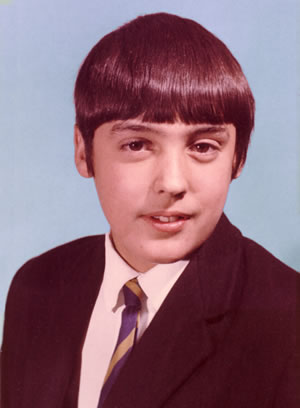
MeThis is the only picture that has survived from my time at Burton Grammar School. I really hate it but, since I have featured a great number of faces of pupils who probably think the same way about theirs, I suppose it is only fair that I should include it.

I joined the school in 1968 and from fairly early on, it was made fairly clear that if I didn’t achieve “Maths, English and three other ‘O’ Levels”, I was doomed to failure. That, therefore, is exactly what I achieved having opted for science subjects.

I was due to stay on to do Maths and Physics ‘A’ Levels but, due to family circumstances, I instead needed to leave and find employment.

Some of the schoolmasters here enjoyed a glorious career that long preceded my knowing them; in meeting some of them as an adult, it is clear that there was sometimes an underlying irony that went straight over the head of a young boy at school; many of them have passed on and we should “never talk ill of the dead”. Be those things as they may, as with the rest of this website, I want to provide an accurate a record as I can of my time there so I speak as I find… or should I say “found”, many decades ago.
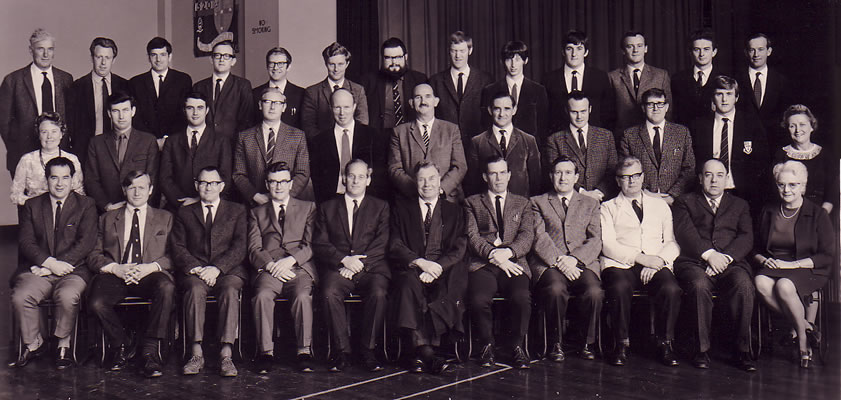
Back Row:

John Andrew (Tinman) – [Metalwork]
‘Tinman’ always seemed to have a certain anger about him. He had deep red veins in his cheeks and when he was having one of his occasional rants, they seemed to glow.

At some point or other, I think most of the class had ducked their head as he bellowed his favourite scorn “Gallagher – you blessed simpleton!!”.

Colin Bagshaw (Bogwash) – [Physics]
Colin was a generally calm and effective teacher. He was my Physics teacher for the whole of my time there and it was always my favourite subject on the timetable. This made the ‘O’ Level a complete breeze with never any doubt that I would pass it without much effort. I am not sure how much of this was down to Mr Bagshaw and how much of it was down to the fact that Physics is just (or was to me anyway), so inherently interesting. Certainly, a school full of teachers like him would make for a very easy passage.

I can remember one slightly amusing anecdote which is nothing to do with school – I used to deliver his daily newspaper to his semi-detached house in Dovedale Close and he was the one person on my round who made me walk back to the pavement and round rather than cut across his lawn.

John Long – [Latin]
I had no contact with Mr Long, nor Latin come to that; he was simply a familiar face.

David Wyatt – [Spanish]
I had to think hard if I actually did Spanish at school, certainly, I can’t count to ten in Spanish which suggests that the brief period for which I took the subject was not particularly arduous.

David was equally wishy-washy leaving a just as scant lasting impression.

John Sneyd – [Physics]
I had nothing to do with John Sneyd, neither for that matter did the rest of the staff seem to. He always seemed a bit of an outsider somehow.

Alan Brewerton (Doc) – [Chemistry]
Doc Brewerton took us for a very brief period, I am not sure if it was even a whole year. He was young and his nickname implied that he was particularly clever though I seem to remember his lessons being pretty dull and humourless.

Robin Langton (Bumble) – [English/Literature]
Bumble didn’t take me for a single lesson. I think his main subject was English Literature which was an ‘options’ subject which I didn’t take. He always seemed very jovial and pretty harmless.

Graham North – [History]
I had absolutely no contact with Graham North and needed help to fill his name in here.

John Armstrong (Louis) – [Maths]
I think Louis was a nice enough chap but completely ‘wet behind the ears’. I am pretty sure it was his first teaching post but generally, he could keep little order and was irresistible to wind up which was an unfortunate combination.

His favourite punishment was rather than dish out 200 lines of 10 words, to award 10 lines of 200 words. The idea only amused him, as a consequence, no one bothered to do them anyway.

He once told us to watch ‘Star Trek’ for homework and to make a note of any occasions where Mr Spock used logic. Unfortunately, my Dad didn’t believe me and wouldn’t let me watch it.

Alan Cure – [Geography]
I had no contact with Alan Cure but he seemed to enjoy very good popularity with those that did.

John French (Frenchy) – [PE]
Frenchy always seemed a bit fearsome with a mean one-eyed scowl which I am sure he must have practiced in the mirror. He only ever took us for games or PE and he certainly made me try for brief periods when I felt that his eyes were upon me.

Chris Aylott – [Maths]
I had absolutely no contact with Mr Aylott. Again, I had to have his name filled in here and, when it was confirmed, I had no recollection of it whatsoever.

Michael Green (Ma) – [English/Economics]
Ma took us as a stand in for occasional lessons. In this role, he was a kind of caretaker teacher and used to give us fairly menial things to do, usually read, to get through the lesson without the need to develop any kind of rapport.

Middle Row:

Barningham – [Office]
Just a vaguely familiar face in the office I’m afraid.

M02 & M03
I swear to this day, these two men are complete imposters who snook into the photo because they happened to be in the school, probably for interviews. I don’t have the foggiest idea who they are.

Chris Shepard (Shep) – [English]
Chris Shepard was a pretty good English teacher and in general, I used to enjoy his lessons. It all seemed to turn a bit sour when noises were first heard about the abolition of Grammar schools when it became obvious that he had very ‘left wing’ sentiments not shared by almost the remainder of the staff.

Peter Dawe (Jackdaw) – [Music]
I always thought that Jackdaw’s name was ‘Jack’ so it was a slight shock when it was corrected to Peter; although thinking about it now, with a name like Dawe, who would ever call their son Jack?!

As a music teacher, he was a complete and utter failure. His lessons were totally meaningless and no-one in his classes gained the slightest musical knowledge. He seemed to spend some time with the very small number of pupils that could actually play an instrument already. Aside from that, the only useful aspect of Music lessons was the chance to catch up with a few lines of the ‘I must not run in the corridor’ type.

Harry Smith (Brab) – [Maths]
I didn’t have Brab for a single lesson. I was slightly disappointed by this in some ways because there was the general air that he was an amazingly good teacher and that students of his were automatically assured of high grade results. He was always a very central character with numerous legendary attributes – such as the ability to draw an almost perfect circle with one quick twirl of the elbow.

Harry seemed to enjoy almost unanimous respect from the lowest pupil to the Headmaster.

G. Davis (Taffy) – [Woodwork/Eng.Drawing]
To say that Taffy was quiet was something of an understatement. He would demonstrate how to make a very neat rectangle hole with gentle taps of a mallet on a chisel and then quietly disappear into the woodwork (excuse the pun), leaving us all to hack a piece of wood to death in the vain attempt of imitating him.

Alan White (Chalky) – [English]
I didn’t have Chalky but he did strike me that his lessons might be fun and animated.

Brian Luckett (Chinner) – [Chemistry]
Brian seemed pretty unique in that he seemed to remember exactly what it was like to be a pupil and almost seemed like he would still like to be one. This had the unfortunate effect that he could generally anticipate most chemical pranks.

Robert James (Jessie) – [French/Latin]
I didn’t have any contact with Mr James but again, he seemed generally popular with everyone who did.

Coates – [Office Secretary]
Just another vaguely familiar face in the office I’m afraid.

Front Row:

Walter Chadbourne (Walt) – [Physics]
I didn’t have any contact with Walt. He only seemed to take lower streams and was probably better known to me as the Scout Leader, not that I was a member. He had a reputation for administering whacks with a gym shoe that I never saw first hand. I was actually very surprised to now learn that he had a longer service with the school than I thought. He always seemed like the Scout Master cajoled into taking a few lessons somehow.

Victor Roebuck (Vic) – [PE/English]
Vic had quite a pleasant manner about him. Firm, but you always knew that he was never really as harsh as he was making himself seem. I think he genuinely enjoyed engaging in sports with boys. I never particularly got on with him because running about on a muddy rugby pitch or, even worse, trudging around sodden farmland was never more than an unfortunately necessary evil to me.

It was actually quite a shock during this project to discover that Vic was such a first class athlete in his day, very narrowly missing out on the Olympic running team.

Ellick Ward (Ernie) – [French]
I didn’t have any teaching exposure to Ernie. I had brief experience of him when I joined the lunchtime ‘Radio Club’ so that I could join others in making a device that could be engineered into a desk to make a faint beeping noise. Four of five of us used to switch them on for a few seconds so that the whole class could delight in watching the masters ears prick up as they wrote on the black-board.

Hugh Wood (Woody) – [French]
Hugh was always friendly and seemed a genuinely nice guy. Unfortunately, his subject was French which no-one ever seemed to have the most remote interest in. Although I never got to take the ‘O’ level, I am actually surprised how much French I almost inexplicably seem to know as an adult which suggests that he was a very effective teacher and that I could have been half-proficient had I been able to muster enough interest.

When the class was noisy, he used to stand and take a pin out of his jacket lapel. We had been conditioned to know that in a few seconds, he was going to drop it and that if its faint ping couldn’t be heard as it hit the floor, the whole class would be in detention.

On one occasion, Chris Borrington deliberately coughed at the crucial moment making everyone groan at him after it was announced that we must all return at the end of school.

Geoffrey Henton (Gaff) – [Geography]
Geoff Henton had an inexplicable air about him. He never shouted – only raised his voice; not once did he ever dish out a single punishment to my recollection, and yet, the moment he entered the room or came into view, there was automatically complete silence and order.

He was a good Geography teacher and I would actually have liked to have taken it as an option but, slightly bizarrely, it was not classed as a science subject so was not available with Biology taking its place.

Bill Gillion (Beak) – [Maths] Headmaster
Bill Gillion was simply the Headmaster was never seen outside of school assembly. I did visit his office on two occasions, neither of them pleasant. On the first, he announced at the end of assembly that someone had been talking the whole way through. He pointed at me and asked me to put my hand up. Though strongly suspecting that I was his quarry, I kept my hand down. His response was to get someone in my vicinity to put their hand up; he then gave instruction, “the boy to his left, put his hand up”, “the boy in front of him put his hand up”; after a few steps, it fell to my turn and when I raised my hand, my heart sank as he announced “Yes, YOU”. I was instructed to report to his study after assembly where I was given a stern telling off. The second occasion was following the fencing accident where a small unsupervised group of us were hacking around with swords outside without wearing face-shields and Robert Whetton was badly injured. I had to go and give my account of the happenings. He did seem a kind, upstanding man though and very worthy Headmaster.

Ron Illingworth (Ronnie) – [Geography]
I had no direct dealings with Ron Illingworth which I must admit, I was slightly relieved about. I always had the impression that he would like to swipe me hard across the back of the head for the sheer pleasure of it. I felt well out of his way but don’t know if he was as fearsome as he seemed.

Norman Jones – [Chemistry]
I didn’t have Norman but he always seemed a pleasant sort.

Raymond Crowther (Joey) – [Biology]
I always thought that Joey was Mr Crowther’s proper name so it was very strange to change his name here from Joseph to Raymond. He was a fairly effective teacher though somehow strangely detached from the rest of the staff. He seemed to spend most of his non-teaching time in a small room at the back of the Biology Lab. I didn’t particularly like Biology though; it was really an imposed subject that I had to do in order to continue with Physics which was my favourite subject.

When the class was unruly, Joey used to stand a chunky table leg up on the front bench and announce something like “Signum Bellum Stat”, which he explained to us was Latin for ‘Symbol of war stands’. This was an indication that the next offender would receive a knock on the head with a wooden baton with a severity (lump size) proportional to the degree of misdemeanour.

I once received the worst punishment, referred to a ‘Crunchie’ as explained below.

Percy Barratt (Butch) – [History]
Percy was another of those familiar characters that ambled around but with whom I had no contact.

Elizabeth Radford (Fanny) – [Divinity/French]
At some point, Mrs Radford seems to have switched from ‘Gertie’ to ‘Elizabeth’ but we only ever really referred to her as Fanny which was always a bit confusing.

Divinity lessons were a complete non-event really. I can only remember pupils being instructed to read a passage from the bible with the constant farce that the next pupil instructed to take over took a while to do so because invariably, no-one but the current reader had got the foggiest idea where the passage was up to.

Questions were sometimes asked at the end with everyone smirking at the hapless victim knowing that his made up answer would be no better than any of theirs.

Missing:

The following masters are not featured in the photo but I did have direct experience of them.

Jack Playll (Pleb) – [History]
Pleb’s history lessons were all comprised as follows: we were given a page range to read from a text book “could you please read pages 112 to 119”. The class would then fall into silence as they armed themselves with elastic bands to flick at one another. Occasionally, when someone made a noise after being caught sharply on the cheek, Jack would look up from his book slightly and cough. And so it went on. Twenty minutes or so later, he would ask questions on the passage we were supposed to have read. It was only a mild dread of being asked a question because a response of “I can’t quite recall the answer sir” simply passed the book to the next person with very little repercussion. To assist things, Mr Playll tended to concentrate his answers on the small minority that were likely to be able to supply an answer and largely left everyone else alone.

He was definitely teaching History for an easy option. He used to heavily tip exam questions to ensure that marks could be easily gained, and wasn’t bothered about ‘O’ levels because most would not take History as an option and those that did would effectively be starting again.

Lewis Heath (Chippy) – [Art]
I quite enjoyed art and Lewis Heath was a decent enough sort of guy. Splodging paint onto paper never really felt like a ‘real’ subject though, particularly since there was no Art ‘O’ level or further ‘lessons’ after the third form, so it always felt like a sort of recreation period for the youngest pupils.

James Moore (Jomo) – [Maths]
Jomo was absolutely legendary! His lessons were a complete riot. He had been persuaded back into service having retired as a local Maths teacher at aged 65, simply because there was a great shortage of maths teachers and the timetable could not be fulfilled.

His maths knowledge seemed such that he wouldn’t be able to pas the ‘O’ level himself and his class control was completely non-existent.

I can remember on one occasion, the adjourning door between classrooms opened and Geoff Henton stuck his head in to find several pupils standing on chairs and an unearthly din. On Gaff’s appearance, everyone immediately sat to silent order; he gave Jomo a sharp look before disappearing again and the class continued with HCFs and LCMs (the ONLY lesson Jomo knew confidently) now much more subdued – but only because of the impending threat from the neighbouring classroom.

David Mart – [Maths]
David Mart started whilst I was at the school but had a much more difficult task on his hands that he could have imagined. He had taken over from Jomo Moore who had firstly, firmly established the culture that Maths was a complete free-for-all and secondly, had left the class quite literally one whole year behind in the syllabus.

To this day, my first lesson with Mr Mart provides me with one of my clearest memories of the school as he very successfully asserted himself where Mr Moore had failed. Maths lessons were suddenly very different with a necessarily increased workload to make up for lost time.

Unknowingly, I had a reasonably strong natural ability for maths. The ‘O’ Level most had once dreaded was completely changed around into one that everyone could take with complete confidence. In a completely unprecedented gesture, I can remember the class collecting all of its tuck-shop money and presenting him with a bottle of wine.

I didn’t find out until this project that David was also an ex-pupil of Burton Grammar School and had attended at both Bond Street and Winshill. By all accounts, he was never a very exceptional student but he turned out to be a very exceptional teacher.


SCHOOL RUGBY

Burton Grammar School had a long and proud tradition of Rugby; “hard and fair play on the sports field to instil a character which carries through to the classroom as a complement to academic success”, and all that. Unfortunately, this was always somewhat lost on me and my memories of the Rugby field may not be entirely typical.

A whole year’s worth of pupils did afternoon sports which usually meant just under ninety pupils. This gave rise to three games. The first, made up of the most impressive thirty, was on the top, carefully tended pitch. The second was on the middle pitch, which was still a very impressive playing surface, inferior to the first only in that it was some distance lower down a steep bank. The third was made up of the rest of the stragglers on the bottom pitch which it would be fair to say, was sometimes ‘quite water-logged’. As you may have already guessed, this included me. I can’t now recall who used to referee the games. Vic and Frenchy took two but I can’t for the life of me remember who used to take the third.

Quite often, there were not quite enough players to make up full teams on the third pitch, sometimes; there was an odd number of players meaning that one side had an extra player, although this was usually in the form of Kenny Mycock which gave little or no advantage. I think it was him I remember one day being adorned in ridiculously ill-fitting spare kit supplied to him after he had tried to forge a letter from his parents to excuse him from the games period for an implausible (and most probably mis-spelled) ailment.

The rules of Rugby were, and remain today, a complete mystery to me. The whistle used to blow, seemingly at random and many of us huddled around in confusion trying to establish whether someone had now got to drop kick the ball or whether we had got to endure another scrum. Almost invariably, it seemed to be the latter which meant, as one of the second-row, I was anticipating getting my ears squashed again, but I didn’t know enough about the rules to question the decision. Neither did I ever really fully understanding the scoring but I learned early in my Rugby career that Mr French did not appreciate the question “Sir, who’s winning?”, so I usually waited until the end of the game where I would try to establish the final score. Not once do I ever recall contributing to it.

Despite my general lack of enthusiasm for the game, it did supply me with some treasured memories. I can remember one occasion in particular, when the field was particularly sodden with one corner being so muddy that to venture onto it meant almost for sure, that ones boots would be completely submerged. The ball plopped down in the middle and shortly afterwards, Frenchy was bellowing at the interested group of pupils standing in a circle around the mud wondering how we were to retrieve it. Frenchy made us all lie on the ground to get covered in mud. “There”, he exclaimed with some satisfaction, “now no-one need worry about getting muddy”. This sparks the memory of another incident were a heavily muddied ball escaped the catch of, I think, Duncan Andrew, and instead bounced off his chest leaving a ball shaped imprint on his previously clean shirt which he then pulled outstretched in front of him and studied it with the disdain that someone might apply to bolognaise sauce being slopped down a best shirt. One more mud anecdote before I move on, some fun was had by sharply kicking ones foot forwards to turn the mud clogged around their boot studs into a muddy projectile to splat on someone’s back. On one occasion, I can recall missing my intended target and instead catching Frenchy on the back of the head. He turned to find out who had dared to throw it; I looked as innocent as possible but was betrayed by a number of traitorous team-mates who were all sniggering in my direction. I was in the middle of trying to explain how it had somehow flown from the bottom of my boot as his sharp slap caught me briskly across the back of the head.


GOOD MEMORIES

Sports Day
I have fond memories of Sports Day. Not for the athletics you understand, ‘Skinny’ Goodwin and myself, being careful not to qualify for any events so that we didn’t have to hare around like demented whippets, devised a much more fun activity.

On Sports days, the steep banks that seperated the different levels of playing field came into play providing a large seating area. Armed with bottles filled with water from the Pavilion, we used to quietly position ourselves a few feet behind a target group, release all of the water and quietly walk away to a spot some distance away from which to observe.

As sure as day, a short while later, the group would instantly spring to their feet feeling their inexplicably wet trousers and we would crack up with as quiet laughter as possible so as not to be discovered.

Bleepers
In the electronics club (run I think by Mr Ward), we made a number of simple bleepers that made a faint bleep when two wires were touched together. These were engineered into around half a dozen desks, well distributed around the form room. At random intervals, the class sniggered as the teacher’s ears pricked up, never quite being able to establish where the faint noises playing for a few seconds were coming from.

Chemical Warfare
Skinny Goodwin found an excellent recipe for ‘nitrogen tri-iodide’, which was a highly explosive powder that could be sprinkled everywhere to produce a loud crack when, for example, a ruler was dropped on it.

The entire stock was eventually confiscated and Chinner Luckett and Doc Brewerton took it to a distant border of the playing fields where they very gingerly disposed of it wearing face masks.

Sledging
I have absolutely no idea where they appeared from but one snowy winter, there was a small fleet of corrigated iron sheets fashioned into sledges with a bent up front and enough space for around four passengers. They were used to hurtle down the bank from the Winshill Church graveyard wall down onto the playground.

It would then be dragged back up and passed to the next waiting team and we would take our place at the back of the queue again.

Unintelligible Questions
There was a short fad where pupils would raise their hand and ask some unintelligible question. When they could stall no longer, the gabble was replaced with a question like “Can I fill my pen please Sir”.

Kudos was gained for a) How long the gabble could be. b) How many times it could be repeated before a proper question was asked. c) The level of fear of the involved teacher (very little for Jomo, maximum points for Gaff Henton).

Army Cadets
I joined the Army Cadet Force with one objective in mind – to fire a gun. I was prompted to join after hearing an account from someone in my class that was already a member that they had spent the previous night on the firing range firing real army guns which was enough to persuade me along.

It turned out to be somewhat duller than I hoped and in fact, .303 rifle shooting was something of a rare treat. Far more time was spent on the playground doing ‘drill’ with Captain Playll shouting (to the best of his ability) “Squad, fa-ace left” whereupon, after the stamping of boots, I would usually end up facing David ‘Numb’ Sherratt wondering which of us was wrong (usually him).

I can remember it being demonstrated how to strip an automatic gun (could be a ‘sten gun’ but don’t quote me) and re-assemble it as quickly and efficiently as possible following which, we all took it in turns. I think the record was around twenty minutes if it could be accepted that the sight was facing the wrong way.

Andrew Bodger seemed to take things seriously and genuinely believe that he was the first line of home defense; thankfully, it was never put to the test.

We spent a few days on an army camp once. My main recollection was getting very comfy on a grass bank with my legs either side of a small mount making a comfortable saddle. The type of gun however, had a much greater recoil than anticipated which brought home most forcibly why this was a very bad idea.


BAD MEMORIES

Fencing Accident
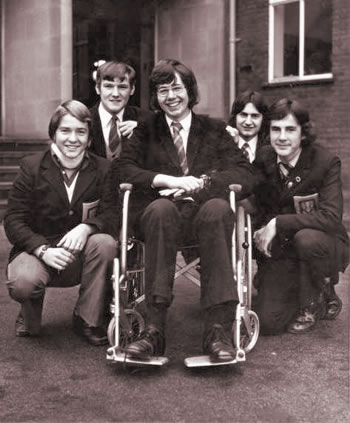
I was a friend of Robert Whetton at Joseph Clark primary school. At the Grammar School, we got split up because he was in the ‘A’ stream, I was in the ‘B’. Though not particularly close friends, I had been to his house in Balmoral Road on numerous occasions. His Mum was always very nice and taught piano. It was there that Robert taught me how to play chess.

On this particular day, Mark Osman was playing in the National Schoolboys Rugby Final at Twickernham. Mr Gillion and Mr Henton, all of the games masters and a number of selected pupils had gone on a coach trip to watch.

It was an ‘easy’ afternoon for those of us that remained and a small group of us, including Robert and myself, went outside as a small unsupervised group having decided to do fencing. Although fencing helmets were provided, we didn’t bother wearing them because you couldn’t see through them very well!

In a very unskilful hack around with Robert, my bowed blade somehow flicked off his and hit him in the face. He dropped to the floor and at first, it didn’t seem serious; everyone expected him to get up and laugh it off. However, he didn’t move and vomit began trickling from his mouth. Myself and Steve Goodwin went to report the incident and an ambulance came and took him away.

It transpired that whilst the foil had only inflicted very minor damage, he had hit his head hard on the floor when he fell which had caused brain damage. As a result of the incident, Robert suffered permanent disability. To this day, it has been one of my greatest regrets and I have thought of him countless times. To some extent, this website is dedicated to him.

First Day
On my very first day at Burton Grammar, I turned up very bewildered by it all, with my school cap. In my allotted main corridor cloakroom area, I was approached by Kelvin Russell who tried to snatch the folded cap out of my pocket. I managed to grab it so we both ended up pulling on it. In the stalemate, I was hoping that he would simply let go; instead, he pushed me in the face which caused me to let go and he disappeared up the corridor laughing, throwing it to someone else rugby style.The cap was never seen again and I got a major roasting for losing a garment we could ill afford when I got home. This has always stuck in my mind; it is amazing how much older second year pupils seemed at the time!

Spoiled Blazer
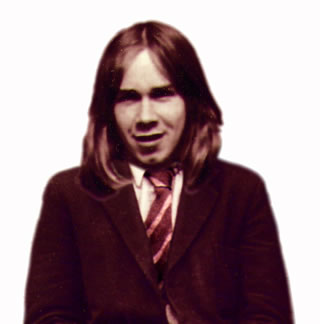
SharpTimes were pretty hard at my house, my Dad being a coal-miner in very troubled times. My clothes seemed to have to last much longer than most people’s and were sometimes shabby. I was fairly proud therefore, to be wearing an overdue new blazer.Going upstairs after assembly, I felt a number of firm strokes down my back. When I turned around, John ‘Scabby’ Sharpe (pictured) gestered that he had done it with his finger. After it was pointed out by others however, I took my blazer off to discover that he had drawn chalk marks as hard as possible all over it.My parents were furious, I got a good beating from my Dad and the marks never did come out fully.

Cross Country
Myself, Jez Stevens (now living in Carlisle) and someone else from Dalebrook Estate whose name escapes me, skipped cross country a few times by lingering to the back and diverting through ‘winshill dales’ where we used to play in the third boy’s house. At the appropriate time, we went back and re-joined the home runners when there was a suitable gap.On one particular occasion (maybe because someone had grassed), Frenchy stood by a stile at Bladon House Farm ticking names off.When we got back, looking as exhausted as possible, it became obvious that we had been rumbled and we were forced to stay behind and run around the whole school perimeter ten times. Worst of all, I missed my evening paper-round and almost got the sack.

Canoeing
One year, I can remember opting for Canoeing as a summer-time Games activity. I had already conjured up the image of gliding around on the river, jabbing my oar in the water on one side or other to force the boat to sharply turn on my command.

It turned out that we had been suckered; we had to report to the Metalwork room where we discovered that the Canoes were in kit form and our first task was to build them. Now when I say “kit form”, I don’t mean two halves that join neatly together and a seat that clips firmly into place – I mean bales of fibre, cans of resin and uncut lengths of wood.. the sort of thing you would complain bitterly to PayPal about if it had turned up off eBay.

For reasons I don’t now understand, the group was a mixture of pupils from my year and pupils from the next year up, including Keith Large, Robert Large and Stephen Johnson. I always thought that each year did games on a different afternoon.

Summer came and went by which time, we hadn’t managed to construct anything that looked remotely sea-worthy, so we never got to actually experience floating on water.


GOOD/BAD NOT SURE MEMORIES

Methane Bubbles
In the chemistry lab., the benches had twin methane taps for use with Bunsen burners. Chinner used to disappear into the small room at the front of the lab for inordinately long periods which we, correctly or otherwise, referred to as ‘fag breaks’. On one such reprieve, someone behind us was going “Aaahh” and an increasing number of pupils were sniggering as they turned around. I joined them when I saw that someone had lit the tap and had an eighteen inch flame roaring towards him as he rubbed his hands, apparently enjoying the warmth. When the distrurbance grew too loud, it was quickly extinguished when Mr Luckett suddenly appeared at the door to investigate. I seem to be far more concerned about the possibility of a flash-back into the supply as it was turned off now that I was then.

This soon progressed to soap bubbles filled with methane to coax into the air and ignite. Eventually, a large methane bubble was quietly manoeuvred to behind someone’s head; one person tapped him on the shoulder as the other lit it to provide the impression that the world had come to a flaming end. Someone tried the same ploy on me but, now alerted to the possibility whenever we were left alone, I turned to spot the bubble which was just as well because Chinner reappeared forcing the perpetrators to burst it – choking me with methane instead. “Get back to your seats”, ordered Mr Luckett. “Gallagher, why have you turned green?” (I made the last question up).

Crunchie
As indicated above, Joey Crowther used to administer punishment in the form of the whack on the head with a special baton, specially chosen I feel for making the loudest possible ringing tone when a cranium was struck.

I think there were five different degrees, ranging from a light tap to a good strike, depending on the seriousness of the offence. The largest was known as a ‘Crunchie’ which I received on one occasion. It was for flicking something slimy (I think a piece of frog) to startle someone as it landed on their exercise book in front of them. My amusement turned to dread when I faced forwards and saw that Joey had been watching the whole proceedings. I was actually surprised how much it actually hurt and felt that it was close to doing some real damage. It certainly brought tears to my eyes.

School trips
Huh?! I have been slightly surprised to read about the exotic trips to Europe and places. I don’t recall any such opportunities (although I would generally have expected to be in the small group that always got left behind to do lessons because my Dad couldn’t/wouldn’t pay the ten bob).

I have a very vague recollection of a trip with the new drama teacher to a theatre that could have been in Leicester, but was equally possibly Nottingham to see some kind of performance. I can’t recall any singing which probably rules out an Opera; I seem to remember not having a bloody clue what was going on, which suggests it may have been a classic Shakespeare play; and I have no recollection of any laughs so it was probably not one of his better works.


CONCLUSION

There are generally strong sentiments that it was a grave government mistake to abolish Grammar Schools, and in some ways, so it was. Comparing my account of the school to much earlier ones however, I get the feeling though, that the ‘rot had already set in’. One of the key indicators of this I feel was the discontinuance of Class 5X.

For a short period in the nineteen-sixties, Burton Grammar School enjoyed one of its finest hours. It was a period of strong Oxford/Cambridge success and an overall academic success that out-performed nearby Repton School – one of the most esteemed Private Schools in the country. Due to enormous pressures, Mr Gillion however, he had to abandon his thoughts of Academic excellence by the top stream of pupils, leaving the lower streams with much less attention. Instead, the reverse was imposed – to bolster a National average deficiency, there was a shift in ethos to making sure that as many pupils as possible received the ideal of five good pass ‘O’ levels. The brighter students could achieve that with much less guidance.

Gone was the overall feeling of great aspiration by those that had it within their grasp; instead, there was the much diminished feeling that everything was geared to trying to ensure that as many as possible got the requisite five ‘O’ levels, ideally including the most esteemed Maths and English, anything above that was a bonus.

True, I got my ‘Maths, English and three others’ which provided me with the minimum requirement for some Higher Education, but I was never one of the pupils that shone – it was they who really suffered.

R.A. ‘Raser’ Smith (1941-49): The War Years

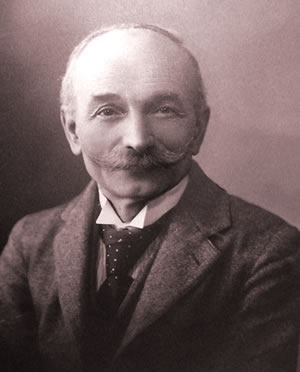
SmithThe Headmaster, W.D. Fraser died of a stroke whilst on a walking holiday in Scotland at Michaelmas half-term 1941. He was eventually succeeded by Harold Moodey in 1942.

Mr Moodey was an Oxford graduate (Chemistry) as per regulations, and probably secured his appointment by having recently had a book published on Analytical Chemistry. I am afraid I endeared myself to him by finding three errors in it.

In my time Mr Moodey never took a chemistry lesson, even when Nick Nicholson was ill. He concentrated on religious instruction, usually using the period to harangue pupils on their poor performance. One of his early acts was to change the house system from one where boys were allocated by area of the town or to the same house as their fathers had been in, to a random distribution. At a time of severe clothes rationing this made him very popular.

Not mentioned so far are Hilda Press; she was a thug who taught French. I am sure many B form members will remember being whacked on the back of the head by this virago. There was also Norman Cleave who returned after the war (Tank group commander) to resume his post as senior English master but left after a term, to become headmaster of Poole Royal Grammar School. In his absence the English posts had been filled by Jake Hammond and Cyril ‘the weed’ Edlin. Cleave taught the Lower Sixth Science Logic for one term. I believe woodwork was abandoned in 1942 due to lack of materials, After the departure of Davis, the subject was taken over by Jenkins who also taught Latin. This master left in 1942 and Jake Hammond took over Latin.

Chemistry was not taught until one reached form 2, George Cooper took us for our first year, his degree was in Chemistry despite being Senior Maths Master. George always played the piano for assembly and the organ at Speech Day, etc. He was organist at Horninglow Methodist Church. Bill Read, Jake Hammond and Ronny Illingworth favoured the Wyggeston Hotel as their watering hole. Unfortunately Bill, who lived at the top of Foston Avenue, was found asleep in the front garden of a member of 4b halfway home, this took some living down.

Tom Parkin achieved notoriety by standing up in the middle of a church sermon and accusing the vicar of using the pulpit as a coward’s castle. He retired at the end of the war to be succeeded by Shorthose (the Drip-after an end of nose feature), another author. His book, ‘The Properties of Matter’ occupied 75% of the teaching time, but only 10% of the examination questions. He was the only master who came to school in a car, a Ford Popular, and had the distinction of being caught in the car in the middle of a level crossing with the gates closed. Schoolboys have eyes and ears everywhere.

Charlie Brown taught History and some Geography and was press ganged into teaching American history to 2A in 1942. He did this by reading a chapter in the text book during the preceding week then regurgitating it as a lesson. One week Charlie, always rather scatter brained, lost his text book. Charlie also kept bees and several times interrupted assembly with “Excuse me Headmaster, has any boy in the Field Lane area seen my bees?”

‘Old Nick’ Nicholson, an Irish communist, was the senior Chemistry master. He had previously been employed in industry which he left under a bit of a cloud. He was held responsible for a gas explosion in a large calciner which disintegrated. Chemistry lessons lasted two periods, for the first part, a lecture/demonstration, the class sat in a circle in an alphabetical order clockwise with Nick at 12 O’clock and Timber Woodcock at 11.30. Consequently Timber got the pleasure of sniffing any obnoxious gasses produced in the demonstration. There was one fire extinguisher, which after use, remained empty for a term.

In Harold Moodey’s time the procedure was for the extant prefects to send a list of preferred candidates for the next year to him, he then amended it. Up to the end of the 1940s prefects had a fair amount of power, they could set lines, put a persistent offender in detention and administer a smart clip on the ear. Discipline was pretty tight.

The War Years

Turning to the war years I started as one of twenty scholarship pupils in September 1941, eight from Grange Street eight from Horninglow Rd. four from the rest of Burton. The total of new entrants was made up to about forty, from the outside districts and the Prep form. The intake was lager than usual due to families moving out of Derby and Birmingham to the Burton area and commuting to their wartime jobs by bus or train. Their sons passed the entrance exam for paying pupils. We were divided into 1A form master Bill Read and 1B. We were taught identical lessons until the February exams and from the results reallocated to 1A&B. These results virtually governed whether you were in the ‘A’ or ‘B’ stream throughout your school career. This had the knock-on result that many of the brighter boys trapped by the scheme were removed and sent to the technical school in Guild Street. This school had a very good reputation thanks in part to the efforts of Arthur Blake, Burton’s very competent Director of Education.

School hours were 9.00 am till 4.05pm with lunch from 12.20 until 2.00pm. The problem of going home in the dark did not occur as single and double summertime were adopted throughout the war years. However detention was moved to Saturday mornings in the mid winter months. As a general rule school could start at 10.00 if the air raid warning had lasted for more than three hours in the preceding night. This was frequently the case in the winter of 1940 but not subsequently.

After school activities were severely limited in the winter months due to the blackout which despite the adoption of summer time, could be as early as 4.45. It was impossible to blackout the school though I think an attempt was made with A room and the adjoining corridors.

Their was also the deterrent of boys having to cycle home in the blackout and masters having to do fire-watching about once a week. An air raid shelter was constructed in the garden where U & V rooms were later constructed and several more in Peel Croft between the grand stand and Lichfield Street. They were relatively shallow shelters due to the possibility of flooding. I can only recall their use on one genuine occasion and several practises. Ironically the ATC’s uncamoulflaged Bulldog bi-plane was parked about 20 yards from the shelters.

Woodwork classes were abandoned in 1942 and with the advent of hit and run raids it was decided that the Art Room with its glass roof, was unsafe. This meant the loss of two class rooms and to compensate rooms were occupied in Bond St infants school which had been closed in 1939 and the Mission Hall in Bond End. As neither locations had an allocation of fuel, classes were conducted in gloves and overcoats. Infant size desks also caused problems. The Mission Hall was however successfully blacked-out, and was used by the Scouts, the ATC and the Aircraft Spotters Club. The Chess Club also functioned during the war years.

Most boys and masters came to school by cycle in all weathers. If it rained or snowed it was impossible to get on the buses unless you lived within two stops of the terminus. Waterproof capes and leggings were in short supply and required clothing coupons for purchase, so assembly and the first lesson were frequently accompanied by a steamy atmosphere. The school yard was surrounded by cycle racks, mostly undercover. All were numbered and you were allocated a number for the year. Cycles had to be pushed along Bond Street  and mounted in Lichfield Street. Lichfield Street had to be crossed by the pedestrian crossing. Scooting on one pedal across the Ferry Bridge was not permitted and detention was the punishment.

In common with other schools the toilets were outside and froze in winter, smoking in the toilets was a caneable offence. Gas masks had to be carried from lesson to lesson until 1944 when regulations became less stringent. The school bell, traditionally rung by the weeks duty prefect, was not rung between 1940 and 1944.

Sport took its usual pattern during the war except that rowing had been abandoned. Rugby was played in the Autumn term and the first few weeks of the Spring term. House matches were played on Peel Croft as Burton rugby club was not functioning. Inter-school matches on Wednesdays and Saturdays were played at Senior and Junior level, travel usually being by Stevenson’s yellow peril. Cricket was also played at the same levels. Amongst the school opponents were:-Lichfield GS, Coton College,Denstone College,Uttoxeter GS, Burton Tech., Ashby GS, Newport GS, Trent College, King Edwards GS Aston & Five Ways, Radcliffe College, Nottingham High Pavement GS, Nottingham GS, Tamworth GS. Some fixtures were cricket only. Photo’s of the Cricket 1st XI are confusing, in general they were taken of the XI chosen for the Old Boys match which began at 11 am and frequently coincided with A level exams. This explains why a number of stalwarts are missing.

The school had a very strong swimming team and thrashed most opponents, the climax came in 1948 with a match against Motherwell GS which we narrowly lost. The opponents had three team members who subsequently swam in the London Olympic Games.

Cross country was the main athletic event in the second half of the spring term. The senior course started on the Ox Hay, then across the Ferry Bridge, through the back streets of Stapenhill, up to Brizlincote Hall Farm, across to Winshill Clump, down Tower Road and Ashby Road to Elms Road; across Stapenhill Road, through the Riverside Gardens and back to the Ox Hay via the Ferry Bridge. Track athletics were not taken very seriously until the arrival of Norman Jones and Norman Paine after the war.

The easing of blackout restrictions in 1944, lead to the renewal of evening activities. The Scouts held Gang shows in the school hall and the drama group got back into full swing.

The Fauld explosion has already been written about. There has been no mention of the fairground fire in 1943, which conveniently started at about 3.50 pm so had most ot he school as audience.

1945 saw many changes, partly due to the influx of new masters, contacts with the Girl’s High School previously fround upon were increased , initially with the Circle Francais (Wood),drama selection of plays with more female characters and by 1947 joint ballroom dancing classes. The cafe at the Ritz cinema also proved a great Saturday morning attraction.

E J Ward (Ernie as we new him then) partially took over rugby from Jake Hammond though there was a slight problem as Ernie had played the dreaded Rugby League as scrum-half for Bradford Northern. The opposition consequently received an unpleasant surprise. ernie also ran the radio society which operated from the sports pavilion, he had a very early so attracted a lot of contacts on the air waves.

There was also a man called Paine about 6’4″ tall, ex-Nottingham University, who took over part of Ronnie Illigworth’s cricket for a time. He lived up to his name, if you dropped a catch , mis-fielded or bowled a wide you were sent to run round the boundary several times.

Norman Jones boosted the interest in athletics and organised a visit to the 1948 Olympic Games. At that time you accumulated points for your house by acheivng a certain standard.

On Sports Day points were also awarded for the positions in the races and the house with the highest aggregate of the combined set of points won the cup. David (Spike) Finch who was Athletics Captain of Drake house caused some embarassment by turning out his house members to achieve the standards to such an extent that the difference between Drake’s pre Sports Day total and that of the other houses could not be made up by results on the day. Another entertaining incident was when Norman introduced and demonstrated the hammer. He got it wrong somehow and the hammer finished in the circle and Norman on his back outside. He had some diffculty in persuading Ronnie Illingworth that those spectators who applauded the effort should not be put in detention. It was quite noticeable that the attitude to the boys, of most of the post 1945 staff arrivals differed considerably from the pre-war ones.

The diagram of the lay out of the school is correct for the late 1940s except that L room was not divided fom the Art Room and J room was the home of 2a Charlie Brown in charge in the early 40s. Incidentally the photo Pre-World War II b is of the Art room not the Woodwork Room. In the early 40s the other form rooms were 1A in F (Frank Reed),4A in G (R Illingworth), 5A in C (H Pitchford), 2B in L, 3B in M (J Daffern), 4B in D (H Press) 5B in B ( J Hammond) Lower 6th Modern in N 6th Science in O (G Cooper). On completion of S and T rooms 2B went to S and the Lower 6th Science to T.

T room was fitted out with a demonstration bench, gas and water taps and basin, though it waas rarely used for its original intention as a supplementary physics lab.. However the was a perforated ventilation brick in the wall between between T and S and in free periods it was not unknown for a fine spray of water to be directed via a rubber tube and the ventilation brick on to the head of the master teaching in S room. It was surprising how often the roof of S room was examined for leaks.

Another feature of S and T rooms was the coke stove, totally inadequate in winter but stoked enthusiasically by the inmates to such an extent that the chimney often glowed red hot. On one occasion a small oxygen cylinder was left in T room, so it was decided that supplementing the air with oxygen would boosted the efficiency of the stove. The experiment was abandoned when the chimney softened and sank several inches.

Prefects and masters did one week on duty per term, this involved opening the garden gate, patrolling the school yard at breaks, tolling the school bell and reading the lesson (getting told off by H Pitchford if you said Jerusalum instead of —lem). In general prefects were allocated to individual forms for one term at a time and were expected to keep order in the absence of the master. They also did Dinner Duty once every three weeks supervising setting up and removing of tables etc.. Sandwiches were eaten in D room which was also used for pupils excused prayers.

Aubrey C. Baggley (1900-06): School Impressions

When I arrived with my brother, I about eleven and a half and he two years my senior, I felt myself a minnow among big fish. I was quite small for my age. What was still more frightening was seeing boys whizzing through the air holding on to pieces of wood tied on to the ends of ropes, the other ends of which were fastened to a circular metal plate at the top of a large, thick, shortened telegraph pole. I learned afterwards that it was a ‘Giant Stride’, and I enjoyed many a round on it myself in later years.

Assembly for prayers, read I his booming voice by the Rev. T.W. Beckett (headmaster) was followed by the daily hymn, sung to the accompaniment of a wheezy harmonium played by a young master named Cole (assistant to Mr Beckett). After he left, Mr Cyril Hartshorn took over but, as an accomplished musician, that harmonium was a real trial to him. He hated it but, with only 150 or so boys, no-one else could be found to be pressed into service.

Mr Beckett was to me, a very imposing person with very large hands, which were used in such a way as to put the fear of the Lord into us. On one occasion, Jack Rudd, a member of my brother’s form, felt the full weight of it. What Jack said I never knew but, as a result, he received a cuff on each side of his face. For two days, his face was red and swollen. Such things were completely accepted in the school in those days.

Mr Beckett left in 1900 to become Vicar of Anslow. Having been Headmaster since 1884, he had a special farewell at the annual prize-giving in the Town Hall. I was greatly impressed by Mrs Beckett who had looked after the twenty or so boarders. She had been greatly liked. With no public transport, except trains, and almost no motor-cars, boys from a distance had to board. Willie Wain from Bretby often came by pony and stabled it in High Street, near the market place.

In September 1900, Mr R.T. Robinson, from Wyggeston School, Leicester, succeeded Mr Beckett and caused something of a stir when he introduced Saturday morning school from 9:00 – 12:30am in place of Wednesday afternoon from 2:00 – 4:00pm. His reason seemed shameless; we were fresher in the morning and Wednesday afternoon could be used for games. He omitted to mention the extra one and a half hours work. In fact, not many boys played football and cricket in school at this time. The games were run by a Sports Club to which members had to pay a fee of 2/6d (12.5p) per term and supply their own gear, and pay for travelling to such places as Ashby, Lichfield and Atherstone. This was prohibitively expensive for quite a number of boys in those days of large families and low wages. The days of financial backing by the Local Education Authority or the ‘State’ were yet to come. There were also ‘bathing sheds’ by a backwater of the Trent used for swimming. “The Field”, as we called it, lay immediately behind Peel Croft, and the pavilion was a very drab, corrugated iron covered hut, the only window being a large wooden panel on one side, which could be pushed open by an iron rod and fastened by then putting the end in a staple. There was no groundsman. It was a DIY world in those days! We rolled the pitch and marked out the whitewash lines ourselves. For non-school matches, ‘Tommy’ Stevenson, who took Form I for all subjects, and who had been said to play on occasion for Warwickshire, and W.H. Robinson known as ‘Taffy’, and the Headmaster’s bother, and still later, A. Rigby the Physics master, all played in the cricket team. R.T.Robinson himself, by now known as ‘Dicky’ ,turned out at centre half in the football team at least once. J.W. Ramshaw, who joined the school when the Physics Lab. was built, also played football at times. Two record scores of later days in1905 stand out in my mind as I was Captain then. We beat Congregational Church 24 goals to nil; Sam Oulton scoring eighteen.

When I first went to Burton Grammar School, I was put in the fourth form on the strength of my having gained one of the three ‘Feoffees’ Scholarships but, having done no Latin or French ever before, I had to catch up with my classmates. In wat was called ‘Extra Division’, I did intensive Latin Primer and ‘Gepp’ work for about eight lessons a week with ‘Piggy’ Jeffcott, and spent the whole of Monday, Wednesday and Friday afternoons doing French, missing all lessons in Music and Art. By the end of the school year, which ran from January to December in those days, I had advanced far enough to start on Vergil’s Aeneid IX in Latin Div. IIb, and ‘Remi et ses Amis” in French Div. IIa. ‘Cambridge Local Examinations’ were compulsory for fourth forms and above so, at aged twelve, I joined my brother and a lot of other boys in evening preparation from 6:00 – 8:00pm at the school from around mid-October to early December. I remember the gas lit rooms with incandescent mantles (the school had no electricity then). One incentive for these examinations for the more gifted boys and their parents was that, for 1st Class Honours 36/- (36 shillings or £1.80) worth of books of one’s own choice were awarded. 24/- (24 shillings or £1.20) was awarded for 2nd Class and 12/- (12 shillings or £0.60) for 3rd Class. In those days, when all books and stationery had to be paid for by one’s parents, such awards were very welcome. Books belonging to school-leavers were often bought second-hand for new boys. Several of mine belonged to someone called ‘Billy Balfry’ who had himself inherited them from an older brother, hence they all had ‘J.C.K. Balfry’ in them.

Earlier on, I mentioned Jack Rudd’s beating by Mr Beckett. R.T. Robinson gave one beating which I should think stood out for years in the minds of all who heard it. Len Hearn, who later gave money for a prize to the school, and so must have forgiven the indignity, was the victim. Having been previously reprimanded for smoking by ‘Dicky’, he was seen smoking again in High Street. The whole school was assembled and ‘Dicky’ lectured us about the offence. He then ordered Len to go to his study. In a few moments, we heard a “swish”. Being boys, we started to count and we became more and more amazed. It went on until we had counted 21 strokes, but not a single cry. Later, I asked Len why he hadn’t shouted out and he said “If he’d have given me one more, I would have yelled the place down”.

During the Second Boer War (1900 – 02), we began Military Drill after school and Sergeant-Major Maher put us through our paces either in the school playground or on ‘The Field’. We also had targets under the covered shed in the playground for rifle-shooting. We used ordinary rifles with tubes inside them making them suitable for the short 22-yard range. ‘Kitten’ Thompson established himself as our ‘crack-shot’.

In a cricket match in 1902 against the Burton Gentlemen, for whom S.H. Evershed, recently Captain of Derbyshire C.C and his brother, Frank Evershed, a Rugby International, played, my brother managed to score 30. They were so impressed that they awarded him with a bat. From then, they continued to award two bats for the best batting and bowling averages. In 1907, I finally got one for batting and H.A. Jones, who later became Dean of Manchester, got the one for bowling.

In 1905, ‘The Cygnet’ came into being. At a meeting in the Chemistry Lecture Room, H.S. Staley was appointed its first Editor. He left at the end of term to go to Birmingham University and later to Cambridge and I succeeded him as Editor.

When Mr Beckett died in 1907, I together with Arthur Bonfield went to represent the school at his funeral.

We always had prayers again at the end of afternoon school. After the service, the Headmaster read out the names of all boys who were to stay behind for detention for various misdemeanours.

We wore red and blue wide-striped caps, commonly known as ‘bull-scarers’ which cost 2/6d (12.5p) or round black or dark blue ‘polo’ caps with the school badge on the front. No blazers. The school caps annoyed the local ‘Park Street Boys’ and there were frequent battles between them on the way to and from school.