Menu Close

1950-53 Biology Field Trips

Biology field trips remembered – Michael Tanton (1946-54)

Raymond Crowther, the biology teacher at the time, established the Burton Grammar School Field Club to some enthusiasm in 1950. In its first year, Mr Crowther took a group from the club, that included me, to the New Forest, where we camped on the edge of heathland and in sight of the Balmer Lawn Hotel at Brockenhurst. The trip had been organized ahead in typical Raymond Crowther style, and to us the arrangements just seemed to happen – I doubt that we appreciated at the time the amount of slow correspondence required in those days to make such trips successful.

All the camping gear was manhandled by us to the guard’s compartment on the train from Burton to London, then from the train down into the Underground station where we were expected by the station staff. The train on the Underground was held while we loaded everything into one of the carriages for the journey to Waterloo Station where the staff again held up the Underground train for the similarly tedious job of off-loading it all again. It then had to be manhandled again onto the Southern Region train, and then off again at Brockenhurst. After some delay, Mr Crowther was able to find his contact at Brockenhurst, who turned up with a lorry to take us and all our gear to the camp site.

The summer of 1950 was very hot, so we had a wonderful two weeks in the New Forest, with many long hikes and a trip across the Solent to the Isle of Wight.

Crowther

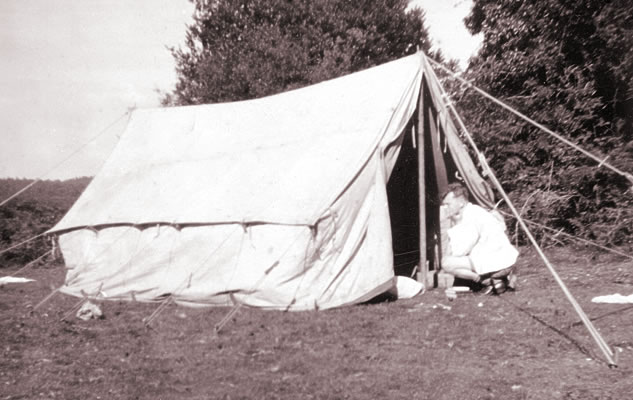
The above photograph shows Raymond Crowther crouched in front of the tent I shared with several others at the edge of the heath near the Balmer Lawn Hotel.

Mr Crowther of course had his own tent, for the rest of us, it was two or three pupils to each tent. They were former army tents which were made of heavy canvas with wooden poles and took quite a lot of effort to erect compared to modern tents! No sewn-in floor of course, and we had to dig a channel all round to lead water away from the tent if it happened to rain (it didn’t – it was a very hot summer!). We had to braille the sides up each morning to air inside, and dig hip holes and fill with bracken from the scrub behind our tent. Sleeping on the ground was then reasonably comfortable. The camping and cooking gear Raymond had managed to borrow from Byrkley Scout Group – but that is almost another story in itself.

The following year, 1951, the Field Club went to the Lake District and camped for three weeks near Watendlath Tarn, again by train and with much man-handling of our gear. My main memory of that trip is of day after day of rain, with damp clothing and bedding that we were assured would be fine once it had been warmed up with body heat!

On several occasions a number of the group walked into Keswick, and at that time one could walk all the way along the middle of road and never encounter a car on the round trip – just the occasional bicycle! In those days the local dialect was very broad, and we found it quite difficult to follow what the locals were saying. On my last trip there, in 2003 with my wife, I found things were very different – cars everywhere, and little evidence of the broad dialect I’d encountered over 50 years ago.

CrowtherIn 1952 and 1953 Raymond found a different venue for the Field Club – Flatford Mill Field Centre. We went to different courses in the two years, the first on freshwater biology, and the next year on estuarine biology. They were a valuable learning experience and we were able to make the most of the good weather in both summers. Best of all, we didn’t need to transport all that camping gear of previous years!

In those days the train trip itself was an experience – first of all from Burton to Leicester on the Leicester Line, then change at Leicester for Kettering, change again at Kettering for the cross-country trip to Cambridge, change at Cambridge for Ipswich, then yet another train to Manningtree where we were met by transport from the Field Station. Many of the railway lines we travelled on for those trips fell to the Beeching axe of the 1960s. Our group, including me, Alan Bull, John Jones, Tony (‘Charles’) Neville, Gordon Pritchard nearly all finished up continuing in one area or another of biology.

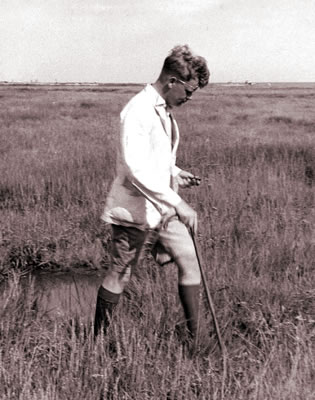
The photograph shows Raymond Crowther walking across a salt marsh near Flatford. This was his characteristic summer garb – brown shoes, khaki shorts and white safari jacket. When we were in the cooler, wetter conditions in the Lake District in 1951 the white coat was replaced by his old RAF tunic top. On these expeditions, he always had his walking stick, his pipe, a tin of Mick McQuaid tobacco, and a hand lens with him.

I used the box camera through to the Flatford Mill Freshwater Biology Course in 1952, but then an uncle gave me an old Zeiss Baby Ikonta camera with a Tessar lens and speeds of 1/25, 1/50 and 1/75th of a second. I used that for the Estuarine Biology course at Flatford Mill in 1953. Another uncle had given me a lens for enlarging – a fairly simple lens, mounted in a tube made of gummed brown paper – he had made it for some device he had been constructing, but had found a better lens.

I pulled out my old Meccano set, acquired an empty National Dried Milk tin as a light box and with balsa wood and two sheets of glass and constructed myself and enlarger. My uncles would have made Heath Robertson look like and amateur, and I’m glad to say some of the Heath Robinson aura seems to have shone on me too. So the attached photos of Flatford were enlarged and developed in my bedroom, and washed in the bathroom sink and glazed on the bedroom window!

1960 Geography Field Trip

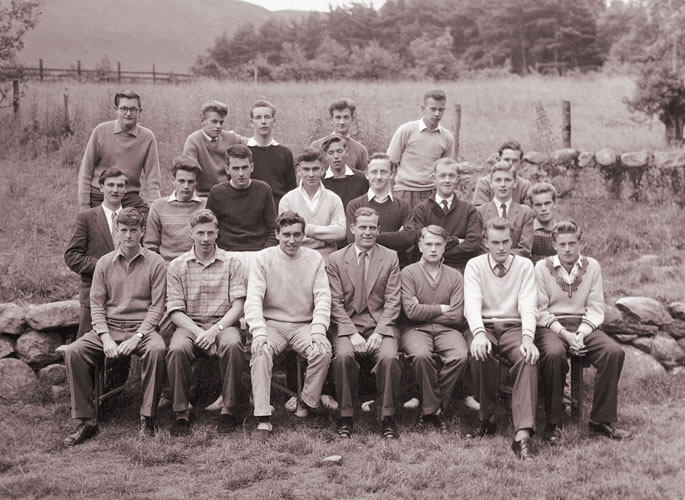
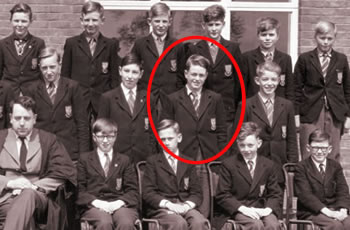
During the 1950s, a number of Grammar School subjects introduced field trips. This photo was taken during July 1960 when R.G. Haywood and Ron Illingworth escorted a party of 20 pupils to the Lake District.

Illingworth
Back Row: M. Elson, G. Garner, Bennett, R. Bluff, Atkin
Middle Row: M01, M. Haynes, Thomas, Peter Jordan, Payne, Smith, M07, David Brunning, M09 (obscured), Stirton
Front Row: P. Hill, P. Gardener, R.G. Haywood, Ron Illingworth, J. Diggens, Taylor, M. Whitewood

The party of boys left Burton on Friday, 15th July for a week’s geographical work in the Lake District under the supervision of Mr. Illingworth and Mr. Haywood. The journey used Stevenson’s Coach and the route taken took them through Preston and Lancaster (being of course, before the availability of the M6 motorway) and through the Lakes to their final destination of Newlands, three miles south-west of Keswick, on the western shore of Lake Derwentwater. Finally arriving at Newlands Hostel around five o’clock, the first thing to do was to unpack everything and have dinner.

Saturday, the first full day, was taken up with a ridge-walk along Causey Pike to the village of Buttermere. The Cumbrian coast and Southern Uplands of Scotland were just visible on parts of the walk. Due to the dangerously steep descent and the time factor, a visit to the actual Buttermere village was abandoned, favouring the less steep descent of Whiteless Pass to the Valley of Soul Beck and following the ‘Becks’ back to Newlands.

Sunday saw the party in the lovely countryside of Watendleth and Borrowdale. The Loclere Falls was the starting point after a boat trip across Lake Derwentwater. The first stop was Watendleth Valley where the local shop did good trade in chocolate, postcards and stamps. From here, the walk took them through Borrowdale to the small village of Grange.

On Monday, the party was taken on an ‘Urban Morphology’. The two towns of Keswick and Cockermouth had been chosen and the party split into two groups with a master going to each town to supervise their studies. Back at the Hostel in the evening, the various findings were recorded. The next day, reports on the work was presented by Mr. Haywood.

Tuesday saw the first bad weather. The planned route for the day was along the Cat Bells Ridge to Dale Head Tarn but half way along the ridge, thick dark clouds came down with the start of some rain so the party returned to the Hostel, finding the best possible shelter on the way arriving back some time before dinner time.

Farm studies were the task for Wednesday. The party was this time divided into three groups with a nominated leader in each. The three areas surveyed were Borrowdale Valley, Bassenthwaite Lake, east-side and Bassenthwaite Lake, west-side. During the course of the day, Mr. Illingworth and Mr. Haywood visited all three groups and after dinner back at the Hostel, the group leaders gave their report.

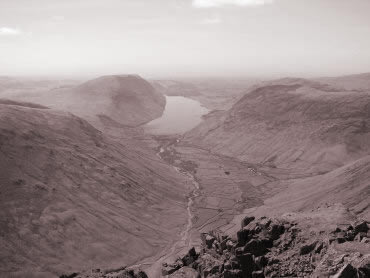
The last full day, Thursday, was spent climbing the Great Gable. The party was taken by bus to Thornywaite. From here, they walked through the village of Seathwaite and, in what became fairly heavy rain, they proceeded to the summit (2,949 ft.). Despite the light veil of cloud, the view was thought well worth the effort ( pictured ).

Friday morning was spent packing before the Stevenson’s Coach arrived for the return journey.

Stuart Haywood (1948-53) Remembers Burton Grammar

In 1948 I was lucky enough to pass the 11-plus and win a place at Burton Boys’ Grammar School, becoming a “Grammar Grub” as such achievers were called. When I left Newhall School I still lived in Wood Lane but during the summer holidays we moved to High Street, Newhall. So new house, new school coincided. My parents were faced with a large bill to finance the purchase of all the accoutrements demanded by the school. I never did acquire all that was listed on the instruction sheet.

After the first year all my school needs were met by Harry Burnton, who had a stall on Swadlincote Market. My father bought my satchel from Mr Snow of Woodville. It was so well made that, when I left, it was still in perfect condition and was sold to another child starting secondary education.

My Grandfather Haywood presented me with a revolutionary new pen as a reward for passing the 11-plus. It was a ballpoint known as a Biro and was very expensive. In those days it cost £2 or £3. It was advertised as the pen that would write under water. Who would want this, a literary diver? I used it in the juniors but the grammar school refused to let boys use them as it was claimed that they would ruin handwriting.

Walking to school was now a thing of the past and so the Newhall boys made their way to Burton on the Midland Red, using a bus pass for free travel.

I remember being self conscious when I first put on the uniform. My cap was a bit too big. It lasted for five years! I had to walk with my head well down so that it perched on the back of my head without falling off.

The school building in Bond Street was opened in 1877 to accommodate 120 boys. In 1948 there were about 550 attending. The headmaster’s house and garden were taken over in 1929, the house being converted to a library and classrooms, and the garden filled with prefabricated buildings. The school has been demolished and is now a car park. When I visit Burton and pass Bond Street now, I am amazed that this small car park on the corner of Lichfield Street was the site of Burton Grammar School. Not only that, but the sports field that was to the west of Peel Croft has disappeared, swallowed up in road re-development and the Safeways supermarket complex.

It was from the pavilion on the sports field that my most disliked sporting activity, cross country running, started. Contemporaries will recall that after only about 50 yards the first obstacle was encountered. On the path to the main road the athletes had to pass close to a paint factory. Usually on our raceday the atmospheric conditions were such that we received the full blast of tremendously acrid fumes given off by the process. The health giving properties of the athletic activity were completely negated in the initial stage, the danger of choking being a more likely outcome.

I and a few more malingerers would proceed with the rest of the field to Stapenhill Pleasure Gardens where we would stop and wait for the competitors to return from the course which took them to Brizlincote, Winshill Water Tower, Elms Road and back to the Pleasure Gardens. We then rejoined the field ensuring that we finished low enough in the order to eliminate any chance of selection for a representative run on a Saturday morning. That would have been a disaster as I had my morning paper round to do, in addition to evening delivery of the Burton Mail. For these two rounds I was paid £2 5s (£2.25p) , a lot of money in those days, but both were large rounds.

I was very surprised on my initial entry to the school playground to notice that the surrounding walls were topped by an entanglement of barbed wire. Having suffered a few physics lessons from a certain Welsh master I realised the necessity for such an action.

It took me about three years to settle into this new environment and then I quite enjoyed myself. What could be more exciting than delving into the mysteries of quadratic equations or learning a geometric theorem. And what about that pre-calculator aid to mathematical logarithms. Remember your characteristics and mantissas?

School dinners were substantial and cheap but certainly not the delight of gourmets among us. My mother was quite shocked when the price per day was increased from 5d to 7d making the weekly cost almost 15p in present money.

The school hall was used for almost everything. It was a gymnasium, assembly room and, occasionally, a theatre. Most significantly for me though, it was used for dining purposes and there would be about 20 tables each seating 10 or 12 boys. It was the responsibility of two boys from each table to make sure that everything was in place for their fellow diners, such as the erection of the tables and placement of forms and chairs.
The food was provided by the School Meals Service and was delivered in metal canisters to the caretaker’s house some distance from the School Hall. Meals cost 5d a day when I first started but had shot up to 7d by the time I left. In current money this is 10p to 15p per week. You could, if you wished, take your own cold collation. At morning break a bun and a jam doughnut were on offer at the tuck shop on the opposite side of Bond Street. This was run by the Rawlings sisters, Lily and Gertie. The cost was 3d for two buns, 1d and 2d respectively; to buy them singly was a halypenny more each. The sisters were also unofficial school nurses, tending to minor injuries.

Boys staying for hot dinners had to take their turn to put up tables, take them down. The canisters had to be carried to the dining area and this was done in rotation by the occupants of each table. Taking the canisters to the hall was no problem as they were all clean. It was the return journey that was the nightmare. In dispensing the food, in particular custard and gravy, the outside of the canisters would be covered in drips and pieces of food which I always seemed to get on my blazer. I would sit in class during the afternoon with a crust developing on my clothing. Not a pretty sight.

A happier memory is of the Rawlings sisters dispensing buns and doughnuts to a long queue of boys at mid-morning break at the tuckshop across the way. They were also called on occasionally to minister to boys who had suffered minor abrasions.

It was on a school trip to the Town Hall that I was introduced to the delights of serious music, a lifelong pleasure, when we were taken to hear a concert by the City of Birmingham Symphony Orchestra specially for children. The programme contained Prokofiev’s Peter and the Wolf and Tchaikovski’s Nutcracker Suite, a very suitable selection for young people.

The same venue was used to hold the annual Speech Day, not the most popular day with most boys. One year a master came to our form and hoped that we would not be too disappointed.

There was insufficient room for the entire school and parents, so would we mind not attending. The same thing happened the next year and we got a day off and an apology and thanks for our selflessness!

My father transported me to school on one occasion. The bus failed to turn up and I was waiting at the stop when my father passed driving a Tunnicliffe’s bread van. He picked me up and I was transported to Bond Street in a commercial vehicle. Dear, oh dear!

Incidentally, Tunnicliffe’s of Newhall had a large grocery shop and baked their own bread The bread was delivered to each household by driving in a yellow battery powered van of which Tunnicliffe’s had a considerable fleet. They were a common sight on the streets of South Derbyshire and, to a lesser extent, Burton.

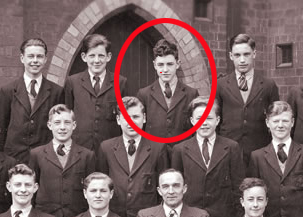
A month before the school photograph was taken the death occurred of King George VI, the present monarch’s father. Mr Pitchford, the headmaster, interrupted a double period of physics taken by Mr Smith and we all assemble in the hall. Mr Pitchford made an announcement that the King had died, ending with “The King is dead, long live the Queen”, and we were the sent home for a week’s mourning.

Mr Smith was popularly known as Brab because his ears protruded a little. Older people will recall that at the time Britain was developing a hugh aircraft called the Braberzon which had a considerable wing span. The plane was an expensive failure.

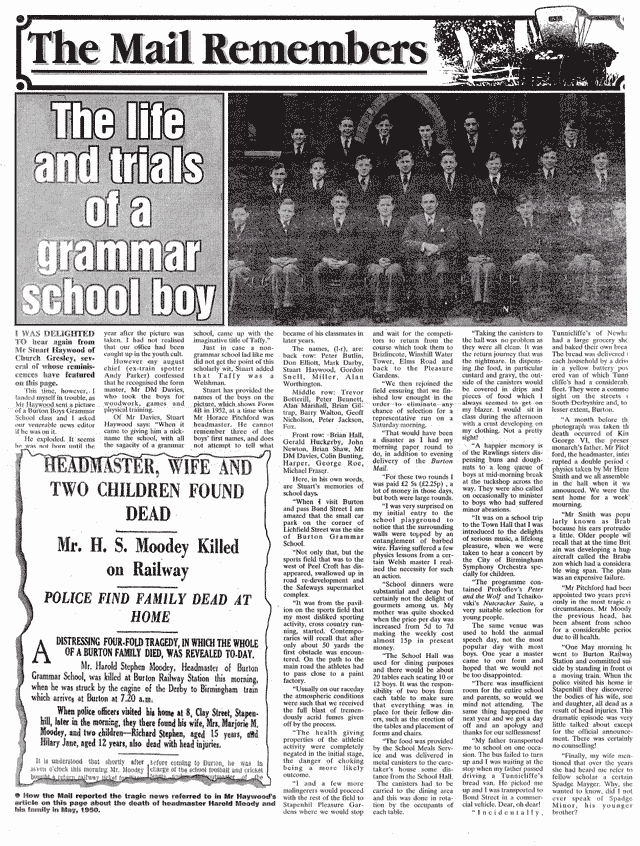
Mr Pitchford had been appointed two years previously in the most tragic of circumstances. Mr Moodey the previous Headmaster, had gone off sick just before Christmas, 1949, and was reported to be seriously ill. One morning in May, 1950, he went to Burton Railway Station and committed suicide by jumping in front of a moving train. When the police visited his Stapenhill home, they discovered the true extent of the tragedy. His wife and teenage son and daughter were all found dead as the resuly of head injuries.

Aside from being announced, strangely, this was never, ever mentioned at school. There was certainly no counselling as there would be today.

Notes on Masters

Mr Illingworth
‘Ronnie’ Illingworth was senior Geography master. He was known for being strict and no-one played him up. I used to marvel at his ability to write on the blackboard without leaving his chair. With his back to the board he could write complicated names such as Venezuela by reaching backwards over his head. He never failed.

Mr Wain
Mr Wain was a French teacher who joined the staff around 1950. In his first lesson he introduced our form to his “black book”. Anyone who misbehaved was noted in this book. He then distributed a short test paper so that he could judge who knew what. I was very bad at French and so I gave the paper a cursory glance before daydreaming. I was awoken from my reverie by a voice demanding “What’s your name boy?”. “Haywood, sir”, I replied. “You are the first person in my black book, Haywood”, he informed me “I caught you copying”. “But I have not written anything down yet sir”. “Don’t argue boy”. And that was that.

About two years later we were given the choice of taking either History or French. I hated French but loved History and so I would have no problem in selecting which one I would take. It was decided though, that the French students would be the boys who finished in the top half of the French exam and the remainder would take history. By some fluke I finished up in the top half in French and so I should have been in that group. However, when we split up into our separate groups for the first time I went with the History boys. No one ever questioned it and consequently, I took History and had some of my best moments in the class of Mr McEwan.

Mr Brown
‘Chasser’ Brown took us for both History and Geography. Often, he was absent minded and not really of this world. One day I was sitting next to Marshall my best friend and I accidentally knocked his pencil onto the floor. “Have you broken that pencil, Marshall”, Mr Brown asked. “Yes Sir”, he replied. “I will put you in detention for that”, Mr Brown said. He obviously noticed the surprise registered on the whole form. He explained, “Do you realise that there are lumberjacks in Canada having to risk life and limb just to produce timber for your pencil? You deserve your punishment”.

At the end of the week our form master Mr Corby reviewed the detention card as was his habit. “Why did Mr Brown put you in detention, Marshall?”, he asked. “Because I broke my pencil”, Marshall replied. “Don’t be silly”, Mr Corby growled, “no one would do that”. “Yes he did”, chorused the form. No more was said of it.

Mr Corby
An old naval man, Mr Corby took us for Maths. As a form master he kept his eye on the weekly ‘Good cause’ collection. When it was discussed where we would like to send the contributions at the end of the year, Mr Corby let us have a free choice as long as it was the Royal Lifeboat Society.

I recall him marking our latest end-of-term examination during a quiet period. He looked up when almost at the end and told us, “Haywood’s flagship at the moment”. He used to cycle to school from his home which I think was on Ashby Road. On wet days he wore waders and it was my job, usually, to pull them off his raised leg. My common ploy was to grasp his leg firmly and pull him, hopping, down the gap between the desks. It usually got a snigger from the rest of the form.

Mr Smith
‘Brab’ Smith had a very powerful voice and, should you provoke his displeasure, his voice would ring round
the school. He was a master who I liked. He took us for Physics and it was during a double period with Mr Smith on Feb 7th 1952 that the headmaster, Mr Pitchford, entered the lab, whispered something to Mr Smith and left. Mr Smith continued the lesson but at the end told us to go to the main hall where the entire school had gathered. Mr Pitchford then announced the death of King George VI and we then went home after a short service.

Mr Pitchford
He was my first form master and History master. It was he who fired my enthusiasm for history, particularly of the locality. I also thoroughly enjoyed a memorable talk given by Mr H J Wain on the history of Bretby. During my time as Mr Pitchford’s pupil I still marvel at the wonderful “Wulfric Spot”

Mr D M Davies T.D.
He was my form master for a year and also took Woodwork and P.T. Although I was useless at Woodwork, I found him an affable man. He was not very affable, however, when I knocked a bowl of stain over his meticulously kept mark book! Fortunately, I could back-pedal round the benches faster than Taffy could go forward.

Mr C F L Read
Mr Read was my Maths master for one year. He had the habit of going to the end of the gangway between the desks and as he walked towards the front of the class he flicked each boy’s ear with his ruler. Not the most endearing habit!

Mrs Lownds
She took Maths and I found her to be a good teacher although some of the boys played her up quite a lot when she became angry and raised her voice. Anyone sat near her would get a little damp with spittle, hence her nickname ‘Spitfire’. Regularly she would say to me when I was in the ‘B’ stream. “I don’t know what you are doing in this form”.

Mr Nicholson
Mr Nicholson was my Chemistry master. For 2 or 3 years, I was “Nick’s favourite”. When he arrived to take the class, he always asked for the detention card and put me in. When I protested, as I always did, his reply to me saying that I had done nothing was, “No, but you WILL”. Nick’s favourite!

Bond Street Assembly Hall

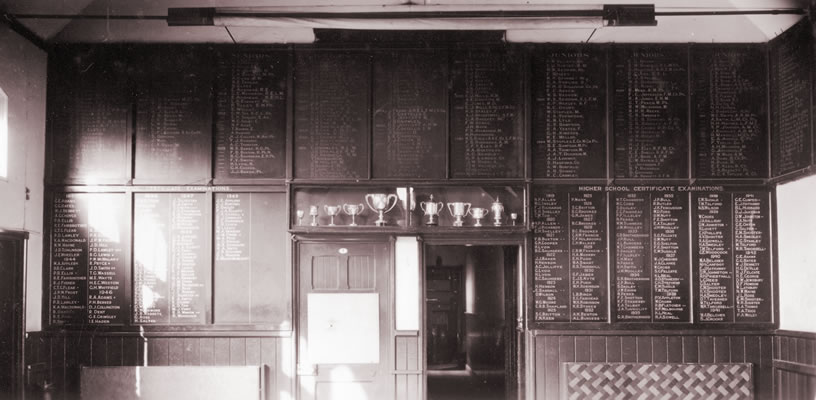
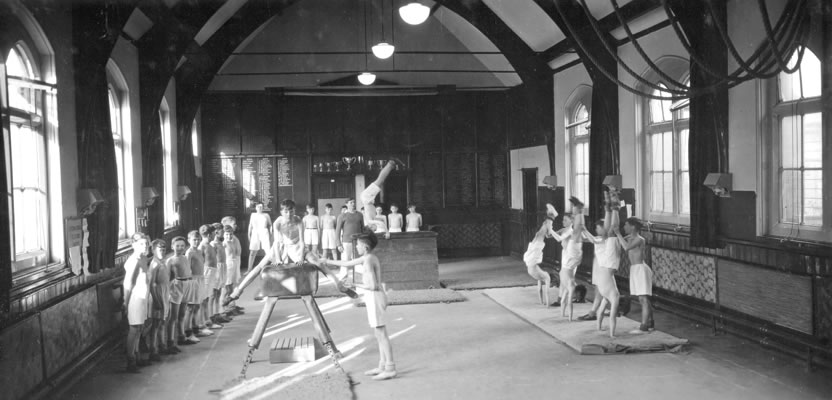
The Assembly Hall at Bond Street provided good service. As well as Assembly Hall, it served as Dinner Room, Gym, Badminton Court, Boxing Ring, Scout ‘hut’ and the venue for umpteen School Societies and out of school-time activities.

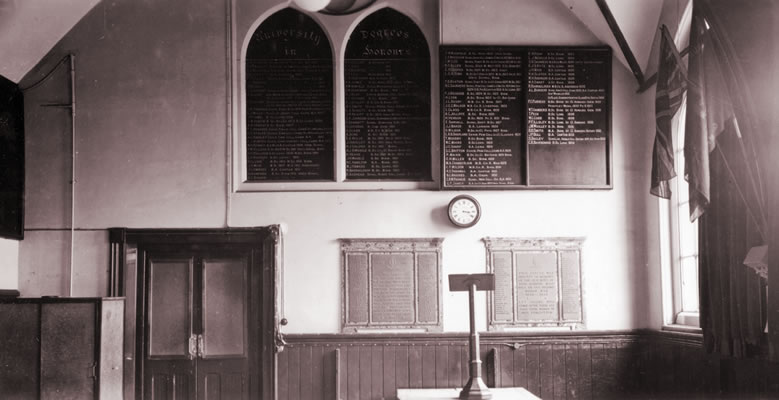
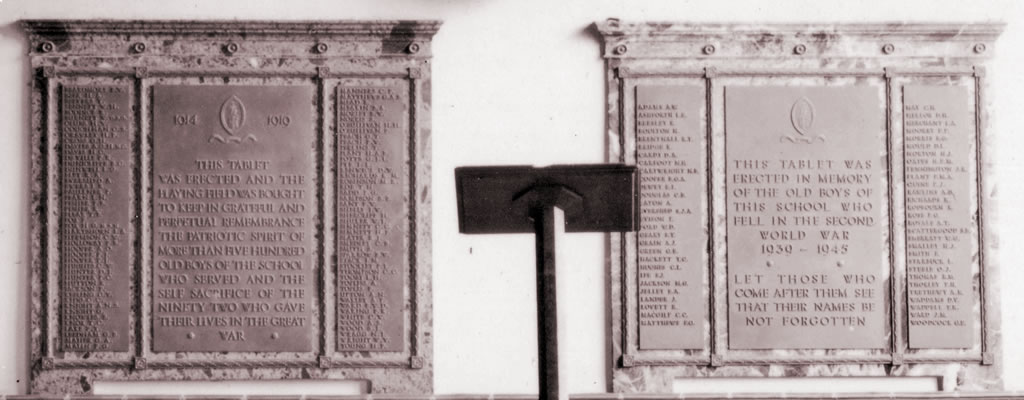
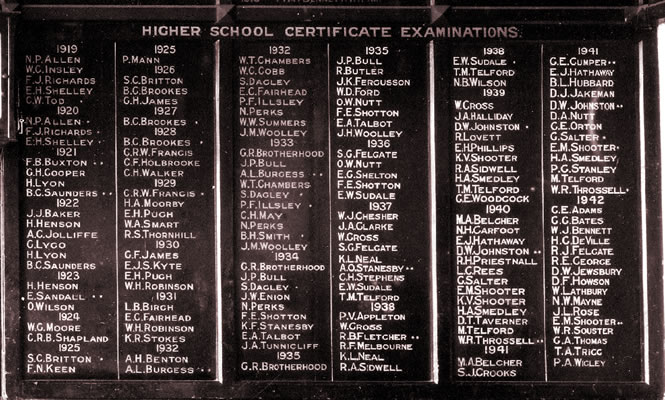
The dais and lectern is where the headmaster stood during assembly and where the head boy read the lesson from. The wall tablets behind were the memorials to ex-pupils who lost their lives in the two World Wars and the boards above recorded the university honours degrees achieved by pupils from the school. Later achievements were recorded on more boards, at the opposite end of the Hall.

School Hall

School Hall

Both memorial tablets were transfered to the foyer of the Winshill School and later to the front of the main hall. More detail can be found here

The double doors opened into a corridor that led to the main entrance (the large oak portal shown on the Christmas card last year) in Bond Street. Off this corridor were A,B and C classrooms, the secretary’s office (Norah Mitton in my time, 1950-57) and the stairs up to the Staffroom, Biology Lab, Art Room, L Room and the Book and Stationery Store. A further corridor led off at a right angle by the secretary’s office towards the Head’s office door, the Junior cloakroom and exit to the playground or Bond Street. The door to D Room was just out of shot on the left side wall the other side of the cupboard that can be seen near the double doors. On the opposite, right side wall, the two flags were the Union Jack and I think, the Scout Troop’s standard.

School Hall

School Hall

The piano stood between the double doors and the dais and was played by Dickie Starling, the music master, and after his departure by Roy Perry, a pupil. About a third the way down the hall, there were 4 or 6 climbing ropes suspended from the ceiling and secured in a bunch on the left side wall. Further down on the left side was the beam apparatus, the box and pommel horse usually stood in the corner at the front, right side, together with a few coconut mats. All these obviously pieces of gym equipment used during PE lessons.

1952 Gym

At the far end of the Hall there was an exit on both side walls, one on the right to the playground, the other to the garden, where the prefabricated classrooms Q, R, S, T and Physics lab were, and the old headmaster’s house which contained the Library, prefects’ and upper sixth form studies and M and P rooms. The door to F room was on the back wall together with a central corridor which led to the Physics lab/LVISc formroom, the Chemistry lab and Ron Illingworth’s G for Geography room which contained a chair that defied the laws of gravity with regard to the angle it could be tilted, with Ron sitting on it, without falling over.

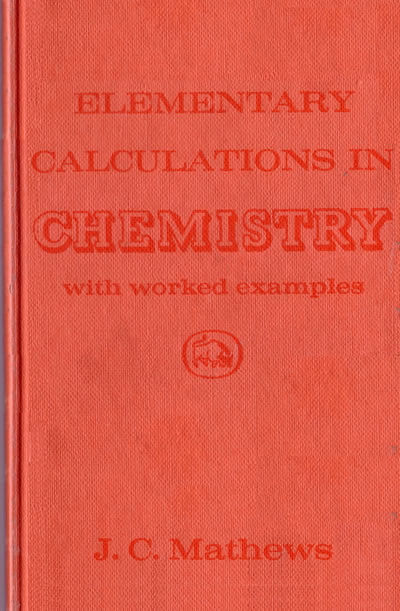
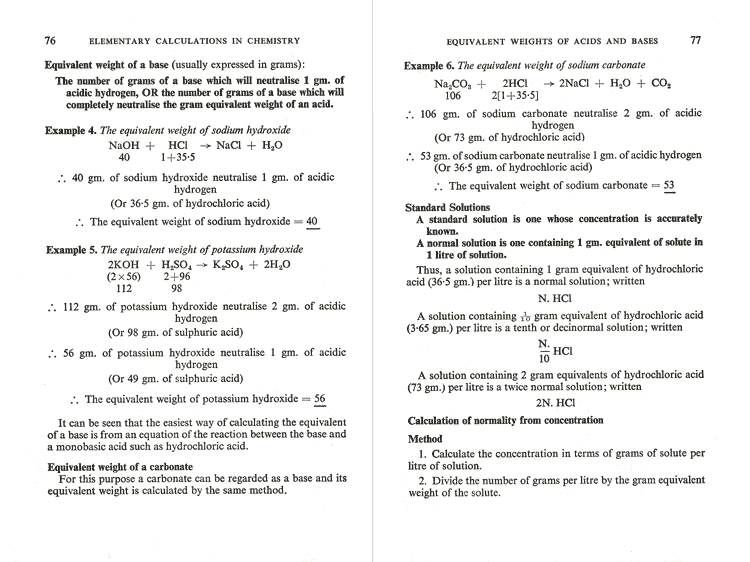
Elementary Calculations in Chemistry

I can certainly remember ‘Elementary Calculations in CHEMISTRY’ by J.C. Mathews and was delighted to get hold of a copy.

Chapters were:

  • I – Molecular Weight and Percentage Composition
  • II – Formulae from Composition
  • III – Reacting weights
  • IV – Boyle’s and Charles’ Laws
  • V – Gram Molecular Volume
  • VI – Reacting Volumes of Gases
  • VII – Vapour Density and Molecular Weights
  • VIII – Diffusion of Gases
  • IX – Equivalent Weights of Elements
  • X – Atomic Weights
  • XI – The Law of Multiple Proportions
  • XII – Equivalent Weights of Acids and Bases
  • XIII – Volumetriv Analysis
  • XIV – Electrolysis
  • XV – Solubility
  • XVI – Revision Exercises 1,2,3

Obligingly, this being well before the introduction of the electronic calculator, at the back of the book were Logarithm and Anti-Logarithm tables!

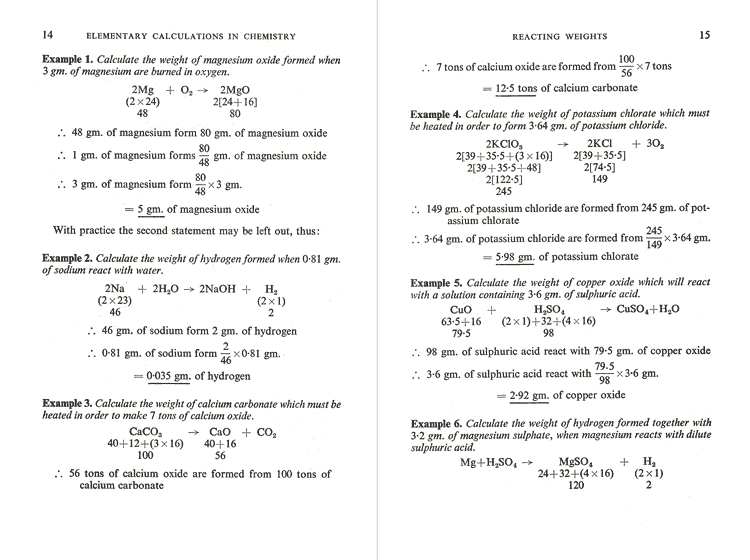
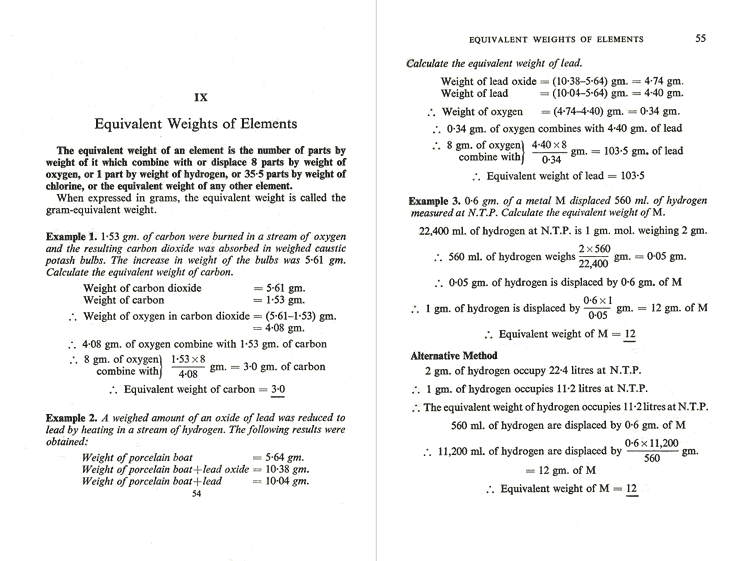
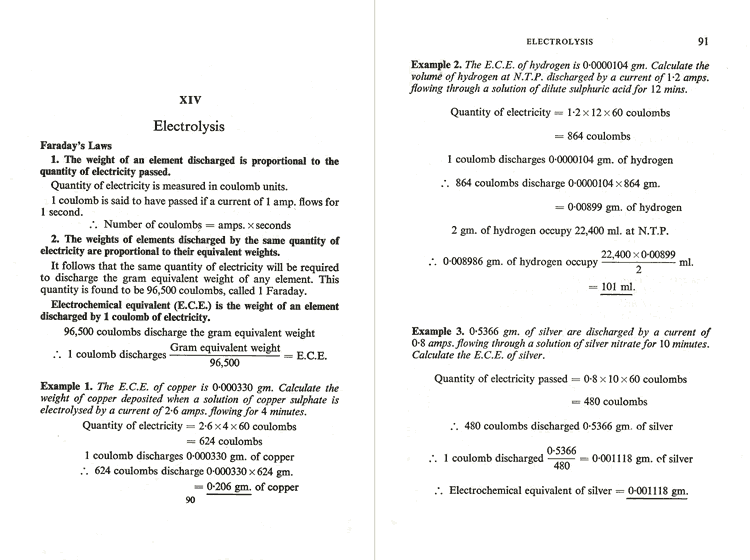
The following page extracts provide a tantilizing glimpse into the past; somehow, they don’t seem to be anything like as fearsome as they seemed at the time…

School Coat of Arms

crests.gif

The original crest dates back to around 1876 and is thought to have been designed by the Headmaster at the time, Mr C.Tripp, in preparation for moving to the new school premises in Bond Street. It is partially derived from the old seal of the Collegiate Church; the shield in the centre is the shield of Burton Abbey. The open book was to depict learning, the bird is generally accepted to be a dove of peace. There was always some controversy over whether the school actually had the rights to use the crest in an official capacity.

On the opening of the new school at Winshill, another new Coat of Arms was introduced. Although not immediately obvious, the scalloped cross and stars are derived from the original shield of Burton Abbey to fit with the newly selected colours. The bishop’s mitre is also influenced by the Abbey and the ‘Deus Nobiscum’ motto is retained.

Sir Clifford Gothard, himself a Burton Grammar School old boy, generously paid the complete cost of having the new Coat of Arms designed and registered with the College of Arms. The Patent of Armorial Bearings was prepared and submitted as follows:

To All and Singular to whom these Presents shall come, the Honourable Sir George Rothe Bellew, Knight Commander of the Royal Victorian Order, Garter Principal King of Arms, Archibald George Blomefield Russell, Esquire, Commander of the Royal Victorian Order, Clarenceux King of Arms, and Sir Gerald Woods Wollaston, Knight Commander of the Most Honourable Order of the Bath, Knight Commander of the Royal Victorian Order, Norroy and Ulster King of Arms, send Greeting! Whereas Violet Evershed, Chairman of the Board of Governors of the Grammar School, Burton-on-Trent, in the County of Stafford, hath represented unto the Most Noble Bernard Marmaduke, Duke of Norfolk, Knight of the Most Noble Order of the Garter, Knight Grand Cross of the Royal Victorian Order, Earl Marshall and Hereditary Marshall of England, and One of Her Majesty’s Most Honourable Privy Council that the said school is of ancient foundation, lands having been endowed for its maintenance by Abbot Beyne in the year 1520. That the said Board of Governors are Governors of a Charity which is regulated by a scheme established by an Order of the Board of Charity Commissioners for England and Wales, dated the Eleventh day of August, 1884, and known and administered under the name of the Burton Endowed Schools. That the Board of Governors of the Grammar School, Burton-on-Trent, is desirous of having Armorial Bearings duly assigned for the said School with lawful authority, and she hath requested the favour of His Grace’s Warrant for Our granting and assigning such Armorial Ensigns as may be proper to be borne and used for the Grammar School, Burton-on-Trent according to the Laws of Arms. And forasmuch as the said Earl Marshall did by Warrant under his hand and seal bearing date the nineteenth day of July last authorise and direct us to grant and assign such Armorial Ensigns accordingly. Know ye therefore that We, the said Garter, Clarenceux, Norroy and Ulster in pursuance of His Grace’s Warrant and by virtue of the Letters Patent of Our several Offices to each of Us respectively granted do by these several Presents grant and assign the Arms following for the Grammar School, Burton-on-Trent, that is to say:— Or on a Cross engrailed Azure five mullets Argent in the first quarter a Mitre of the second as the same are in the margin hereof more depicted to be borne and used for ever hereafter for the Grammar School, Burton-on-Trent, according to the Laws of Arms.

In Witness whereof We the said Garter, Clarenceux and Norroy and Ulster Kings of Arms have to these Presents subscribed Our names and affixed the seals of Our several Offices this Seventh day of October in the Fourth year of the Reign of Our Sovereign Lady Elizabeth the Second by the Grace of God of the United Kingdom of Great Britain and Northern Ireland and of Her other Realms and Territories Queen, Head of the Commonwealth, Defender of the Faith and in the year of Our Lord One thousand nine hundred and fifty-five.

(Signed)

G. R. Bellew, Archibald G. B. Russell, Gerald W. Wollaston,
Garter, Clarenceux, Norroy and Ulster.

The Arms were granted in December 1955 and in that winter edition of the Cygnet magazine, a colour page was included so that each boy should have a copy of the new arms.

On moving to the new school, the following announcement was made by the Headmaster, Herbert Pitchford:

In the course of a long history, the Grammar School in Burton upon Trent has known quite a number of changes and has thus far, survived them all. Under various names and on different sites, the school has worked under several kinds of government, adapting itself to the needs of successive generations and preserving a tradition of learning and service. Now there is to be another change, the removal from Bond Street to Winshill where, in mors spacious accommodation, the tradition may be continued and extended.

At the same time, the school badge is to be altered and the Headmaster wishes the purpose of thr new badge to be understood. It is not just another innovation but rather, an attempt to confirm and establish in a time of transition, a link with the past. For it must be admitted that the school’s right to the present badge has for long been the subject of controversy, as Mr Harold Moodey’s ‘Outline of the History of the School’ published in 1944 makes clear. All we can say from the scanty evidence is that the present badge was designed in the time of Mr C.U. Tripp, who was the Headmaster from 1874 to 1882, and that it was most likely adopted as the official badge in 1876, when the old school in Friars’ Walk was replaced by the (present) building in Bond Street.

When the architect responsible for the design of the buildings in Winshill asked for the emblems of the school which could be displayed as part of the interior decoration, it was felt that the existing badge possessed neither the heraldic accuracy nor the unquestioned authenticity required. The Headmaster therefore, decided that the time was opportune for the school to achieve its own acknowledged coat of arms an asked Mr Lewis Heath, the school’s art master, to design a badge that could be submitted for approval to the College of Arms.

Mr Heath produced a new badge which retains the basic features of the old one, the seal taken from the seal of the Collegiate Church of 1541 and probably itself derived from the Arms of the Abbey. It also emphasizes, by the inclusion of the mitre, the school’s foundation by Abbot Beyne who endowed lands for its maintenance in 1520. Thus, the new design reaches back beyond the present one and preserves the connection of the school with the Abbey of Burton. It is, moreover, heraldically correct and is a very beautiful badge.

The Governors of the School and the Committee of the Old Boys Association having agreed to the idea and to the design, the next step was to submit Mr Heath’s design to the College of Arms for approval. At the suggestion on the Clarenceux King of Arms, the mitre was included in the first quarter so as not to conflict with the existing rights. A petition was then made to the Earl Marshal for a Patent of Armorial Bearings. This involved considerable expense which was met by the generous offer of Mr C.F. Gothard, B.Sc., F.C.A., Old Boy and Governor, who paid for the whole cost of the registration and of the painting of the Coat of Arms. Thus, the Burton Grammar School now possesses its own official Coat of Arms.

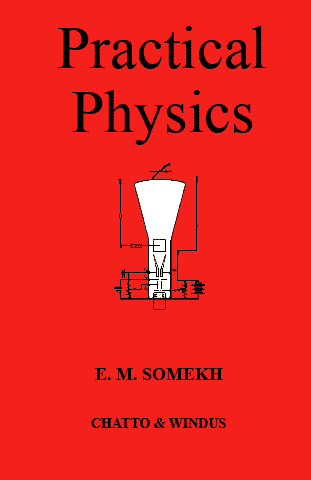
Practical Physics

Practical Physics has a double significance with Burton Grammar School. Firstly because it was used by those who took ‘A’ Level Practical Physics in the Sixth Form during the 1960s, and secondly, because the author was Ezra Somekh who taught Physics at the school from 1956 to 1967.

The book contained a number of novel experiments that Ezra himself had designed and it became a widely used text book. Mr Somekh, partly due to the success of the book, eventually, became a chief A-Level examiner.

1941 Old Boys Visit

This 1941 photo shows a visit back to the school by some Old Boys. The Headmasters position had recently been taken over from W.D. Fraser by Harold Stephen Moodey who is in the centre of the doorway. To his left is a young man that had already made Wing Commander.

The man to Mr Moodey’s right is thought to have been a member of staff but no-one has managed to identify him. Next right is James ‘Jim’ Woolley, complete with wings and pilot officer rank and who was to go on to rise quickly through the ranks.

The others are unknown.

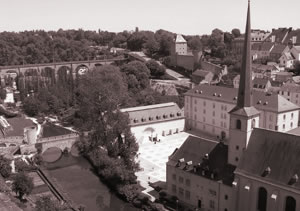
1960 – Luxembourg Trip

An Account by P. Cartwright:

The party, which was led by Mr Ellick (Ernie) Ward the French teacher, consisted of boys from the Senior section of the school and one boy from the Technical High School; there were eighteen of us altogether.

Our coach to take us to London left from Burton Town Hall at 4:45am on the Thursday morning after we had broken up for the summer holidays. The 10:00am boat train from London’s Victoria Station took us to Dover where we caught the 11:00am boat to Ostend, Belgium. The channel crossing was calm and we arrived in Ostend three hours later in bright sunshine, welcomed to the Continent but reminded of England and Burton by a large advertisement for ‘Bass Beer’ on the harbour.

We spent our first night in Brussels, where we arrived at 5:30pm by express train direct from Ostend. The city has a well used tramcar service and the small single-decker tramcars travel underground as well as on the streets,many of which are not tarmaced but instead surfaced with small square slabs of concrete. We stayed the night at the Flemish Youth Hostel, an old country building which had been restored and we were somewhat discouraged by both the accommodation and the food. Fortunately, this hostel turned out to be the worst one we stayed in.

At 8:30pm the next morning, we set out for the train station to catch a direct express to Luxembourg City. The train passed through the hilly, wooded countryside characteristic of Southern Belgium and Luxembourg. We arrived in Luxembourg City, the capital of the Grand Duchy, at 12:30pm and, after lunch, we walked round the old city of tall buildings until after four o’clock, when we caught the auto-rail to Ettelbruck, 25 Km north on the river Shzette. We stayed the night at the Youth Hostel here and next morning, caught the auto-rail to Goebelsmuhle. From here, we walked in the pouring rain across wooded countryside to the small village of Kautenback and on to the town of Wiltz, this time along the road because of the very wet conditions; a distance of 17 Km in all.
Soon after we arrived, the rain stopped and the sun shone for the rest of the day to raise spirits. Among the attractions at Wiltz was an Operatic Festival and an American tank which stood as a relic of the Second World War.

We left Wiltz the next morning, again in bright sunshine and headed on foot for Clervaux in the north. The weather and scenery were magnificent and, after stopping on the way to have refreshments and the usual mid-day meal of bread and jam, we arrived at Clervaux, a quaint old town in the bottom of a deep valley cut by the river Clerf. With its pointed roofs, a castle and a monastery, the town felt like one straight out of a fairy tale.

The next day, it was raining again so, instead of walking, we caight the auto-rail to Ettelbruck where, because of the weather, we hardly did anything until 5:30pm when we caught the train to Diekirch, ‘The Burton-on-Trent of Luxembourg’. We travelled by bus from Diekirch to Vianden where we stayed for the following two nights, again, in a Youth Hostel. Vianden is on the eastern border of Luxembourg, bordering with Germany and catered for tourists. The town is situated in yet another deep valley where a river had cut deep into the surrounding wooded country which seemed to characterize Luxembourg, and a chair-lift passes from the town, across the river and up to a chalet on the mountainside. At the top of the mountain was a 13th century castle overlooking the town. We could see a scheme in progress for damming up the valley to provide power or a supply of water.
After staying two nights at Vianden, we hiked to Beaufort to the south-east, a town with a another 13th century castle. Having spent a night at Beaufort Youth Hostel, we set out in more pouring rain for Echternach. Our route was through some soaked woodland but a spectacle worth seeing was the ‘seven sisters’; seven deep gorges or narrow faults in solid rock, each only a few feet wide. It was still raining when we arrived at Echternach, which is the second largest town in Luxemburg. It had an ancient Basilica and a very modern Youth Hostel where we spent our final night in Luxemburg.

From Echternach, we travelled by bus the next day back to Luxembourg City where we caught the train to Brussels. From Brussels, we travelled to Bruges. Bruges had long been a favourite destination for Burton Grammar School trips being a much visited tourist centre as one of the most important commercial cities in Europe during the 13th and 14th centuries. We marvelled at the buildings, monuments, churches, palaces and bridges with its network of canals which connected up with the wide sea canal to Zeebrugge. We also saw the white statue of Madonna by Michelangelo in the ‘Church of Our Lady’. The new Youth Hostel at Bruges was plagued with mosquitoes resulting in many bites but nothing stopped us having an enjoyable time. Back the same way as we came through Ostend, Dover and London, we finally returned to Burton on July 31st.

1954 Howarths Advert

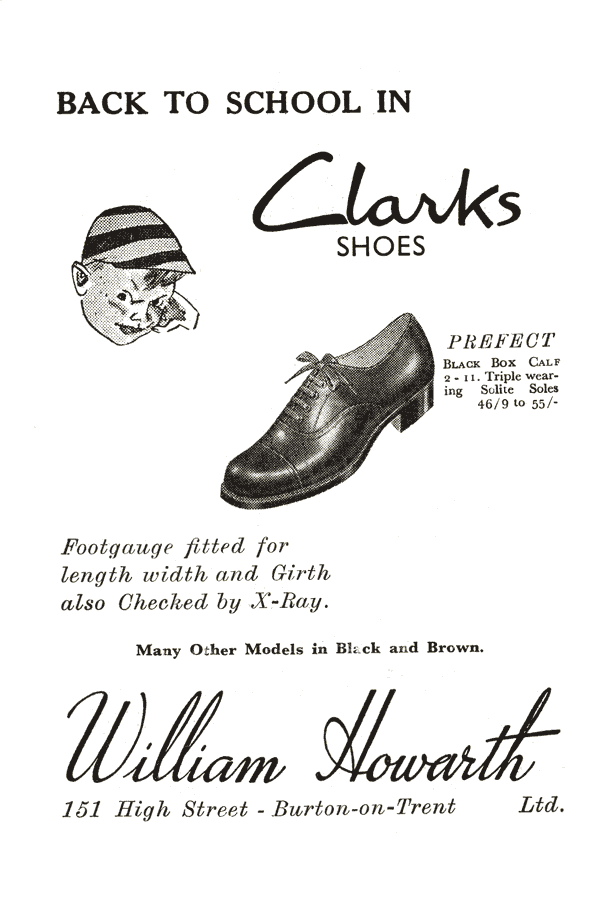
In 1954, William Howarth’s in High Street was often the first port of call for new school shoes; and I must admit, I can see why – at 49/9d (£2.49), for a pair of X-Ray checked stout brogues, I could even be tempted myself.

Howarth