PART 1
This is a transcription of Harold Moodey’s ‘Outline History of the Burton Grammar School’ as appears on the website as a series of images of the original document published in March, 1944. It was produced to improve searching and ease the burden of researchers that come after me.
A few errors may have been inadvertently introduced; the images should always be used as the master source. An known errors, inconsistencies or ‘olde’ spelling has been copied verbatim because it is not my place to change them!
An Outline History of the Burton Grammar School (1520 to 1884)
by Harold S. Moodey
CONTENTS:
Introduction
1. Burton-on-Trent Grammar School
2. Foundation of the School
3. The Reformation
4. The Endowment
5. Early Master and Pupils
6. The Dissolution of the Abbey
7. Burton Collegiate Church
8. First Trustees
9. The School Badge
10. The Collegiate Church Dissolved
11. Lady Elizabeth Paulett’s Benefaction
12. After the Dissolution
13. 1605
14. The First School
15. Allsop, Finney, and Astle
16. Three Eighteenth Century Pupils
(PART 2)
17. Trust Deed of 1745
18. The Earls of Uxbridge
19. A Chancery Suit, 1746
20. 1782
21. A Decline?
22. The Charity Commission, 1824
23. A New School Building
21. Allsop’s School, 1849
25. Fees introduced, 1858
26. Rev. H. Day. Head Master
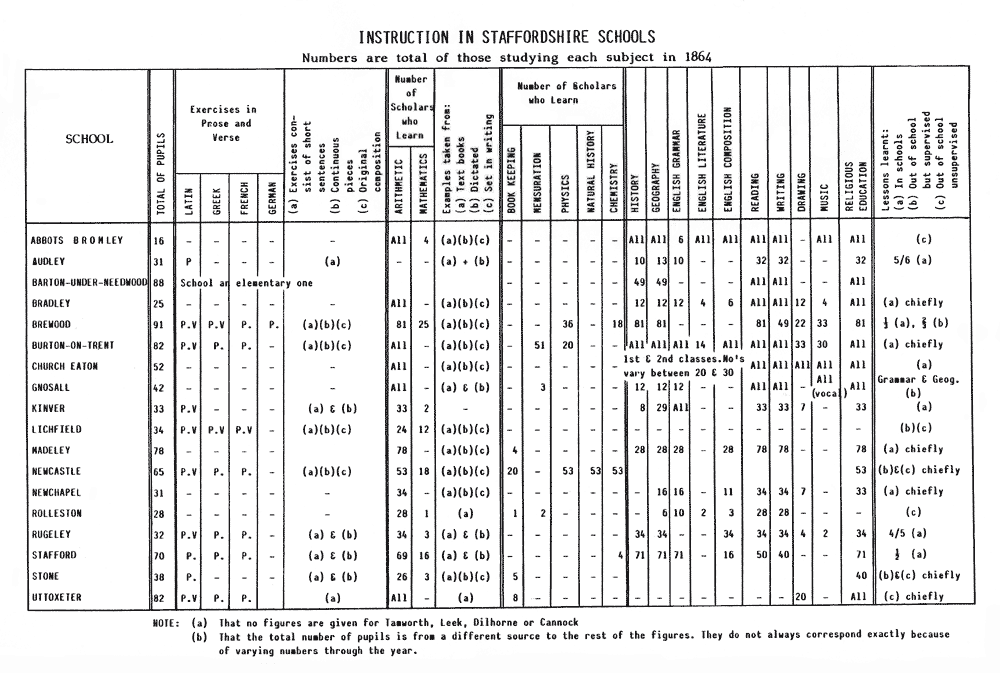
27. An Inspection, 1864
28. Schools Enquiry Commission, 1869
29. The School in 1873
30. Burton Endowed Schools, 1871
31. 1873 – 1876
32. 1877 – 1881
33. Finale, 1884
The House of Paget
Trustees
Headmasters
Pupils
Foundation Day
Envoi
INTRODUCTION.
The reader who peruses the pages which follow will probably remark that their publication is premature. He will find that the history recorded is far from complete; he may find that surmise plays a larger part than he would wish; he may discover some mistakes.
It is precisely for these reasons that the publication has taken its present form. The intention is to give an opportunity to Old Boys and other possible local historians to remedy the deficiencies. They may be able to supply missing details, to correct errors, and perhaps to unearth original documents, such as the original conveyance, the Paulettt will, etc., a task for which the present compiler has not been able to discover time or facilities.
A complete history or the school is long overdue; when, as appears probable, the 1944 Education Act comes into operation and closes another chapter in the life of the school, it will be a duty to posterity to put upon record all that we can about the “old” school.
The history of Burton-on-Trent Grammar School divides itself naturally into three parts: the early years, when the school functioned in a one-roomed building in the churchyard; the years of the Friars’ Walk School; and the period spent in Bond Street. The present record covers the first two and a few years of the third.
The sources or the Information recorded are manifold. The following books, among others, have been consulted:
Underhill: History of Burton-on Trent (1841).
Molyneux: History of Burton-on-Trent (1869).
Wesley: History of Burton-on-Trent (1847).
White: History of Staffordshire (1851).
White: History of Staffordshire (1834).
Shaw: History of Staffordshire (1798).
Griffith: Schools and Endowments of Staffordshire (1860).
Baskerville: English Monks and the Dissolution (1936).
Dugdale: Monasticon Anglicanum (1722).
Dugdale: England and Wales Delineated (about 1815).
Leach: English Schools at the Reformation (1911).
Leach: The Schools of Mediaeval England (1916).
Dictionary of National Biography.
Reports of the Charity Commission. 1824, and of the Endowed Schools Commission, 1869.
Journal of the Derbyshire Archaeological Society, 1923.
In addition, many helpers have contributed, sometimes with a chance remark or observation, sometimes with masses of pieces of information. Outstanding among the latter are two Old Boys – the Rev. J. E. Auden. who after a long and distinguished career in the Church and in the Army, and as historian and author, is living in retirement at Armitage, unfortunately now confined to his house: and Mr. B. H. Smith, who contributed three valuable articles to the Cygnet’ in 1929; and in addition. Mr. C. Underhill, whose ‘History of Burton-on-Trent’ has been of great use, and who has readily supplied a lot of additional matter. Others to whom the writer is indebted are Mrs. E. E. Cope; Messrs. F. R Bell, W. Clubb. F. Evershed, G. W. Harris. H. H. Pitchford, R. T.Robinson. Read Samble, V.G. Bock-West. J.S.Tucker, H.J. Wain, S.A. Ward; Miss W. Mulley, and the Vicar or Burton (the Rev. C. O. Haden). There are others, but memory Is fallible, and those omitted must be tolerant and forgiving.
These pages are dedicated to the memory of our founder and benefactors: Beyne, Paulett, Finney. Allsop, Astle; to all those whose labours and achievements have brought the school to its present level of distinction; and to those Old Boys who lie in foreign fields, and will not return after having ensured for us the continuance of our lives, and that of the school, in the freedom we prize, but have not vet learned how to use. They have provided us with a heritage; we who are now present or past members of the school must not regard It lightly.
1. BURTON-ON-TRENT GRAMMAR SCHOOL.
Burton Grammar School throughout the whole of Us history since its endowment, four and a quarter centuries ago, has been a free Grammar School. The freedom has been from control of the Church or of any other “close” authority. The term Tree’ has frequently been misunderstood: as Mr. J. E. Auden, who will be mentioned several limes in the pages which follow, puts it: ‘liber homo’ is not a man who of necessity gives his services free of charge.
It is true that the school was required to provide education free to the sons of poor parents, and this it has alwavs done. In fact, it carried out its obligations so conscientiously that during the earlv nineteenth century is did so at the – expense of efficiency. If fees had been charged earlier than, as we shall see was the case, in 1858, the school would have been wealthier, and might have done even better things than it actually achieved at that period.
When fees were introduced, free places were still offered, and this system continued until the introduction in the present century of “special places”; and even now eight Boys, who achieve distinction in the entrance examination, are awarded free “Alsop scholarships” (the Charity Commissioners are responsible for the spelling) and eight others “Feoffees’ exhibitions.” These boys hold places entirely exempt from fees.
Thus Burton Grammar School, unlike a number of schools of similar foundation, where fees have been misappropriated, and poor scholars excluded in direct contradiction of the terms of their endowments, has throughout its history honourablv fulfilled the purpose of its founder. The relative importance of honour and prestige may be a matter of opinion: we know we have no cause for shame or rebuke in our history. We can regret that the school was not better endowed during Its difficult days by some who might have allowed the school to share the wealth which flowed into the town; but that is another story.
A Grammar School in ancient days was a school in which the classics, Latin and Greek were taught and studied.as opposed to an elementary school, where education was more or less confined to reading, writing and arithmetic. In volution has considerably modified the function of a Grammar School; the classics have had to share their priority with Modern Studies and with Science, and now we must regard a Grammar School as one in which, for those who desire and can achieve it. an education is available in as many faculties’ as possible up to the standard for entrance to the Universities. In this part of its function, with one short break, the school too has always fulfilled its obligations.
Here is the history, as far as it has been re-discovered, of the Free Grammar School of Abbot William Beyne at Burton-on-Trent, Staffordshire.
2. FOUNDATION OF THE SCHOOL.
The traditional date of the foundation of Burton-on-Trent Grammar School is 1520. It is possible that this date settled into tradition after the publication of Shaw’s “History of Staffordshire” in 1798. Shaw recorded that the 32ud Abbot of Burton Abbey, William Beyne (which he also spelt Bean and Ueane) founded and endowed the free Grammar School of Burlon-upon Trent “about 1521)” by placing in the hands of Richard Sacheverell sufficient money to purchase land to produce an annual rent of 8 marks (£5. 6s. 8d.) to be employed in the maintenance of a school and schoolmaster.
This appears to he the earliest information at present available as to the origin of the school; and some uncertainty arises at once. According to Shaw, the abbot died in 1525, and presumably ” about 1520″ was named merely as indicating some lime before the death of the abbot.
But available evidence as to the date of the death of Abbot Beyne not seems to uphold Shaw’s statement that it occurred in 1525.lt was not till February, 1531, that letters of the Dean and Chapter of Lichfield empowered Thomas Bach, chancellor.of London,Richard Lee, D.D., Robert Norbury, prior of Burton Abbey, and William Edys, ‘third prior’ and pittancer, to elect a new abbot. In April, 1531, William Boston, a monk of Peterborough, was confirmed in his election as Abbot.
It was on 28th February, 1529, that a Mortmain Licence was granted to Sir Richard Sacheverell ‘to alienate the manor of and certain messages in Overton (or Urton) under Arden, Leicester, and the manor of Brayston (or Breastonl, Derbyshire, to the annual value of £8 (12 marks) to William Heane, Abbot, and the monastery of SS. Mary and Modwin, Burton upon Trent.
We notice the divergence between the 8 marks mentioned by Shaw, and the 12 marks named in the actual citation. This, of course, could easily be accounted for by skilful use of the funds which were available; or even more simply by a misunderstanding on the part of Shaw, who may have contused eight marks and eight pounds during his investigations.
It is difficult to believe that if the funds were made available in 1520, it would have taken the nine years from then till 1529 to complete the negotiations, though it is not impossible. It has been suggested that Shaw’s use of the word “maintenance” rather than “foundation” or a school can perhaps be considered to indicate the maintenance of a school which was already in existence. This would be more helpful if Sir Richard Sacheverell had not, in his will of 1535, as we shall see later, required his nephew to “stablish and fynysh” the school. The position is that while we arc justified in regarding 28th February, 1529, as the date of the endowment of the school as a free School, we must consider the question as to whether the school existed before that date, and if so, for how long and in what form.
Burton Abbey was founded in the year 1004 by Wulfric Spot, Earl of Murcia. Many monasteries, possibly the majority, especially Benedictine monasteries, are known throughout the history of England to have had their own schools. Their services, of course, were conducted in Latin, and the only available method by which their novices could be educated was by means or a school in or attached to the foundation. The choristers were given an elementary education in reading and writing and in Music, in “Song Schools”; at least some of the monks-to-be were given more advanced instruction in “Grammar Schools”. It is known, too. that it was common for the sons of many of the laity to be sent to Grammar Schools to join with the inmates of the monasteries for their education; it is mainly, in fact, in this way that those of the populace of the outside world who became educated and who came to occupy positions of prominence in the world of politics, or of law, or of medicine, gained at least the first stages in their education.
In many monasteries there were chantry schools. Money was often bequeathed to ensure the regular singing of masses for the souls of benefactors, and many chantries became very wealthy. Their funds were often used for the maintenance of chantry schools, which provided education for the children ot the districts surrounding the monasteries.
That the existence or schools in monasteries was a common thing is evidenced by the decisions of the Lateran councils of 1179 and 1215. Under these decisions, in all churches of sufficient means a master was to be appointed to teach the clerks and other children whose parents could not afford the means. It is a far from certain that the orders were universally complied with. In many cases it is likely that the instruction was carried out by one or more of the monks; in some cases by the Abbot himself.
Whether Burton Abbey actually possessed a school in its early days we do not know. Unfortunately the procedure during the dissolution, to which we shall refer later, in most cases removed the possibility of direct evidence. A number of the monasteries when submitting to assessment, attempted to include education expenses under the heading of ‘Alms’, but this was not allowed. If the reverse had been the case, much more historical information about monastery schools would have remained at our disposal.
We do know, however, on the evidence which we will quote in due course, that education took place in Burton Abbey us early us in 1416: and by analogy with other monasteries, we can assume that it took place in a properly organised school.
Burton Abbey had its chantry, but again we do not know that it possessed its chantry school. A large number of chantries remained after the death of Henry VIII, but this was not the case at Burton. The surviving chantries were dissolved in the reign or Edward VI and in a number of Instances some of their funds were devoted to the support of their schools, which were granted new charters. It is amusing to think that Edward VI was for centuries regarded as a munificent benefactor of schools, whereas in fact what he (or rather, the Protector, Somerset) did was in plunder the chantries, and to destroy most of their schools, while in a relatively few places he allowed the schools to retain sufficient of their own funds to carry on. We cannot assume, though, that every chantry had its school; of five chantries at Walsall, for instance, not one chantry had devoted any of its funds to such a purpose.
Whether the chantry at Burton was well endowed, we can only guess. We know that in 1254 the Abbey was “assessed” at 11 marks (£9 6s. 8d.) and paid to the King a “tenth”, viz., 18s. 8d. Of this, the chantry was considered to be worth 2 shillings and its contribution 2d. In the time of Henry VI11, according to Dugdale, the Abbey was valued at £507 7s 0d (This figure was not correct: omissions and errors were later corrected, and the resulting value proved to be £513 19s 4d).
If we use the ratio between 2 shillings and £9 6s.8d.We deduce that the Chantry was then worth £ 1 10s Od; if, as is likely, during the intervening period further endowments had been added, the figure may have been higher, say £7 or £8. Whether this sum Is the same as that matte available to Sir Richard Sacheverell by mere coincidence we can only guess. The date of the origin of the school is thus seen to he unknown.
If the foundation was in fad a consequence of the Mortmain Licence referred to above, then, as we shall see on a later page, we must decide that the school began its independent existence on 4th September, 1537, when the first schoolmaster of whom we have knowledge was appointed. But we have evidence of a refugee from Holland who was probably at the school in 1530. His circumstances make II appear very unlikely that he was living at that time in the Abbey. Further, we know of a pupil who was sent in Oxford in 1535, and that the “bursary” for the maintenance of such pupils was established in 1416. If a school existed already In. or under the aeyis of. the Abbey, it may have been established for very many years.
The question which we have to answer is apparently not whether there was a school in Burton in 1520 – it seems clear that there was one long before that – but whether we are justified in regarding the school as the early Burton Grammar School. Leach would say unhesitatingly that we are; if we agree, then we may for convenience continue to accept 1520 as the traditional date of the beginning of the school, but with the reservation that we are sure that the real beginning was much earlier.
3. THE REFORMATION.
It may be interesting to consider the question as to why the endowment of the school should have taken place.
In 1529 King Henry VIII. had been on the throne for twenty years. The New Learning had been introduced into England. In 1197 Colet had astonished Oxford University by lecturing on St. Paul’s epistles on the basis of the Creek texts. Later, he became Dean of St. Paul’s, and in 1505 founded St. Paul’s School, which claims to be the first English school in which Greek as well as Latin was taught.
The King himself was learned, and it is said that the members of his Court were more learned than those of any University.
On the Continent the first stages of what is known as the Reformation were taking place. In Germany. Martin Luther’s activities were making themselves felt. In 1517 he had nailed to the door of the Castle Church of Wittenburg his famous theses attacking the doctrine of indulgences. In 1519 he questioned, among other things, the supremacy of the Pope. In 1527 Home was sacked by the Emperor, Charles V.
When the effects of the revolt of Luther reached England, the seed fell on fertile soil. There was abroad a spirit definitely antipathetic to the monasteries. The opposition at this lime was not to Roman Catholicism; it was to the domination by the monasteries of political and everyday life. What concerned the ordinary man, and in addition, many of the ‘secular’ clergy, i.e, the clergy outside the monasteries, was chiefly that as landlords, they were regarded as oppressors. Their demands, both of labour and of money, were heavy, and they were resented.
And then, in 1531, Henry VIII demanded, in a manner characteristic of himself, that his marriage with Catherine of Aragon should be declared invalid. Wolsey was charged with the task of obtaining the necessary declaration from the Pope, and failed.
Now this episode was not the real cause of the Reformation in England. It merely provided the occasion for the beginning of developments which for long had been inevitable. The thing which mattered was the reason for the refusal of the Pope’s sanction. The Pope, after the sacking of Rome, was in the power of Charles V, Catherine’s nephew and protector. In other words, through the Pope, English domestic politics were subject to the control of foreign power. To Henry this was intolerable, and when he determined to put and end to it, he had the country behind him. He became Head of the Church in England.
Henry at first had no intention of intefering with religion in England to any degree beyond ensuring that the jurisdiction of the Pope in the country should no longer exist in any manner whatever, This, he decided, with reason, could not be achieved while the monasteries with their great temporal powers survived. So, from purely political motives, he proceeded to dissolve the monasteries and chantries. He confiscated their property and their wealth, and proceeded to distribute them among his friends and favourites, or to retain them for himself, or to sell them. The suppression was in progress when he died; it was completed in the following reign.
Unfortunately, during the process of destruction, some schools perished with the monasteries, and many more with the chantries, though as we have seen, a number survived and started a new phase of their existence.
Did Beyne foresee what was likely to happen, and take steps to ensure continuance of his school even if, as proved to be the case, the blow should befall his Abbey? It is far from an impossible supposition, and in it we may find further ground for claiming that the school was in existence before the date when it comes into history.
It may be a relevant consideration that in 1495, the Bishop of Lichfield, in whose diocese the Abbey was, had suppressed the Austin Priory of St. John at Lichfield, and had used the site and property for a Grammar School and Almshouses. Although Beyne did not become Abbot until 1502, he would have heard of this, and we can ask whether the knowledge had any effect on his policy. It is possible that the idea of endowing the school may have suggested itself in the knowledge of the endowment of the Lichfield school. Whether this is so or not, it is more than likely that he could see the probable trend of events, and instituted the endowment as a precaution in case of action by the King. It is noteworthy that the lands acquired were well outside the manor, and so were unlikely to be affected by any adverse developments which might take place there.
Mr Underhill adds this note: “Beyne by his action was possibly attempting to show he was making his contribution to the New Learning, by making provision for scholars other than those in his other schools, the Song School, nominally held for choristers, and the Novices’ School, held in the West Abbey of the cloisters under the Master of the Novices. From the latter it is possible that a scholar was sent to Oxford, for in 1416 Abbot Sudbury instituted a payment of £10 per annum for the maintenance of a scholar at the Benedictine Gloucester College at Oxford. The King nominated this scholar and at his command a further £2 was paid to the scholar for his maintenance. In 1530, when Valor Ecclesiasticus was drawn up, there appeared under the heading of “Disbursements” an entry lor “Education” of £12, made up in this way. The scholar at that time was named Belfield.”
Shall we be badly in error if we claim Belfield as our first known Old Boy who went to the University!
4. THE ENDOWMENT.
The school lands were thus described in the Report of the Charity Commission in 1867:
1. The estate at Orton on the Kill at first comprised 127 acres, but under the powers of an enclosure act of 1782 some exchange took place. The acreage was reduced to 120; a farm-house and building were included. The exchange, however, was beneficial to the estate.
2. At Breasdon there were two properties; a farm-house and buildings, covering 81a. 3r., and another farm-house with outbuildings, occupying 30a. 2r.
From the last a small piece of land had been taken before 1821 by the proprietors of the Derby canal navigation, and for this a yearly compensation of 5 shillings was then being paid. A further reduction had taken place by 1867; some of the land had been sold to the railway, and the proceeds, £187 3s 3d, had been invested in 3 per cent Consols. The income from this appeared in the accounts as “railway dividends”.
The magnitude of the gift should be noted. A rent of £8 a year can perhaps be regarded as the equivalent of a lower middle-class salary. Beyne apparently considered it adequate as the salary of the schoolmaster.
The determination of the modern equivalent of mediaeval money is difficult, since so many points of view have changed. Dr. Caulton, from a comprehensive examination of documents referring to the first halt of the fourteenth century concluded that the modern equivalent of a sum of money of that lime could be obtained by multiplying the sum by 10. The multiplier must be considerably less for a period two centuries later. The view of the Rev. Dr. Salter, quoted by Baskerville is that the number applicable to the mid-sixteenth century is from 25 to 30. This figure is compatible with our remark above: £8 will be the equivalent of about £250 a year.
If we accept this, then the conclusion is that the capital value of the endowment would be in modern money something over £5,000, which sounds reasonable, since the area of the lands was 230 acres. In 1800 the value of the lands had risen to £152; this may have been due to developments. If not, the sum named is an underestimate. In any case, it was a magnificent endowment, and it gives us an insight into the magnitude of the wealth of the Abbey. (Tanner showed that the average revenues of 180 monasteries at the time of the dissolution was £350; Burton was by no means the poorest, and as we have seen, the Abbey was valued at £513 – what We may in modern terms regard as an annual income of at least £125,000).
5. EARLY MASTER AND PUPILS.
The non-existence of early records is a misfortune which is not peculiar to Burton Grammar School, though it is more marked here than with some other schools. There are, of course, two possible explanations: one that the records have been lost or destroyed, the other that records were never kept. At different stages in the history of the school the explanation may be sometimes one, sometimes the other: but the effect is the same in either case, except that lost records may at some time be recovered. Meanwhile most of our information must of necessity come from outside sources, and many of our conclusions must be tentative and in the nature of surmise.
Our knowledge is that William Beyne placed funds in the hands of Sir Richard Sachcverell, and that on 28th February, 1529, a licence was granted for the alienation of the school lands. Richard Sacheverell was born before 1469; his elder brother John was slain at Bosworth. He was a member of Henry VIII’s Privy Council and was treasurer of the vanguard of the army which under the personal command of the King, invaded France on 16th June. 1513. He was knighted at Tournai. He married Mary, Baroness Hungerford, Botreaux, Molines and Moelst, in her own right, and widow of Lord Hastings. This information is from Sir George R. Sitwell’s “Letters of the Sitwells and the Sacheverells”(1900).
In his will, dated 24th March, 1535, Sir Richard wrote: “And I geve and bequethe to my nevewe Raufe Sacheverell the custodye and wardship and marriage of Fraunces Kebell… to marye him at his pleasure, upon condition my said nevewe endeavour his self to his power that the found-acion of the scole at Barton upon Trent in the countie of Stafford, may be stablished and fynyshed with convenient speed as may beaftermydeceas.” The school, therefore, was not “stablished” in 1535. The date of Sir Richard’s death Is not known, but the Burton Charity Records mention not Sir Richard, but Ralph. It seems likely that Sir Richard died shortly after the date of his will, and that his nephew carried out its requirements. On 4th September, 1537, Richard Harmon was appointed master; and it seems justifiable to conclude that it was on this date that Burton Grammar School first met in its own building, in the churchyard.
But it is still hard to believe that this represents the beginning of the school. It may be that Harman was the first master who was not an official of the Abbey, and that until that time the Burton school was directly under its control.
Justification for the point of view that the school was at least well-established before 1529 is to be found in the “Letters and papers, foreign and domestic, vol. XX, p.77; 27 Henry VIII (1536)”. There a document appears, worded thus:
“Petition to the King by Thos. Pointz, sometime dwelling in Antwerp and married to one of the same town, who five years ago was banished the Emperor’s countries for matters of religion, and repaired to England where he had already placed his second son Fardinando Pointz at school in Burton-upon-Trent. About a twelvemonth afterwards, Robert Tempest, draper, of London, being the second inheritor in possibility to the lands of the petitioner, by a forged letter in petitioner’s name to Geo. Constantino, who had the oversight or the said Fardinando, conveyed him to Flanders. Desires that Robert Tempest be sent lor by poursuivant and made to restore his son: and that John Chester, draper, of London, be also commissioned to restore his other son, Robert Pointz, whom he received of petitioner’s wife, who remains apart from him in Antwerp”
From this we know that there was a school in Burton in 1530, and that one of its pupils, Furdiuando Pointz, came to it from Antwerp It is surely reasonable to think that the introduction of the boy to the school, connected as it apparently was with religious persecution, was effected through monastic channels, and that the school was connected with Burton Abbey, in other words, was Burton Grammar School or its progenitor.
Belfield, who went to Oxford in 1535, has already been mentioned.
It is possible, too, that the school may name as early pupils three brothers Sutton, of whom one became famous as a martyr.
James Sutton, a carpenter of Burton, had a son Robert, who was baptised in the Parish Church in 1512 or 1543, on 11th September. At the age of 10 Robert went to Oxford as a scholar of Christ Church, where he took the degrees of B. A. and M. A., and was ordained a clergyman of the Church of England. When he went to school we do not know but his family finances were obviously limited, and, we can think that he received his education at Abbot Beyne’s Grammar School in his home town.
After six years as Rector of Lutterworth. Leicester, Robert was converted to Roman Catholicism, and joined his brothers Abraham and William, who may also have been pupils at Burton, at Douai. Abraham and Robert were ordained at Cambra. on 23rd February, 1578, and returned to England a month later. In 1585 Robert was banished but he returned. In 1587 while visiting prisoners in Stafford jail, he was himself arrested. After a trial by Sir Walter Aston, of Tixall, he was sentenced to be hanged, drawn and quartered, and on 27th July, 1587 he was executed at Gallows Flat, Silkmoor, near Stafford.
The Venerable Robert Sutton was Burton’s only known martyr. Relics exist: Stonyhurst College possesses a thumb, the Franciscan Convent at Taunton owns a rib bone, and the Benedictine Monastery at Landerneau, Finisterre, claims a thigh bone of the martyr.
(A tablet is displayed at Lichfield commemorating the death of one Wightman of Burton, the last man in England burnt at the stake. Wightman, however, is not regarded as a martyr of the Christian faith, and is not on the roll in Rome. He was an Arian, and therefore a heretic).
6. THE DISSOLUTION OF THE ABBEY.
On 14th August, 1511, by royal decree, the Abbey was dissolved, and was replaced, as were some other institutions, by a Collegiate Church.
When Henry VIII dissolved the monasteries, his motives were probably high. In many places he established or secured the continuance of schools. And though he had no scruples about acquiring for himself or disposing of at least a part of the monastic property, he had no intention of undermining cither true religion or education. To some schools he gave charters; there is. however, no evidence that this was the case at Burton. Perhaps, in view of the fact that the school possessed its own property already, he regarded it as unnecessary. It is of interest, however, to record the terms of the statute with which the foundations of the Henry VIII schools were established, for they are relevant:
“Whereas it seemed good to us…God thereunto, as we believe, moving us. to suppress and to abolish and to convert to far better uses for the true worship of Almighty God and the far greater benefit of the Commonwealth the monasteries which everywhere existed in our realm, both because the sincere and most ancient religion, (he most admired uprightness of life, and the most profound knowledge of languages and learning, the praise of which virtues it appears flourished in the earliest monasteries, now in the progress of time have become corrupt and deficient and changed to the foulest superstition and the most disgraceful idleness and lust and the grossest ignorance of Holy Scripture, and because of their grave and manifold enormities, as for other just and reasonable causes:
Wherefore we, thinking it more in conformity with the divine will and a more Christian thing that where ignorance and superstition reigned there the true worship of God should flourish and the holy gospel of Christ be assiduously and in purity preached: and further that by the increase of Christian faith and piety the youth of my realm may bo instructed in good literature and the poor for ever maintained, we have in the place of the same monasteries erected and established churches, some of which we will, shall be called cathedral and others collegiate churches: for the rule and Governance of which churches we have caused to be drawn up the laws and statutes which follow…”
Collegiate churches had existed from early times. They had been part of the educational system of the country. University colleges, each with a church (or ‘chapel’) attached, and collegiate churches, with song schools or grammar schools attached, existed in various places. The difference was that university colleges existed for study and prayer; the collegiate churches for prayer and study: or, as J .each puts it, at a university college the purpose was primarily education and secondarily religious services: at a collegiate church the reverse was the case.
The change from a monastery to a collegiate church transferred the control from “religious” to secular clergy. Most of the secular clergy supported the king at the Reformation; most welcomed the removal of temporal power from the monasteries: and when the demand came they accepted the King as henceforth the head of the Church in England – some with a reservation as far as the law of Christ allows,”a reservation which did not greatly concern or perturb the King.
7. BURTON COLLEGIATE CHURCH.
And so Burton Abbey became the Burton Collegiate Church, having a status not much below that of a cathedral. The Abbot, William Edie, became first dean: certain of the monks became canons, of whom there were four, and others were given lesser positions. Those who were not absorbed in the duties of the college were pensioned; so were many of the servants. The schoolmaster, Richard Harman. was to continue at a salary, according to Leach, of £20 a year. If this sum is correct, then the income from the school lands would not have sufficed, and either some of the resources of the college or contributions from the gilds,or both, must have been used in addition to the endowment income. We have seen that the value of the Abbey in 1535 was £513. 19s. 4d: that of the Collegiate Church in 1546 was £335.17s. 7d. In general, a greal part of the lands of the Abbeys were confiscated and sold to peers, courtiers, and others. Burton seems to have been more kindly treated than some places, and there would have been no difficulty in supplying additional funds If they were needed.
8. FIRST TRUSTEES.
Just before the dissolution of the Abbey, Ralph Sacheverell, on 20th October, 1540, had conveyed the school lauds in trust to three trustees. The trustees appointed were Richard Dethlck, gentleman, of Newhall and William Moorcock, mercer, and Hugh Gilbert, draper, both of Burton, and their heirs. But how or whether they co-operation with the Collegiate Church in financing the school Is a question still to be answered. When they were next heard of, in 1605, their record does not seem to have been above reproach, as we shall see.
Mortlock and Gilbert were almost certainly prominent members of the Clothworkers’ gild, one of the three town gilds, mentioned above, from whose possessions the funds of the present Feoffees have been derived It was natural that the trust of the new foundation should be put into the hands of inhabitants answering such a description. As a matter of fact, when Richard Harman was appointed, he was required to lecture three times weekly in the Parish Church. These lectures would be to the three trade gilds of the town whose members were the civic leaders. The town charities were in their hands, and from their funds too could easily come any supplementary income necessary.
9. THE SCHOOL BADGE.
The connection between the Collegiate Church and the school is illustrated by the school badge.
In Burke’s “General Armoury” (1841) the arms of the Abbey were described thus:
“on a field or, in a cross engrayled azure, five mullets pierced argent.” (For some reason Burke refers to “Burton Abbey, Burton-on-Trent, Leicestershire”). A document in the British Museum, quoted by Shaw, gives a list of the arms painted upon the windows of the Abbey Church which stood till 1719, when it was pulled down and replaced by the present Parish Church. Among the arms listed was one described in the same terms as the above. The device also appeared painted on glass at Hill Hall, Abbots Bromley, the manor house of the Abbots of Burton.
There was in the Abbey Church an old alabaster figure, unidentifiable, upon which once again was the same device. This figure has been transferred to the Burton Museum. Of this figure, and its shield, Erdeswick, writing in 1590. quoted by Shaw, says: “(This) monument the common fame (of the unskillfull) reports to have been the tomb of the first founder. Wulfricus Spott, and that cannot in any wise be so, for being of alabaster It is fashioned both for armour, shield, and all olher things, something like our new monuments. So Edward III is the oldest it can possible be: and a man would rather by the shield (for it is square at both ends, and flourished with gold both above and beneath, as the Londoners set out shields in their pageants) think it were of Edward IV or Henry VII time: and yet I can by no means learn whose it should be, and writing there is none. If it be indeed the founder’s shield as it may be. for I have seen the coat well and old in other places, both of the church and the town, then did some of the Abbots of late make this monument new in respect of some old one that was decayed, as it might be they did. For you know the monks were very careful to set out gay things for their founders But surely I rather conjecture it was made for some benefactor of theirs that had lived in later time than Wolfricus Spott”.
Commenting on this, Mrs. E. E Cope, of Finchampstead, Berks, an authority on heraldry, but who unfortunately because of failing eyesight is unable now to pursue the matter, says: “The fact that the arms may look modern is no clue to their date. They may have been redrawn some time by a descendent.” She suggests that if the arms are not those of the founder, one possibility is that they belonged to a benefactor of French origin.
Whether the Abbey arms were originally those of Wulfrich Spot, the founder, is still, therefore, a matter to be settled.
When the Abbey was replaced by the Collegiate Church, it was decreed that the latter should have its own corporate seal. This is described by Dugdale. (“England and Wales Delineated”. 1815). “The abbey of Burton was founded and endowed by UIfric, Earl of Mercia, about 1002, and many privileges were granted to it by different monarchs, bishops, and others; some of Its abbots even sat in Parliament. The seal of the College is one of the most beautiful specimens of that kind of sculpture in England. It is a representation of the Last Supper, with the arms of Ulfric the founder”.
The school badge is a derivation from the seal. The badge is not circular, as is the seal, but is mitre-shaped, like the Abbey seals (which, however, bore as a rule figures, and not the Abbey Arms). At the base is the shield, and at the lop the dove. In place of the representation of the last supper is an open book, presumably a Bible, and incorporated is the date 1520. The origin of the badge is another problem still to be solved. Mr 0.G. Rock-West disputes the right of the school to the Bible and dove. Me presented to the school in 1910 a painting of the shield with helmet and mantlings, about which he writes: ” The painting was done to hang in the school and to show that the school was not entitled to a crest, and that the crest of (he Bible and Dove should not have been introduced. When Abbot Beyne founded the Grammar School he granted the arms or a cross engrailed azure 5 mullets of the field, being the arms of the Abbey. At that time persons bearing arms could grant them to other individuals; but later it could be done only by grant from the College of Arms. So if the school wanted a crest to go with the arms a grant from the college would have to be obtained. The School has a prescriptive right to the arms as granted by the Abbot. The helmet and mantlings go with the arms. Whoever added the Bible and Dove did so without authority.”
It is perhaps unfortunate that we do not know who added the Bible anil Dove, nor who added the scroll with its motto; Doctrina vim promovet insitam. In the conflict between prescriptive right and actual possession, the probability is that for some time to come, at least, the latter will win! Mr. J. K. Auden and Mr. Evershed write that they have no recollection of the use of the badge in 1873 or 1876, though Mr. Read Samble recalls that it was in use in the 1880’s. A photograph of the boys at the school in 1877 shows badges on some of the caps worn by the boys; it is impossible to identify the design, but it is certainly not that of the present badge.
10. THE COLLEGIATE CHURCH DISSOLVED.
The Collegiate Church of Burton was destined to be short-lived. Sir William Paget, the King’s Secretary, who had been knighted for his services on a commission which secured peace with the King of France when war seemed imminent, was in high favour with the King. He had been granted the estates of the dissolved Hospital of Kepler, Co. Durham, in 1515, but he apparently preferred Burton and its manors. And so, by a patent of 31st January, 1546, “in consideration of the sale to the Crown” of the Durham manor, the College was suppressed, and the property, including Burton and all the surrounding villages, passed into his hands. There were a number of charges which he had to fulfil, including many rents, totalling nearly £350, and payments for the curate of Burton, another priest, the organist, and the Bailiff.
It will be seen that the property taken over was of enormous value. (We have mentioned already that its annual income was £335. 17s. 7d.) in the following September the charges were remitted upon the transfer to the Crown of lands and tenements in Middlesex and a cash payment of £5,000.
The personnel of the College received final wages, and in some cases a ‘reward’, or compensation for lost wages. The Dean and several other of the clergy received pensions. As regards Richard Harman, Leach says that on 3rd March, 15-16, he was paid £10 for his half-year’s pension to Lady Day following, “but no further, as the King has provided for him otherwise”. Hibbert, however, says that in September of that year, there was paid to Richard Harinan, “scole mr” the sum of “Cs.” (100 s.) wages due to “Crystmas next”, but no reward.
On the face of it (for we are again forced to surmise), it appears that as far as the King was concerned, Harman was intended to stop teaching at Lady Day, 1516. But it looks, on Hibbert’s record, as If he was still teaching in September, and then received a quarter-year’s salary of £5 to the following Christmas. The figure of £20 for his salary certainly appears to be correct.
How or whether the King did actually “provide otherwise”for Richard Harman We do not know. We are without definite knowledge of the school for the next 47 years; but an endowment in 1593, providing as it did for a grant towards the salaries both of a master and of an usher, justifies us in concluding that not only did the school continue, but that it prospered to such an extent that one man could no longer cope with the pupils who attended. This endowment will now be discussed.
11. LADY ELIZABETH PAULETT’S BENEFACTION.
Lady, or Dame, Elizabeth Paulett was the daughter of Walter Blount, of Nether Hall. Burton, in which town she was Loin. Nether Hall was built early in the fifteenth century by John Blount, on ancestor, at the lower end of Anderstaff Lane. This lane formerly extended from the corner of Horninglow Street and Bridge Street to a point near the site of the present Gasworks. It was the lane that led to the ‘toft’ (house with a yard attached) of the family of Andcrslcy. or Anslow. The Mall has long since disappeared; the site is now much less picturesquely occupied by Salts’ cooperage; the former orchard is replaced by The Gasworks !
Lady Paulett’s first husband was Anthony Beresford, of Thorpe, Derbyshire; her second Sir Thomas Pope, Lord of the Manor of Tittenhanger. Go. Herts.,founder of Trinity College, Oxford; he died in January, 1559. In December of that year Dame Elizabeth married Sir Hugh Paulett.of Hinton St. George, Somerset,father of Sir Amyas Paulett.who was custodian of Mary Queen of Scots during some of the many years she spent at Tutbury and at Chartley.
Lady Paulett was a devout Catholic, though the fact that she married a Lord of a Manor, and the nature of some of the property which she left, make it appear likely that she, like Sir William Paget, gained some very real advantage from the dissolution of the monasteries.
She died on 7th October, 1593. Among her benefactions to Burton were funds from which were built some Almshouses, property yielding money for the purchase of bread for distribution to twelve poor persons at church every Sunday after morning service, and a bequest to the school. Clearly, although she lived away from Burton, she had knowledge of the needs of the town, and the fact of her bequest to the school gives us all the evidence we require of continued service. According to Shaw “she gave by deed a certain annuity of £1O per annum, to be issuing out of the dissolved monastery (at Clerkenwell)…. also divers lands in Bently, Derbyshire (Fenny Bentley, near Ashbourne) to pay £6 a year to the schoolmaster of Burton and £3 a year to the usher”. Shaw’s information is derived from a report of charities made to Parliament pursuant to an Act passed in 1786 but his account is not quite in accord with accounts from other sources. The report of the Charity Commissioners, 1824, includes the words; “An annual stipend of 3 l. for the master and 6 l. to the usher was also granted by Dame Elizabeth Paulett in the 33rd year of Queen Elizabeth, to be paid out of a rent charge of 10 l. a year charged on certain premises in the county of Middlesex”. Molyneux gives a statement of school income, probably for 17-15, in which £21 comes from the “Breason” lands, £25 from the lauds at Orton-on-the-Hill. and £9 “payable from the Duke of Newcastle out of the Clerkenwell House to the Head Master”.
Lady Paulettt’s property at Clerkenwell included a house called the Garner House, and another, ClerkenWell House, which appears to have formed part of the dissolved monastery there. White, in 1834, said that in addition to two-thirds of the rent of the school lands, the master was receiving £3 under Lady Paulclt’s benefaction, and the usher.in addition to one-third, £6. These two sums came from a rent-charge of £10, the remaining £1 going to the almswomen. This was by then not strictly correct.
On 4th December, 1795, the original source of income was exchanged for £333 6s. 8d., 3 per cent. Consols, £9 of the income from which, was thereafter included in the school accounts as “Clerkenwell dividends”.
The nature of this benefaction was. through nobody’s fault a matter of what, presumably, must be called bad luck. Dame Paulelt could not have foreseen the changes in the value of property and of money which would take place in the centuries following her death; if she had, and if she had bequeathed the actual property to the school instead of an annuity Of the fixed value of £9. derived from the property, what a difference it might have made) The value of the school lands in 1529 was £8 a year: by 1867 it had increased to £152. By analogy, then, the Paulett endowment of 1593 might have become at the same date worth at least an equal amount, and if this had happened, the whole fortunes of the school during the nineteenth century might have been different. Possibly, by a varied form of gift in 1593. Burton Grammar School in the nineteenth century might have been made wealthy, and the reports on the school, and the development of the school itself might have constituted an entirely different history.
The commuting of the rent charge for an equivalent amount of Consols was, of course, quite in order; it fixed the annual payment in perpetuity at £9 a year. Is this one of the minor ‘ifs’of history? At a conservative estimate,if Dame Paulett had only been able to foresee the future, the School in the course of years might have benefited by £25,000! When in 1871 a new scheme, to which we shall refer in due course, amalgamated some funds for the future benefit of the Grammar and Alsop schools. he Paulett Consols, and whatever other funds were accumulated in cash, were not mentioned. They presumably reverted to the Feoffees, who have, in fact, paid into the School funds far more than £9 a year from other sources.
(As a matter of interest, a doorway remains on what was once the Paulett Almshouses, but is now the office of Weights and Measures, hearing the date A.D. 1593.)
12. AFTER THE DISSOLUTION.
There were troubled times in England during the decades which followed the dissolution of themonasteries. In a series of developments which we cannot outline here, there came a complete breakaway, not only from Home, but from Roman Catholicism, during the reigns of Henry VIII and Edward VI. There was a return under Mary; finally, during the reign of Elizabeth, by the Act of Supremacy of 1559 the Papal power in England was for ever abolished, and by the Act of Uniformity the Prayer Hook became the only legal form of worship. The settlement was by no means obviously final at the time, however, and there was no immediate disappearance of anxiety or of threats to internal peace. Elizabeth would have no children to succeed her. and the heir presumptive, Mary Queen of Scots, granddaughter of Henry VIII, was a staunch Catholic.
At this time a Reformation was taking place in Scotland, too, under the leadership of John Knox. Its character was very different from that of the English Reformation. In England the new state of things was brought about by the action of the King, to a great extent helped by the people. In Scotland it was a movement of the people against the Queen who, in 1567 was deposed, and fled to England. In credibly trusting, she cast herself upon the protection of her kinswoman, Elizabeth. It is safe to surmise that the English Queen accepted her new responsibility with little gratification; from her point of view, Mary constituted a focal point of danger, not merely for the future, but for the actual present. However, Elizabeth accorded to Mary the desired protection, though it took the form of virtual imprisonment for her guest. As events proved, the strain eventually proved too great, and though the inevitable consequence was war with Spain, Mary was executed in 1587.
Burton, its school, and the neighbourhood were directly affected by these events. Several times – in 1569, 1570, 1573, 1578, 1581,and 1585, Mary was at Tutbury, and on the last occasion was in charge of Sir Amyas Paulett, stepson of Dame Elizabeth. She also must have come into more or less direct contact with Thomas, Lord Paget.
Sir William Paget, the first Lord of the Manor of Burton, had been created first Baron Paget of Beaudesert by Edward VI (or by the Protector) on 3rd December, 1549. He had died in 1503, and had been succeeded by his son Henry, who in turn died in 1578. He had no children, and his brolher, Thomas, became third Baron. (The first Baron is described by Itaskerville as the strongest agent in the country against a possible restoration of the monasteries). Thomas, too, was a staunch Catholic.
In 1584 Francis Throgmorton was executed for plotting, with the Spanish Ambassador and many prominent English Catholics, the escape of Queen Mary. Thomas came under suspicion, and fled to France. In his absence, he and his brother Charles were attainted by Parliament. Thomas’s property, that is, the Burton estates, was confiscated, and reverted to the Crown. His houses at Beaudesert and at Burton were stripped by Thomas Gresley, High Sheriff of Staffordshire. Some of the furniture was sold, and some was sent to Tutbury Castle for the use of Mary. Elizabeth, even at this stage, was still extraordinary tolerant, and when Mary complained of the inadequacy and unsatisfactory nature of her new furnishings, supplied other.
Thirteen years later the Paget estates were restored to Thomas’s
son, William. In 1603 the title was restored, and William became fourth
Baron. But the return of the estates was by no means a free gift. It
was subject to a fee-farm rent of the enormous sum of £715 0s. lld.
and to the following charges: £ s. d.
To the annual stipend of thecurate of Burton … 14 10 0
To the annual stipend of the parish Clerk … 2 0 0
As an annual payment for a preacher at Burton 14 0 0
To the annual stipend of a schoolmaster … 2 0 0
Thus began a connection between the school and the house of Paget which has continued throughout almost the whole of the subsequent history of the school. At this point the income of the school apparently was £8 or more from the school lands. £9 from Lady Paulett’s bequest, and £2 as above – £19 a year. If this was the whole of the income available for the payment of both a master and an usher, things were Jess favourable than in (he days of the Collegiate Church, when the master alone was receiving £20.
13. 1605.
Mr. Kichard Dethick. as a trustee, appears to have been not all that could have been desired. This fact was brought to light by a dispute which arose about 1005. Dethick and two Burton tradesmen, Moorcock and Gilbert, had been appointed trustees in 1540, with an arrangement for their heirs to succeed in due course. By 1605 Moorcock and Gilbert had faded out of the picture; the original feoffment had never been renewed, and it had become impossible to discover which of their heirs, if any, were trustees: they had certainly, if they existed, ceased to function.
Dethick by some means had apparently gained complete control of the trust, and had misappropriated it. Not only did he lease the lands at Orton, but he received “fines” on his own account, and settled these upon his son at his marriage. In consequence of these abuses, a Commission of Charitable Uses was appointed. On 20th August, 1605, by a decree of the Commissioners, a new settlement was made, and fresh trustees were appointed. William, Lord Paget was chairman.
At the time or the enquiry, a Mr. Barnes, claiming that his wife was one of the house of Dethick, styled himself a trustee of the School Lands. He, with Solomon Clarke, one of the feoffees of the town lands (which appear to be an inheritance from the properties of the former gilds of the town), granted leases of the school estates, and took fines to his own use. At the death of the schoolmaster, Barnes, with others who claimed to be heirs of Dethick, proceeded to propose a successor. But this course was strongly opposed by Lord Paget, and the matter was brought before Sir John Turton. His advice was that all parties should surrender their claims to his lordship’s lands, and take a conveyance from him. This was accordingly done, and new leases were granted to the tenants in possession. An amicable solution was thus reached in what might have ueveloped into an awkward situation.
The new trustees appointed Mr. Hazard and Mr. Shilton schoolmasters. A matter of interest will be to confirm what is likely- that Mr. Shilton was Clerk of the Church, as were others of that name in the following two centuries.
14. THE FIRST SCHOOL.
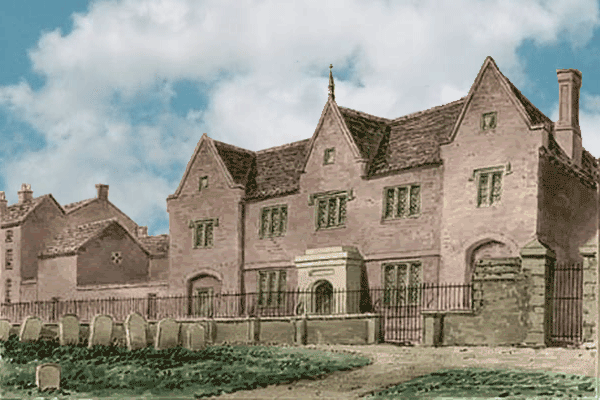
Up to this point we have no knowledge of the school itself, except that, as shown on an earlier page, it is a fair deduction that the building was first opened on 4th September, 1537. Our earliest definite information is from Molyneux, who says that in 1656 there was a house adjoining the school, on land formerly belonging to Burton Abbey, occupied rent-free by the schoolmaster. From other sources, and descriptions of the school as it existed at later dates, we can form a clearer picture.
The original school was a low, one-storeyed brick building. Of its size, we know that sixty scholars represented the limit of its capacity. Whether it contained any furniture we can only guess: it was not inevitable that at that time school- were furnished at all.
Robert Hamonde, who left an endowment for a school at Hampton, Middlesex, directed in his will that his school should consist of “a howse with seates in.” It seems clear, then, that some schools contained no scats; whether the scholars stood all the time, or sat upon the floor, we must decide as we please!.
Leach (in “The Schools of Mediaeval England’) gives illustrations of two illuminated MSS. now in the British Museum. One of them, (British Museum MS. Royal 6 EVI., f.541), depicts an English fourteenth century school in which the master has a scat and a reading desk; three scholars are seated, apparently on the floor; four others are standing. Another, however (Brit. Mus. MS. Burney, 270 f.94, about 1350) depicts a pupil being caned upon the hand during a lesson. In the background of this picture is a long bench. Whether the Burton school was “a howse with seates in,” therefore, we do not know.
The report of the Charity commissioners of 1824 tells that the school premises consisted of a schoolroom with a dwelling-house on one side and a stable on the other, and a small garden, and adds that the premises did not afford suitable accommodation for the master, and that the house was let by him to a poor person. We can draw our own conclusions.
The first school stood in the north-west corner of the churchyard, that is. presumably, the corner where now Friar’s Walk turns towards the present Andressey Bridge, or perhaps opposite to the entrance to Anglesey Passage.
Of subsequent school buildings we will speak later.
15. ALLSOPP, FINNEY, AND ASTLE.
There were some other educational endowments in Burton, which, though not directly bestowed upon the Grammar School have, in the course of history, become directly connected with it and Its present foundation.
At some time in the seventeenth century (according to Shaw, the bequest was reported to the Commissioners in 1784), William Finney, a London tradesman, who was born at Lichfield, gave £110 to the town’s charities. With the money land was bought in Anderstaff Lane: it was called Finney’s Close. The rent from the close was to be used in apprenticing one poor boy yearly. Molyncux reports that the annual value of Finney’s charity in 1702 was £5 10s- Od.; in 1866 it had increased to £208.
Richard Allsopp was a prominent Burton citizen. He and Francis Astle, (to be mentioned later) were among the parishioners who were present at a meeting, described by Underhill, convened to investigate what appears to be a certain inefficiency in the control of the funds with which the new Parish Church (opened in 1723, though not completed for several years afterwards) was being built. He was in fact, appointed a member of the vestry on llth May, 1701, und acted until 1722. He was a leading member of the clothworkers’ gild; in 1709 he was constable of the town, this appointment being at that time the highest civic honour.
Richard Allsopp died on 3rd July. I728 and was buried at Burton Church. His will was dated 26th May, 1728. In it he says:
“Whereas John Spendelow late of Litchfield is indebted to me in several sums of money lent to him and paid for his use for part. Whereof he mortgaged to me a piece of meadow ground in the liberty of Kings Bromley called the Haselere and two little tenements in Stowe Street in Litchfield but the Haselere being engaged by Mortgage to Mrs. Ann Hayley, late of Litchfield for £100 I did at request of the said Spendelow discharged and pay off the executors of the said Mrs. Ann Bayley whereby there Is now by principal interest and other disbursements for his use £230 due to me from the said John Spendelow. And for a further security I had by Spendelow’s order a surrender in the Court at Kings Bromley of a Close called meadow ditch and two acres of arable laud in the liberty of Kings Bromley. Now I do hereby give and bequeath to the poor of Burton for ever for a Charity school all any estate right title or interest in or to all of the lands before mentioned which are or was the said John Spendelow’s and also all my right title or interest in or to the said £230 before mentioned as lent to or disbursed for the use of the said John Spendelow the interest or product thereof to be employed for a Charity school for teaching poore children not exceeding thirty children at a time of the poorest families in Burton. Regard being chiefly had to the children of such parents as are the most constant frequenters of the publique ordinances and it is my Will and desire that the person who shall be employed to teach the said children he of a sober and religious life and conversation and shall teach them the Church Catechisms and endeavour to instruct them in the fundamental of the Christian religion as by law established in the Church of England.”
Allsopp required the appointment of five trustees who, among other things, “shall have power to inspect the Charity schools, and to rectify all disorders and to appoint a person to teach the said Schollard (Scholars?) and upon any misdemeanour either to remove the said person or to withdraw the payment until visible amendment.”
He also made arrangement that if by any chance the value of his endowment should prove to be below £200, that it should be made up to that value from bis other possessions. This however proved not to be necessary.
The in script Ion upon the tablet in the Church commemorating Allsopp reads:
Here lyes Mr. Richard Allsop, of this town, mercer, a person of sound understanding, great industry, inflexible honesty and commendable frugality (for he was frugal, that he might be charitable). Hs was a cheerful companion, a sincere friend and a good Christian. Thus he lived esteemed and dyed lamented by the friends of virtue. July 3rd, 1728. Act. 77. He left by his will proved in the Arches ten pounds per Annum for ever for ye instruction of 30 poor children of the Town in Christian knowledge and ten pounds to the Poor of Hathorn in Leicestershire for ever.
The property at King’s Bromley occupied 11 acres. On the occasion of the Burton enclosure in 1782, this was exchanged for two pieces of land on Horninglow Moor, of area three and a half acres, and one on Goosemoor, of five and a half acres. These were then let at £24 per annum. The value of Allsopp’s charity, according to Underhill, was £8 in 1786, and by 1866 had become £453
In 1735 Francis Astle, whom we have already mentioned, save by feoffment land at Hatton, occupying 3 acres, called the Rush Holme Close The income from this endowment was to clothe “for ever” six poor boys scholars in the school of Bichard Allsopp, with coats, waistcoats, and breeches of grey cloth, together with hats, shoes, and stockings.
16. THREE EIGHTEENTH CENTURY PUPILS.
John Jervis was born in 1731. His famous naval career is common knowledge. He fought in Keppel’s action of 1778. He received the Order of the Bath after seizing the French ship “Pegase” in 1782, and took part, during the same year, in the relief of Gibraltar by Lord Howe. In the course of the war with Prance at the time of the French Revolution, he took possession of the West Indian Islands of Martinique, Guadeloupe, and St. Lucia. In 1797 he ventured as admiral to close in with the Spanish fleet off Cape St. Vincent in spite of tremendous odds. The result was a brilliant victory, in which Nelson participated. In his later years, as Lord St. Vincent, he became First Lord of the Admiralty.
In his memoirs, Jervis says that he was sent to the Grammar School at Burton-on-Trent where he was taught the rudiments of Greek and Latin. He was at first Intended to follow the profession of his father, that of the law, but a change in the family plans led to his being transferred in 1747 to Swindell’s Academy at Greenwich, where he received a training for the sea. He joined the Navy in 1747.
Besides the interesting knowledge that the school can claim so distinguished an officer as Jervis among its past pupils, this chance piece of information gives us a most valuable insight into a period of the school’s history when material is somewhat scanty.
What is important is the knowledge that the school continued to function as a true Grammar School. By this is meant that the subjects of .instruction were still the classics, as opposed to reading, writing, and arithmetic, which constituted the main part of the curriculum in the elementary schools.
In the course of time, a large number of the Schools endowed or established in early times had failed to maintain their status. Some were degraded to elementary status (the free school at Rolleston provides a nearby example): in other cases the school passed out of existence, and its funds survived in the provision of scholarships or exhibitions. Burton Grammar School maintained its status, and though it has passed through troublous times, has never failed to do so.
Another Old Boy, who attended the School under the same Headmaster as Jervis, the Rev. H. Jackson, was Thomas Byard. This information was revealed at a school Speech Day in the time of Mr. R. T. Robinson’s Headmastership, by Mrs. Grafftey Smith, wife of the then Vicar of Newhall, Byard’s great grand – daughter. Byard commanded the ” Foudroyant,” of 98 guns, and for a short time Nelson’s ship. He was knighted in 1793 for his services in Ihe French war. Jackson wrote some verses ” The Glory of Burton.” to be found in a volume called “The Flowers of Scottish Poetry.” One verse runs:
‘Brave Byard. the glory of Burton, was there.
Who like Jervis. his countryman, never knew fear.
The first broadside he gave, the Dutch fleets we all cleared.
For he fought like a tar of Old England. Hurrah.’
The name of another contemporary scholar of Jervis’s is known. He was called Hopkins. From the Rev. J. E. Auden, an old Boy of 1873. of whom Hopkins was an ancestor, we have received this information:
“Hopkins was a son of Mr. Hopkins who built a house at Horninglow (called then Dog Lane Farm, now Donnithorpe) in 1713. The builder’s son was so joyed at the great victory won by his old schoolfellow that he planted round the croft of his farm a long row of poplar trees, the number of them recalling the number of ships sunk, captured, or fatally damaged, of the enemy’s fleet. Some of them still stand at “The Poplars” (a comparatively modern affair built in my life time). I remember how 75 years ago the row of trees was perfect, and all standing upright.”

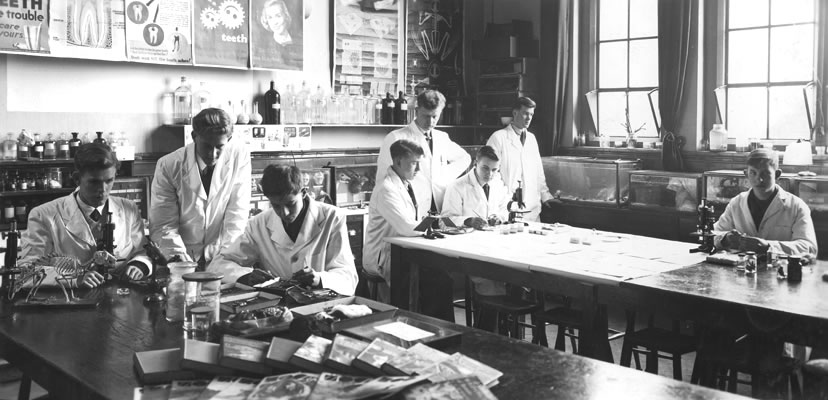
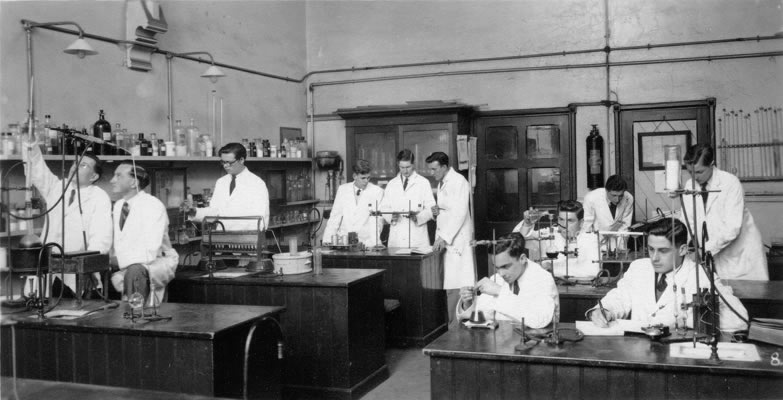
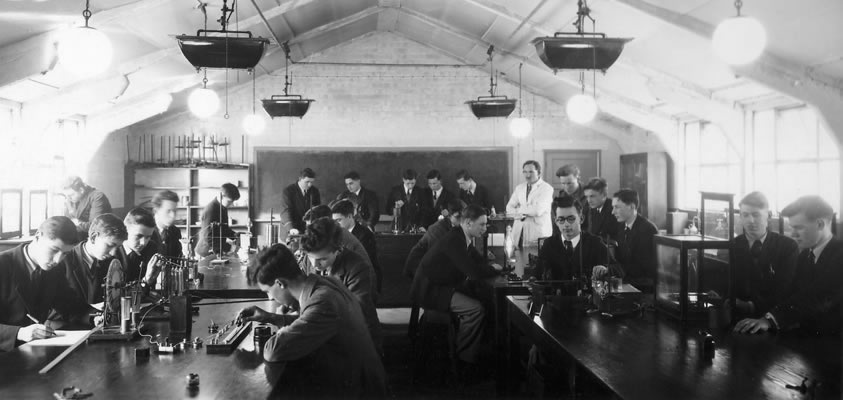
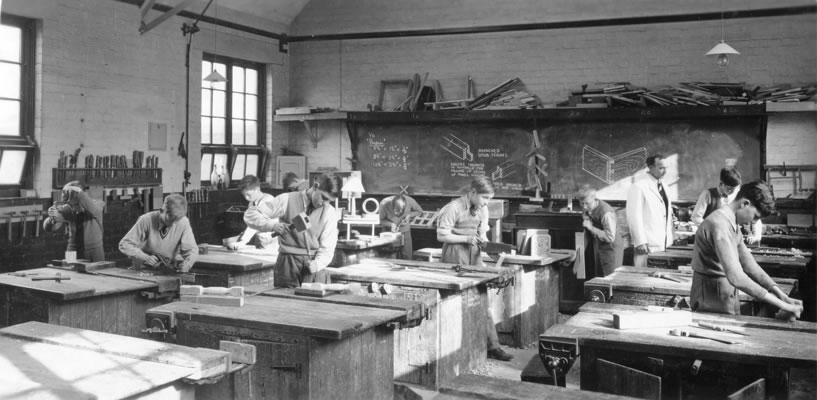
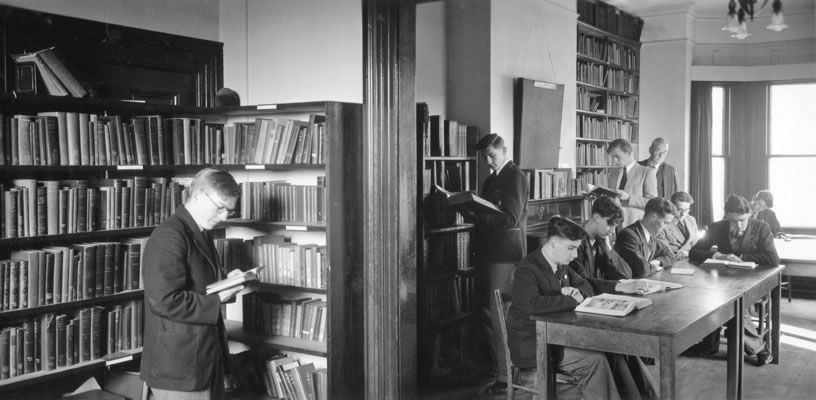
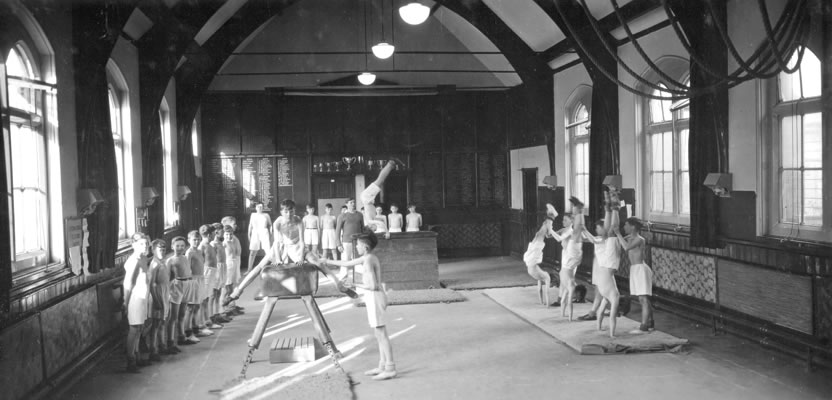
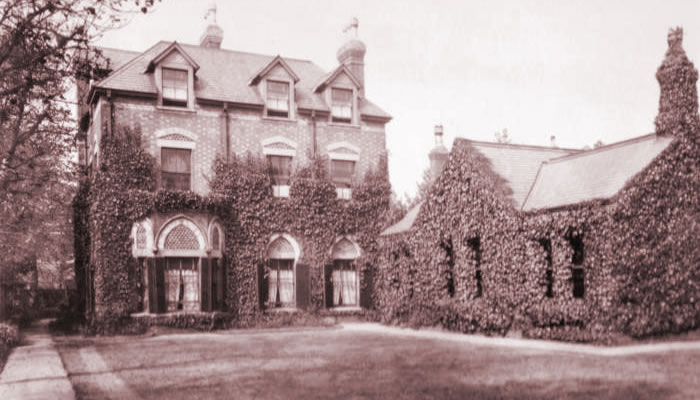
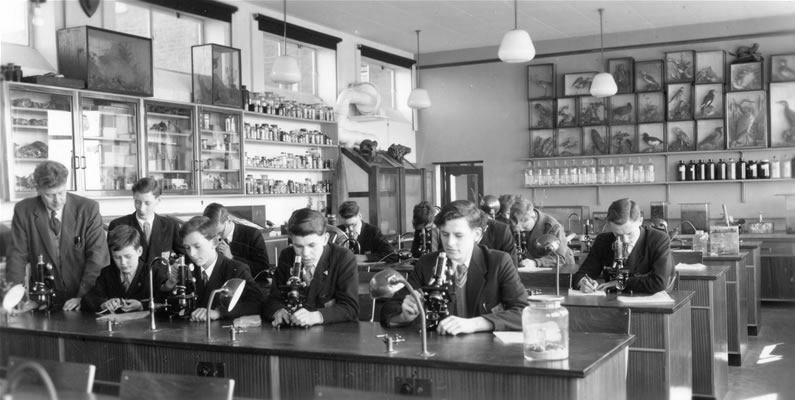
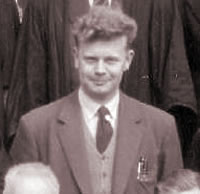 Raymond Crowther was educated at Heath Grammar School in Halifax. He qualified from here for a degree at University College, Durham but, during his time there, war broke out which meant that he was to join the RAF. During the war, he spent most of the time with the coastal command in Iceland. At the end of the war, he made the decision not to go back and complete his degree but rather, to complete teacher training.
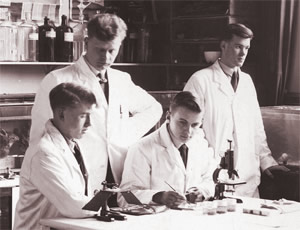 Raymond always had a strong interest in microbiology and in physiology. He had a contact at Birmingham University who supplied a whole range of bacterial cultures which were maintained in the small sanctum off the Biology laboratory at Bond Street. The Grammar School had what would nowadays be considered a quite frightening collection of pathogens. The marine tanks also had an interesting origin. Raymond sourced them from contacts at the Marine Biological Station in Plymouth who supplied carboys of seawater and the specimens of marine life – which were far from easy to keep thriving!
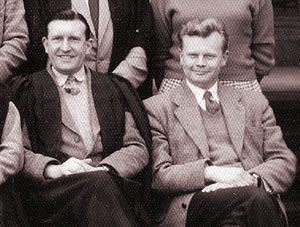 Raymond’s enthusiasm for his subject was considerable. From somewhere he had acquired a dead dog, and decided that the skeleton would be an excellent teaching tool. The problem was, how to get rid of the flesh? The solution was to ‘let nature take its course’ by allowing natural bacteria and flies to do their job! The dog was ensheathed in chicken wire and suspended out of the lab window, more or less above the door into the cloakroom area and opposite the door to the woodwork room.
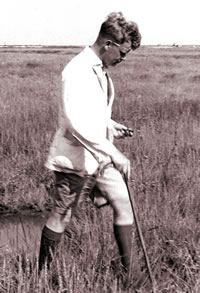 He established the Field Club by popular request and in 1950 took a group to the New Forest, where they camped on the edge of heathland and in sight of the Balmer Lawn Hotel at Brockenhurst. The trip down had been organized ahead in typical Raymond Crowther style, and to students the arrangements just seemed to happen with no regard for the much time and correspondence required by Mr Crowther to ensure that the trip was very successful.

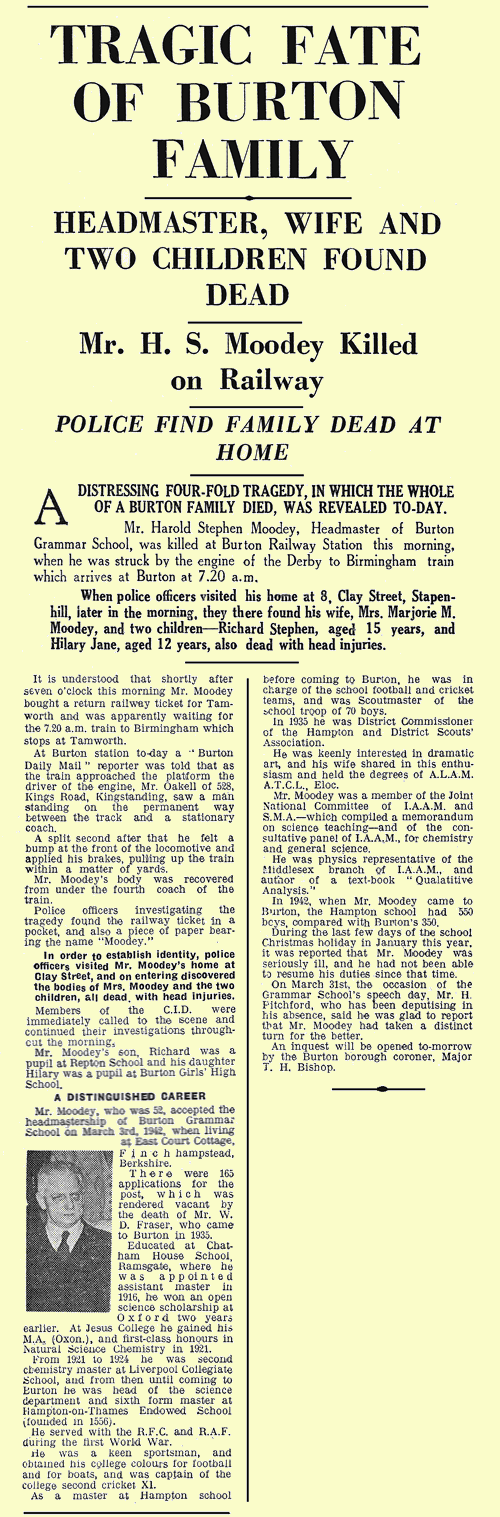 TRAGIC FATE OF BURTON FAMILY
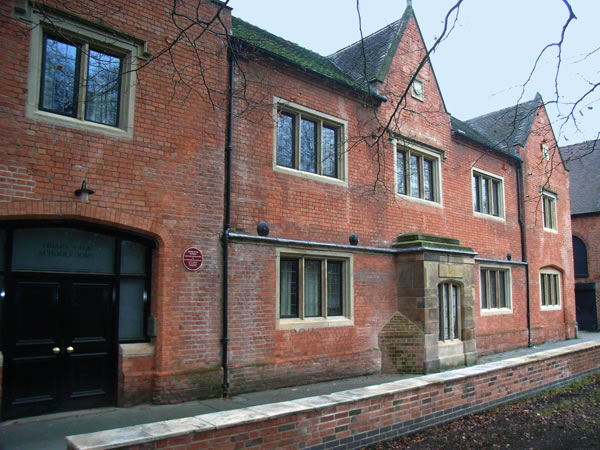
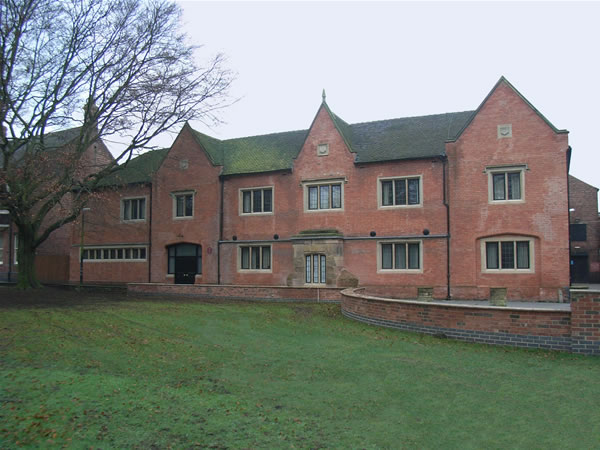
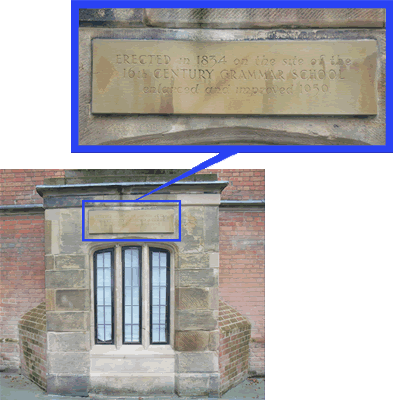
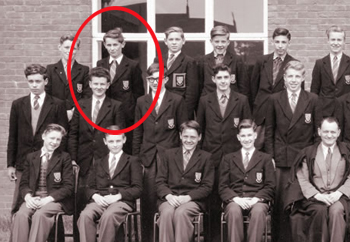 On the face of it there’s never been anything special about Bond Street. Nothing at all, except, that is, for many of us who used to turn up there from Monday to Friday each week, weighed down with bulging satchels wondering what the day held in store. No, not the fashionable shopping paradise situated in London’s West End. This Bond Street was, and still is, the Burton upon Trent version. Stretching from Lichfield Street to the old Ice Storage building it was a thoroughfare far less grandiose than it’s namesake in the capital. Gaze along it these days from a vantage point on the pavement near Peel Croft and you will notice the open ground on the left which is used as a car park. And, like me, you will probably wonder how a school with it’s sprawling collection of outbuildings could possibly have fitted into such a tiny piece of land. But it did, for this is where Burton Grammar School was situated – from 1877 until the new premises in Winshill were opened in 1957.