Menu Close

1946 – First French Exchange

ArrasDuring 1945, with a strong post-war enthusiasm for re-establishing friendly connections in Europe, recently joined Hugh Wood in collaboration with the ‘Alliance Francaise’ formed a branch of ‘Le Cercle Francais’.

The first visiting French lecturer to Burton Grammar School was Professeur Daniel Mornet and, on his return he forged the link with the ‘Union Fraternelle Franco-Britannique’ situated in Arras who were trying to establish exchanges between English and French school pupils.

Their Honorary Secretary, Monsieur F. Rosset, a retired Police Commissioner was a decicated supporter and was to eventually be awarded an MBE for his efforts. The very first Anglo-French exchanges were start that year, 1946, and were to flourish for almost thirty years.

French Exchange

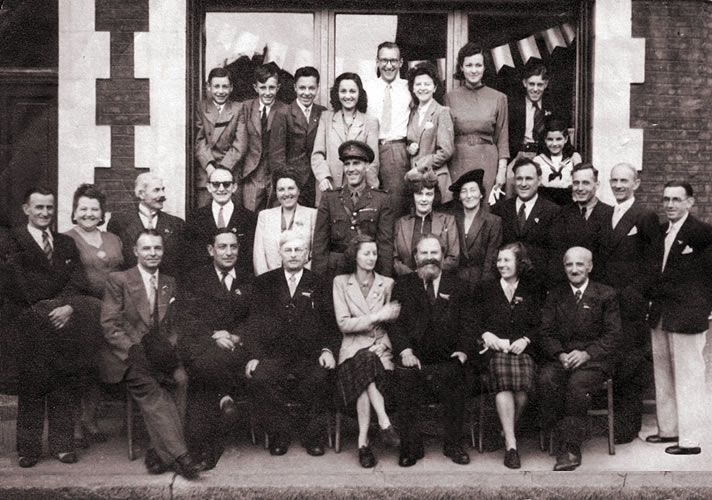
First French Exchange – Ian Pidoux

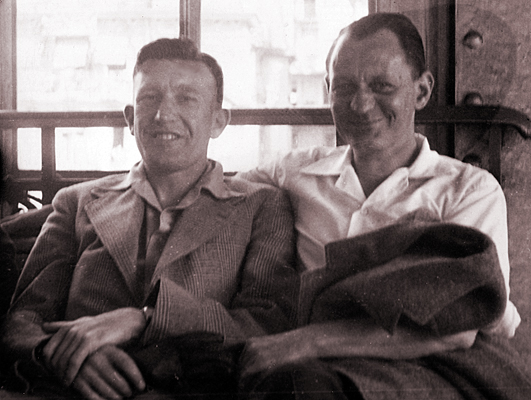
“This picture was taken in Arras, France after the 14th July parade in 1946 during the very first school exchange with that town. Four of us took part and in those days the four of us travelled alone from Burton to Arras!

From the welcome we got at Calais Maritime as we left the ferry I gathered that we were in fact the first British schoolboys to take part in an exchange after World War II but I may have got this wrong. We were certainly among the first. On the window ledge you can see two out of the four of us, myself second from the left and one other extreme right whose name now escapes me but who I know lived in Stretton Post Office at the time. I took part in three more exchanges“.

1949 – French Exchange

French Exchange

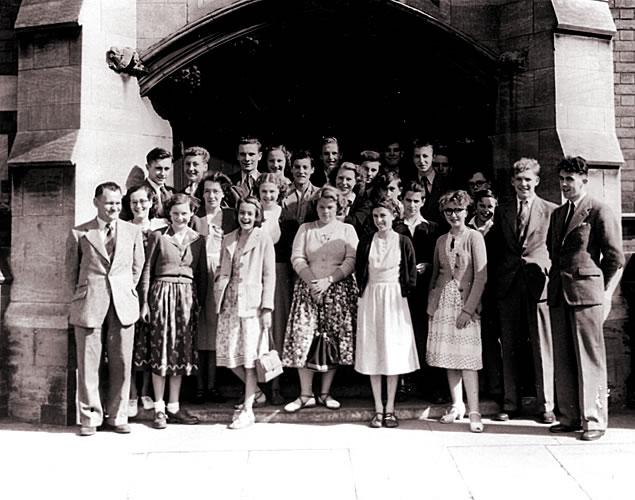
French Exchange – Ian Pidoux

“This picture was taken during the 1949 exchange, the last one in which I took part. By now the numbers were greater and it was a shared expedition with the Girls High School – but we still travelled as a group without accompanying adults.

This photo was not taken in France but on the ‘English’ part of the exchange on the steps of Burton Town Hall after a reception there. Apart from myself (back row left), Mr Ellick Ward (front row left), Harvey Griffiths and Fred Mallett (front row right) I can see the spectacled face of Roy Harrison and one other Grammar School pupil third in from the right on the back row“.

1948 – London Trip


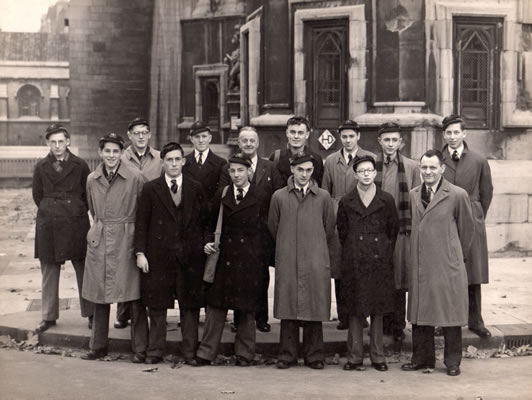
Back Row: Hunter, Julian Appleby, Roy Eden, A.W. Lyne (Burton Labour MP), Larch, Brian Sharrat, Ian Pidoux, Woolley
Front Row: Donald Warden, Carey Hopkinson,  F03, Derek Holford, Guy Smith, Ellick Ward

This was a Sixth Form day trip to London. As well as Ellick Ward, the trip was accompanied by Burton’s first Labour Party MP who can be seen trying to disguise himself as a pupil at the rear.

The MP is A.W. Lyne who won the Staffordshire Burton Division in the 1945 General Election – he defended the seat in the 1950 General Election but was unsuccessful.  Ellick Ward was the chairman of the Burton Labour Party which was part of the reason behind the visit. The picture is taken outside of the Houses of Parliament which was one of the main places visited.

1951 – Bruges (Belgium) Trip

Among those Standing:
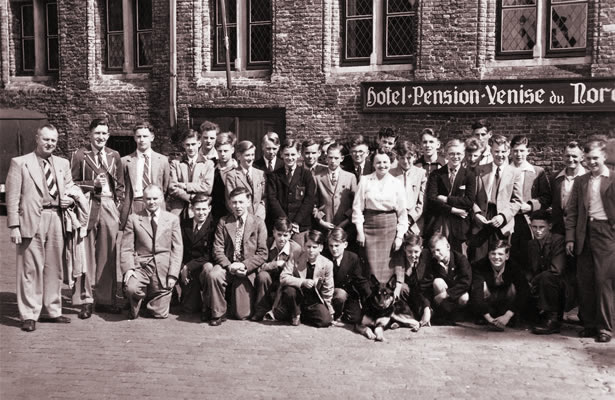
A. Michiels (Proprietor), Norman Jones, Ken Parkin, J. Copley, I. Bloor, D. Batkin,D. Malintosh, E. Ranby, Ward, J. Aston, Chadwick, Tilling, Jones, Rose, Darby, Ellis, D. Hopkinson, Gilbert, Hunter, Woollett, Dawson, Ellick Ward, Wilkinson

Kneeling:
H. Parkes, Wright, Meakin, Owen, Fraser, B. Bourne, ‘Tarzan’ Hall, Smith, T. Pigott, Rawbon

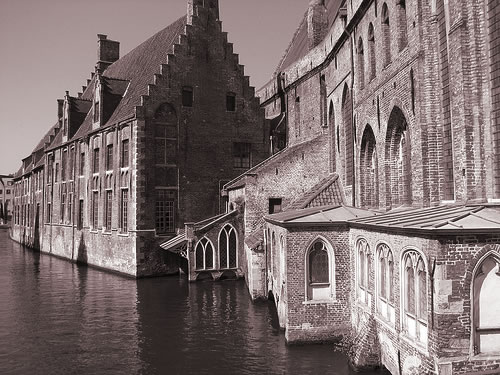
brugge

1957 – Bruges (Belgium) Trip


By 1957, the Bruges trip seems to have found some popularity with school masters; aside from the usual Ellick Ward and Norman Jones, also present are Walter Chadbourne, Raymond Crowther, Hugh Wood and Jake Hammond. I wonder how pleased the pupils were to find such a conspicuous staff presence ?!

Among the pupils are Roy Chamberlain (M02), Robin Langton (M03), David Smart (M04), A. Dytham (M05), Noble (M06), David Berker (M08), Gordon Marjoram (M09), David Brunning (F02), Jack Richards (F08) and Woosnam-Savage (F09)

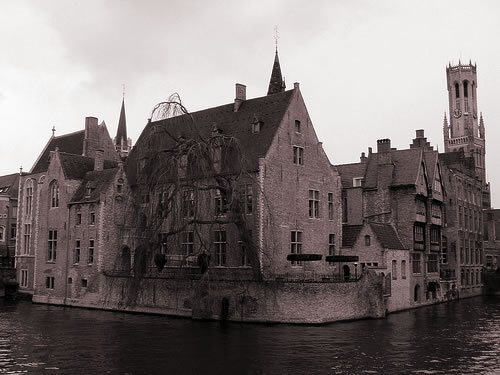
brugge

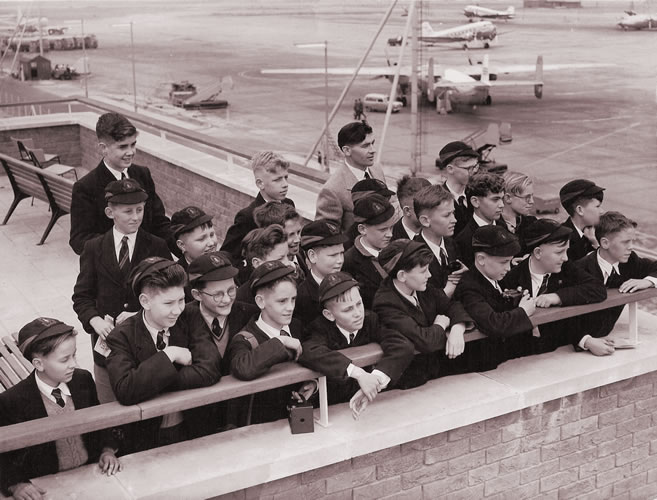
1956 – London Heathrow Airport

heathrow
Front Row: Measham, Sarginson, Elson, Peter Smith, John Monk, Elder, Smith, Clemson, Bloss
Middle Row: Hambling, Murkin, Peter Tripp (half hidden), John Lings (slightly behind), Marshall, Whitewood, David Moore, Andrew Limb, Williams, Chinnery
Back Row: John Hodgson, Bob Ash, Walter Chadbourne (master), B04, Michael Hill (both hidden and slightly forward), Brambley

This was a visit by Class 3B of 1957 to the ‘New’ London Heathrow Airport. The Queen had opened the first permanent terminal building, the Europa Building (now known as Terminal 2), in 1955.

heathrow

John Goodhead: 1959 RAF Church Fenton Cadet Visit

In the 1950s the RAF seemed to be very exciting. The new RAF fighter planes the Supermarine Swift and the Hawker Hunter broke several world records. The new Gloster Javelin all weather fighter had a delta wing and new Air-to-Air missiles. The iconic V-bombers were entering service. The first V-bomber was the Valiant painted in ‘anti-flash’ white. A year later there were the delta winged Avro Vulcans, then a year after that the last of the V-bomber types, the crescent winged Victors. Even RAF Transport Command had a jet transport squadron by the time I joined the Grammar School.

Bomber Command was commissioning a Thor missile squadron and Fighter Command seemed to be swapping fighter planes for Ramjet powered Bloodhound missiles. Then the amazing Lightning interceptor entered service so there was still a chance to be a pilot of the future in the RAF.

With all this in mind a week or two at an RAF camp in the late 1950s and early 60s looked like an exciting prospect for any RAF cadet.

Training Squadrons and Air Experience.
I am sure that most of the RAF personnel do not fly when they are at work, however it was important to get cadets into planes and off the ground. This was called Air Experience. At camps there were two ways to get Air Experience. The first was to be a passenger on a multi engine training flight with free seats in the back. The second was to become a temporary trainee pilot and sit with a pilot instructor, hands-on.


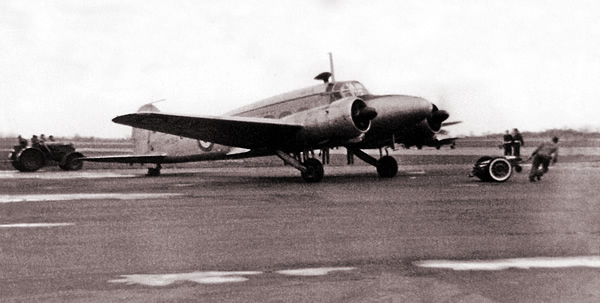
The Avro Anson looked like an old mini airliner. This type had been in service with the RAF since before WW2 and was still the standard twin engine trainer in the 1950s and 60s. They were slow, noisy, often smelling of ‘AvGas’ and exhaust fumes and were nothing like the supersonic RAF of the New Elizabethan Era of the newspaper headlines.

The Avro Anson was the most common provider of our Air Experience probably because there seemed to be one at every camp, more at RAF Shawbury and RAF Swinderby. One time Cadet Under Officer Ian Quayle took over the controls of one and took us all for a spin for an half an hour or so.


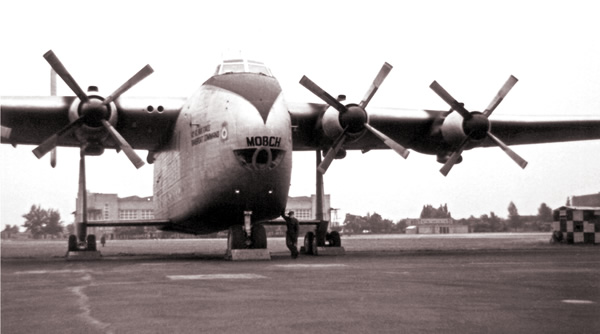
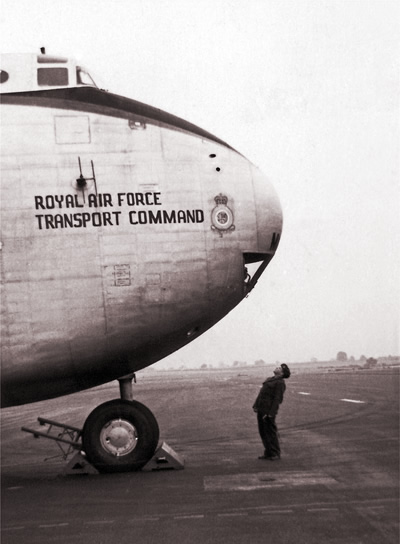
While at camp with Transport Command at RAF Dishforth we had the opportunity to fly in a Blackburn Beverly transport which was quite new, having only been in service since about 1955. At the time of entering service it was the largest aircraft in the RAF, I suppose they were around 3 stories high, they could carry 30 paratroopers in the tail boom and many more in the main cargo hold.

This is why I had my chum in the above shot for scale. There was an opportunity to fly in one of these planes when the crew were training on circuits and bumps. Circuits and bumps involves a plane taking off, flying round and coming in to land, rolling along the runway, powering up and taking off again, then doing it all over again and again. I declined the kind offer. Fortunately there was an option to go on the rifle range.

I had a hands-on opportunity in a De Havilland Chipmunk. This was a tandem seat basic trainer. I remember that it was difficult to walk to and get into the aircraft with my parachute bashing against the back of my legs, below the knee.

I also had a go in a Vampire T11, this fighter trainer had ejector seats. An aircraftwoman fastened me into the parachute which was fastened to the ejector seat. Even my ankles were strapped to the seat to stop my legs from flaying around and getting chopped off in the event of ejecting. Once I was fastened in, the aircraftwoman pulled out the seat’s arming pin and it’s big red disc from the back of the seat (like the pin out of the grenade) then showed it to me and stuck it in a pocket on the side of the seat. Now I knew that the seat was armed and it was safe for the pilot to take off.
Frontline Squadrons.


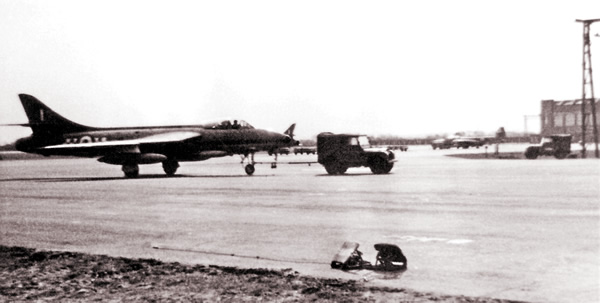
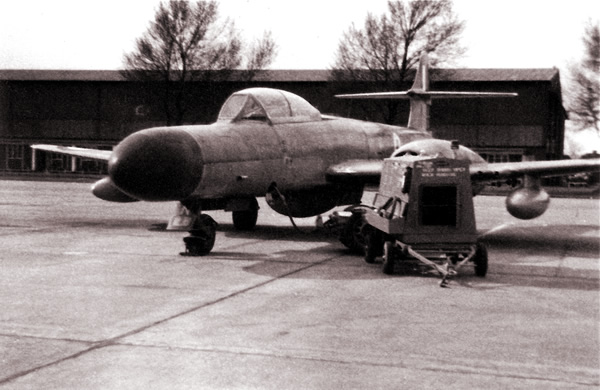
At RAF Church Fenton in 1959 there were two squadrons, one flying Hawker Hunter day fighters and another flying Gloster Meteor NF11 and NF14 night fighters. The Meteors were in the process of being phased out as the new Gloster Javelin night fighters came into service. If we had flown in a Meteor the bail out instructions were as follows; If you should need to leave the aircraft the pilot will let you know. He will tell you that he is releasing the canopy. After he has released the canopy he will tell you to stand. You stand and the airflow will carry you out of the cockpit to safety. So you stand, get hit in the chest by a 500+ mph gale which will thrust you backwards into the tail fin. Some new definition of the term ‘Safety’?

When I discovered the black and white contact prints from which these photographs have been taken I could not believe how very old fashioned the Meteors look. We were not allowed to photograph the Javelin or it’s air to air missiles.

RAF camps and air fields seemed to me to be a bit strange. Vast expanses of flat ground, buildings sparse and most of the time there seemed to be no one around. Great times, did a lot of shooting and learned a lot. However the RAF was a lot sexier in the newspapers.

1958 – School Choir


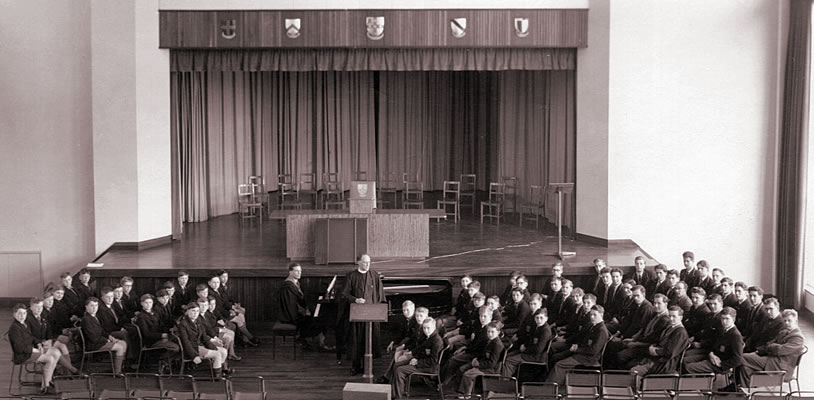
Most conspicuous in this 1958 photo are, Ron Illingworth on the piano and Reverend Paul Appleton as choirmaster.

Right Row (from front): Raymond ‘Joey’ Crowther, Lewis ‘Chippy’ Heath, Peter Evanson, R1-4 , David Berker, Peter Jennings, Rodney Hardwick, Alan Whittaker
Second Right: Noble, Colin Mason, R2-3, ‘Taff’ Davies, Bob Knight, Brian Bradbury, Bert Copestake
Third Right: Hugh Wood, P. Boulder, R. Llewellyn, Anthony Hughes, Maurice Kersey, Alan Cloves, R3-7
Fourth Right: R4-1, R4-2, ‘Polly’ Lownds, R4-4, R4-5, R4-6

(The scratch, painstakingly removed as part of the restore, was re-introduced after I realised that it was a cable to the large on-stage speaker!).

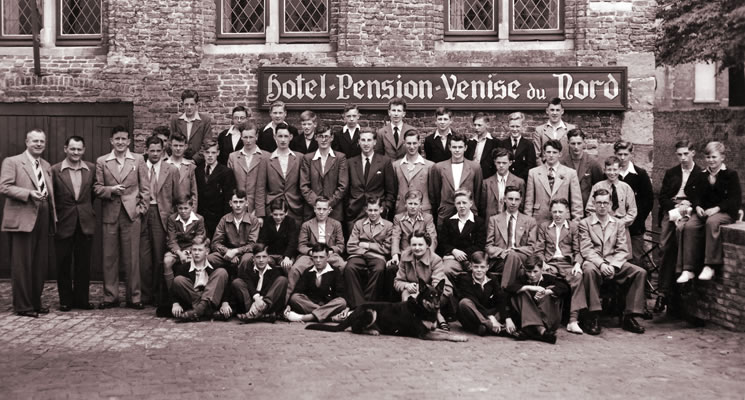
1952 – Bruges (Belgium) Trip


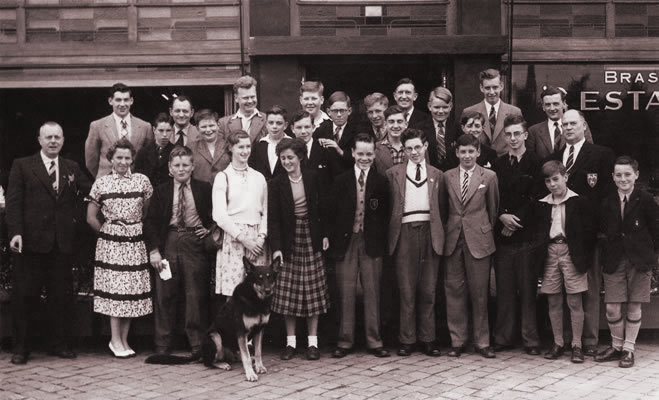
Back Row: Michael Darby, George Kay, Keith Miller, Ken Mellor, Dennis King, Alun Thomas, Roger Kerry, B08, Norman Harvey, Gary Farmer
Standing: A. Michiels (Proprietor), Ellick Ward, Norman Jones, Langstone, Joe Bailey, M06, M07, Kirk, A.E. Prevett, M10, John Hancock, M12, M13, M14, Iain Cotton, G.R. Prevett, ‘Squeaker’ Alliss, David Green, M19, Glyn Hall
Seated on Bench: Tom Parker, Dave Hobby, Dave Orme, Tony Docksey, F05, F06, F07, F08, Tony McGlynn, F10
Seated on Floor: FL01, Brian Bradbury, Bob Fletcher, Proprietress of the hotel with her dog,  Chris Goddard, John Adams.
car

An account by Bob Fletcher (seated on floor third from left)…

The school trip to Bruges in Belgium was an annual event during the time I attended the Grammar School. Please forgive my lapses in memory but it is over 50 years ago after all when I went – 1952 I believe, when I was 12 and in form 2A. One received an invitation at the beginning of the school year, I believe, and places were allocated on a first come first served basis as far as I remember. The trip took place in the summer, but I can’t remember whether it was during term time or during the summer vacation – I’m sure someone who went on one of the trips will answer that question.

On departure day we met up at Burton railway station, presumably in the morning, carrying our suitcases (or, more likely with the younger ones like myself, the suitcase being carried by a parent) shoes polished, hair combed and probably new clothes bought specially for the trip. We boarded a train to London, presumably changing at Derby. Once in London we travelled on the underground to Charing Cross station (or was it Waterloo?), where we boarded the train for Dover. At Dover we boarded the ferryboat to Ostend and I remember that the sea was very rough, so most of us spent the trip below decks feeling decidedly queasy. No doubt a few were actually seasick. I don’t recall very much else about the sea trip and can’t remember how long it took. At Ostend we boarded a train to Bruges; again I don’t remember much about it or how we got from the station to the hotel. I remember thinking that the railway engines looked different to the ones in England. At the hotel we were allocated rooms but I don’t remember how many to a room or who I shared with.

Whilst in Bruges we went on a trip to Walcheren Island which I think is just over the border in Holland. I took with me on the trip an old Brownie box camera which I left on a stall in the market place whilst making a purchase of some sort of souvenir, so I ended up with no souvenir photographs to show people back home. I don’t recall any other organised trips but I do remember having lots of free time to look around Bruges, which I remember as a quaint town (city?) with its canals and ladies in the streets spinning lace garments. A few of us made friends with a Belgian boy of around our age and he showed us around lots of places including the beautiful cathedral. He even took us to meet his parents. Some of us, despite our age, were smokers and purchased Belgian cigarettes, because they were cheaper than English ones, but the Belgian lad thought we were mad, as he only smoked English ones because of their superior quality.

One day a group of us were smoking in my bedroom, which was at the end of a corridor, when someone heard “Ernie” Ward at the other end of the corridor. The others quickly left to go to their own rooms leaving me to face him alone. I quickly swilled my face and rinsed my mouth out just before “Ernie” entered, sniffed and said “Has someone been smoking in here?” to which I replied “No sir, there’s only me in here, it must be coming in through the window.” Fortunately for me he did not question that stupid remark, but turned round and walked away.

Although my memory of the trip has been dulled by advancing years, I know that I thoroughly enjoyed my first trip abroad as did everyone else who went. It was interesting to find out that although we had a slight understanding of the French language, (but not Flemish which was spoken by many Belgians), most of the Belgian people we came across spoke very good English. I remember a group of us once getting slightly lost and asking, in schoolboy French, an old lady for directions back to the hotel. She started to reply in very fast French, which we could not understand, but once we explained that we were English she gave us the directions in perfect English.

Although it was 1952, there was still a great deal of rationing in England, seemingly more so than in Belgium, for I remember purchasing a bag of sugar to take home for my mum, who was very pleased to receive it. I was very grateful to my parents for giving me the opportunity to travel abroad, something which they themselves had never done at that time.

My final recollection of the trip is that carrying a suitcase around left me with a blister on the middle finger of my left hand. A few days after returning from the trip I was on my travels again to attend a cadet camp in South Wales. Whilst there, the blister on my finger turned septic and I ended up in the camp hospital where they lanced the finger to remove the poison within the wound. At least I did not have to get up early every morning and go on exercises with the rest of the lads, but spent several days lying or sitting around getting pampered by the orderlies because of my young age.

Because of the time spent in hospital I was unable to finish smoking the packet of cigarettes which I had in my army shirt pocket. I forgot to take them out of the pocket when I got home and next morning was horrified to find that my mum had removed the shirt from my bedroom and had washed it. When she subsequently started ironing it she discovered a mangled pack of cigarettes in the pocket. I don’t remember what punishment I received for that, but believe it was tempered by the fact that I had been in hospital.