Menu Close

1950 trip to the New Forest

In 1950, Raymond Crowther (Biology) took the Field Club on a camping trip to Brockenhurst in the New Forest. The trip also included the Isle of Wight


Camp, complete with camp fire, was established in the shade of a huge old oak tree near the Balmer Lawn Hotel, Brockenhurst. At far left of the picture is George Moore; the next two people are unidentified. Raymond Crowther is standing in the roped-off area and Ian Scott is seated on the ground.

The photo was taken by Mick Tanton from the position of a large fallen tree trunk that provided a convenient seating area for meals!


John Thompson chopping wood for the fire.

Co-incidentally, Mick Tanton met John again in the early 1960s when working at the Nature Conservancy’s Monks Wood Experimental Station between Huntingdon and Peterborough. John was the Warden for the area and lived on a cottage adjacent to the Research Station.


A.C. ‘Charles’ Neville in pursuit of a butterfly near camp. Both he and Mick Tanton and some of the others in the group went on to Imperial College London to study Zoology and Applied Entomology and after a Doctorate pursued successful research in insect cuticle and flight. He joined the staff of Bristol University as Mick Tanton emigrated to Australia.


Brian Hill (left) and AC. ‘Charles’ Neville ready for a butterfly-hunting sortie. 1950 was a very hot summer and butterflies abounded in the New Forest, and as several of the group were keen entomologists, they were often our on forays.


Similarly in this Photo, with Mick Tanton in the centre and Charles Neville at left.


On one of the days of the two week camp Raymond Crowther took the party to the Isle of Wight. This is a trip that you could not do in the same fashion today, as they caught the train from Brockenhurst to Lymington, a line long since closed. Then it was ferry across the Solent to Cowes.

Mick Tanton cannot recall how the group got to Alum Bay at the western end of the island, but it may have been by train to Freshwater – the line was certainly in use then.

They walked across the downs and Mick remembers the myriads of Chalkhill Blue butterflies on the chalk grassland.

The group used Alum Bay for swimming, while Mr Crowther relaxed on the gravel beach.


Raymond Crowther walking along the beach. Unfortunately a blurred photo because of his and my movement, but it does show his typical field garb of the time, and the shadow cast on his shoulder by his inseperable pipe is clearly visible!

1951 trip to the Lake District

In 1951, Raymond Crowther (Biology) took a group to the Lake District


M. Wilkins, solo abseiling on a cliff face almost opposite the campsite near Watendlath Tarn
He was an experienced rock climber, but the group was very impressed by his display.


Raymond Crowther took the group on several long hikes across country during our stay in the Lake District. The cool and wet conditions we experienced throughout the three weeks meant that his usual linen summer jacket did not appear, but was replaced with the top from his old RAF tunic.

He is seen here paused to recharge his pipe from the ever-present tin of Mick McQuaid tobacco.


The Mick McQuaid tins served a variety of uses as well as for carrying tobacco, as a holder for botanical, zoological or geological specimens and, as here, the lid was handy for scooping up a drink of water.

1953 trip to Flatford Mill Centre

In 1953, Raymond Crowther (Biology) took the Field Club to the Flatford Mill Field Centre near Colchester, Essex, for an Estuarine Biology course. Mick Tanton, now living in Australia, supplied the photographs and accounts.

Crowther

The above photograph shows a collected sample being examined for aquatic life. Lying on the ground is John Jones under the watchful eye of Alan Bull, who went on I think to be a Professor at Birmingham University. The two girls from a North London school tended to join the group, which was always very lively. They are Dilys Povah, and beyond Nancy ? standing in the water is David Hopkinson together with Mick Cornes with his back to the camera, and sitting on the bank in the distance, pipe in mouth, is Raymond Crowther, in front of him is Michael Cooke who is difficult to discern but identified by himself over fifty-six years later! The pupil furthest from the camera is Brian Hill.

Crowther
Alan Bull seated and recording data with Dilys Povah identifying material. Nancy ? is sampling water beyond.


Burton Grammar pupils worked in different groups which included pupils from other schools.
In this photo from left to right is Nancy ?, Dilys Povah, and then three BGS pupils, Alan Bull, (unknown) and A.C. ‘Charles’ Neville.


Samples were washed through in a sieve, and in this photo A.C. ‘Charles’ Neville is sorting through and identifying material.


Finally, Raymond Crowther, back in usual summer garb and inevitable pipe in mouth, inspecting salt-marsh plants at close quarters.

1952 – Montreux, Switzerland

In 1952, Norman Jones and Ellick Ward accompanied a group to Montreux in Switzerland. The entire group can be seen here up in the mountains. It is not clear who the two girls are and how they come to be there.

Back Row: Malcolm Griffin, Robin Shorthose, Jones, McGlynn, Ellick Ward, B06, G.A. Smith, Brian (Sam) Staley, John Hancock, Mick Jordan, Maurice Bucket, Sinclair, G. Shaw, Rose (and the two ladies in totally the wrong footwear!)
Front Row: Norman Jones, Gerard Evans, Barry Bourne, Iain Cotton, Godfrey Cooper, G. Moore, Michael Fraser, Gary Acres. 

One of Robin Shorthose’s clearest memories of the trip was when a group of them went into a cinema that was showing, what was considered at the time to be a ‘risque’ film. In the foyer, fearing that it might be expensive, Gerard Evans braved to try out his french on an usherette with “Combien?”

This surprised her and caused quite a lot of amusement to the group. They still did not know how much tickets were until they got to the box office still feeling slightly nervous.

They went for a row on the lake where the Chateau de Chillon remains to this day, one of the most unchanged picturesque sights. On this occasion, having seen plenty of snow on the trip, they under-estimated the strength of the sun and many of them ended up with bad sunburn.

The other memory strongly recalled was that many of the Montreux citizens still walked around carrying rifles despite the war having ended some seven years earlier.

C.C.F. Royal Centenary Parade, 1960

Remembered by T.H. Quayle L.VISc.

Two cadets, one from each section of the School C.C.F., were invited to attend the Cadet Royal Centenary Parade on the 22nd July, 1960. Corpral Price from the army section, and myself from the R.A.F. section, were the lucky ones.

We arrived, after an uneventful journey, at Woolwich Arsenal. We were immediately taken into a small room and our particulars were taken by several officers. I was handed a piece of paper with the mysterious formula “Con-naught, Room 38” scrawled on it. This, I assumed, was my barrack block and room number. I was right ! I was separated from Cpl. Price, being an R.A.F. cadet, and taken to my room. Whilst I was settling in cadets from all over the country, from the Isle of Wight to Glasgow and from Bristol to London arrived one by one.

At about five o’clock we were told that it was time to go for tea, which was had in a Cookhouse about a quarter of a mile from our barracks. After tea we went to see a film show in the camp cinema.

The next morning we were allowed a lie in, and then, after breakfast, we were inspected by an R.A.F.V.R. officer, who told us that there would be two rehearsals, one in the afternoon and the other after tea.

The afternoon parade rehearsal was quite tiring because of the long waits while the organising officers discussed various points about the parade, and also whilst an officer directed us from a loudspeaker van. An army and a navy officer played the part of the Queen and Prince Philip in the rehearsals ; it was quite touching to see the short navy officer gallantly-helping the tall thin army man from the Land-Rover.

In the evening the barrack was a hive of activity. Never before had so many belts received such generous layers of bianco and boots so much “spit and polish.” Most people were in bed by nine-thirty as everyone knew that we should have to be up early for the great day.

After breakfast, all wearing our “best bib and tucker”, and knowing that we would not return to our barracks again, we packed our luggage and ourselves into our respective coaches and set off for Wellington Barracks. On the way we were put at our ease by the strains of “Housewives’ Choice” coming from the coach radio and also by chewing the barley sugars that we had been given. Arriving at Wellington Barracks we immediately fell in, and after a short pause marched off to Buckingham Palace to the accompaniment of the Band of the Junior Wing H.M. Royal Marines.

We entered the Palace through the back way, the highly-mysterious “Electricians’ Gate.” We had to wait about a quarter of an hour for the Queen to appear with Prince Phillip, and as she did so we were ordered to attention and then saluted. The Queen then inspected us, going round on a Land-Rover. When Her Majesty returned to the dais we were again called to attention while General Sir Oliver Leese presented the C.C.F. Commemoration Book. Three hearty cheers were given and then the banners moved forward to their positions near the Terrace Steps. Then we all took part in a march past the Queen to music appropriate to whichever section was passing the dais. We marched out of the main Palace gates and back to Wellington Barracks, where we had a packed lunch.

After lunch we marched to Westminster Abbey for a service, and then back to the barracks for tea. When tea was over we boarded buses for our respective stations.

At St. Pancras station I rejoined Cpl. Price and we entered our reserved compartment back to Burton. On the way we noticed several people reading newspaper articles of the parade of the “Soldiers who never go to war.”

Beethoven Night (Leicester) – School Trip

As remembered by A.J. Williams, U.VISc

On November 1st, 1960, members of the Music Club accompanied by several members of staff visited the De Montfort Hall, Leicester, to hear a Beethoven Concert given by the Royal Philharmonic Orchestra conducted by Royalton Kisch.

The following works were played : Overture to “Egmont” ; Symphony No. 7 in A major ; Symphony No. 3 in E flat major (Eroica).

“Egmont” is a play by the German poet and philosopher Goethe, to which Beethoven composed incidental music. It tells the story of the struggle for freedom of the Dutch people against their Spanish oppressors. In gaining their liberty, however, the hero Egmont is killed.

All his life Beethoven was obsessed with this theme — the right of humanity to freedom and liberty, and it is to be found in many of his large scale works, notably the 3rd and 5th Symphonies. The overture is programmatic in design — the sombre opening bars which lead to a tense and agitated section portray the oppression of the Dutch and their struggle for freedom.

The final section depicts the death of Egmont in the battle, but liberty is gained and the overture ends on a triumphant note.

The Eroica symphony is closely allied in mood to the Egmont overture, but the issues involved are bigger and more universal. One can, I think, dispense with the many “programmes” that have been hoisted on to its shoulders, for the music speaks for itself. Suffice to say that in composing this gigantic symphony Beethoven opened the door to a completely new world of symphonic thought and expression. The movements are all longer, more complex in design, and structure and express more profound and lofty emotions than had hitherto been heard.

The first movement is intensely heroic and noble, and the second is a profoundly tragic funeral march. For the third movement Beethoven writes one of his “daemonic” scherzi. full of rough, buffeting good spirits and impulsive energy. The trio, with its wonderful parts for the horns, is more serene.

For the finale Beethoven wrote a series of variations, enclosing a fugue, on a theme from his “Prometheus” ballet, and the symphony is rounded off in the most noble manner.

The seventh symphony is characterised in all of its movements by a constant rhythmical drive, and of all Beethoven’s works it is the most vitally alive in its super-abundance of pure creative energy. The first movement is prefaced by a long introduction which sets a note of grandeur on the whole work. It leads into the vivace with its impulsive rhythms and brilliant orchestral colouring. The second movement in A minor is in no way tragic as is its counterpart in the Eroica, but moves thoughtfully and seriously forward under its rhythmic pulse. The scherzo is full of Beethovenish fun and high spirits, and after the trio, an Austrian pilgrims’ hymn, has been heard twice, threatens to repeat it yet a third time before it is rudely cut short — a typical Beethoven joke. The finale is supposed to have had its origins in a Cossack folk tune, but whatever the origins the energy and drive are terrific and one is borne forward on the crest of a continuous wave of sound to be precipitated headlong in the closing bars.

The orchestra, with the exception of the second trumpet, who seemed to be having an off night, played superbly throughout, handled with extreme precision by Royalton Kisch. His tempi were finely judged on the whole, although the first movement of the seventh symphony seemed a little lax, and the trios of the third movement would have been more impressive if taken a little more slowly. On the whole it was a most successful night.

1953 – Bruges (Belgium) Trip


Back Row: B01, B02, Robert Taylor, Bernard Capes, Colin Colson, B06, B07, David Green, B09, Richard Wedd, John Allcock, Peter Manlove
Front Row: F01, Ellick Ward, Alan Archer, David Bunting, Mick Tracey, Rod Purbrick, F07, Norman Odam, Jonathon Underhill, M Savage, F11, Gordon Gretton, Insley, Alan Cloves, Norman Roe, M Curran, Proprietor, Norman Jones

A closer look…

1950-53 Biology Field Trips

Biology field trips remembered – Michael Tanton (1946-54)

Raymond Crowther, the biology teacher at the time, established the Burton Grammar School Field Club to some enthusiasm in 1950. In its first year, Mr Crowther took a group from the club, that included me, to the New Forest, where we camped on the edge of heathland and in sight of the Balmer Lawn Hotel at Brockenhurst. The trip had been organized ahead in typical Raymond Crowther style, and to us the arrangements just seemed to happen – I doubt that we appreciated at the time the amount of slow correspondence required in those days to make such trips successful.

All the camping gear was manhandled by us to the guard’s compartment on the train from Burton to London, then from the train down into the Underground station where we were expected by the station staff. The train on the Underground was held while we loaded everything into one of the carriages for the journey to Waterloo Station where the staff again held up the Underground train for the similarly tedious job of off-loading it all again. It then had to be manhandled again onto the Southern Region train, and then off again at Brockenhurst. After some delay, Mr Crowther was able to find his contact at Brockenhurst, who turned up with a lorry to take us and all our gear to the camp site.

The summer of 1950 was very hot, so we had a wonderful two weeks in the New Forest, with many long hikes and a trip across the Solent to the Isle of Wight.
Crowther

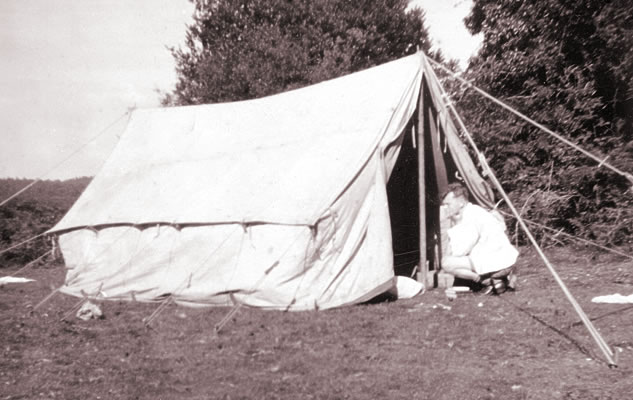
The above photograph shows Raymond Crowther crouched in front of the tent I shared with several others at the edge of the heath near the Balmer Lawn Hotel.

Mr Crowther of course had his own tent, for the rest of us, it was two or three pupils to each tent. They were former army tents which were made of heavy canvas with wooden poles and took quite a lot of effort to erect compared to modern tents! No sewn-in floor of course, and we had to dig a channel all round to lead water away from the tent if it happened to rain (it didn’t – it was a very hot summer!). We had to braille the sides up each morning to air inside, and dig hip holes and fill with bracken from the scrub behind our tent. Sleeping on the ground was then reasonably comfortable. The camping and cooking gear Raymond had managed to borrow from Byrkley Scout Group – but that is almost another story in itself.

The following year, 1951, the Field Club went to the Lake District and camped for three weeks near Watendlath Tarn, again by train and with much man-handling of our gear. My main memory of that trip is of day after day of rain, with damp clothing and bedding that we were assured would be fine once it had been warmed up with body heat!

On several occasions a number of the group walked into Keswick, and at that time one could walk all the way along the middle of road and never encounter a car on the round trip – just the occasional bicycle! In those days the local dialect was very broad, and we found it quite difficult to follow what the locals were saying. On my last trip there, in 2003 with my wife, I found things were very different – cars everywhere, and little evidence of the broad dialect I’d encountered over 50 years ago.
CrowtherIn 1952 and 1953 Raymond found a different venue for the Field Club – Flatford Mill Field Centre. We went to different courses in the two years, the first on freshwater biology, and the next year on estuarine biology. They were a valuable learning experience and we were able to make the most of the good weather in both summers. Best of all, we didn’t need to transport all that camping gear of previous years!

In those days the train trip itself was an experience – first of all from Burton to Leicester on the Leicester Line, then change at Leicester for Kettering, change again at Kettering for the cross-country trip to Cambridge, change at Cambridge for Ipswich, then yet another train to Manningtree where we were met by transport from the Field Station. Many of the railway lines we travelled on for those trips fell to the Beeching axe of the 1960s. Our group, including me, Alan Bull, John Jones, Tony (‘Charles’) Neville, Gordon Pritchard nearly all finished up continuing in one area or another of biology.

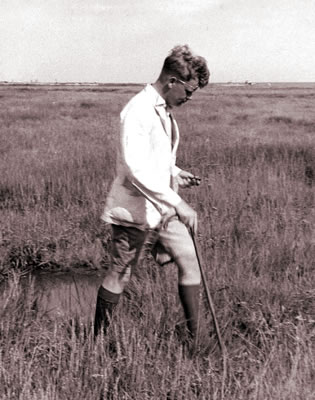
The photograph shows Raymond Crowther walking across a salt marsh near Flatford. This was his characteristic summer garb – brown shoes, khaki shorts and white safari jacket. When we were in the cooler, wetter conditions in the Lake District in 1951 the white coat was replaced by his old RAF tunic top. On these expeditions, he always had his walking stick, his pipe, a tin of Mick McQuaid tobacco, and a hand lens with him.

I used the box camera through to the Flatford Mill Freshwater Biology Course in 1952, but then an uncle gave me an old Zeiss Baby Ikonta camera with a Tessar lens and speeds of 1/25, 1/50 and 1/75th of a second. I used that for the Estuarine Biology course at Flatford Mill in 1953. Another uncle had given me a lens for enlarging – a fairly simple lens, mounted in a tube made of gummed brown paper – he had made it for some device he had been constructing, but had found a better lens.

I pulled out my old Meccano set, acquired an empty National Dried Milk tin as a light box and with balsa wood and two sheets of glass and constructed myself and enlarger. My uncles would have made Heath Robertson look like and amateur, and I’m glad to say some of the Heath Robinson aura seems to have shone on me too. So the attached photos of Flatford were enlarged and developed in my bedroom, and washed in the bathroom sink and glazed on the bedroom window!

1960 Geography Field Trip

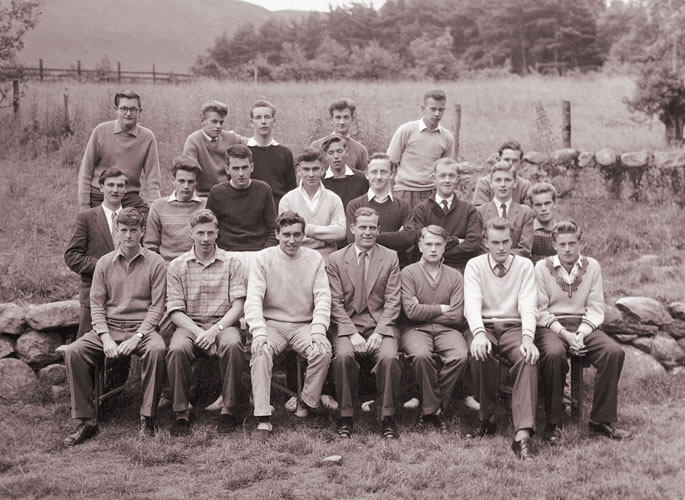
During the 1950s, a number of Grammar School subjects introduced field trips. This photo was taken during July 1960 when R.G. Haywood and Ron Illingworth escorted a party of 20 pupils to the Lake District.

Illingworth
Back Row: M. Elson, G. Garner, Bennett, R. Bluff, Atkin
Middle Row: M01, M. Haynes, Thomas, Peter Jordan, Payne, Smith, M07, David Brunning, M09 (obscured), Stirton
Front Row: P. Hill, P. Gardener, R.G. Haywood, Ron Illingworth, J. Diggens, Taylor, M. Whitewood

The party of boys left Burton on Friday, 15th July for a week’s geographical work in the Lake District under the supervision of Mr. Illingworth and Mr. Haywood. The journey used Stevenson’s Coach and the route taken took them through Preston and Lancaster (being of course, before the availability of the M6 motorway) and through the Lakes to their final destination of Newlands, three miles south-west of Keswick, on the western shore of Lake Derwentwater. Finally arriving at Newlands Hostel around five o’clock, the first thing to do was to unpack everything and have dinner.

Saturday, the first full day, was taken up with a ridge-walk along Causey Pike to the village of Buttermere. The Cumbrian coast and Southern Uplands of Scotland were just visible on parts of the walk. Due to the dangerously steep descent and the time factor, a visit to the actual Buttermere village was abandoned, favouring the less steep descent of Whiteless Pass to the Valley of Soul Beck and following the ‘Becks’ back to Newlands.

Sunday saw the party in the lovely countryside of Watendleth and Borrowdale. The Loclere Falls was the starting point after a boat trip across Lake Derwentwater. The first stop was Watendleth Valley where the local shop did good trade in chocolate, postcards and stamps. From here, the walk took them through Borrowdale to the small village of Grange.

On Monday, the party was taken on an ‘Urban Morphology’. The two towns of Keswick and Cockermouth had been chosen and the party split into two groups with a master going to each town to supervise their studies. Back at the Hostel in the evening, the various findings were recorded. The next day, reports on the work was presented by Mr. Haywood.

Tuesday saw the first bad weather. The planned route for the day was along the Cat Bells Ridge to Dale Head Tarn but half way along the ridge, thick dark clouds came down with the start of some rain so the party returned to the Hostel, finding the best possible shelter on the way arriving back some time before dinner time.
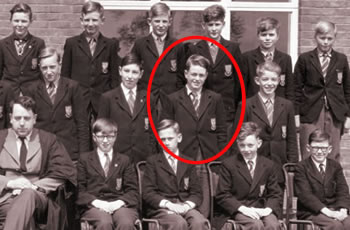
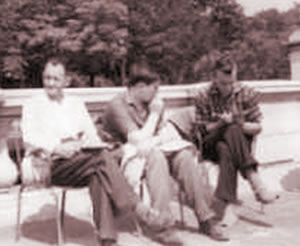
Farm studies were the task for Wednesday. The party was this time divided into three groups with a nominated leader in each. The three areas surveyed were Borrowdale Valley, Bassenthwaite Lake, east-side and Bassenthwaite Lake, west-side. During the course of the day, Mr. Illingworth and Mr. Haywood visited all three groups and after dinner back at the Hostel, the group leaders gave their report.

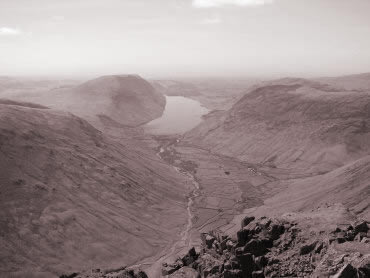
The last full day, Thursday, was spent climbing the Great Gable. The party was taken by bus to Thornywaite. From here, they walked through the village of Seathwaite and, in what became fairly heavy rain, they proceeded to the summit (2,949 ft.). Despite the light veil of cloud, the view was thought well worth the effort ( pictured ).

Friday morning was spent packing before the Stevenson’s Coach arrived for the return journey.

1960 – Luxembourg Trip

An Account by P. Cartwright:

The party, which was led by Mr Ellick (Ernie) Ward the French teacher, consisted of boys from the Senior section of the school and one boy from the Technical High School; there were eighteen of us altogether.

Our coach to take us to London left from Burton Town Hall at 4:45am on the Thursday morning after we had broken up for the summer holidays. The 10:00am boat train from London’s Victoria Station took us to Dover where we caught the 11:00am boat to Ostend, Belgium. The channel crossing was calm and we arrived in Ostend three hours later in bright sunshine, welcomed to the Continent but reminded of England and Burton by a large advertisement for ‘Bass Beer’ on the harbour.

We spent our first night in Brussels, where we arrived at 5:30pm by express train direct from Ostend. The city has a well used tramcar service and the small single-decker tramcars travel underground as well as on the streets,many of which are not tarmaced but instead surfaced with small square slabs of concrete. We stayed the night at the Flemish Youth Hostel, an old country building which had been restored and we were somewhat discouraged by both the accommodation and the food. Fortunately, this hostel turned out to be the worst one we stayed in.

At 8:30pm the next morning, we set out for the train station to catch a direct express to Luxembourg City. The train passed through the hilly, wooded countryside characteristic of Southern Belgium and Luxembourg. We arrived in Luxembourg City, the capital of the Grand Duchy, at 12:30pm and, after lunch, we walked round the old city of tall buildings until after four o’clock, when we caught the auto-rail to Ettelbruck, 25 Km north on the river Shzette. We stayed the night at the Youth Hostel here and next morning, caught the auto-rail to Goebelsmuhle. From here, we walked in the pouring rain across wooded countryside to the small village of Kautenback and on to the town of Wiltz, this time along the road because of the very wet conditions; a distance of 17 Km in all.
Soon after we arrived, the rain stopped and the sun shone for the rest of the day to raise spirits. Among the attractions at Wiltz was an Operatic Festival and an American tank which stood as a relic of the Second World War.

We left Wiltz the next morning, again in bright sunshine and headed on foot for Clervaux in the north. The weather and scenery were magnificent and, after stopping on the way to have refreshments and the usual mid-day meal of bread and jam, we arrived at Clervaux, a quaint old town in the bottom of a deep valley cut by the river Clerf. With its pointed roofs, a castle and a monastery, the town felt like one straight out of a fairy tale.

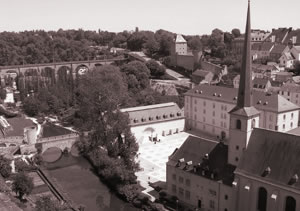
The next day, it was raining again so, instead of walking, we caight the auto-rail to Ettelbruck where, because of the weather, we hardly did anything until 5:30pm when we caught the train to Diekirch, ‘The Burton-on-Trent of Luxembourg’. We travelled by bus from Diekirch to Vianden where we stayed for the following two nights, again, in a Youth Hostel. Vianden is on the eastern border of Luxembourg, bordering with Germany and catered for tourists. The town is situated in yet another deep valley where a river had cut deep into the surrounding wooded country which seemed to characterize Luxembourg, and a chair-lift passes from the town, across the river and up to a chalet on the mountainside. At the top of the mountain was a 13th century castle overlooking the town. We could see a scheme in progress for damming up the valley to provide power or a supply of water.

After staying two nights at Vianden, we hiked to Beaufort to the south-east, a town with a another 13th century castle. Having spent a night at Beaufort Youth Hostel, we set out in more pouring rain for Echternach. Our route was through some soaked woodland but a spectacle worth seeing was the ‘seven sisters’; seven deep gorges or narrow faults in solid rock, each only a few feet wide. It was still raining when we arrived at Echternach, which is the second largest town in Luxemburg. It had an ancient Basilica and a very modern Youth Hostel where we spent our final night in Luxemburg.

From Echternach, we travelled by bus the next day back to Luxembourg City where we caught the train to Brussels. From Brussels, we travelled to Bruges. Bruges had long been a favourite destination for Burton Grammar School trips being a much visited tourist centre as one of the most important commercial cities in Europe during the 13th and 14th centuries. We marvelled at the buildings, monuments, churches, palaces and bridges with its network of canals which connected up with the wide sea canal to Zeebrugge. We also saw the white statue of Madonna by Michelangelo in the ‘Church of Our Lady’. The new Youth Hostel at Bruges was plagued with mosquitoes resulting in many bites but nothing stopped us having an enjoyable time. Back the same way as we came through Ostend, Dover and London, we finally returned to Burton on July 31st.