Menu Close

1953 trip to Flatford Mill Centre

In 1953, Raymond Crowther (Biology) took the Field Club to the Flatford Mill Field Centre near Colchester, Essex, for an Estuarine Biology course. Mick Tanton, now living in Australia, supplied the photographs and accounts.

Crowther

The above photograph shows a collected sample being examined for aquatic life. Lying on the ground is John Jones under the watchful eye of Alan Bull, who went on I think to be a Professor at Birmingham University. The two girls from a North London school tended to join the group, which was always very lively. They are Dilys Povah, and beyond Nancy ? standing in the water is David Hopkinson together with Mick Cornes with his back to the camera, and sitting on the bank in the distance, pipe in mouth, is Raymond Crowther, in front of him is Michael Cooke who is difficult to discern but identified by himself over fifty-six years later! The pupil furthest from the camera is Brian Hill.

Crowther
Alan Bull seated and recording data with Dilys Povah identifying material. Nancy ? is sampling water beyond.


Burton Grammar pupils worked in different groups which included pupils from other schools.
In this photo from left to right is Nancy ?, Dilys Povah, and then three BGS pupils, Alan Bull, (unknown) and A.C. ‘Charles’ Neville.


Samples were washed through in a sieve, and in this photo A.C. ‘Charles’ Neville is sorting through and identifying material.


Finally, Raymond Crowther, back in usual summer garb and inevitable pipe in mouth, inspecting salt-marsh plants at close quarters.

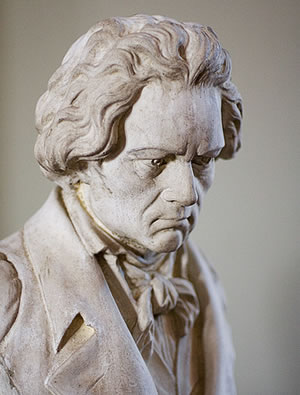
Beethoven Night (Leicester) – School Trip

As remembered by A.J. Williams, U.VISc

On November 1st, 1960, members of the Music Club accompanied by several members of staff visited the De Montfort Hall, Leicester, to hear a Beethoven Concert given by the Royal Philharmonic Orchestra conducted by Royalton Kisch.

The following works were played : Overture to “Egmont” ; Symphony No. 7 in A major ; Symphony No. 3 in E flat major (Eroica).

“Egmont” is a play by the German poet and philosopher Goethe, to which Beethoven composed incidental music. It tells the story of the struggle for freedom of the Dutch people against their Spanish oppressors. In gaining their liberty, however, the hero Egmont is killed.

All his life Beethoven was obsessed with this theme — the right of humanity to freedom and liberty, and it is to be found in many of his large scale works, notably the 3rd and 5th Symphonies. The overture is programmatic in design — the sombre opening bars which lead to a tense and agitated section portray the oppression of the Dutch and their struggle for freedom.

The final section depicts the death of Egmont in the battle, but liberty is gained and the overture ends on a triumphant note.

The Eroica symphony is closely allied in mood to the Egmont overture, but the issues involved are bigger and more universal. One can, I think, dispense with the many “programmes” that have been hoisted on to its shoulders, for the music speaks for itself. Suffice to say that in composing this gigantic symphony Beethoven opened the door to a completely new world of symphonic thought and expression. The movements are all longer, more complex in design, and structure and express more profound and lofty emotions than had hitherto been heard.

The first movement is intensely heroic and noble, and the second is a profoundly tragic funeral march. For the third movement Beethoven writes one of his “daemonic” scherzi. full of rough, buffeting good spirits and impulsive energy. The trio, with its wonderful parts for the horns, is more serene.

For the finale Beethoven wrote a series of variations, enclosing a fugue, on a theme from his “Prometheus” ballet, and the symphony is rounded off in the most noble manner.

The seventh symphony is characterised in all of its movements by a constant rhythmical drive, and of all Beethoven’s works it is the most vitally alive in its super-abundance of pure creative energy. The first movement is prefaced by a long introduction which sets a note of grandeur on the whole work. It leads into the vivace with its impulsive rhythms and brilliant orchestral colouring. The second movement in A minor is in no way tragic as is its counterpart in the Eroica, but moves thoughtfully and seriously forward under its rhythmic pulse. The scherzo is full of Beethovenish fun and high spirits, and after the trio, an Austrian pilgrims’ hymn, has been heard twice, threatens to repeat it yet a third time before it is rudely cut short — a typical Beethoven joke. The finale is supposed to have had its origins in a Cossack folk tune, but whatever the origins the energy and drive are terrific and one is borne forward on the crest of a continuous wave of sound to be precipitated headlong in the closing bars.

The orchestra, with the exception of the second trumpet, who seemed to be having an off night, played superbly throughout, handled with extreme precision by Royalton Kisch. His tempi were finely judged on the whole, although the first movement of the seventh symphony seemed a little lax, and the trios of the third movement would have been more impressive if taken a little more slowly. On the whole it was a most successful night.

1950-53 Biology Field Trips

Biology field trips remembered – Michael Tanton (1946-54)

Raymond Crowther, the biology teacher at the time, established the Burton Grammar School Field Club to some enthusiasm in 1950. In its first year, Mr Crowther took a group from the club, that included me, to the New Forest, where we camped on the edge of heathland and in sight of the Balmer Lawn Hotel at Brockenhurst. The trip had been organized ahead in typical Raymond Crowther style, and to us the arrangements just seemed to happen – I doubt that we appreciated at the time the amount of slow correspondence required in those days to make such trips successful.

All the camping gear was manhandled by us to the guard’s compartment on the train from Burton to London, then from the train down into the Underground station where we were expected by the station staff. The train on the Underground was held while we loaded everything into one of the carriages for the journey to Waterloo Station where the staff again held up the Underground train for the similarly tedious job of off-loading it all again. It then had to be manhandled again onto the Southern Region train, and then off again at Brockenhurst. After some delay, Mr Crowther was able to find his contact at Brockenhurst, who turned up with a lorry to take us and all our gear to the camp site.

The summer of 1950 was very hot, so we had a wonderful two weeks in the New Forest, with many long hikes and a trip across the Solent to the Isle of Wight.
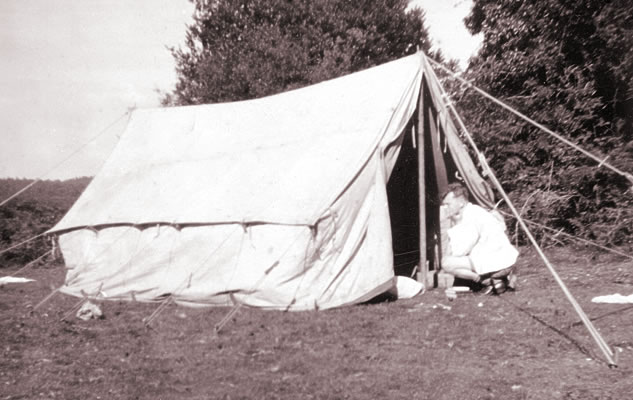
Crowther

The above photograph shows Raymond Crowther crouched in front of the tent I shared with several others at the edge of the heath near the Balmer Lawn Hotel.

Mr Crowther of course had his own tent, for the rest of us, it was two or three pupils to each tent. They were former army tents which were made of heavy canvas with wooden poles and took quite a lot of effort to erect compared to modern tents! No sewn-in floor of course, and we had to dig a channel all round to lead water away from the tent if it happened to rain (it didn’t – it was a very hot summer!). We had to braille the sides up each morning to air inside, and dig hip holes and fill with bracken from the scrub behind our tent. Sleeping on the ground was then reasonably comfortable. The camping and cooking gear Raymond had managed to borrow from Byrkley Scout Group – but that is almost another story in itself.

The following year, 1951, the Field Club went to the Lake District and camped for three weeks near Watendlath Tarn, again by train and with much man-handling of our gear. My main memory of that trip is of day after day of rain, with damp clothing and bedding that we were assured would be fine once it had been warmed up with body heat!

On several occasions a number of the group walked into Keswick, and at that time one could walk all the way along the middle of road and never encounter a car on the round trip – just the occasional bicycle! In those days the local dialect was very broad, and we found it quite difficult to follow what the locals were saying. On my last trip there, in 2003 with my wife, I found things were very different – cars everywhere, and little evidence of the broad dialect I’d encountered over 50 years ago.
CrowtherIn 1952 and 1953 Raymond found a different venue for the Field Club – Flatford Mill Field Centre. We went to different courses in the two years, the first on freshwater biology, and the next year on estuarine biology. They were a valuable learning experience and we were able to make the most of the good weather in both summers. Best of all, we didn’t need to transport all that camping gear of previous years!

In those days the train trip itself was an experience – first of all from Burton to Leicester on the Leicester Line, then change at Leicester for Kettering, change again at Kettering for the cross-country trip to Cambridge, change at Cambridge for Ipswich, then yet another train to Manningtree where we were met by transport from the Field Station. Many of the railway lines we travelled on for those trips fell to the Beeching axe of the 1960s. Our group, including me, Alan Bull, John Jones, Tony (‘Charles’) Neville, Gordon Pritchard nearly all finished up continuing in one area or another of biology.

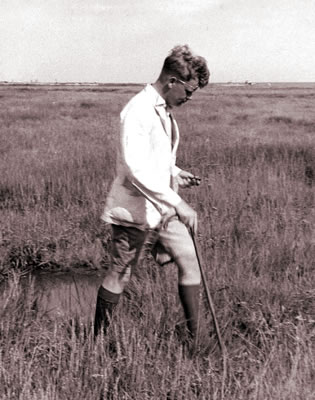
The photograph shows Raymond Crowther walking across a salt marsh near Flatford. This was his characteristic summer garb – brown shoes, khaki shorts and white safari jacket. When we were in the cooler, wetter conditions in the Lake District in 1951 the white coat was replaced by his old RAF tunic top. On these expeditions, he always had his walking stick, his pipe, a tin of Mick McQuaid tobacco, and a hand lens with him.

I used the box camera through to the Flatford Mill Freshwater Biology Course in 1952, but then an uncle gave me an old Zeiss Baby Ikonta camera with a Tessar lens and speeds of 1/25, 1/50 and 1/75th of a second. I used that for the Estuarine Biology course at Flatford Mill in 1953. Another uncle had given me a lens for enlarging – a fairly simple lens, mounted in a tube made of gummed brown paper – he had made it for some device he had been constructing, but had found a better lens.

I pulled out my old Meccano set, acquired an empty National Dried Milk tin as a light box and with balsa wood and two sheets of glass and constructed myself and enlarger. My uncles would have made Heath Robertson look like and amateur, and I’m glad to say some of the Heath Robinson aura seems to have shone on me too. So the attached photos of Flatford were enlarged and developed in my bedroom, and washed in the bathroom sink and glazed on the bedroom window!

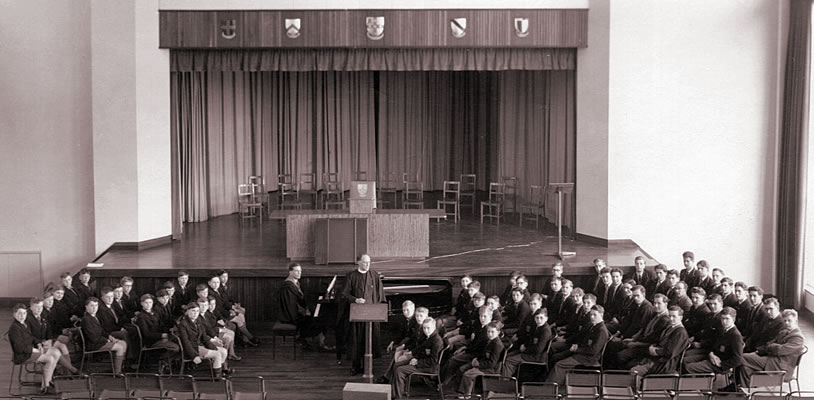
1958 – School Choir


Most conspicuous in this 1958 photo are, Ron Illingworth on the piano and Reverend Paul Appleton as choirmaster.

Right Row (from front): Raymond ‘Joey’ Crowther, Lewis ‘Chippy’ Heath, Peter Evanson, R1-4 , David Berker, Peter Jennings, Rodney Hardwick, Alan Whittaker
Second Right: Noble, Colin Mason, R2-3, ‘Taff’ Davies, Bob Knight, Brian Bradbury, Bert Copestake
Third Right: Hugh Wood, P. Boulder, R. Llewellyn, Anthony Hughes, Maurice Kersey, Alan Cloves, R3-7
Fourth Right: R4-1, R4-2, ‘Polly’ Lownds, R4-4, R4-5, R4-6

(The scratch, painstakingly removed as part of the restore, was re-introduced after I realised that it was a cable to the large on-stage speaker!).

School Societies

In the 1950s, before the popularization of television and before anyone could have even conceived of the Internet, School Societies played a significant role. The below list of them will give some idea:

Select item to view:

  • Art Club
  • Literary Society
  • Cactus and Succulent Society
  • Chess Club (Take a team trial!)
  • Choral Society
  • Christian Union
  • Dramatic Society
  • International Relations Society
  • Field Club
  • Film Society
  • French Society (Cercle Francais)
  • Geographical Society
  • Historical Society
  • Latin Club
  • Metalwork Club
  • Music Appeciation Society
  • Photographic Society
  • Radio Society
  • Sixth Form Society
  • Stamp Society
  • Young Farmers Club
  • 2A Society

Some others later introduced include:

  • Angling Club
  • Astronomical Society
  • Debating Society
  • Model Aero-Club
  • Model Engineering Society
  • Physics Club
  • Walking Club
  • War Games Society
  • Wildlife Society