Menu Close

R.A. ‘Raser’ Smith (1941-49): The War Years

SmithThe Headmaster, W.D. Fraser died of a stroke whilst on a walking holiday in Scotland at Michaelmas half-term 1941. He was eventually succeeded by Harold Moodey in 1942.

Mr Moodey was an Oxford graduate (Chemistry) as per regulations, and probably secured his appointment by having recently had a book published on Analytical Chemistry. I am afraid I endeared myself to him by finding three errors in it.

In my time Mr Moodey never took a chemistry lesson, even when Nick Nicholson was ill. He concentrated on religious instruction, usually using the period to harangue pupils on their poor performance. One of his early acts was to change the house system from one where boys were allocated by area of the town or to the same house as their fathers had been in, to a random distribution. At a time of severe clothes rationing this made him very popular.

Not mentioned so far are Hilda Press; she was a thug who taught French. I am sure many B form members will remember being whacked on the back of the head by this virago. There was also Norman Cleave who returned after the war (Tank group commander) to resume his post as senior English master but left after a term, to become headmaster of Poole Royal Grammar School. In his absence the English posts had been filled by Jake Hammond and Cyril ‘the weed’ Edlin. Cleave taught the Lower Sixth Science Logic for one term. I believe woodwork was abandoned in 1942 due to lack of materials, After the departure of Davis, the subject was taken over by Jenkins who also taught Latin. This master left in 1942 and Jake Hammond took over Latin.

Chemistry was not taught until one reached form 2, George Cooper took us for our first year, his degree was in Chemistry despite being Senior Maths Master. George always played the piano for assembly and the organ at Speech Day, etc. He was organist at Horninglow Methodist Church. Bill Read, Jake Hammond and Ronny Illingworth favoured the Wyggeston Hotel as their watering hole. Unfortunately Bill, who lived at the top of Foston Avenue, was found asleep in the front garden of a member of 4b halfway home, this took some living down.

Tom Parkin achieved notoriety by standing up in the middle of a church sermon and accusing the vicar of using the pulpit as a coward’s castle. He retired at the end of the war to be succeeded by Shorthose (the Drip-after an end of nose feature), another author. His book, ‘The Properties of Matter’ occupied 75% of the teaching time, but only 10% of the examination questions. He was the only master who came to school in a car, a Ford Popular, and had the distinction of being caught in the car in the middle of a level crossing with the gates closed. Schoolboys have eyes and ears everywhere.

Charlie Brown taught History and some Geography and was press ganged into teaching American history to 2A in 1942. He did this by reading a chapter in the text book during the preceding week then regurgitating it as a lesson. One week Charlie, always rather scatter brained, lost his text book. Charlie also kept bees and several times interrupted assembly with “Excuse me Headmaster, has any boy in the Field Lane area seen my bees?”

‘Old Nick’ Nicholson, an Irish communist, was the senior Chemistry master. He had previously been employed in industry which he left under a bit of a cloud. He was held responsible for a gas explosion in a large calciner which disintegrated. Chemistry lessons lasted two periods, for the first part, a lecture/demonstration, the class sat in a circle in an alphabetical order clockwise with Nick at 12 O’clock and Timber Woodcock at 11.30. Consequently Timber got the pleasure of sniffing any obnoxious gasses produced in the demonstration. There was one fire extinguisher, which after use, remained empty for a term.

In Harold Moodey’s time the procedure was for the extant prefects to send a list of preferred candidates for the next year to him, he then amended it. Up to the end of the 1940s prefects had a fair amount of power, they could set lines, put a persistent offender in detention and administer a smart clip on the ear. Discipline was pretty tight.

The War Years

Turning to the war years I started as one of twenty scholarship pupils in September 1941, eight from Grange Street eight from Horninglow Rd. four from the rest of Burton. The total of new entrants was made up to about forty, from the outside districts and the Prep form. The intake was lager than usual due to families moving out of Derby and Birmingham to the Burton area and commuting to their wartime jobs by bus or train. Their sons passed the entrance exam for paying pupils. We were divided into 1A form master Bill Read and 1B. We were taught identical lessons until the February exams and from the results reallocated to 1A&B. These results virtually governed whether you were in the ‘A’ or ‘B’ stream throughout your school career. This had the knock-on result that many of the brighter boys trapped by the scheme were removed and sent to the technical school in Guild Street. This school had a very good reputation thanks in part to the efforts of Arthur Blake, Burton’s very competent Director of Education.

School hours were 9.00 am till 4.05pm with lunch from 12.20 until 2.00pm. The problem of going home in the dark did not occur as single and double summertime were adopted throughout the war years. However detention was moved to Saturday mornings in the mid winter months. As a general rule school could start at 10.00 if the air raid warning had lasted for more than three hours in the preceding night. This was frequently the case in the winter of 1940 but not subsequently.

After school activities were severely limited in the winter months due to the blackout which despite the adoption of summer time, could be as early as 4.45. It was impossible to blackout the school though I think an attempt was made with A room and the adjoining corridors.

Their was also the deterrent of boys having to cycle home in the blackout and masters having to do fire-watching about once a week. An air raid shelter was constructed in the garden where U & V rooms were later constructed and several more in Peel Croft between the grand stand and Lichfield Street. They were relatively shallow shelters due to the possibility of flooding. I can only recall their use on one genuine occasion and several practises. Ironically the ATC’s uncamoulflaged Bulldog bi-plane was parked about 20 yards from the shelters.

Woodwork classes were abandoned in 1942 and with the advent of hit and run raids it was decided that the Art Room with its glass roof, was unsafe. This meant the loss of two class rooms and to compensate rooms were occupied in Bond St infants school which had been closed in 1939 and the Mission Hall in Bond End. As neither locations had an allocation of fuel, classes were conducted in gloves and overcoats. Infant size desks also caused problems. The Mission Hall was however successfully blacked-out, and was used by the Scouts, the ATC and the Aircraft Spotters Club. The Chess Club also functioned during the war years.

Most boys and masters came to school by cycle in all weathers. If it rained or snowed it was impossible to get on the buses unless you lived within two stops of the terminus. Waterproof capes and leggings were in short supply and required clothing coupons for purchase, so assembly and the first lesson were frequently accompanied by a steamy atmosphere. The school yard was surrounded by cycle racks, mostly undercover. All were numbered and you were allocated a number for the year. Cycles had to be pushed along Bond Street  and mounted in Lichfield Street. Lichfield Street had to be crossed by the pedestrian crossing. Scooting on one pedal across the Ferry Bridge was not permitted and detention was the punishment.

In common with other schools the toilets were outside and froze in winter, smoking in the toilets was a caneable offence. Gas masks had to be carried from lesson to lesson until 1944 when regulations became less stringent. The school bell, traditionally rung by the weeks duty prefect, was not rung between 1940 and 1944.

Sport took its usual pattern during the war except that rowing had been abandoned. Rugby was played in the Autumn term and the first few weeks of the Spring term. House matches were played on Peel Croft as Burton rugby club was not functioning. Inter-school matches on Wednesdays and Saturdays were played at Senior and Junior level, travel usually being by Stevenson’s yellow peril. Cricket was also played at the same levels. Amongst the school opponents were:-Lichfield GS, Coton College,Denstone College,Uttoxeter GS, Burton Tech., Ashby GS, Newport GS, Trent College, King Edwards GS Aston & Five Ways, Radcliffe College, Nottingham High Pavement GS, Nottingham GS, Tamworth GS. Some fixtures were cricket only. Photo’s of the Cricket 1st XI are confusing, in general they were taken of the XI chosen for the Old Boys match which began at 11 am and frequently coincided with A level exams. This explains why a number of stalwarts are missing.

The school had a very strong swimming team and thrashed most opponents, the climax came in 1948 with a match against Motherwell GS which we narrowly lost. The opponents had three team members who subsequently swam in the London Olympic Games.

Cross country was the main athletic event in the second half of the spring term. The senior course started on the Ox Hay, then across the Ferry Bridge, through the back streets of Stapenhill, up to Brizlincote Hall Farm, across to Winshill Clump, down Tower Road and Ashby Road to Elms Road; across Stapenhill Road, through the Riverside Gardens and back to the Ox Hay via the Ferry Bridge. Track athletics were not taken very seriously until the arrival of Norman Jones and Norman Paine after the war.

The easing of blackout restrictions in 1944, lead to the renewal of evening activities. The Scouts held Gang shows in the school hall and the drama group got back into full swing.

The Fauld explosion has already been written about. There has been no mention of the fairground fire in 1943, which conveniently started at about 3.50 pm so had most ot he school as audience.

1945 saw many changes, partly due to the influx of new masters, contacts with the Girl’s High School previously fround upon were increased , initially with the Circle Francais (Wood),drama selection of plays with more female characters and by 1947 joint ballroom dancing classes. The cafe at the Ritz cinema also proved a great Saturday morning attraction.

E J Ward (Ernie as we new him then) partially took over rugby from Jake Hammond though there was a slight problem as Ernie had played the dreaded Rugby League as scrum-half for Bradford Northern. The opposition consequently received an unpleasant surprise. ernie also ran the radio society which operated from the sports pavilion, he had a very early so attracted a lot of contacts on the air waves.

There was also a man called Paine about 6’4″ tall, ex-Nottingham University, who took over part of Ronnie Illigworth’s cricket for a time. He lived up to his name, if you dropped a catch , mis-fielded or bowled a wide you were sent to run round the boundary several times.

Norman Jones boosted the interest in athletics and organised a visit to the 1948 Olympic Games. At that time you accumulated points for your house by acheivng a certain standard.

On Sports Day points were also awarded for the positions in the races and the house with the highest aggregate of the combined set of points won the cup. David (Spike) Finch who was Athletics Captain of Drake house caused some embarassment by turning out his house members to achieve the standards to such an extent that the difference between Drake’s pre Sports Day total and that of the other houses could not be made up by results on the day. Another entertaining incident was when Norman introduced and demonstrated the hammer. He got it wrong somehow and the hammer finished in the circle and Norman on his back outside. He had some diffculty in persuading Ronnie Illingworth that those spectators who applauded the effort should not be put in detention. It was quite noticeable that the attitude to the boys, of most of the post 1945 staff arrivals differed considerably from the pre-war ones.

The diagram of the lay out of the school is correct for the late 1940s except that L room was not divided fom the Art Room and J room was the home of 2a Charlie Brown in charge in the early 40s. Incidentally the photo Pre-World War II b is of the Art room not the Woodwork Room. In the early 40s the other form rooms were 1A in F (Frank Reed),4A in G (R Illingworth), 5A in C (H Pitchford), 2B in L, 3B in M (J Daffern), 4B in D (H Press) 5B in B ( J Hammond) Lower 6th Modern in N 6th Science in O (G Cooper). On completion of S and T rooms 2B went to S and the Lower 6th Science to T.

T room was fitted out with a demonstration bench, gas and water taps and basin, though it waas rarely used for its original intention as a supplementary physics lab.. However the was a perforated ventilation brick in the wall between between T and S and in free periods it was not unknown for a fine spray of water to be directed via a rubber tube and the ventilation brick on to the head of the master teaching in S room. It was surprising how often the roof of S room was examined for leaks.

Another feature of S and T rooms was the coke stove, totally inadequate in winter but stoked enthusiasically by the inmates to such an extent that the chimney often glowed red hot. On one occasion a small oxygen cylinder was left in T room, so it was decided that supplementing the air with oxygen would boosted the efficiency of the stove. The experiment was abandoned when the chimney softened and sank several inches.

Prefects and masters did one week on duty per term, this involved opening the garden gate, patrolling the school yard at breaks, tolling the school bell and reading the lesson (getting told off by H Pitchford if you said Jerusalum instead of —lem). In general prefects were allocated to individual forms for one term at a time and were expected to keep order in the absence of the master. They also did Dinner Duty once every three weeks supervising setting up and removing of tables etc.. Sandwiches were eaten in D room which was also used for pupils excused prayers.
Aubrey C. Baggley (1900-06): School Impressions

When I arrived with my brother, I about eleven and a half and he two years my senior, I felt myself a minnow among big fish. I was quite small for my age. What was still more frightening was seeing boys whizzing through the air holding on to pieces of wood tied on to the ends of ropes, the other ends of which were fastened to a circular metal plate at the top of a large, thick, shortened telegraph pole. I learned afterwards that it was a ‘Giant Stride’, and I enjoyed many a round on it myself in later years.

Assembly for prayers, read I his booming voice by the Rev. T.W. Beckett (headmaster) was followed by the daily hymn, sung to the accompaniment of a wheezy harmonium played by a young master named Cole (assistant to Mr Beckett). After he left, Mr Cyril Hartshorn took over but, as an accomplished musician, that harmonium was a real trial to him. He hated it but, with only 150 or so boys, no-one else could be found to be pressed into service.

Mr Beckett was to me, a very imposing person with very large hands, which were used in such a way as to put the fear of the Lord into us. On one occasion, Jack Rudd, a member of my brother’s form, felt the full weight of it. What Jack said I never knew but, as a result, he received a cuff on each side of his face. For two days, his face was red and swollen. Such things were completely accepted in the school in those days.

Mr Beckett left in 1900 to become Vicar of Anslow. Having been Headmaster since 1884, he had a special farewell at the annual prize-giving in the Town Hall. I was greatly impressed by Mrs Beckett who had looked after the twenty or so boarders. She had been greatly liked. With no public transport, except trains, and almost no motor-cars, boys from a distance had to board. Willie Wain from Bretby often came by pony and stabled it in High Street, near the market place.

In September 1900, Mr R.T. Robinson, from Wyggeston School, Leicester, succeeded Mr Beckett and caused something of a stir when he introduced Saturday morning school from 9:00 – 12:30am in place of Wednesday afternoon from 2:00 – 4:00pm. His reason seemed shameless; we were fresher in the morning and Wednesday afternoon could be used for games. He omitted to mention the extra one and a half hours work. In fact, not many boys played football and cricket in school at this time. The games were run by a Sports Club to which members had to pay a fee of 2/6d (12.5p) per term and supply their own gear, and pay for travelling to such places as Ashby, Lichfield and Atherstone. This was prohibitively expensive for quite a number of boys in those days of large families and low wages. The days of financial backing by the Local Education Authority or the ‘State’ were yet to come. There were also ‘bathing sheds’ by a backwater of the Trent used for swimming. “The Field”, as we called it, lay immediately behind Peel Croft, and the pavilion was a very drab, corrugated iron covered hut, the only window being a large wooden panel on one side, which could be pushed open by an iron rod and fastened by then putting the end in a staple. There was no groundsman. It was a DIY world in those days! We rolled the pitch and marked out the whitewash lines ourselves. For non-school matches, ‘Tommy’ Stevenson, who took Form I for all subjects, and who had been said to play on occasion for Warwickshire, and W.H. Robinson known as ‘Taffy’, and the Headmaster’s bother, and still later, A. Rigby the Physics master, all played in the cricket team. R.T.Robinson himself, by now known as ‘Dicky’ ,turned out at centre half in the football team at least once. J.W. Ramshaw, who joined the school when the Physics Lab. was built, also played football at times. Two record scores of later days in1905 stand out in my mind as I was Captain then. We beat Congregational Church 24 goals to nil; Sam Oulton scoring eighteen.

When I first went to Burton Grammar School, I was put in the fourth form on the strength of my having gained one of the three ‘Feoffees’ Scholarships but, having done no Latin or French ever before, I had to catch up with my classmates. In wat was called ‘Extra Division’, I did intensive Latin Primer and ‘Gepp’ work for about eight lessons a week with ‘Piggy’ Jeffcott, and spent the whole of Monday, Wednesday and Friday afternoons doing French, missing all lessons in Music and Art. By the end of the school year, which ran from January to December in those days, I had advanced far enough to start on Vergil’s Aeneid IX in Latin Div. IIb, and ‘Remi et ses Amis” in French Div. IIa. ‘Cambridge Local Examinations’ were compulsory for fourth forms and above so, at aged twelve, I joined my brother and a lot of other boys in evening preparation from 6:00 – 8:00pm at the school from around mid-October to early December. I remember the gas lit rooms with incandescent mantles (the school had no electricity then). One incentive for these examinations for the more gifted boys and their parents was that, for 1st Class Honours 36/- (36 shillings or £1.80) worth of books of one’s own choice were awarded. 24/- (24 shillings or £1.20) was awarded for 2nd Class and 12/- (12 shillings or £0.60) for 3rd Class. In those days, when all books and stationery had to be paid for by one’s parents, such awards were very welcome. Books belonging to school-leavers were often bought second-hand for new boys. Several of mine belonged to someone called ‘Billy Balfry’ who had himself inherited them from an older brother, hence they all had ‘J.C.K. Balfry’ in them.

Earlier on, I mentioned Jack Rudd’s beating by Mr Beckett. R.T. Robinson gave one beating which I should think stood out for years in the minds of all who heard it. Len Hearn, who later gave money for a prize to the school, and so must have forgiven the indignity, was the victim. Having been previously reprimanded for smoking by ‘Dicky’, he was seen smoking again in High Street. The whole school was assembled and ‘Dicky’ lectured us about the offence. He then ordered Len to go to his study. In a few moments, we heard a “swish”. Being boys, we started to count and we became more and more amazed. It went on until we had counted 21 strokes, but not a single cry. Later, I asked Len why he hadn’t shouted out and he said “If he’d have given me one more, I would have yelled the place down”.

During the Second Boer War (1900 – 02), we began Military Drill after school and Sergeant-Major Maher put us through our paces either in the school playground or on ‘The Field’. We also had targets under the covered shed in the playground for rifle-shooting. We used ordinary rifles with tubes inside them making them suitable for the short 22-yard range. ‘Kitten’ Thompson established himself as our ‘crack-shot’.

In a cricket match in 1902 against the Burton Gentlemen, for whom S.H. Evershed, recently Captain of Derbyshire C.C and his brother, Frank Evershed, a Rugby International, played, my brother managed to score 30. They were so impressed that they awarded him with a bat. From then, they continued to award two bats for the best batting and bowling averages. In 1907, I finally got one for batting and H.A. Jones, who later became Dean of Manchester, got the one for bowling.

In 1905, ‘The Cygnet’ came into being. At a meeting in the Chemistry Lecture Room, H.S. Staley was appointed its first Editor. He left at the end of term to go to Birmingham University and later to Cambridge and I succeeded him as Editor.

When Mr Beckett died in 1907, I together with Arthur Bonfield went to represent the school at his funeral.

We always had prayers again at the end of afternoon school. After the service, the Headmaster read out the names of all boys who were to stay behind for detention for various misdemeanours.

We wore red and blue wide-striped caps, commonly known as ‘bull-scarers’ which cost 2/6d (12.5p) or round black or dark blue ‘polo’ caps with the school badge on the front. No blazers. The school caps annoyed the local ‘Park Street Boys’ and there were frequent battles between them on the way to and from school.

Ted Warren (1936–42): School Memories

WarrenSchool started with assembly in the hall under the eagle eye of Tom Parkin. The Headmaster read a prayer, a hymn was sung, notices read and then quietly and orderly we left for our classrooms. Breaktime we went across Bond Street to the Rawlings sisters (Gertie & Maisie) where if you were lucky, you bought a doughnut or a twist. Back to school until Dinner time from 12:00am to 1:30pm and finally home at 4:00pm
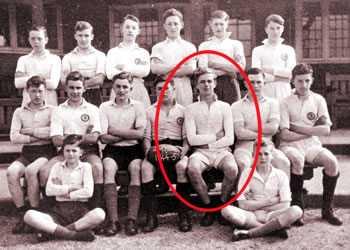
The school had scholarship boys & fee payers. I remember lining up in the hall to pay Mr Marshall of Talbot Stein & Evershed. Fees per term were £5-5-0 if you lived in the Borough, and £7-7-0 if you lived outside. Uniform, which was strictly enforced, was either blue blazer, grey flannels, white or grey shirt with blue & red school tie, and blue cap with a broad red band at the back OR a grey suit. These had to be purchased at either Tarvers or Ellis & Sons.
For sports, in those days masters used to coach boys after school. Frank Read, swimming, Ron Illingworth, cricket & Jake Hammond, rugby. House matches were held on Saturday mornings and you were expected to attend wearing school caps and were punished if you forgot your cap.

Some of the outstanding students were:
P.C.H. Davies who was a fine sportsman, captaining the school at cricket, rugby and athletics. He set many school records, some were still held by him when the school ceased. Norman Dent became an English cross country runner.
Oscar Deville became a C.B.E. before being knighted for his services to industry. He is a very gifted man. John Dent was knighted for services to aviation & travel. On a sad note – N Carfoot, Tom Thorley & Peter Berry all died due to war service.

Some memories of the staff:
The Headmaster, Mr Frazer, died tragically in 1941. Deputy Head and Physics master Tom Parkin was feared in early years but respected in the 5th & 6th forms. ‘Cherry’ Major Orchard was a territorial so went to war in 1938-9, and returned to the school afterwards. Dai Davies – Woodwork and P/T Terrier with South Staffs, was also called up 1938-9, returning after war. Nicholson took us for Chemistry and Dai Hughes for English & Cricket. Frank Read took Maths & coached swimming. During the war he was C.O. 351 Squadron Air Training Corps . Ron Illingworth – Geography & coached cricket and was also an officer in 351 ATC. ‘Chasser’ Brown, History master, formed a League of Nations society which ceased when war broke out.

The famous H.H. Pitchford, who taugh both History and Geography, always carried a small case with him and wore a trilby hat. He ran the school bookshop for years with George Cooper and was eventually to become Headmaster. ‘Scraggy’ Shan taught French and had a viscious right hand. ‘Bunny’ Leighton also taught French and organised the school scouts. ‘Daddy’ Spooner taught Art. Monsieur Vinc was yet another French teacher but he resigned before the war and returned to Belgium where he died fighting for the Belgian Resistance. ‘Reggie’ Neale taught Biology and was a good rugby referee; he left to join the Navy; he did not come back to BGS but became a well known author. N. Crystal, who I can only just remember, came back to Burton after the war but he did not return to BGS being blinded and badly injured by bomb explosion due to his service with a bomb disposal unit. ‘Connie’ Illsley came to replace Neale as Biology teacher and was the first lady on staff. Lastly ‘the boy who never left’ BGS, George Cooper, gained a scholarship to BGS Higher School Certificate and entrance to university. Qualified and returned to teach at BGS for the whole of his long scholastic career; he taught Maths and helped to run the school bookshop.

Don Payne (1942-45): BGS as an Evacuee

PayneHaving been bombed out in London’s East End in 1941, I was evacuated with my brother Dennis and my Mother to Newhall near Burton. We were billeted in a very small cottage in the back gardens of homes in Oversetts Rd. “Grandy Sabin one of the characters of Newhall was the tenant. He lived and slept in one downstairs room whilst we used all the other rooms. There was no bathroom and an outside toilet. The downstairs rooms must have been infested with cockroaches because if we returned home at night and switched the lights on there was a very large gathering of them in the middle of the floor! My primary school was in Newhall. In 1942 I had to take the London County Council entrance examination at the primary school and the paper was sent to the London Education Authority for assessment. Due to administrative delays my results were not processed until October 1942 and I was awarded a special place at Burton Grammar School; my London grammar school would have been Coopers Company Boys School in East London.

I enrolled at Burton Grammar on 23rd October 1942 and was immediately in trouble with French language having missed the first few weeks of lessons. My early impression of Horace Pitchford (History) was of a dapper but fierce master who did not suffer fools gladly! During my first few months at school I managed second place behind Brian Fretwell in the Junior Cross Country race and we were both awarded our Athletic Colours. This helped me integrate into school life very quickly as I was recognised by Masters and senior boys of the school.

I never carried a gas mask although we had them at home. Assembly was in the main hall, in form order and Tom Parkin Senior Master would scowl at any one making too much noise before we were addressed by the “Beak” Mr. Harold Moodey. Tom Parkin, for all his serious exterior, frequently had a half smile on his face as if to say “I know what boys can be like”. Masters and Prefects could give detention for various misdemeanours which required attendance on Saturday morning to complete set work. Morning and afternoon breaks were in the rather small playground. The tuck-shop opposite the main entrance, run by Lily and Gertie provided smashing current buns and they did brisk business. For mid-day meals we sat on benches at long tables in the Hall. Food was still plentiful and I frequently went up for seconds if they were available.

I do not think the school had an air raid shelter as I never visited one during my time. Emeny air raids were at night when they bombed Coventry, Birmingham, and Derby (Rolls Royce) and other industrial cities. You could hear the anti aircraft guns and the steady drone of enemy bombers. Blackout of all lights was enforced with shaded headlights on vehicles and black curtains which had to be drawn when lights were switched on. In the later part of the war we saw plenty of large formations of American bombers and fighters that were carrying out daylight bombing missions over enemy territory.

Discipline at school was strict but fair. All boys had to wear the school hat and tie and touch their hat when acknowledging a member of staff out of school. I never had a school blazer as family finances were tight. The annual Speech Day took place in the Town Hall. I believe all the school attended and the Masters wore their gowns with University colours. Awards were made for various achievements during the academic year and consisted of books with a label inside indicating the proficiency and signed by the Headmaster. During my stay I was taught variously by Connie Illsey, Polly Lownds, Miss Selby, Jake Hammond, Bill Read, Ronnie Illingworth, Joey Daffern, George Cooper, Chazzer Brown, and Horace Pitchford. Although I was not taught by Mr. Moodey I did make his acquaintance when receiving “six of the best” for some demeanour in my first year! Sporting activities consisted of Rugby, Cricket, Athletics and Swimming. There were regular matches against other schools including Trent College, Denstone College, K.E.S. Aston, K.E.S. Birmingham and Repton. These were limited because of transport difficulties. Inter House matches were introduced during the war to stimulate competition and were mainly played on Wednesday afternoons and Saturday mornings.

As a member of the air scouts we had the opportunity to cycle to Fradley airfield which was an Officer Training Unit. They used Wellington Bombers for training which consisted mainly of “circuits and bumps” continuingly landing and taking off for about two hours. If flying was taking place that day you drew a parachute and when the plane was ready you climbed aboard and had a rather bumpy flight for two hours. It was just too bad if you felt sick as you could not get off! There were a number of clubs at the school which met after school hours.

Any boy at the school during 1944 will remember the explosion when the ammunition dump at 21 MU RAF Fauld near Hanbury blew up.4,000 tons of bombs blasted a crater 400ft deep and three quarters of a mile long. One farm with all buildings, wagons, horse, cattle and six people disappeared. It happened on 27th November 1944,was the largest explosion during both World Wars, and killed seventy people, eighteen of which were never found. At the time, just past eleven, Chazzer Brown was taking my class for Geography. There was a muffled rumble and all the lights in the room rattled. Chazzer, quite unruffled just got on with the lesson. Later that week I cycled to the area and many of the local roads had large clods of earth littered about that had been deposited by the blast. The area was cordoned off and even in 2004 sections of land are cordoned off due to unexploded bombs.

John Hicklin: The Fauld Explosion

It was just after 11 o’clock on a foggy Monday morning,the 27th November 1944. As a ten year old boy I sat at my desk in ‘A’ room at the Burton Grammar School. I thought that I was about to faint. Without any noise at all my desk seemed to rise up towards me, or perhaps I was going down towards it. A very strange sensation was soon gone but quickly the whole class realised we had all experienced the same feeling. From the floor upstairs came a noise of the whole class there scrambling under their desks. Around lunchtime the rumours were well established and it was only later that we found out that the ‘Dump’ had gone up.

The ‘Dump’ was an ammunition store underground in some old gypsum mine workings at Fauld about five and a half miles from our school.The blast of some 4000 tons of high explosive bombs detonating together had sent tremours underground for many many miles and what seems to have happened was that the whole school building, floor, desks and all had silently moved as one then settled down again.

On the way home I stopped to take train numbers but there was still a dense fog and we heard the endless sounds of emergency vehicles going to the local hospital that was just down the road from us. I remember the eerieness of everything drove me home.

My mother was away in Derby for her father that day and only learned of the awful event that evening. The following day mother went with the WVS mobile canteen to the site at Fauld and did her stint two days each week until the following March. I remember she had some harrowing tales to tell and I don’t believe I heard the worst. The whole area was a sea of liquid mud which frequently came over the tops of their wellingtons as they moved around the site in threes and fours holding hands as so many small craters were just levelled with the liquid mud.

Sixty-eight people lost their lives in a bang which took out the crater, (which was some 90 feet deep and covering an area of 12 acres) in a second. A whole farm with buildings implements and stock vanished without trace. A thousand acres of topsoil was redistributed, some up to 11 miles away.
The crater is still there near the small village of Hanbury and is now marked on the Ordnance Survey map. A Memorial stone and plaque stand alongside the crater and each Remembrance Sunday the names of those who lost their lives there are read out in church alongside the those that fell during the two world wars.

Stories and facts of this tragedy abound. So horrific was it that tales of ‘When the Dump went up’ will be told for generations to come.

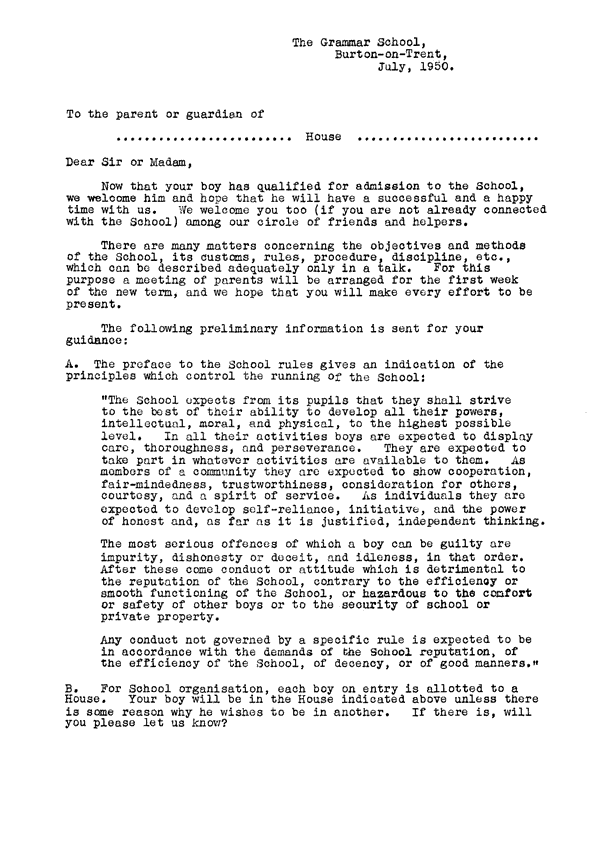
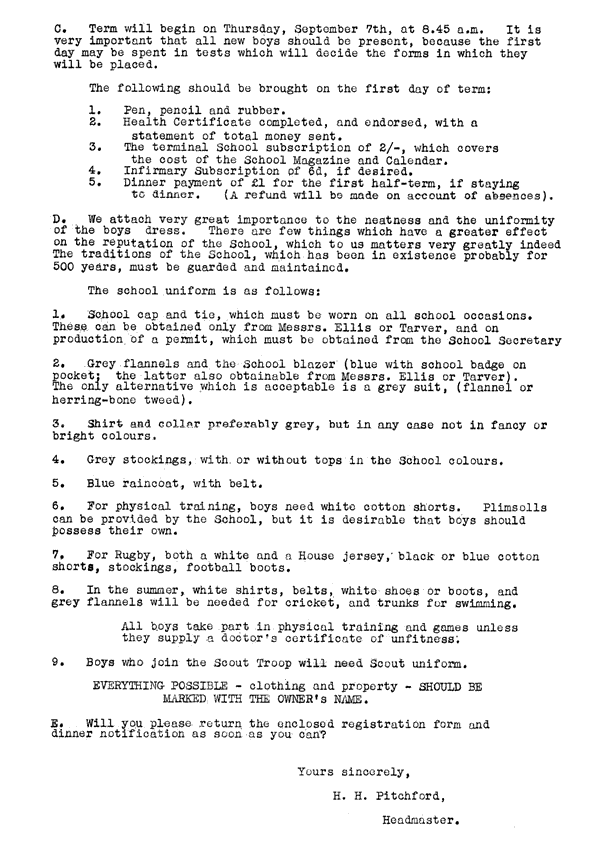
1950 Registration Letter

The following form was sent to the parents of all pupils that had passed for the Grammar School.

It makes for interesting reading now and looks very primitive having been produced on a typewriter well before word-processors were available.

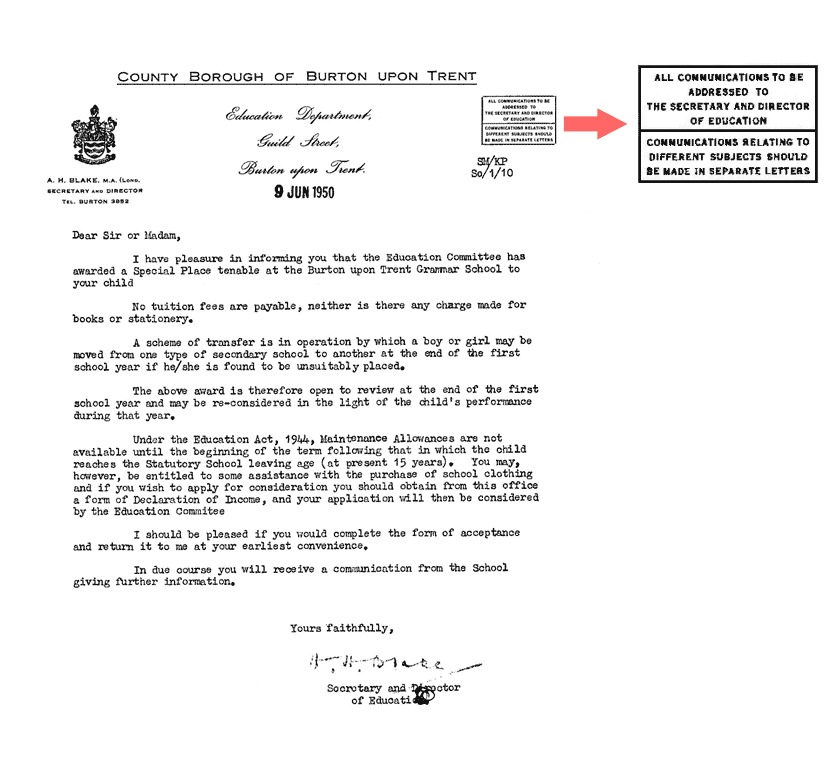
1950 Placement Letter

The following letter was sent to inform parents or guardians that their child had been awarded a place at the (Bond Street) Burton Grammar School.

The letters were sent from the then County Borough Education Department and signed by the Education Secretary and Director, Arthur Blake who was for a time, at the same school as Bill Gillion who he would later appoint as Headmaster at the ‘new’ Winshill School.

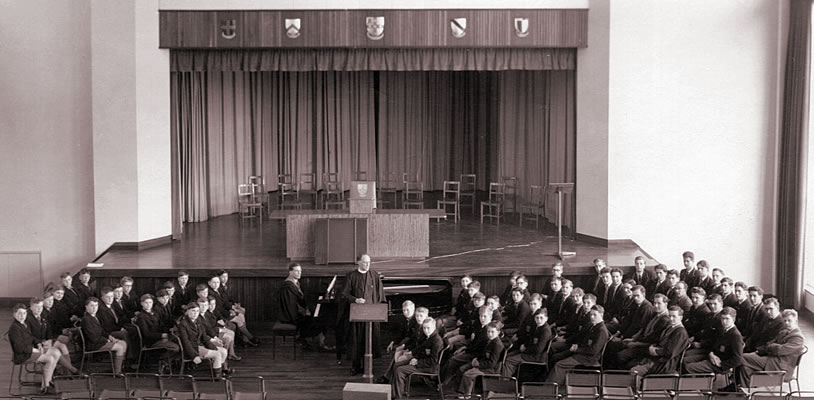
1958 – School Choir


Most conspicuous in this 1958 photo are, Ron Illingworth on the piano and Reverend Paul Appleton as choirmaster.

Right Row (from front): Raymond ‘Joey’ Crowther, Lewis ‘Chippy’ Heath, Peter Evanson, R1-4 , David Berker, Peter Jennings, Rodney Hardwick, Alan Whittaker
Second Right: Noble, Colin Mason, R2-3, ‘Taff’ Davies, Bob Knight, Brian Bradbury, Bert Copestake
Third Right: Hugh Wood, P. Boulder, R. Llewellyn, Anthony Hughes, Maurice Kersey, Alan Cloves, R3-7
Fourth Right: R4-1, R4-2, ‘Polly’ Lownds, R4-4, R4-5, R4-6

(The scratch, painstakingly removed as part of the restore, was re-introduced after I realised that it was a cable to the large on-stage speaker!).

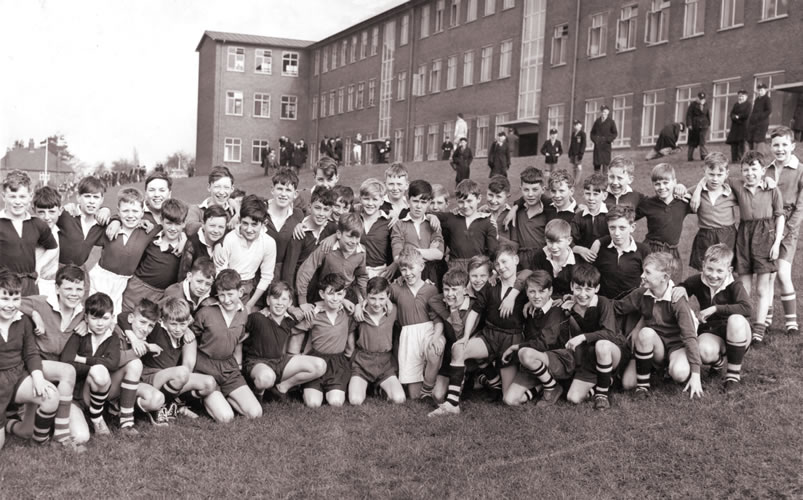
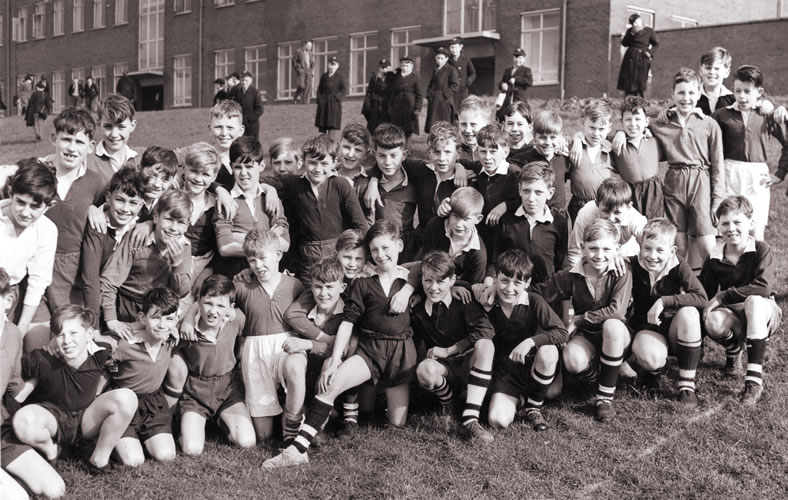
1959 Casual Photos

A couple of supplied photos taken in 1959 are too good to leave out because they capture the mood so well.


There are probably a few too many to name but they show the first-formers kitted up ready for ‘games’. The fact that the photo is black and white hides the assortment of Blue (Drake), Green (Clive), Maroon (Wellington) and Black (Nelson) shirts and socks.

Bond Street Tour (1952)

This set of pictures shows the Bond Street premises towards the end of its time, shortly before work was finally about to commence on the newly planned school in Winshill.

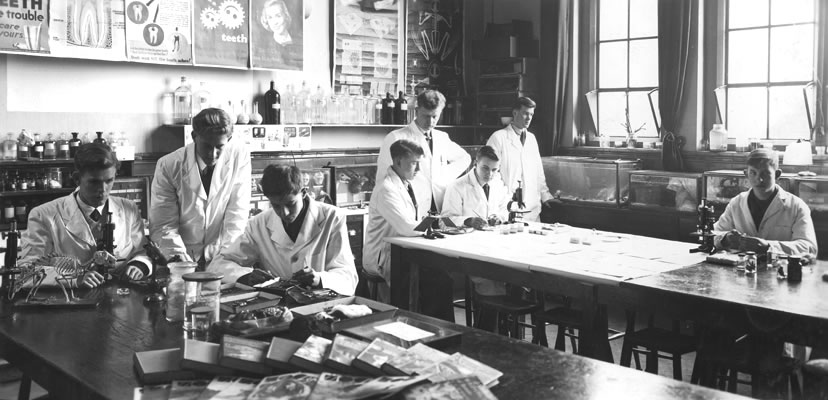
Biology Lab
1952 Biology
(From Left) Hassop, David Runacre, L03 –  R01, Raymond ‘Joey’ Crowther (Master), Michael Tanton, Keith Day, Robin Shorthose

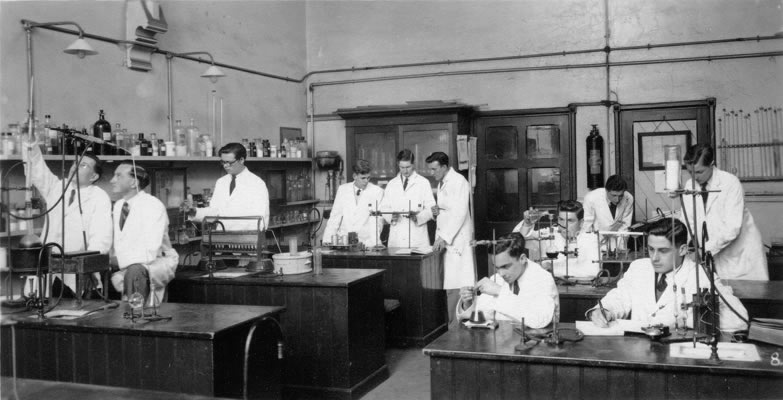
Chemistry Lab
1952 Chemistry
(From Left) K. Smith, Ralph Hodson (new Master), Mike Freegarde, Hassop, Geoff Shone, Norman Jones, J. Simnett, K. Stanyon, M. Wilkins, John Pickering, Shaw

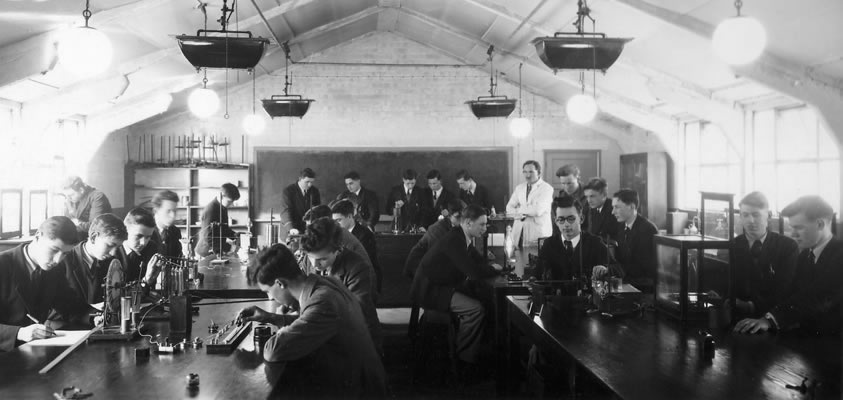
Science Lab1952 Science
Harry ‘Brab’ Smith, who first taught General Science (Physics) and Chemistry as well as maths.

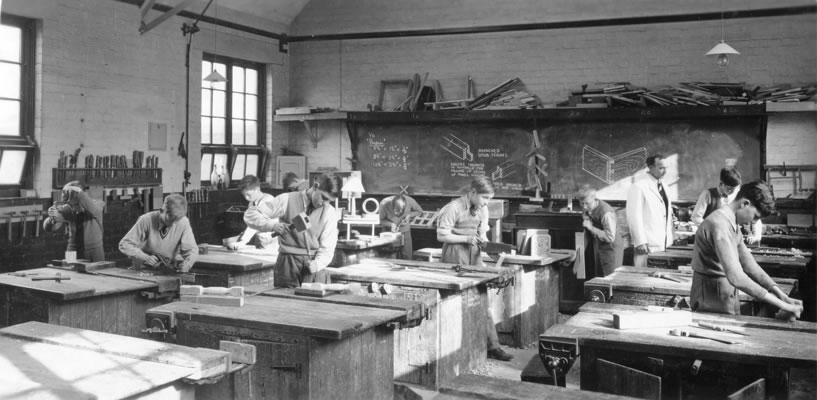
Woodwork Workshop
1952 Woodwork
Dai ‘Taffy’ Davies keeping everyone busy

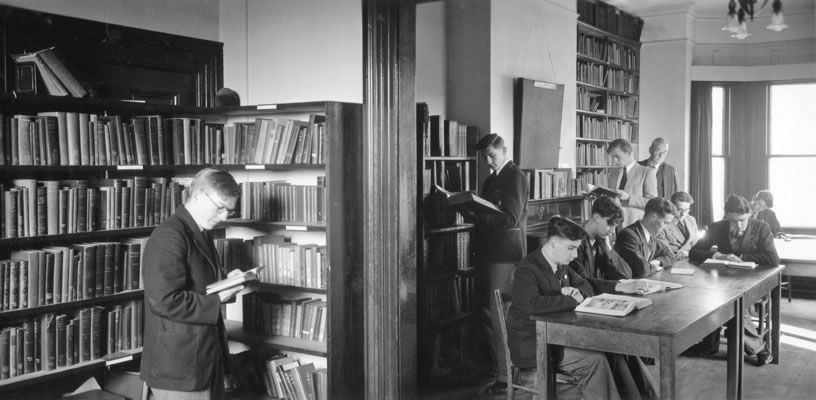
Library
1952 Library
Standing (left to right): I.G. Halliwell, R.A. Lester, P.G.W. Bond and Chazzer Brown (Master and Librarian)
Seated (left to right): G.D. Evans, S02, J.E. Hancock, I.J. Cotton, R.G. Keightley

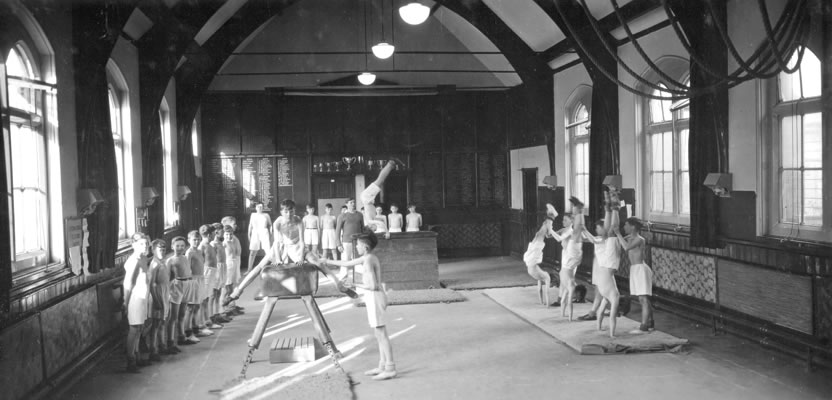
Gym (actually, School Hall in one of its many roles)
1952 Gym
(Left wall from front) Ebberley, Hassent, Gostelow, Cotton, Hunt, Robertson, Knowles, Weston
(Rear wall from left) Cooper, Cartwright, Robinson, Laud, Harrison, Attwood, Ling, Woolett
(Handstands from front) Sharp supported by Cox, Richards supported by Mortimer, ? supported by Bentley
(Horse) Recently started Vic Roebuck watching Whysall
(Vault) Watts watched by Gibbs